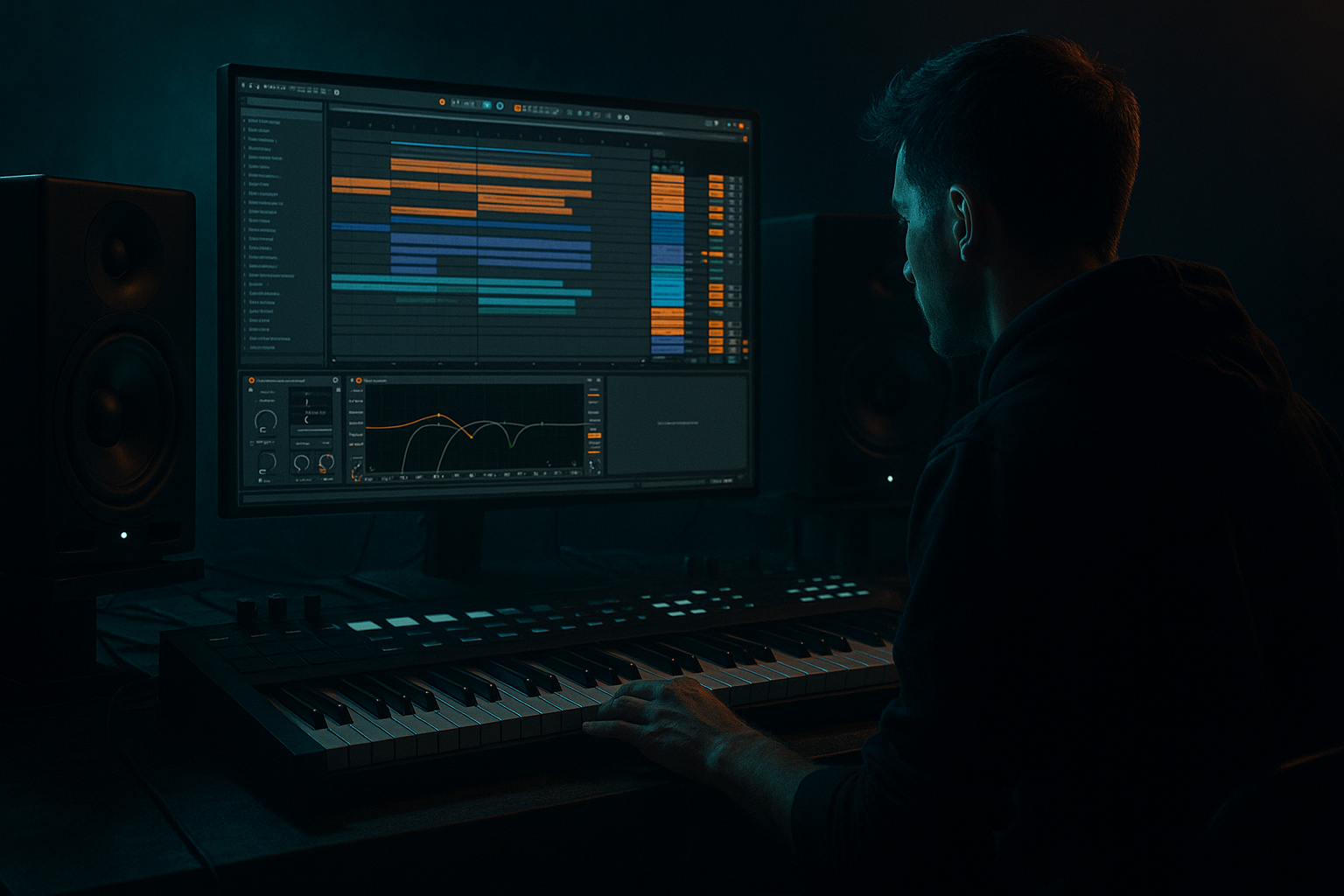
Main tutorial
Low-End Pressure Method: Mid Bass Warp in Ableton Live 12 for Jungle / Oldskool DnB Vibes
1. Lesson overview
This lesson is about building pressure in the low end by warping a mid-bass layer so it moves with the groove like classic jungle and oldskool drum & bass.
Instead of using a static bass note or a clean modern reese that just sits there, you’ll create a mid-bass phrase that is warped, rhythmic, and slightly unstable in a controlled way. That “moving” quality is a huge part of early DnB energy 🔥
In Ableton Live 12, this works especially well because you can combine:
- Warping to lock bass movement to the grid
- Saturation and filtering to shape attitude
- Sidechain compression to make space for the kick and snare
- Layering so the low end stays solid while the mid-bass carries the vibe
- A mid-bass sample or synth bounce warped into a tight jungle-style phrase
- A sub layer underneath for weight
- A processing chain that makes the mid-bass gritty, controlled, and punchy
- A simple rolling DnB arrangement idea you can use in a track
- Sub: clean sine or triangle, following root notes
- Mid-bass: a warped, filtered, slightly overdriven phrase with groove
- Drums: breakbeat energy and hard snare placement
- Movement: bass hits react to the drum pattern instead of fighting it
- BPM: 160–174
- For oldskool/jungle feel: 165–170 BPM
- Keep the drums energetic but leave room for the bass phrase to “talk”
- Oscillator 1: Saw or square
- Oscillator 2: Saw, detuned slightly
- Unison: low amount, not too wide
- Filter: low-pass with moderate resonance
- Amp envelope: short attack, medium-decay, low sustain
- Add subtle drive in the filter section
- Use a sine or triangle for a cleaner oldskool body
- Add FM subtly if you want a more metallic jungle edge
- Complex Pro for fuller bass phrases
- Beats if I want a chopped, aggressive edge
- Make sure the clip is in time with the grid
- Adjust the start marker so the bass hits cleanly on the transient
- If necessary, use Warp Markers to pull notes into a more rolling syncopation
- Pull a note slightly late for a laid-back jungle bounce
- Tighten a note slightly early for a more urgent push
- Stretch one bass hit so it blooms into the snare space
- Chop the phrase into call-and-response with the drums
- Make the bass hit on the “and” before the snare
- Let it decay as the snare lands
- Then bring another bass movement after the snare
- High-pass very gently only if needed to remove sub rumble
- Cut muddy area around 200–400 Hz if the bass is boxy
- Add a small presence lift around 700 Hz–1.5 kHz if you want more character
- If the bass is too fizzy, reduce around 3–6 kHz
- Drive: +2 to +8 dB depending on source
- Soft Clip: On
- Curve: Default is fine, but try gentler curves for smoother warmth
- Output: compensate so you’re not just making it louder
- Drive: 5–20%
- Crunch: low to moderate
- Boom: very careful here; only if you know exactly what it’s doing
- Transients: slightly down if the bass is too clicky
- Damp: use to darken harsh highs
- Duplicate snare hits to a muted MIDI track
- Use that track as the sidechain input
- Put Utility at the end of the bass chain
- Set Width to 0% on the sub layer
- For mid-bass layer, keep it mostly mono or narrow
- Only widen higher harmonics if needed, and carefully
- Use Operator with sine wave, or a very clean sampled sub
- Keep it mono
- Follow root notes simply
- Low-pass if needed
- Your warped audio bass
- High-pass around 80–120 Hz depending on the arrangement
- Let it carry motion, grit, and groove
- 8-bar intro with filtered bass hints
- Main drop with full warped bass phrase
- Variation every 4 bars by changing warp position or muting a note
- Fill bars where the bass pauses for drum fills or breaks
- Breakdown where the bass is filtered and distant, then returns harder
- Start darker
- Open it over 4 or 8 bars
- Then slam it shut before a snare fill or re-drop
- Filter cutoff
- Saturator drive
- Reverb send on select bass hits only
- Warp marker adjustments if you’ve rendered audio and want subtle phrase changes
- Volume for accent hits
- Saturator
- Roar if you want newer Live 12-style aggressive color
- Overdrive
- Redux for aliasing grit, used subtly
- Low-pass filter opening on the drop
- Resonant sweep into a bass fill
- Band-pass section for an answering phrase
- Add a low-mid reese layer
- Keep it quieter than the main bass phrase
- High-pass it so it doesn’t fight the sub
- Saturator with Soft Clip
- Or a clipped master-style preview bus, carefully
- kick/break accents
- snare ghost notes
- short drum fills before the main snare
- One clean sub layer
- One warped mid-bass audio layer
- Sidechain compression to the kick
- Saturation and EQ shaping
- Does the bass feel more rhythmic?
- Does it leave room for the snare?
- Does it feel more “jungle” and less static?
- Is the low end still solid?
- Build a strong drum foundation first
- Use a separate sub layer for the true low end
- Warp the mid-bass for motion and attitude
- Process with EQ Eight, Saturator, Drum Buss, Compressor, Utility
- Keep the bass mono and the groove snare-friendly
- Use automation and resampling for variation
- a step-by-step Ableton rack chain
- a MIDI + audio template
- or a preset recipe for jungle bass warp movement
This is not about making the bass huge and messy. It’s about making it feel heavy, alive, and pushed forward without destroying the kick/snare engine.
---
2. What you will build
By the end, you’ll have:
Final result concept
Think:
---
3. Step-by-step walkthrough
Step 1: Start with a drum foundation
Before touching bass, get the groove right.
#### In Ableton Live 12:
1. Load a classic breakbeat or program a drum pattern.
2. Place the snare on beat 2 and 4 for a rolling DnB feel, or use a jungle-style chopped break with ghost snares.
3. Add:
- Kick
- Snare
- Hats/shakers
- Optional break layer
#### Good starting vibe:
If your drums are too busy, the bass warp won’t feel powerful. You need gaps for the bass to punch through.
---
Step 2: Create a mid-bass source
You can use a synth or a sampled bass phrase.
#### Option A: Synth bass in Wavetable or Operator
A simple starting patch:
Wavetable
Operator
Record a 1-bar or 2-bar phrase with notes that follow the root movement. Keep it simple. The warp movement will do the talking.
#### Option B: Sampled bass
You can also bounce a bass phrase from a synth and re-import it as audio. This is excellent for warp-based groove shaping.
---
Step 3: Consolidate and warp the bass audio
This is the heart of the method.
#### Why warp?
Warping lets you treat the bass like a rhythmic sample, which is very useful for jungle-style phrasing. You can tighten timing, stretch notes, and create a slightly elastic feel.
#### How to do it:
1. Bounce or freeze/flatten your bass phrase to audio.
2. Double-click the audio clip.
3. Enable Warp.
4. Set the correct Warp Mode:
- Complex Pro if the bass has more tonal content and you want smooth stretching
- Beats if it’s more percussive and chopped
- Tones if it’s a simpler monophonic bass line and you want natural character
For jungle/oldskool pressure, I usually start with:
#### Important tuning steps:
---
Step 4: Shape the warp for groove, not just timing
Now we’re moving from “correct” to “character.”
#### Try these warp moves:
A good jungle bass phrase often leaves a tiny pocket before the snare, then answers after it. That space creates the pressure.
#### Practical example:
If your snare is on beat 2:
That’s classic tension-release.
---
Step 5: Build a bass processing chain in Ableton
Now process the warped mid-bass so it sits with authority.
#### Suggested chain:
1. EQ Eight
2. Saturator
3. Drum Buss or Overdrive
4. Compressor with sidechain
5. Utility
6. Optional: Redux or Roar for extra bite
---
Step 6: EQ the bass properly
Open EQ Eight first.
#### Basic EQ moves:
#### Important:
Do not boost the sub region on the mid-bass layer.
Let the sub layer own the 30–90 Hz area.
---
Step 7: Add saturation for pressure
Use Saturator to give the bass density and audible midrange.
#### Suggested settings:
The goal is not distortion for its own sake. The goal is to make the bass feel closer and more physical.
If you want darker oldskool grit, you can push drive harder and then tame it with EQ.
---
Step 8: Use Drum Buss for controlled aggression
Drum Buss is excellent on mid-bass because it adds weight, transient shape, and harmonics.
#### Good starting settings:
For jungle vibes, a little Drum Buss can make the bass feel like it came from a dusty sampler or an overdriven old rack unit 📼
---
Step 9: Sidechain the bass to the kick and snare groove
In DnB, the bass has to breathe around the drums.
#### Using Compressor:
1. Add Compressor after saturation.
2. Enable Sidechain.
3. Select the kick as input.
4. Set:
- Ratio: 2:1 to 4:1
- Attack: 1–10 ms
- Release: 50–120 ms
- Threshold: enough to get 2–6 dB gain reduction
#### For snare-driven pressure:
You can sidechain lightly from the snare too, or use Ghost Triggers:
This is very useful if you want the bass to duck before the snare slams through.
---
Step 10: Control the stereo image
Keep the low end tight and mono.
#### Use Utility:
If the warped bass is too wide, it will sound impressive in solo but weak in the mix.
---
Step 11: Separate sub from mid-bass
This is critical.
#### Sub layer:
#### Mid-bass layer:
This separation gives you the classic “weight plus attitude” combination that defines so much DnB.
---
Step 12: Use arrangement tricks to make the bass feel bigger
A warped bass phrase should not loop identically forever.
#### Arrangement ideas:
#### Oldskool-style trick:
Automate a low-pass filter on the bass layer:
That slow reveal adds tension without needing more notes.
---
Step 13: Add movement with automation
Now make the bass feel alive.
#### Automate:
A tiny automation curve can make a loop feel like a performance.
---
Step 14: Use resampling for extra jungle character
One of the best Ableton techniques for this method is resampling.
#### Workflow:
1. Record your processed bass into a new audio track.
2. Slice it or re-warp it.
3. Reverse certain hits or chop them into a new pattern.
4. Layer the new chopped version quietly under the original.
This can create those classic broken, sample-era jungle textures that feel raw and intentional.
---
4. Common mistakes
1. Making the mid-bass too sub-heavy
If the warped bass owns the low sub range, the mix gets muddy fast.
Fix: high-pass the mid-bass and let the sub do the foundation.
---
2. Over-warping the phrase
If you stretch and move every hit too much, the groove loses its punch.
Fix: warp only what serves the rhythm. Leave some notes natural.
---
3. Too much stereo width
Wide bass sounds exciting in headphones but collapses in club systems.
Fix: keep bass mono or nearly mono below about 120 Hz.
---
4. Too much distortion before EQ
If you distort a bass heavily and don’t control the tone afterward, the mix gets harsh.
Fix: saturate, then EQ. Check the harshness around 2–6 kHz.
---
5. Sidechain pumping too much
If the bass ducks too hard, it stops feeling like a solid DnB line.
Fix: use moderate gain reduction and shape the release to recover musically.
---
6. Ignoring the snare
In DnB, the snare is sacred. If the bass fights it, the whole drop weakens.
Fix: arrange bass phrases around snare hits, not through them.
---
5. Pro tips for darker/heavier DnB
Tip 1: Use darker harmonics, not just more distortion
For heavier vibes, add harmonics around 150 Hz to 1 kHz, not just top-end fuzz.
Good stock devices:
---
Tip 2: Filter the bass like a sample, not a synth
A lot of oldskool pressure comes from filter motion.
Try:
Use Auto Filter for easy automation.
---
Tip 3: Layer a reese under the warped phrase
If you want more menace:
This gives the track a darker wall underneath the rhythmic motion.
---
Tip 4: Resample through gentle clipping
A lightly clipped bass often sounds bigger in DnB than a perfectly clean one.
Try:
This adds the “driven sampler” energy common in jungle and oldskool records.
---
Tip 5: Let the bass phrase answer the breaks
If your drums include chopped breaks, align bass hits to:
That call-and-response pattern is a huge part of the genre identity.
---
6. Mini practice exercise
Exercise: Build a 2-bar warped jungle bass loop
#### Your task:
Create a 2-bar bass phrase in Ableton Live 12 with:
#### Steps:
1. Program a simple 2-bar bass MIDI phrase in Operator or Wavetable.
2. Bounce it to audio.
3. Turn on Warp and use Complex Pro or Beats.
4. Move 2–3 warp markers so the phrase feels more syncopated.
5. Add EQ Eight, Saturator, and Compressor.
6. Add a separate sub underneath.
7. Compare:
- Version A: straight bass
- Version B: warped bass with movement
#### What to listen for:
Aim to make Version B feel more alive without becoming sloppy.
---
7. Recap
The Low-End Pressure method is all about making your mid-bass behave like a rhythmic sample inside the mix. In Ableton Live 12, warping gives you a powerful way to shape the bass groove so it locks into the drums with that classic jungle / oldskool DnB push.
Core ideas to remember:
If you get this right, your bass won’t just be “present” — it will pressurize the track 😈
If you want, I can also turn this into:

