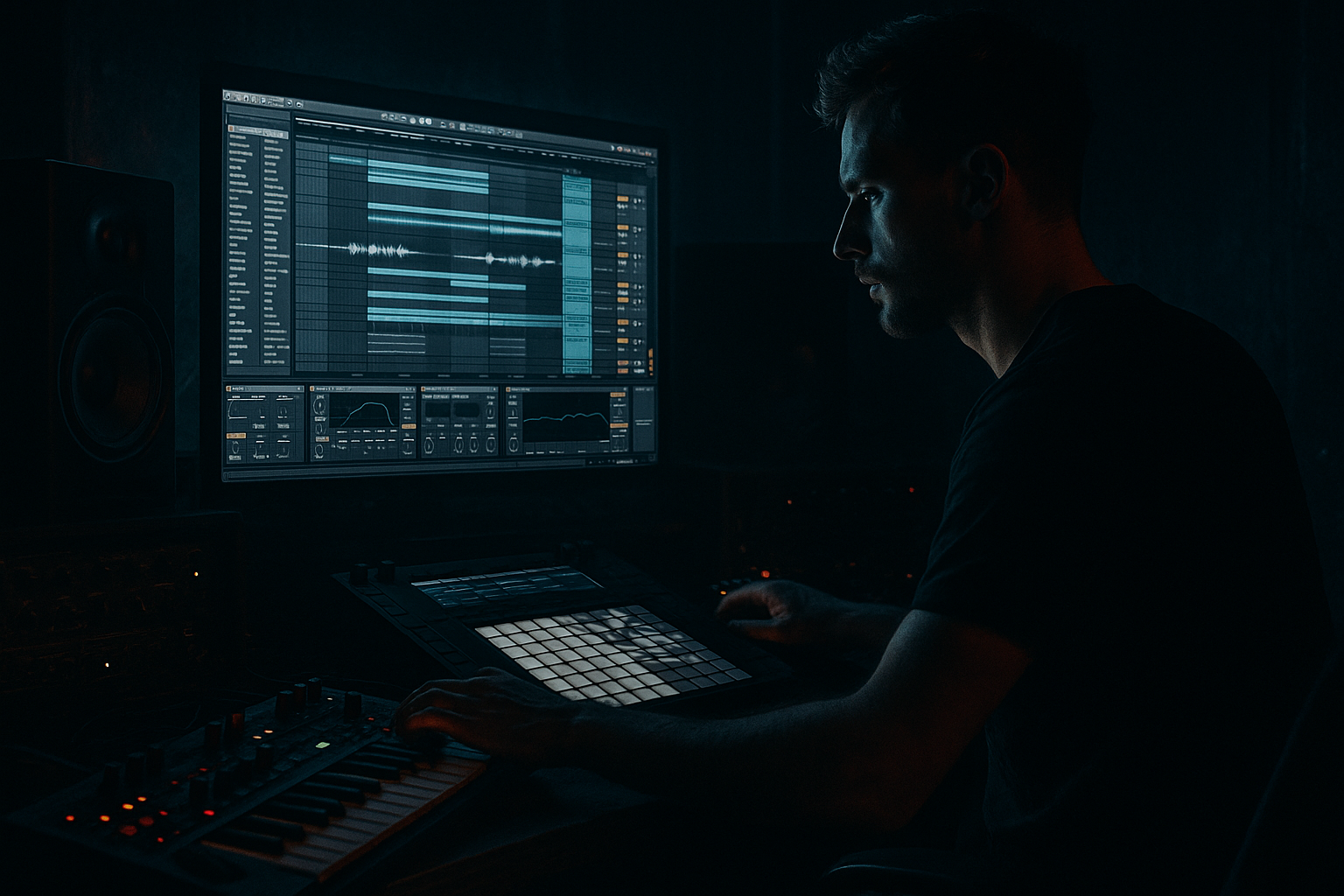
Main tutorial
1. Lesson overview
You’ll learn how to design a heavy “foghorn” bass for drum & bass in Ableton Live—clean subs with a warped, resonant mid/high fog layer that punches through breaks and rolls. This is an intermediate-level, practical walkthrough: synth programming, routing, effects chains, resampling tricks, and arrangement tips so your foghorn sits massive in a 170–176 BPM DnB mix. Expect exact device chains, parameter suggestions, and workflow ideas using Ableton stock devices. 🎛️🎚️
Tempo reference: DnB ~ 170–176 BPM. I’ll use 174 BPM examples.
2. What you will build
A three-layer DnB bass stack:
1. Sub layer — clean sine for the low-end foundation (mono).
2. Foghorn layer — a resonant, formant-style mid layer with pitch modulation and filter movement (Wavetable/Operator).
3. Texture/grit layer — resampled and heavily processed audio for character (Corpus/Grain Delay/Saturator).
These layers are mixed and processed with EQ, distortion, and sidechain so the result is heavy, clear, and distinctly DnB-friendly (cuts through breaks, sits with fast kicks). 🔊
3. Step-by-step walkthrough
Pre-flight
- Set BPM to 174.
- Create a simple 1–2 bar MIDI bassline in DnB style (long sustained notes with occasional short stabs or short slides on off-beats). We'll program a rolling bass: long note on bar 1 (1 bar sustain), short stabs on bar 2 — adapt to your groove.
- Intro (0:00–0:16): teaser fog — long pads, reverb-heavy foghorn at low volume with side-chained pulsing to hint the groove.
- Build (0:16–0:32): drop in bass bus delayed reverb, increase consonant pitched hits; automate Glide lower for tighter groove.
- Drop/Full arrangement: Foghorn plays the main sustained note across the bar; at 1/8 or 1/4 positions use short stabs or pitch slides to accent drum rolls (sync tail to break accents).
- Breakdowns: strip sub, keep fog layer drenched in reverb and Corpus for atmosphere.
- Macro map: Filter Cutoff, Corpus frequency, Saturator Drive, and Bass Bus Glue threshold to a macro for instant “growl” control.
- Automate Filter Cutoff and Resonance on long notes to make the foghorn breathe. Use short boosts with snare hits for emphasis.
- Too much distortion on the sub layer → causes muddiness and phase issues. Keep sub clean and mono.
- Making everything stereo at low frequencies → leads to unstable low end. Keep <120–150 Hz mono.
- Over-resonating bandpass/resonance so the sound squeals and masks other elements. Tame resonance with EQ or slight compression.
- Sidechaining too hard or too slow → bass will pump unnaturally in fast DnB. Aim for quick attack and moderate release.
- Using too wide unison on low-mids — causes phase cancellation and mud. Keep low-mids either mono or with minimal stereo spread.
- Not checking in mono — you’ll be surprised how things collapse. Always check the sub and bus in mono.
- Pitch modulation: add a tiny LFO to pitch (subtle random / sample-hold) on fog layer to create unsettling micro-tuning. Map to a macro to dial in darkness.
- Parallel distortion: duplicate the foghorn track, heavy distort, lowpass to kill sub, then blend in for upper harmonic aggression.
- Use mid/side processing: compress mid band lightly and make sides more textural so the bass punches while the sides add horror ambience.
- Use a low, sub-octave synth (transpose -1 octave) layered subtly under the main sub for subterranean pressure — duck it on kick transients.
- Automate Corpus resonance peaks in breaks to emphasize a “howl” on snare hits.
- Add short ring-mod or frequency-shifter bursts synced to drum fills for metallic aggression.
- Resample long sustains, granular-stretch them (Warp mode: Complex Pro or Grain Delay), then re-pitch to create monstrous pads that sit above the sub but below the drums. Use these sparingly in drops for weight.
- Saturate and then EQ — distortion adds harmonics that can be carved effectively. Use a narrow boost at the foghorn’s sweet spot before distortion, then tame with post EQ.
- Build three layers: clean mono sub, resonant foghorn mid (Wavetable/Operator), and gritty resampled texture. Layer and bus them with EQ, Saturator, Corpus, and sidechain compression to the kick for DnB energy.
- Keep the sub clean and mono; sculpt the mid with bandpass/formant resonance; push character with resampling and distortion.
- Automate filter, resonance, and pitch envelopes for the classic foghorn slides and breathing.
- Check in mono, use moderate sidechain, and use mid/side processing to keep low end focused while the sides create atmosphere.
Layer A — Sub (clean mono low-end)
1. Create MIDI track → Instrument: Operator.
2. Operator settings:
- Algorithm: Carrier-only (no internal complex FM).
- Oscillator A (Carrier): Sine wave, coarse tune 0.
- Octave: -2 (or -1 depending on key) so it sits around 40–60 Hz for a typical sub.
- Unison: 1 (keep it mono and clean).
- Pitch Envelope (optional): tiny amount if you want a subtle pop at the attack (Pitch env amount 0–3 semitones, decay 60–150 ms).
3. Effects chain (Audio FX order):
- EQ Eight: High-pass at 20 Hz (slope 24 dB) to remove rumble; gentle low-shelf if needed. Boost nothing; keep it clean.
- Utility: Width 0% (mono the sub). Gain: trim so peak meters sit around -6 to -12 dBFS.
- Glue Compressor (optional parallel): Light compression for consistent level.
4. Routing: keep this mono sub low and not affected by heavy distortion. This layer is the foundation.
Layer B — Foghorn (character & presence)
1. Create MIDI track → Instrument: Wavetable (preferred) or Operator if you want FM-style grit.
2. Wavetable suggested init:
- Oscillator 1: Select a wavetable with formant/harmonic content (Ableton’s “Formant” or “Basic Shapes” warped toward vowel-like spectrum). Start with a saw or formant-like shape.
- Oscillator 2: Optional, set an octave up or detuned saw for harmonic richness, lower oscillator level to -6 to -12 dB.
- Unison: 2–3 voices (Detune small: 0.02–0.08).
- Mode: Mono (global) and Glide on. Glide time: 15–60 ms depending on how smoothed you want slides — DnB often benefits from a noticeable but not too long slide (try 30 ms).
3. Filter:
- Filter Type: Bandpass or Lowpass 24 dB with emphasis on a resonant peak. Bandpass often gives the foghorn vowel presence.
- Cutoff: start around 300–800 Hz (you’ll automate this).
- Resonance: 4–8 (push it but avoid self-oscillation).
4. Envelopes:
- Filter envelope amount: 40–70% so attack transient opens the filter then decays into the body.
- Filter ENV ADSR: Attack 0–8 ms, Decay 300–600 ms, Sustain 30–50%, Release 50–120 ms (tweak with note length).
- Amp envelope: Attack 0–15 ms, Decay 150–350 ms, Sustain 50–80%, Release 40–120 ms.
5. Pitch envelope (for the slide/“honking”):
- Set a Pitch Envelope or a dedicated envelope in Wavetable: start +12 to +18 semitones at note-on, decay 150–400 ms to base pitch. This creates an initial honk/slide down.
- Alternatively use MIDI pitch-bend programmed per note (negative pitch-bend on note start) for tighter control.
6. Modulation:
- LFO 1: Slow, triangle/sine, rate ~0.1–0.6 Hz (free) or synced to 1/4–1/2 for rhythm. Map to Filter Cutoff ~ +/- 100–400 Hz for slow wobble.
- LFO 2: small random sample-and-hold to detune/resonance for movement.
7. Foghorn effects chain:
- EQ Eight: Remove sub below 100 Hz with HP filter (slope 24 dB). Boost a narrow band around the formant region (~400–1200 Hz) by 2–6 dB if needed.
- Saturator: Drive 3–8 dB, Soft Clip on. Mode: Analog Clip or Classic for warmth.
- Erosion: Type “Noise” or “Sine” set amount 8–20% to add subtle texture.
- Corpus: Set mode to “Plate”/“Tube” or “Tuned Body”. Tune Corpus to the main formant frequency (around 400–800 Hz) and raise Decay & Damp to taste — this is where foghorn metallic resonance comes alive. Drive a little.
- Auto Filter (Optional): Low frequency LFO side-chaining for rhythmic ducking; use moderate resonance and a low-cut automation for movement.
- EQ Eight (post): Sculpt highs, cut muddy 200–350 Hz if too boxy.
8. Routing considerations:
- Keep this layer wider than the sub but not too wide in low-mids. Use Utility width ~60–80% or use EQ Eight mid/side to push high mids to stereo while mono-ing low <150 Hz.
Layer C — Texture / Grit (resampled audio, heavy processing)
1. Make an audio track for resampling.
2. Route to Resample or a specific track output and record-through the foghorn patch playing a short phrase (1 bar). Record multiple takes with different articulations: heavy attack, long sustain, reverse hits.
3. Import the best take into a new audio track and warp it to 1/16 or Complex Pro if stretched.
4. Processing chain:
- Simpler (or Sampler) for pitching and triggering one-shots, or just use clip playback.
- Grain Delay (tiny grain size for micro-ambience) or Frequency Shifter (subtle) to give alien texture.
- Corpus (again) for tuned resonance—experiment with high freq tuned resonance to simulate horn body.
- Redux: bit-reduction & sample-rate reduction for harshness. Mix dry/wet.
- Saturator: more aggressive drive (Drive 6–12 dB) and maybe switch to “Analog Clip”.
- EQ Eight: sculpt off the low end beneath 200 Hz (leave sub to Layer A).
- Utility: widen or create stereo spread with subtle left/right ping-pong delays.
5. Use this layer in parallel (blend lower level under foghorn) to add growl without messing sub.
Glue all layers together
1. Bussing:
- Create a Bass Bus Group and send Sub, Foghorn, and Texture to it.
- On Bass Bus: EQ Eight (surgical), Multiband Dynamics to tame mids (compress mid band harder), Saturator in parallel chain for controlled distortion.
2. Sidechain:
- Add Compressor or Glue Compressor set to sidechain to Kick (select external input).
- Settings: Ratio 3–6:1, Threshold to taste for -3 to -8 dB ducking, Attack 1–10 ms, Release 50–120 ms. This ensures bass breathes with the kick/snare hits in fast DnB breaks.
3. Mono the sub:
- On the Bass Bus, use Utility with “Width” automation or a low-cut on mid-side processing to keep 30–120 Hz mono.
4. Final EQ:
- On Bus/Master tweak: Cut 200–400 Hz slightly if muddy; boost presence around 900–1800 Hz if foghorn needs to cut through hats/snare.
Arrangement ideas (DnB context)
Automation & performance
4. Common mistakes
5. Pro tips for darker/heavier DnB
6. Mini practice exercise (30–60 minutes)
Goal: Build an 8-bar loop at 174 BPM that drops into a full foghorn bass drop.
Step-by-step:
1. Draw a 2-bar MIDI clip: Bar 1: long note covering 1 bar; Bar 2: two short stabs on beats & the “and” of 2 (basic DnB rhythm).
2. Sub: Program Operator sine at -1 or -2 octave. Mono it, HP at 20 Hz, Utility width 0%.
3. Foghorn: Use Wavetable. Set Osc 1 to a formantish wavetable, Bandpass filter at ~500 Hz, resonance 6, filter ENV with decay 350 ms, pitch envelope +12 semis decay 250 ms.
4. Add Saturator (Drive 4 dB) and Corpus tuned to 600 Hz on the fog layer.
5. Resample a short hit from the fog layer into audio, throw on Redux (bit-reduction 6–12), and mix under the fog layer ~ -6 dB.
6. Bus them to Bass Bus with Glue compressor sidechained to a simple kick (program a 1/4 note kick or use an existing drum break).
7. Automate Wavetable cutoff: raise at bar 1 & 5 for a build, drop for the hit.
8. Export loop or render in place and check in mono to ensure sub stability.
Outcome: You should have a clear sub, a honking foghorn mid, and an abrasive texture — all sitting with a breathing sidechain to kick.
7. Recap
Now go make something that shakes the floor and cuts through the breakbeat — and post a render if you want feedback. Let’s get that horn howling. 🔥🎧

