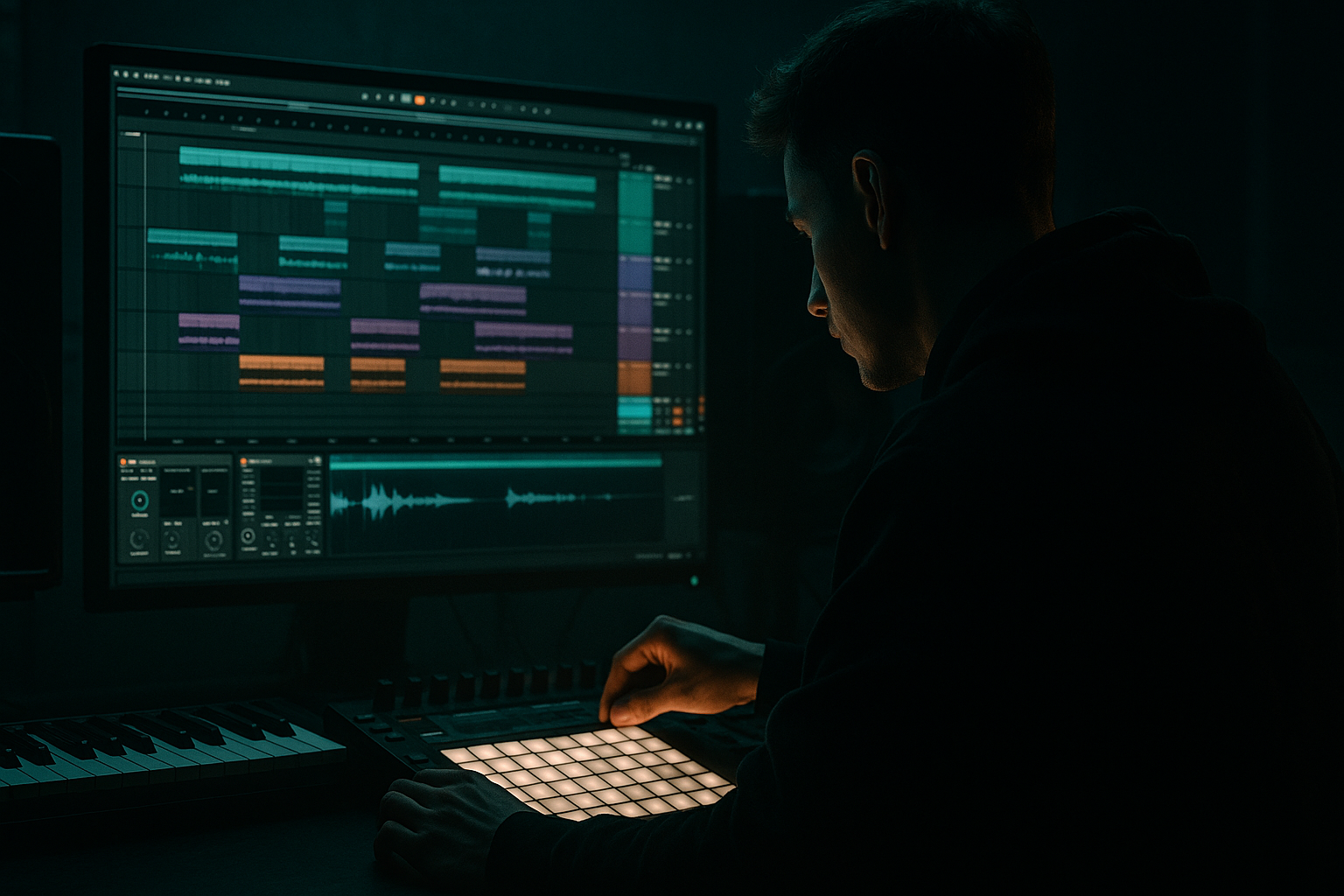
Main tutorial
```markdown
Masterclass: Bassline with Jungle Swing in Ableton Live 12 🥁🔊
Skill level: Intermediate
Category: Basslines (DnB / Jungle / Rolling)
---
1) Lesson overview 🎛️
In this lesson, you’ll build a rolling DnB/jungle bassline that locks to swingy breakbeats without sounding late, sloppy, or off-grid. We’ll focus on:
- A classic two-layer bass approach (sub + mid/reese)
- Jungle swing timing (micro-shifts, groove pools, and note lengths)
- Sidechain + envelope control so the bass breathes with breaks
- A clean, mix-ready Ableton stock device chain (Saturator, EQ Eight, Glue Compressor, Auto Filter, Utility, etc.)
- Arrangement moves to keep it evolving across an 8–16 bar loop
- A Sub Bass track (tight, mono, controlled)
- A Mid Bass track (movement + grit, stereo managed)
- A Bass Bus (glue, saturation, and final control)
- A 16-bar loop with:
- Operator (fast, clean sub)
- Amp Envelope (A Env):
- Sustain: -6 to -12 dB
- Release: 80–150 ms
- Osc 1: Basic Shapes → square-ish or saw-ish
- Osc 2: off (or a subtle detune layer)
- Unison: 2 voices, Amount 15–25%
- Filter: LP24
- Anchor notes: sit on root (D) and fifth (A) for drive
- Answer notes: small steps (C, F, G) for funk
- Length: 16 bars
- Start with a 2-bar loop, then expand.
- D1 (short) on 1.1
- D1 (short) on 1.2
- A0 (short) on 1.3
- D1 (short) on 1.3.3 (a little “pickup”)
- F1 (short) on 1.4
- D1 on 2.1
- C1 on 2.2
- D1 on 2.3
- G0 on 2.3.3
- A0 on 2.4
- Sub: 80–160 ms for tight rollers, 160–280 ms for more legato
- Mid: can be slightly longer than sub, but avoid constant overlap
- Identify off-beat notes (the “and” of the beat)
- Nudge some notes late by 5–15 ms
- Nudge occasional pickup notes early by 3–8 ms (creates urgency)
- Turn off grid temporarily (`Cmd/Ctrl + 4`)
- Use the Delay field in the track (in ms) for global feel tweaks:
- Enable Sidechain
- Input: your Drum Bus (or Kick channel if separate)
- Start settings:
- Bars 1–4: simple pattern (root-heavy)
- Bars 5–8: introduce one extra pickup note + slightly more mid filter open
- Bars 9–12: call/response variation (swap one note to C or F)
- Bars 13–16: strongest version (open filter + add one reso movement)
- Wavetable Filter Cutoff: open gradually across 8 bars
- Auto Filter Resonance: tiny rise in last 2 bars before drop
- Saturator Drive: +1–2 dB in the “peak” phrase
- Utility Gain: automate -1 dB on mid if chorus gets crowded
- Parallel distortion on MID:
- Reese “push/pull” with subtle detune:
- Add controlled movement with LFO (but tempo-safe):
- Tighten transient perception (without killing dynamics):
- Darker tone shaping:
- You built a two-layer DnB bass: sub stays stable, mid carries groove and character.
- You applied jungle swing using Groove Pool + targeted micro-timing (not random).
- You controlled pocket with sidechain compression tuned to the break.
- You made it track-ready with a Bass Bus and simple 16-bar arrangement evolution.
Goal: A bassline that rolls, bounces, and drives like proper jungle/DnB.
---
2) What you will build ✅
By the end you’ll have:
- Jungle swing feel
- Call/response bass phrases
- Variation every 4 bars
- Automated filter/resonance moments for energy
---
3) Step-by-step walkthrough 🧠
Step 0 — Session setup (tempo, grid, groove) ⚙️
1. Set tempo:
- Jungle/DnB sweet spot: 165–175 BPM
- Start at 174 BPM (classic rolling pace)
2. Warp settings for drums (if using breaks):
- On break sample: try Beats warp mode
- Preserve: Transients
- If it gets clicky: raise Transient Loop Mode or soften with a tiny fade in clip
3. Create a Groove Pool baseline:
- Open Groove Pool
- Load a groove like: MPC 16 Swing 57–62 (or similar)
- Start at 55–60% swing for jungle (you’ll refine later)
> Important: We’re not just applying swing to everything. We’ll apply it intelligently, mainly to bass mids and selected notes.
---
Step 1 — Build the Sub Bass (clean + consistent) 🧱
Create a MIDI track: “SUB”.
#### Instrument choice (stock)
- Algorithm: A only
- Oscillator A: Sine
- Level: 0 dB (adjust later)
#### Sub envelope settings (Operator)
- Attack: 0–5 ms
- Decay: 200–400 ms
- Sustain: -inf or very low (if you want plucky subs)
- Release: 60–120 ms
For a more “held” sub (common in rollers):
#### Sub processing chain (stock)
1. EQ Eight
- HP filter at 20–30 Hz (gentle) to remove rumble
- Optional tiny dip if it’s boxy: 200–300 Hz -2 dB
2. Saturator
- Mode: Soft Sine or Analog Clip
- Drive: 1–4 dB
- Output: compensate so level matches on/off
- Goal: add harmonics so the sub translates on smaller systems
3. Utility
- Bass Mono: On
- Width: 0% (keep the sub centered)
> Sub rule: stable pitch, stable timing, stable level. Let the mid layer do the talking.
---
Step 2 — Build the Mid Bass (movement + attitude) 🐍
Create MIDI track: “MID”.
#### Instrument (stock): Wavetable (or Operator if you prefer)
Wavetable settings (starting point):
- Cutoff: 200–600 Hz (we’ll automate)
- Drive: 2–6
- Resonance: low (0.10–0.25)
#### Mid processing chain (stock)
1. Auto Filter
- Type: Lowpass 24
- Envelope: small amount (for note-to-note movement)
- Rate: off (we’ll keep it controlled)
2. Saturator
- Mode: Analog Clip
- Drive: 4–10 dB (depends how aggressive you want)
- Soft Clip: On
3. EQ Eight
- High-pass at 90–140 Hz (make room for sub)
- Tame harshness: 2–5 kHz if needed
- Optional presence: tiny boost 700–1.5k if it needs “speak”
4. Glue Compressor
- Attack: 10 ms
- Release: Auto
- Ratio: 2:1
- Aim for 1–3 dB gain reduction on peaks
5. Utility
- Width: 80–110%
- If it gets messy: keep it closer to 80–90%
---
Step 3 — Write the bassline (rolling + jungle swing) ✍️
We’ll write in D minor (classic vibe), but any key works.
#### Pattern concept: “Anchor + Answer”
#### MIDI clip setup
#### A practical 2-bar bass idea (notes + rhythm)
Use 1/8 grid initially, then add swing and micro-shifts.
Bar 1 (example):
Bar 2 (variation):
> Keep notes shorter than you think at first. In jungle, note length = groove.
#### Note length targets (great starting point)
Tip: In the MIDI editor, set Legato off for sub, then manually choose lengths.
---
Step 4 — Add swing the right way (Groove + micro-timing) 🕺
Now we make it jungle.
#### 4A) Groove Pool on MID (not SUB first)
1. Drag your chosen groove (e.g., MPC 16 Swing 59) onto the MID clip
2. In the clip Groove settings:
- Timing: 50–80 (start 60)
- Random: 2–6 (tiny humanization)
- Velocity: 0–15 (optional, if your patch responds nicely)
Why MID first?
If you swing the sub too much, your low-end can feel late and smear with the kick. Jungle swing tends to feel better when the character layer dances, while the sub stays solid.
#### 4B) Manual micro-shifts (the secret sauce)
In the MIDI editor:
Ableton workflow tip:
- MID Delay: +5 to +15 ms
- SUB Delay: 0 to +5 ms (rarely more)
---
Step 5 — Sidechain to the drums (so it breathes) 🌬️
You’ve got breaks + kick. The bass needs to tuck under them.
#### Sidechain method (stock): Compressor
On SUB and MID tracks, add Compressor (or Glue Compressor).
- Ratio: 4:1
- Attack: 1–3 ms
- Release: 60–120 ms (time it to the groove)
- Threshold: adjust for 2–5 dB GR on sub, 1–3 dB on mid
DnB timing trick:
Set release so the bass returns just before the next important drum hit. If your break has ghost notes, you may want a slightly faster release to avoid pumping.
---
Step 6 — Bass Bus glue + safety (clean low end, loud mids) 🧼
Group SUB + MID into “BASS BUS”.
#### Bass Bus chain (stock)
1. EQ Eight
- Check build-up around 120–250 Hz
- If mud: dip 180 Hz -1 to -3 dB
2. Saturator
- Drive 1–3 dB (glue harmonics)
3. Glue Compressor
- Attack 10 ms, Release Auto
- Ratio 2:1
- GR: 1–2 dB (just kissing)
4. Limiter (optional safety)
- Ceiling: -0.3 dB
- Don’t smash—this is just protection
---
Step 7 — Make it roll for 16 bars (arrangement + automation) 🔁
A great loop becomes a track when it evolves.
#### 16-bar arrangement blueprint (fast + effective)
#### Automation ideas (stock devices)
Jungle authenticity move:
Make one bar slightly “wrong” in a cool way—an extra ghost note or a surprise rest. Jungle thrives on controlled chaos.
---
4) Common mistakes 🚫
1. Swinging the sub too much
- Result: weak, late low-end. Keep sub mostly tight.
2. Overlapping notes (especially in sub)
- Result: phase/level inconsistencies. Shorten notes and avoid constant legato.
3. Too much stereo in low frequencies
- Result: unstable mono compatibility. Mono your sub with Utility.
4. Sidechain set and forget
- Pumping or not enough pocket. Tune release to the break’s rhythm.
5. Mid bass too loud vs drums
- If the break loses snap, pull mid down 1–3 dB and re-check.
---
5) Pro tips for darker/heavier DnB 🕳️⚡
- Create a return track with Saturator (heavy) + EQ Eight (band-limit 200–4k)
- Send MID into it for controlled aggression.
- In Wavetable: Unison 2 voices, tiny detune.
- Add Chorus-Ensemble very lightly but keep lows filtered out afterward.
- Use Auto Filter with a slow LFO rate (like 1/2 or 1 bar)
- Keep depth small so it doesn’t wobble like dubstep.
- Add Drum Buss on MID very subtly:
- Drive: 2–5
- Boom: 0
- Crunch: 5–15%
- Use EQ Eight: gentle shelf down around 6–10 kHz on the bass bus
- Let drums own the air; let bass own the menace.
---
6) Mini practice exercise 📝
Do this in 20–30 minutes:
1. Build SUB (Operator sine) + MID (Wavetable) like above.
2. Write a 2-bar bassline using only: D, A, C, F.
3. Apply groove to MID only:
- Timing 60, Random 3.
4. Manually nudge two notes late by ~10 ms.
5. Sidechain SUB + MID to drums:
- Aim for 3 dB GR on SUB, 2 dB on MID.
6. Expand to 8 bars and add:
- One bar with a rest (space is swing!)
- One bar with an extra pickup note before beat 1
Export a quick bounce and listen on low volume: if it still feels like it rolls, you nailed it.
---
7) Recap 🔁
If you want, tell me your target style (e.g., 94 jungle, modern rollers, techstep, halftime DnB) and I’ll give you a bass MIDI rhythm template + device rack settings tailored to that sound.
```

