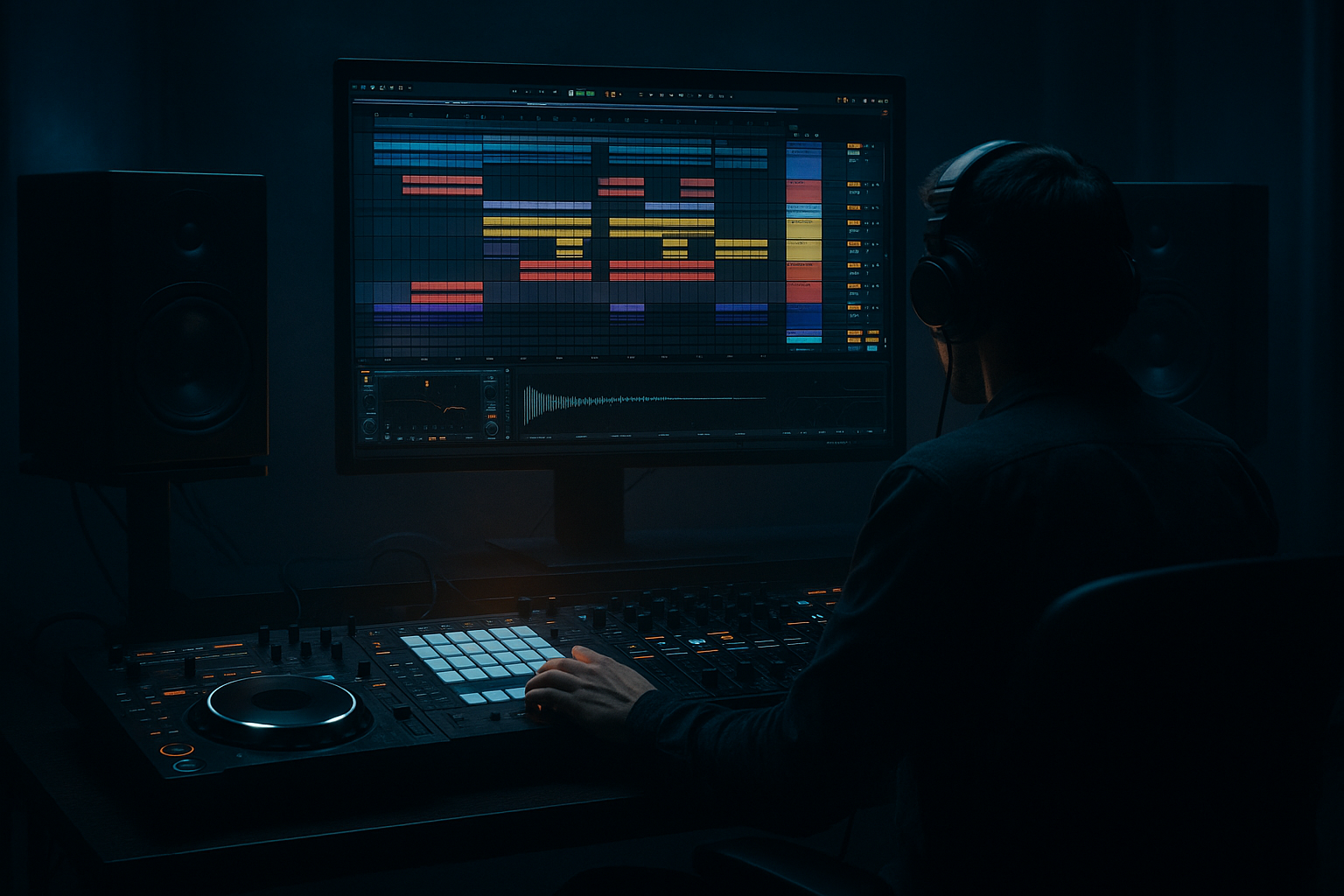
Main tutorial
Metallic FX Shots using Arrangement View (DnB Sound Design in Ableton Live) 🥁⚙️
1) Lesson overview
Metallic FX shots are those sharp, shiny, industrial hits you hear in drum & bass intros, drops, fills, and switch-ups—like “clang” stabs, robot impacts, and chrome zaps. In this lesson you’ll design your own metallic one-shots using only Ableton stock devices, then arrange them in a DnB context using Arrangement View workflows (resampling, slicing, freezing, and printing audio).
By the end, you’ll have a small palette of metallic hits you can throw into rolling sections and jungle-style edits with confidence. 🎛️
---
2) What you will build
You’ll create:
- 3–6 metallic FX one-shots (short, punchy, mix-ready)
- A printed audio track containing variations (so it’s easy to arrange)
- A simple DnB arrangement moment: a fill + pre-drop tease + drop accent
- Operator (metallic source)
- Echo + Reverb (space + tail design)
- Saturator (bite)
- Auto Filter (tight control)
- Drum Buss (weight + smack)
- Utility (mono control)
- Arrangement View tools: Consolidate, Freeze/Flatten, Resample, Reverse, Fades
- Device: Saturator
- Mode: Analog Clip (good for aggressive DnB edges)
- Drive: 3–8 dB
- Turn Soft Clip ON
- If it gets harsh, reduce Drive and do tone shaping later.
- Filter type: HP24 or HP12
- Frequency: 200–500 Hz (metal shots often don’t need sub)
- Add resonance:
- Optional: slight movement
- Time: set to Sync, 1/16 or 1/8
- Feedback: 10–25%
- Filter:
- Stereo: 90–120% (widen a touch)
- Keep Dry/Wet: 8–20%
- Size: 20–35%
- Decay Time: 0.6–1.4 s
- Pre-Delay: 10–25 ms (keeps the hit punchy)
- Low Cut: 300–800 Hz
- High Cut: 7–12 kHz
- Dry/Wet: 10–18%
- Bar 8 (end of phrase): add a metallic hit on beat 4 leading into the next 8 bars.
- Bar 16 (drop transition): reverse metal → silence gap (1/8) → impact hit on bar 17.
- If it’s a main impact: Bass Mono (or just Width)
- If it fights the snare: reduce gain -2 to -6 dB and place it around the snare, not on top.
- Drive: 5–15%
- Crunch: 0–20% (careful—can fizz)
- Boom: OFF or very low for metallic shots (they don’t need sub)
- Transient: +5 to +20 (if you want it to “snap”)
- End-of-4 / end-of-8 bar markers: beat 4 impact
- Call-and-response with the snare: place a quieter metal hit on the “and” after snare (2.2 or 4.2 in 4/4)
- Drop accents: 1st hit of the drop, then only every 4 bars
- Jungle edits: rapid 1/16 metallic ticks for 1 beat, then stop (contrast is everything)
- Too long tails: your reverb rings over the break and kills punch. Keep decay controlled and filter the reverb low end.
- Too much low end: metallic shots with sub content will clash with your rolling bass. High-pass them.
- Over-widening: massive stereo on a transient hit can feel phasey and weak in mono.
- No fades: clicks happen constantly with one-shots—use tiny fades.
- Overusing the effect: if the metallic hit happens every bar, it stops feeling special.
- Make it nastier with erosion-style texture (stock):
- Sidechain the tail to the snare or kick:
- Pitch automation for tension:
- Layer with a very quiet “thud”:
- You designed metallic hits using Operator FM (fast, controllable, very DnB).
- You shaped them with Saturator + Auto Filter and gave them vibe using Echo + Reverb.
- You committed the sound in Arrangement View (Freeze/Flatten or Resampling), then edited like a producer: split, fade, reverse, pitch, place.
- You arranged metallic shots as punctuation—perfect for rolling drum & bass energy. ⚡
You’ll use:
---
3) Step-by-step walkthrough
Step 0 — Set up a DnB-ready Arrangement View
1. Set tempo to 172–174 BPM.
2. Create a basic loop so you design in context:
- Add a Drum Rack with a simple kick + snare + hats pattern (even a placeholder is fine).
- Arrange a 16-bar section:
- Bars 1–8: intro/roll
- Bars 9–16: drop
This gives you a musical “home” to place your metallic shots.
---
Step 1 — Create the metallic source (Operator)
1. Create a MIDI Track → drop Operator on it.
2. In Operator, aim for “FM metallic” (classic DnB techy tone):
- Algorithm: use one where B modulates A (B → A).
- Osc A: Sine (default is fine)
- Osc B: Sine
- B Level: start around 35–55%
- Coarse tuning:
- A = 1.00
- B = 2.00 or 3.00 (higher ratios = more metallic)
3. Shape it like a shot:
- Amp Envelope (A Envelope):
- Attack: 0–2 ms
- Decay: 120–250 ms
- Sustain: -inf (or very low)
- Release: 40–120 ms
✅ Play short MIDI notes (1/16–1/8). You should hear a “ting/clang” that dies quickly.
Quick tip: If it sounds too “tone-y,” increase B Coarse (e.g., 4.00–7.00) and/or reduce Decay a bit.
---
Step 2 — Add transient bite + control (Saturator + Auto Filter)
After Operator, add:
#### 2A) Saturator (for edge)
#### 2B) Auto Filter (to make it “mix-ready”)
- Resonance: 10–25% for a “ring”
- Enable LFO amount: 5–10%
- Rate: 1/8 or 1/16 (subtle—don’t wobble it too much)
---
Step 3 — Make it cinematic/industrial (Echo + Reverb as a designed tail)
Metal FX in DnB often have a controlled tail that feels big but doesn’t wash the drums.
#### 3A) Echo (short, metallic reflections)
- HP around 300–800 Hz
- LP around 6–10 kHz
#### 3B) Reverb (short plate-ish tail)
🎯 Goal: a punchy hit with a controlled “air” tail that sits behind the snare.
---
Step 4 — Turn it into an audio one-shot (Arrangement View printing)
Now we’ll commit the sound so it’s easy to chop, reverse, fade, and place.
Method A (fast): Freeze + Flatten
1. In Arrangement View, draw a few MIDI notes on the Operator track (try different pitches: C3, D#3, F3).
2. Right-click the track → Freeze Track.
3. Right-click again → Flatten.
You now have audio on that track.
Method B (classic DnB resample): Resampling
1. Create a new Audio Track called `METAL_PRINT`.
2. Set its Audio From to Resampling.
3. Arm `METAL_PRINT`.
4. Solo your metallic track and record a few bars of hits and variations.
This captures the exact vibe (including tails) and feels very “DnB workflow.” ✅
---
Step 5 — Slice, shape, and build variations (audio editing in Arrangement View)
On the printed audio:
1. Warp OFF for one-shots (usually best):
- Click the clip → turn Warp off (so it stays punchy).
2. Create clean one-shots:
- Select a region → Cmd/Ctrl + E to split.
- Trim to the transient.
- Add short Fades:
- 1–5 ms fade-in to avoid clicks
- 10–50 ms fade-out to shape the tail
3. Make instant DnB variations:
- Reverse one shot (Clip view → Reverse) → great for pre-drop suck-ins.
- Pitch a copy down -3 to -7 semitones for heavier impacts.
- Duplicate and shorten to micro “ticks” for glitchy fills.
Arrangement idea (super common in rolling DnB):
---
Step 6 — Glue it into the mix (Utility + Drum Buss)
On your printed metallic audio track:
#### 6A) Utility
- Set Width: 80–100% (don’t go insanely wide)
#### 6B) Drum Buss (optional, but very DnB)
---
Step 7 — Place shots like a DnB producer (arrangement patterns)
Use metallic hits as rhythmic punctuation, not constant noise:
Go-to placements:
---
4) Common mistakes
---
5) Pro tips for darker/heavier DnB 🖤
Add Erosion (after Saturator)
- Mode: Noise
- Freq: 2–8 kHz
- Amount: 0.2–1.5 (tiny changes go far)
This adds grimy high-end “rust” that suits neuro/techy rollers.
Use Compressor on the metallic audio, sidechained from the snare.
- Ratio: 3:1
- Attack: 1–5 ms
- Release: 80–180 ms
- Gain reduction: 2–5 dB
Tail ducks out of the way = cleaner drums.
Print a longer metal tone, then automate Clip Transpose down into the drop (classic industrial fall).
Under your metal shot, layer a short low-mid impact (even a tom). High-pass the metal, low-pass the thud. The combo hits harder.
---
6) Mini practice exercise (10 minutes) ⏱️
1. Create three Operator metallic shots:
- Shot A: bright and short (decay ~120 ms)
- Shot B: slightly longer with more reverb (decay ~220 ms, reverb ~1.2 s)
- Shot C: darker (Auto Filter LP around 7–9 kHz, less resonance)
2. Print them to audio using Resampling.
3. In Arrangement View, place:
- Shot A on bar 8 beat 4
- Shot B reversed starting on bar 16 beat 4.3 (a tiny lead-in)
- Shot C as the drop impact on bar 17 beat 1
4. Bounce a quick 16-bar preview and listen:
If the groove loses punch, shorten tails and high-pass more aggressively.
---
7) Recap
If you tell me what sub-genre you’re aiming for (liquid, jump-up, neuro, jungle/amen), I can suggest a matching metallic chain and where to place shots in a typical 32-bar arrangement.

