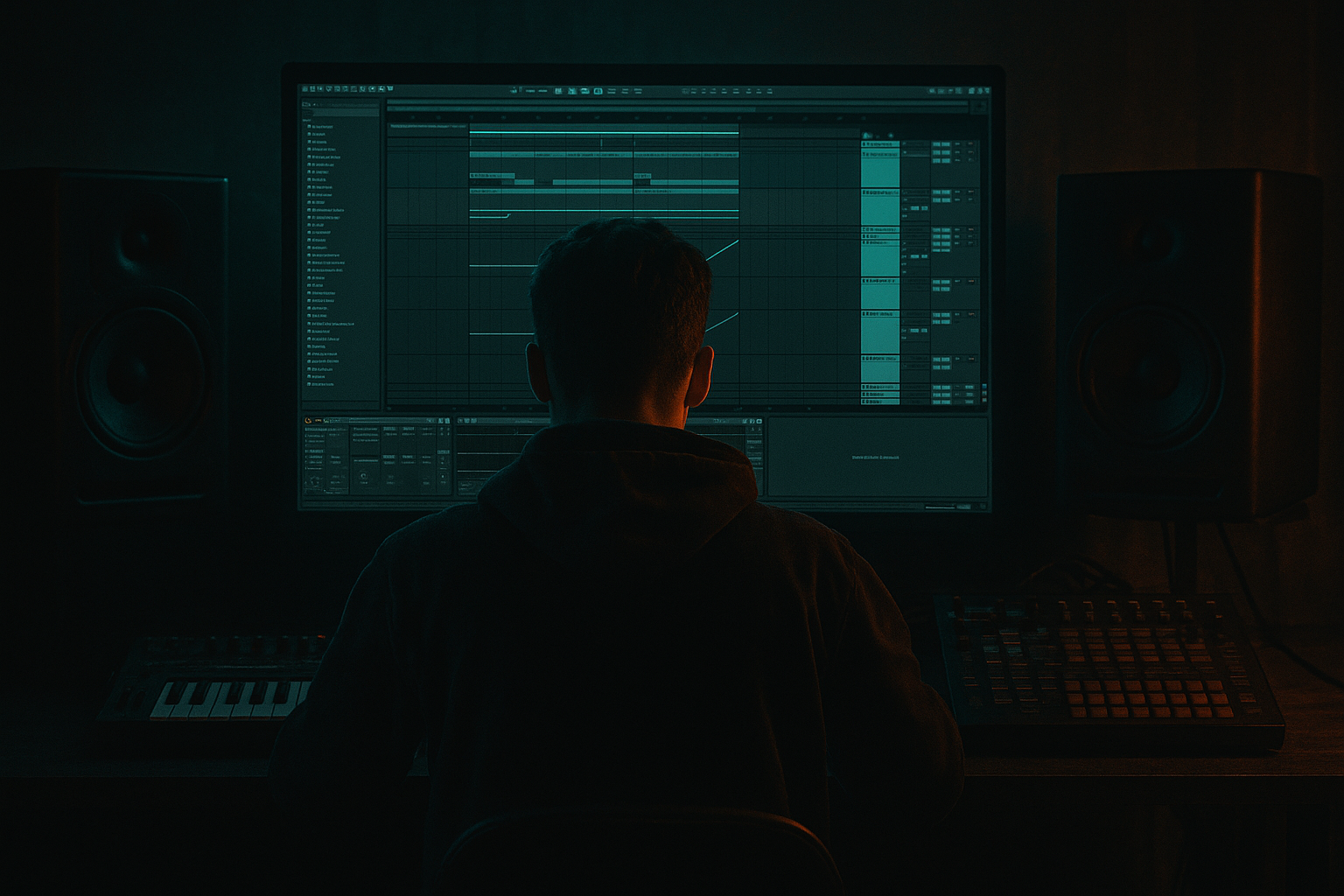
Main tutorial
Method for Breakbeat with Chopped-Vinyl Character in Ableton Live 12
1. Lesson overview
In this lesson, you’ll learn how to turn a clean breakbeat into something that feels like it came off a battered jungle dubplate or a chopped-up vinyl loop, while still sounding tight and modern in Ableton Live 12. This is a huge part of drum and bass, jungle, and rolling bass music—especially when you want that gritty, human, slightly unstable energy that makes a beat feel alive. 🥁
We’ll focus on a practical workflow:
- slicing a break into playable pieces
- re-ordering and re-grooving the hits
- adding vinyl-style movement, grit, and pitch wobble
- shaping the loop so it still hits hard in a DnB mix
- preparing it for arrangement like an actual track, not just a loop
- a chopped breakbeat loop with vinyl-style feel
- subtle pitch drift, noise, and saturation
- a tight low-end that works around a kick and bassline
- a loop that can be used in:
- Simpler
- Drum Rack
- Audio Effects Rack
- Saturator
- Drum Buss
- Auto Filter
- Redux
- EQ Eight
- Utility
- Groove Pool
- Warp
- Echo or Delay
- optionally Vinyl Distortion if available in your pack/library
- classic amen-style breaks
- funky drummer-style breaks
- dusty soul breaks with ghost notes
- any loop with snare swing and hi-hat chatter
- strong snare hits
- interesting ghost notes
- some room tone or tape noise
- a groove that feels “played,” not robotic
- Preserve: 1/16 or 1/8 for transient-heavy breaks
- Transient Loop Mode: On if the break is looping and you want movement preserved
- Seg. BPM: match the project tempo properly
- 170–174 BPM for rolling / modern DnB
- 165–172 BPM for more classic jungle feel
- Slice to Drum Rack by Transient
- you can re-order hits fast
- you can layer hits
- you can mute, duplicate, or retrigger parts
- you can add effects per hit if needed
- start with the original groove
- repeat one snare hit
- cut a kick early
- place a hi-hat pickup before the snare
- leave tiny gaps for vinyl-like tension
- kick on 1
- ghost snare on 1e
- snare on 2
- chopped hi-hat on 2a
- kick on 3
- snare on 4
- extra break fill into the next bar
- slight irregularity
- micro-gaps
- hit repeats
- changing velocity
- tiny timing offsets
- vary note velocity between repeated hits
- make ghost notes quieter
- make lead snare hits stronger
- lower a few hat hits to create a natural lilt
- main kick/snare hits: 90–127 velocity
- ghost notes: 25–70 velocity
- hat chatter: 40–90 velocity
- activate Transposition per pad or note
- slightly detune a few chops:
- use tiny variations, not huge jumps
- subtly dip pitch on a repeat
- pitch down the end of a fill
- create “turntable drag” style moments
- Chorus-Ensemble
- very subtle Frequency Shifter
- tiny Auto Pan movement
- high-pass very low rumble if needed
- cut muddy low mids around 200–400 Hz
- tame harsh top if the break is too sharp
- High-pass at 30–40 Hz
- Small cut at 250–350 Hz if boxy
- Gentle shelf cut above 10–12 kHz if too crisp
- Drive: 2–6 dB
- Soft Clip: On
- Base: default is fine
- Drive: 5–15%
- Boom: low or off if the break is already busy
- Transient: slightly up for snap
- Crunch: subtle, around 5–20%
- Downsample: low to moderate
- Bit Reduction: subtle, not extreme
- blend in lightly
- automate a gentle low-pass sweep into fills
- slightly darken intro sections
- open the filter on drops
- Low-pass
- resonance low to moderate
- keep movement musical
- trim the break to sit properly in the mix
- optionally reduce stereo width if the break is too wide
- keep low end centered
- vinyl crackle
- record hiss
- room noise
- dusty ambience
- Operator noise
- Auto Filter
- Saturator
- Utility
- move one snare a few milliseconds late
- nudge a kick slightly early
- duplicate a hat hit for a stutter effect
- insert a short gap before a fill
- zoom in and manually shift notes by tiny amounts
- use clip start markers for chopped entry points
- add short rests before key hits
- filtered break loop
- vinyl noise
- minimal bass tease
- one chopped snare repeat
- increase break intensity
- bring in ghost notes
- open the filter
- add a fill every 8 bars
- full break chops
- bassline in call-and-response
- extra snare layers or ghost percussion
- slight variation every 4 or 8 bars
- strip the break back
- use only hats, noise, and a few chopped hits
- reintroduce the main snare for tension
- new chop pattern
- stronger saturation
- extra fills or reversed snippets
- re-slice the bounced version
- reverse a few pieces
- pitch one fill down
- add new edits
- EQ Eight to soften harsh highs
- Auto Filter low-pass automation
- Saturator for body
- one chopped break for body and movement
- one tight top percussion layer for attack
- low-passed dusty layer
- high-passed crisp layer
- bar 8
- bar 16
- before the drop
- at the end of a 4-bar phrase
- ominous jungle intros
- tense build-ups
- halftime-to-DnB switch sections
- Compressor with sidechain
- or Glue Compressor if that feels better
- Saturator
- Redux
- Drum Buss
- 1 main kick-snare phrase
- 3 chopped variations
- 1 fill at the end
- pick a break with natural personality
- warp it cleanly
- slice it to a Drum Rack
- rebuild it with edits, gaps, and repeats
- humanize velocity and timing
- add subtle saturation, reduction, and filtering
- arrange it like a real DnB track
- resample and refine for extra grit 🎛️
This is a beginner-friendly mastering lesson, but the actual goal is to make your break sound like a finished, characterful element rather than a plain sample.
---
2. What you will build
By the end, you’ll have:
- intro sections
- drop layers
- breakdown textures
- fill sections and switch-ups
You’ll be using stock Ableton tools like:
---
3. Step-by-step walkthrough
Step 1: Choose the right break
Start with a break that already has movement and transient detail.
Good choices for DnB/jungle:
Important: don’t start with a super-clean modern loop if you want chopped-vinyl character. You want a break that already has some personality.
#### What to listen for:
---
Step 2: Warp the break properly
Drag the break into an audio track.
1. Double-click the clip.
2. Turn on Warp.
3. Set the first downbeat correctly.
4. Choose a warp mode:
- Beats for punchy drum loops
- Complex or Complex Pro if the break has lots of tonal room sound
5. Set the loop length to a musical bar length, usually:
- 1 bar for tight loop work
- 2 bars for more natural phrasing
#### Recommended warp settings:
For DnB, start around:
---
Step 3: Slice the break into a Drum Rack
This is where the chopped character starts to appear.
1. Right-click the audio clip.
2. Choose Slice to New MIDI Track.
3. Slice by:
- Transient if you want intelligent hit-based chopping
- 1/8 or 1/16 if you want strict rhythmic control
For beginner workflow, I recommend:
This gives you each hit on its own pad.
#### Why this helps:
---
Step 4: Program a chopped-vinyl pattern
Now write a MIDI clip with a deliberately “edited” feel.
Instead of looping the break straight through, try this structure:
#### Example 1-bar DnB chop idea:
This creates that “someone manually edited a break on turntables” feel.
#### Key idea:
Do not make it perfect.
A vinyl-chop character comes from:
---
Step 5: Add groove, not just quantization
A lot of beginners over-quantize breaks and accidentally remove the whole vibe.
Use Ableton’s Groove Pool.
1. Drag a groove from:
- an MPC-style swing
- a drum loop groove from your library
2. Apply it lightly to your MIDI clip
3. Start with subtle settings:
- Timing: 10–30%
- Random: 0–10%
- Velocity: 5–20%
- Base: usually keep at 1/16 unless needed
#### For jungle flavor:
Try a slightly late snare feel and looser hats.
#### For rolling DnB:
Keep the kick/snare grid tighter, but let hats and ghost notes move.
---
Step 6: Humanize the slice velocities
A chopped-vinyl break should breathe.
In MIDI view:
#### Rough starting point:
If every note is the same level, it starts sounding like a machine loop rather than a break.
---
Step 7: Add pitch movement for vinyl character
Vinyl chops often feel slightly unstable in pitch.
You can do this in a few ways:
#### Option A: Simpler pitch variation
If your slices are in Simpler:
- -1 to -5 semitones for darker hits
- +1 to +3 semitones for accidental lifted bits
#### Option B: Clip envelopes
Use clip envelopes or automation to:
#### Option C: Chorus-style drift
You can fake instability with:
Keep it subtle. The goal is character, not seasickness.
---
Step 8: Build a vinyl-style effects chain
Now let’s process the break so it feels older, dirtier, and more physical.
A solid stock Ableton chain:
#### 1. EQ Eight
Use EQ to clean and shape:
#### Suggested starting points:
---
#### 2. Saturator
Adds harmonic density and grime.
Suggested settings:
If you want a more tape/vinyl feel, don’t overdo it.
Just enough to thicken the transients.
---
#### 3. Drum Buss
Excellent for DnB breaks.
Suggested starting settings:
Use this carefully. Too much Drum Buss can make the break lose its chopped detail.
---
#### 4. Redux
This is great for a more lo-fi chopped-vinyl edge.
Suggested settings:
Try mixing it in parallel if your break gets too crushed.
---
#### 5. Auto Filter
Use this for DJ-style movement and old-record shaping.
Ideas:
Set:
---
#### 6. Utility
Use Utility for clean gain staging:
---
Step 9: Add noise and “record” texture
Vinyl character isn’t only about the drums. It’s also about the background texture.
You can add a very quiet noise layer:
#### Option A: Use a separate audio track
Add:
Low-pass it so it doesn’t fight the hats.
#### Option B: Make your own with stock devices
Create a return or utility chain with:
Keep it subtle and tucked behind the break.
---
Step 10: Use timing tricks to fake a chopped sample feel
One reason chopped-vinyl breaks feel good is because they’re slightly imperfect.
Try these tricks:
In Ableton:
Even tiny changes can make a big difference.
---
Step 11: Arrange it like a DnB record
Now place the break in a real arrangement.
A strong structure might be:
#### Intro
#### Build
#### Drop
#### Breakdown
#### Second drop
A chopped-vinyl break becomes much more effective when it evolves across the track.
---
Step 12: Bounce and resample for extra character
This is a classic DnB trick.
Once your chopped break feels good:
1. Freeze and flatten, or
2. Resample it to audio
Then:
This workflow helps the break feel more “found” and less programmed.
---
4. Common mistakes
1. Over-quantizing everything
If every hit is locked perfectly to the grid, the break loses its vinyl feel.
Fix: keep some hits slightly late/early and use light groove only.
---
2. Making it too dirty
A chopped-vinyl break should feel gritty, but still punch in a DnB mix.
Fix: use saturation and reduction subtly. If the snare disappears, you’ve gone too far.
---
3. No dynamic contrast
If all slices are the same velocity and the same length, the break feels flat.
Fix: vary velocities, leave gaps, and create quieter ghost notes.
---
4. Too much low end in the break
In DnB, the break and bassline must coexist.
Fix: high-pass the break carefully, and leave the sub to the bass and kick system.
---
5. Using a break that’s too clean
A pristine loop may not naturally deliver the vinyl vibe.
Fix: choose a break with some dust, room, or old-school swing already in it.
---
6. Ignoring arrangement
A great loop repeated for 2 minutes still sounds like a loop.
Fix: change the chop pattern every 4, 8, or 16 bars.
---
5. Pro tips for darker/heavier DnB
Tip 1: Darken the break without killing the attack
Use:
This helps the break sit under dark bass design without sounding brittle.
---
Tip 2: Layer a crisp top break with a dirty mid break
A strong DnB drum sound often comes from layering:
Use Utility and EQ to keep layers separated:
---
Tip 3: Put your heavy fills at phrase endings
For darker DnB, make fills happen:
This gives the track that intense “next section incoming” energy.
---
Tip 4: Use reverse chops and ghost reverses
Reverse one or two slices before a snare or crash.
This works especially well for:
---
Tip 5: Sidechain the break lightly to the bass
If your bass is powerful, a tiny bit of sidechain ducking can help the break breathe.
Use:
Keep it subtle. The break should still feel natural.
---
Tip 6: Try parallel crunch
Duplicate the break or use a return track with:
Blend it under the clean break.
This gives you heaviness without destroying the detail.
---
6. Mini practice exercise
Exercise: Build a 4-bar chopped-vinyl DnB loop
#### Goal:
Create a 4-bar break loop with:
#### Steps:
1. Load a break into Ableton.
2. Slice it to a Drum Rack.
3. Program a 1-bar loop with:
- main snare on beat 2 and 4
- at least 2 ghost notes
- 1 duplicated hat chop
4. Copy it across 4 bars.
5. In bars 2–4:
- move one hit slightly off-grid
- change one velocity
- add one reverse or muted slice
6. Add:
- EQ Eight
- Saturator
- Drum Buss
- a light groove
7. Bounce it and listen in context with a bassline.
#### Challenge:
Make bar 4 sound like a “vinyl edit” that naturally leads back to bar 1.
---
7. Recap
You’ve now got a practical method for making a breakbeat with chopped-vinyl character in Ableton Live 12 for drum and bass:
The main idea is simple:
don’t just loop the break—edit it like a performance.
That’s what gives you the classic chopped-vinyl energy that works so well in jungle and DnB. If you want, I can also turn this into a screen-by-screen Ableton Live 12 workflow or give you a specific drum rack chain for this sound.

