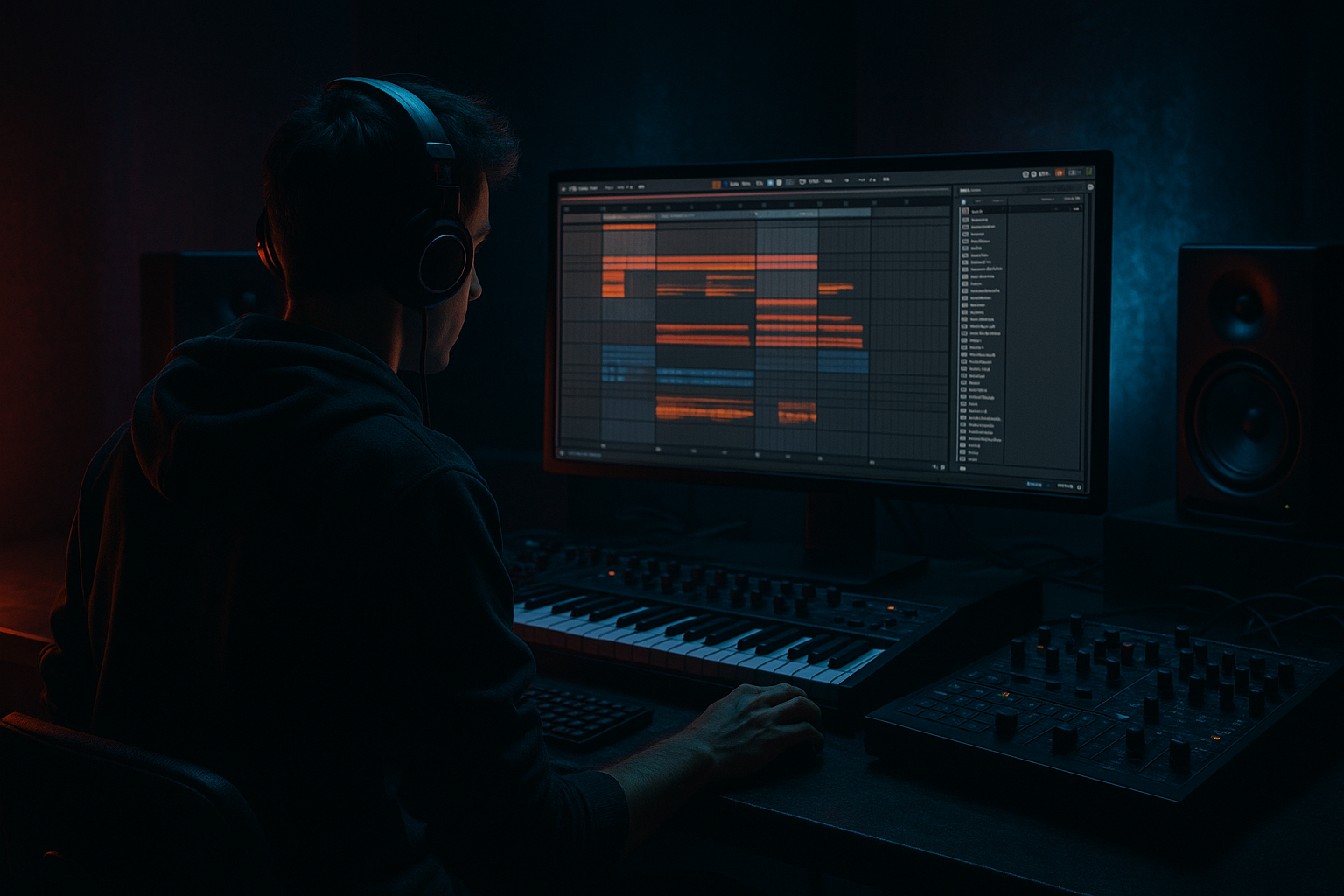
Main tutorial
Method for an Intro with Heavyweight Sub Impact (Ableton Live 12)
Jungle / oldskool DnB vibes — Beginner Basslines lesson 🔊🔥
---
1. Lesson overview
This lesson shows a reliable, repeatable method to make your intro build tension and then slam into a heavyweight sub drop—the kind of classic jungle/DnB impact where the room suddenly feels bigger.
You’ll learn how to:
- Set up a clean, powerful sub bass (that won’t distort into mush)
- Create an intro “tease” using filtering, reverb tails, and tension FX
- Design a drop moment using arrangement + automation (not just “turn it up”)
- Use Ableton Live 12 stock devices to get pro results fast ✅
- Sub bass impact (tight, mono, controlled)
- Low-end reveal (intro hides the weight, drop releases it)
- Classic cues: filtered breaks, dubby stabs, riser/noise, reverb “suck-out”
- Device: Hybrid Reverb
- Mode: Hall or Plate
- Decay: 3–6s
- High Cut: 6–10 kHz
- Low Cut: 200–400 Hz (important: keep low end out of reverb)
- Device: Echo
- Time: 1/8 or 1/4 dotted
- Feedback: 20–35%
- Filter: cut lows below 200 Hz
- Amp Envelope:
- Notes: A1 (55 Hz) and G1 (49 Hz) or E1 (41 Hz)
- Rhythm:
- Filter type: Low-pass (LP24)
- Frequency: start around 90–140 Hz
- Resonance: 0.5–1.2
- Drive: small amount if needed (0–3)
- Intro start: 120 Hz (sub partially hidden but still “felt” lightly)
- Build to drop: 80–100 Hz (even more “underwater”)
- At the drop: Open fully (or just turn Auto Filter OFF at drop)
- Intro: -inf to -12 dB
- Last bar before drop: dip quickly down 2–4 dB
- Drop: jump to your normal level (e.g. -8 to -6 dB depending on headroom)
- Last snare/fill before drop: send more (big tail)
- Right at the drop: hard cut the return for 1 beat
- EQ Eight: keep mostly 40–90 Hz
- Saturator: 1–2 dB drive
- Utility: mono
- Filtered break loop (Auto Filter LP)
- Dubby stab hits (send to reverb/delay)
- Sub playing but filtered + low in volume
- Bring in more break detail (open filter slightly)
- Add a noise riser (Operator noise or samples)
- Sub gets quieter/filtered more right before bar 17
- Full breaks
- Sub full bandwidth (Auto Filter off/open)
- Optional mid-bass layer or Reese (light, controlled)
- Instrument: Operator or Wavetable
- Use a saw/square blend, then low-pass it around 200–400 Hz
- EQ Eight: High-pass at 90–120 Hz (leave true sub to the sub track)
- Light Saturator or Roar (Ableton Live 12) for grit
- Keep it mono-ish or narrow below 200 Hz (Utility width reduction)
- Sidechain the sub to the kick (subtle, not pumpy):
- Use Roar gently on MID BASS (not sub) for dark grit.
- Add sub movement with tiny pitch envelopes (Operator/Wavetable):
- For jungle authenticity: use break edits and tape-ish saturation (Saturator/Drum Bus) rather than modern EDM risers.
- Heavyweight sub impact comes from contrast and control, not just volume.
- Your intro should tease the bass using low-pass filtering, reverb tails, and level dips.
- Keep the sub mono, clean, and headroom-friendly, then let the drop reveal it.
- Use Ableton stock tools: Wavetable/Operator, Utility, EQ Eight, Saturator, Auto Filter, Hybrid Reverb, Echo.
---
2. What you will build
A 16–32 bar intro that feels authentic to oldskool jungle / rolling DnB, ending in a drop with:
---
3. Step-by-step walkthrough
Step 0 — Project setup (fast, genre-correct)
1. Set tempo: 165–175 BPM (try 170 BPM for classic vibes).
2. In Preferences → Audio, keep latency reasonable; sub programming needs accurate timing.
3. Add these tracks:
- SUB (MIDI)
- MID BASS (optional)
- DRUMS (breaks)
- FX / ATMOS
- RETURN A: Reverb
- RETURN B: Delay
Return A Reverb (stock):
Return B Delay (stock):
---
Step 1 — Build a clean heavyweight sub (the foundation) 🧱
On your SUB MIDI track:
#### Option A (simple + effective): Wavetable Sub
1. Add Wavetable
2. Oscillator 1:
- Wave: Sine
- Voices: 1 (mono)
3. Turn Oscillator 2 OFF (keep it clean)
4. In the Filter section: you can leave filter off, or use a gentle low-pass.
#### Sub envelope (tight jungle/DnB feel)
- Attack: 0–5 ms
- Decay: 200–400 ms (optional, depends on note length)
- Sustain: -inf to 0 dB (if you want short notes vs held notes)
- Release: 60–120 ms (prevents clicks)
#### Add a utility chain for control (stock devices)
After Wavetable, add:
1. Utility
- Width: 0% (mono the sub)
- Gain: keep around -12 to -6 dB while building
2. EQ Eight
- High-pass: OFF (don’t cut your sub fundamentals)
- Add a gentle cut if muddy:
- Bell at 200–350 Hz, -2 to -4 dB, Q ~1.2
- Optional: tiny dip around 40–60 Hz if it booms too hard.
3. Saturator (for perceived weight without huge peak level)
- Mode: Soft Sine or Analog Clip
- Drive: 1–4 dB
- Output: reduce to match level
- Keep it subtle—your goal is audible sub presence, not fuzz.
> DnB rule: Sub is a single job: solid low fundamental, consistent, mono, controlled. Everything else can be dirty.
---
Step 2 — Write a classic rolling sub pattern (beginner-friendly) 🥁
In MIDI, try 1-bar loop then extend it.
Key tip: Jungle/DnB sub often “talks” with the kick pattern. Leave space.
Example pattern idea (in A minor):
- Hit on 1
- Short note on 1.3
- Another on 2
- Space before snare hits (classic: snare on 2 and 4)
If you’re unsure: keep mostly A1, and use one note change every 2 bars.
---
Step 3 — The intro trick: “Hide the sub, then reveal it” 🎭
This is the core method for heavyweight impact.
#### 3A) Put the sub in the track early… but filtered/quiet
In the intro (first 8–16 bars), keep sub playing but not fully audible.
On the SUB track, add Auto Filter before Saturator:
Now automate Auto Filter Frequency:
Yes—counterintuitive: you can make the sub feel bigger by removing low-mid hints right before the drop, then letting the full spectrum snap in.
#### 3B) Automate the sub level for a “suck then slam”
Automate Utility Gain (after Wavetable):
That tiny dip before the drop makes the sub hit feel larger without actually being louder.
---
Step 4 — Add “impact shaping” on the master of the drop moment (safe beginner method)
You can create a drop impact without wrecking your mix.
#### 4A) Reverb tail “cut” (classic jungle move) 🌪️
On Return A Reverb, automate the return level:
This creates the feeling of the space collapsing, making the drop feel huge.
#### 4B) A tiny “sub hit” layer (optional but very effective) 💥
Create a new audio track: SUB HIT
1. Load a short sine hit (you can even resample your sub):
- Freeze/Flatten the sub note, cut a tiny chunk, fade it.
2. Put it exactly on drop bar 1.
Process it lightly:
Keep it quiet—this is a punch cue, not a separate bassline.
---
Step 5 — Arrange a jungle-style intro that sets up the bass drop 🧩
Here’s a simple 32-bar plan:
Bars 1–8 (Tease):
Bars 9–16 (Tension):
Bars 17–32 (Drop):
---
Step 6 — (Optional) Add a mid-bass layer without ruining the sub 😈
If you want oldskool weight and presence on small speakers:
Create MID BASS track:
---
4. Common mistakes
1. Stereo sub 🚫
- If your sub isn’t mono, it will disappear on big systems and clash with kicks.
2. Too much distortion on the sub
- Heavy saturation creates upper harmonics that fight the break + mids.
3. No headroom
- If your sub is already near 0 dB, your drop can’t “feel bigger.”
4. Filtering the sub the wrong way
- High-passing the sub in the intro removes the fundamental—use low-pass to hide presence, not the core.
5. Reverb in the low end
- Low frequencies in reverb = mud. Always low-cut your reverb return.
---
5. Pro tips for darker/heavier DnB
Use Compressor on SUB → Sidechain from Kick track
- Ratio: 2:1–4:1
- Attack: 5–15 ms
- Release: 60–120 ms
- Aim for 1–3 dB gain reduction on kick hits.
Keep sub clean; make the layer dirty.
0–20 ms pitch drop can add “thump,” but don’t overdo it.
---
6. Mini practice exercise (15 minutes) ⏱️
1. Make a 16-bar loop: breaks + sub.
2. Automate:
- SUB Auto Filter cutoff (intro hidden → drop open)
- Return A reverb send up in bar 15, then cut at bar 17
- Utility Gain dip -3 dB in the last half bar before drop
3. Bounce (export) two versions:
- Version A: no automation
- Version B: with the full intro method
4. Compare which one feels heavier at the same peak level.
---
7. Recap ✅
If you tell me your BPM and whether you’re using a classic break (Amen, Think, etc.), I can suggest a matching 2-bar sub rhythm that locks with it.

