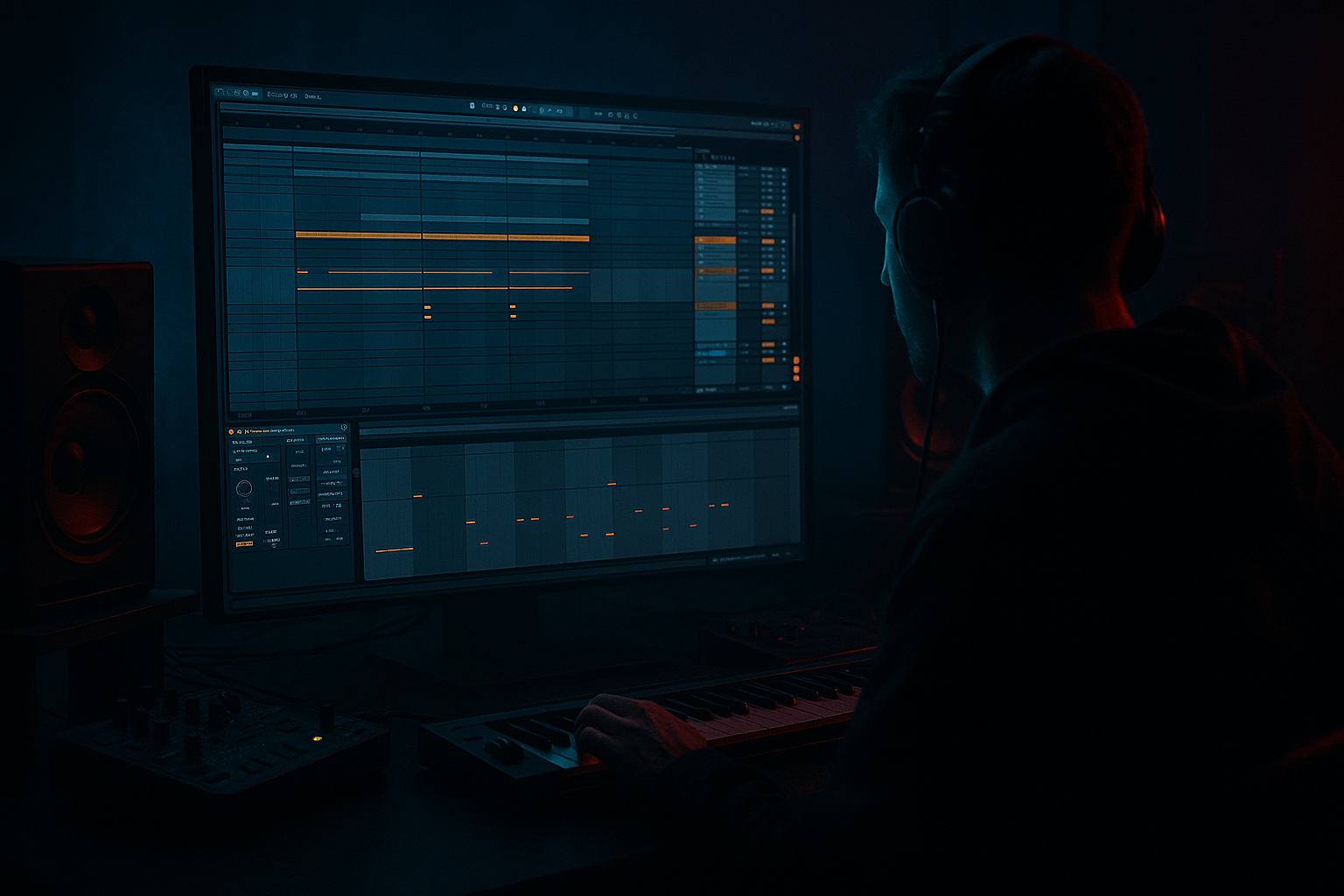
Main tutorial
```markdown
Micro-fill Design for Modern Control with Vintage Tone (DnB in Ableton Live)
1) Lesson overview
Micro-fills are those tiny drum moments—often 1/16 to 1/4 bar—that reset attention without derailing the roll. In modern DnB, they’re surgical: tight timing, controlled spectrum, intentional stereo. But the best ones feel like jungle hardware: crunchy transient smear, tape-ish movement, little pitch wobbles, and human swing. 🎛️
In this lesson you’ll design micro-fills that:
- Cut through a dense rolling break/2-step without sounding “plug-in obvious”
- Stay controlled (gain-staged, mono-safe lows, predictable impact)
- Carry vintage tone (saturation, resample workflows, pitch artifacts, transient rounding)
- Saturator → Drum Buss → EQ Eight → Glue Compressor → Utility
- Optional: Redux (light), Echo (micro), Reverb (gated/short)
- A snare ghost (lighter snare sample or filtered copy)
- A closed hat with short decay
- A ride tick or shaker layer (very quiet)
- A tiny reverse (snare or hat reverse)
- Target the last 1/8 or 1/4 bar before a phrase change.
- Example: in bar 8, place:
- Add Groove Pool swing subtly:
- Or manually nudge notes:
- On the ghost snare chain inside Drum Rack:
- A tuned tom or “rave stab hit”
- A snare flam (two snares layered)
- A kick triplet (short, punchy kick)
- Optional: a short crash choke (super short decay)
- Place two 1/16 snares before the 1:
- Velocity:
- Pitch:
- 4 hits at 1/16 into the next bar:
- Add Decay automation (if using Simpler):
- On the tom/stab device chain:
- Use Transient control:
- Every 8 bars: a ghost fill (1/8 bar)
- Every 16 bars: an impact fill (1/4 bar) + texture tail
- Before drops: a texture fill that ramps, then hard mutes
- Automate the `FILL BUS` volume down to -inf for the last 1/16.
- Or gate it using Auto Pan as a tremolo at 1/16 then stop abruptly.
- `FILL BUS` Utility Gain (overall fill intensity per section)
- Saturator Drive (more drive in breakdowns, less in busy drops)
- EQ Eight high-shelf (darker in drop, brighter in intro)
- Too loud: If the fill is competing with the snare, it’s not a micro-fill anymore.
- Low-end spill: Fills under ~120 Hz quickly wreck sub clarity. High-pass aggressively.
- Over-randomization: Human feel is great, but if every hit is different, the groove stops feeling intentional.
- Too much stereo: Wide fills can yank the mix sideways. Keep lows mono and check in mono.
- Overuse: If there’s a fill every 2 bars, none of them feel special.
- Over-bright “digital” transient: Modern samples + no rounding = clicky, EDM-ish fills. Use transient reduction and saturation.
- Make fills “mid-forward,” not “sub-forward.”
- Parallel filth (controlled):
- Darker hat stutters:
- Clip the Fill Bus gently:
- Break-aware fills:
- Micro-fills in modern DnB are about precision and restraint.
- Build three lanes (ghost/impact/texture) feeding a Fill Bus for one-knob control.
- Use vintage tone via saturation, transient rounding, subtle degradation, and—most importantly—resampling.
- Place fills at phrase edges, and use micro-gaps to increase impact without adding density.
- Keep lows tight, keep levels modest, and make every fill earn its spot. 🔥
Assumptions: You already know Drum Racks, warping, resampling, and basic bussing in Ableton Live.
---
2) What you will build
You’ll build a Micro-Fill Rack with 3 lanes you can drop into any DnB drum group:
1. Ghost Fill Lane (subtle, groove-enhancing): hats/snare ghosts, tiny reverses, nudges
2. Impact Fill Lane (attention grab): tom/stab hits, snare drag, kick triplet, short riser
3. Texture Fill Lane (vintage glue): resampled grit, vinyl-ish noise, AM/ring artifacts
All lanes feed a Fill Bus with “modern control / vintage tone” processing:
Arrangement goal: fills that live in the last 1/8–1/4 of a phrase (every 8/16 bars), with quick bypass/automation for mix discipline.
---
3) Step-by-step walkthrough
Step 0 — Session & routing (make it fast to deploy)
1. Tempo: 172–176 BPM.
2. In Session View or Arrangement, put your drums in a Drum Group:
- `DRUMS (Group)`
- `KICK`
- `SNARE`
- `BREAK`
- `HATS`
- `FILLS (Group)` ✅ new
3. Inside `FILLS`, create three MIDI tracks:
- `FILL_GHOST`
- `FILL_IMPACT`
- `FILL_TEXTURE`
4. Route all three to a return-like audio track:
- Create an Audio Track named `FILL BUS`
- Set each fill track Audio To → FILL BUS
- Set `FILL BUS` Audio To → DRUMS Group or your DRUMS BUS
This gives you one fader/chain for fill level. Clean control. 👍
---
Step 1 — Build your “vintage-controlled” Fill Bus chain
On `FILL BUS`, insert:
1. EQ Eight
- HPF around 120–180 Hz (24 dB/oct)
Goal: fills shouldn’t fight the kick/sub.
- Gentle dip 250–400 Hz if boxy
- Optional shelf down above 12 kHz if too “modern bright”
2. Saturator
- Analog Clip mode
- Drive: 2–6 dB (start 3.5 dB)
- Soft Clip: On
- Output: trim so bypass ≈ processed loudness
3. Drum Buss
- Drive: 5–15%
- Crunch: 0–10% (use sparingly)
- Transients: -5 to -20 (rounds the front = vintage)
- Boom: Off or very low (0–5%) and tune away from sub (e.g., 60–80 Hz) if used
4. Glue Compressor
- Attack: 3 ms
- Release: 0.1–0.3 s or Auto
- Ratio: 2:1
- Aim for 1–2 dB GR on fills only
- Soft Clip: optional if you’re pushing level
5. Utility
- Bass Mono: 120 Hz
- Width: 80–110% depending on how wide your main hats are
- Gain: use as final trim
Why this works: Saturator + Drum Buss gives the “older sampler / driven desk” vibe, while EQ/Glue/Utility keep it disciplined and mix-ready.
---
Step 2 — Create Ghost micro-fills (the rolling glue)
On `FILL_GHOST`, load a Drum Rack (or simpler: a Simpler per sound). Use:
Programming (classic DnB micro-fill placement):
- 1/16 ghost snare hits leading into the downbeat (a mini “drag”)
- A hat stutter: 3–4 hits at 1/32 or swung 1/16
Timing control tips (modern):
- Try MPC 16 Swing 57 at 10–20%
- Push the last ghost -5 to -12 ms (slightly early) for urgency
- Pull one hat +8 to +15 ms for human push-pull
Tone tips (vintage):
- Auto Filter: HP around 200 Hz, LP around 8–10 kHz
- Saturator: Drive 1–3 dB, Soft Clip on
- Optional: Redux very light:
- Bit Reduction: 12–14
- Sample Rate: 22–30 kHz
- Mix: 10–25% (use Dry/Wet if you put it after)
Keep these quiet—often -18 to -10 dB relative to main snare.
---
Step 3 — Impact micro-fills (attention without chaos)
On `FILL_IMPACT`, build a Drum Rack with:
Two reliable DnB patterns (pick one):
A) 1/8 bar “snare drag” into drop
- Hit at 1e and 1a (or just the last two 1/16 of the bar)
- first hit 50–70
- second hit 80–110
- Detune first hit -10 to -30 cents for imperfect hardware vibe
B) 1/4 bar “tom roll” (jungle-tech hybrid)
- Pitch down slightly each hit: 0 → -1 → -2 → -3 semitones
- Shorter at the end to “choke” the phrase
Modern control: keep the low end clean
- EQ Eight HP at 120–200 Hz
- If you want low tom weight, carve a hole in bass instead—don’t let fills freestyle below 120.
Impact shaping:
- Drum Buss Transients at +5 to +15 if you need more crack
- Or -10 if it’s too pokey and modern
---
Step 4 — Texture micro-fills (resample for authentic dirt)
This is where you get the “old record / sampler / pirate radio” magic without losing engineering control. 🎚️
1. On `FILL_TEXTURE`, create an Audio track or a Drum Rack slot that plays resampled fill audio.
2. Resampling workflow (fast):
- Create a new audio track: `RESAMPLE_PRINT`
- Set Audio From → FILL BUS (or from the specific fill lane)
- Arm it + record 4–8 bars while triggering fills
- Now you have printed audio you can slice and place precisely
3. Turn that audio into a playable fill kit:
- Right click the clip → Slice to New MIDI Track
- Slicing preset: Built-in → Slicing (or Transient)
- Now you can re-trigger crunchy slices with tight MIDI timing
4. Vintage processing ideas (pick 1–2):
- Echo (micro slap, not audible delay):
- Time: 1/64 or 1/32
- Feedback: 5–12%
- Filter: HP ~ 300 Hz, LP ~ 6–8 kHz
- Dry/Wet: 5–12%
- Hybrid Reverb (short “room” + gate feel):
- Early reflections up, tail very short
- Decay: 0.2–0.6 s
- HP: 400 Hz, LP: 7–9 kHz
- Dry/Wet: 3–8%
- Vinyl-ish movement using Auto Filter + LFO:
- Auto Filter LP at 8–12 kHz
- LFO amount tiny (2–6%) at 0.2–0.6 Hz (slow wobble)
- Redux on the printed audio:
- Sample Rate: 16–28 kHz
- Bit: 10–14
- Use 100% wet if it’s subtle; otherwise mix via chain volume
Key concept: Print > slice > re-trigger. That’s how you get “vintage unpredictability” with “modern repeatability.”
---
Step 5 — Arrangement: where micro-fills actually work in rolling DnB
Use them like punctuation, not paragraphs.
Placement map (very usable):
Classic trick: Fill ends with a micro-gap (1/16–1/8 bar of silence) right before the downbeat.
Automation lanes to use:
---
4) Common mistakes
---
5) Pro tips for darker/heavier DnB 🖤
Aim fills to live in 200 Hz–4 kHz, where aggression reads on small systems.
- Create a return `FILL DIRT`
- Put Pedal (Saturation) → Amp (Clean/Blues) → Cabinet → EQ Eight
- Send only the texture lane, keep return low (-20 to -12 dB).
This gives Neuro-ish grit without touching your main drum buss.
Low-pass hats to 7–10 kHz, then add tiny saturation to bring presence back without brightness.
Use Glue Soft Clip or a Saturator at the end with minimal drive. Fills should feel “caught.”
If your break is busy, design fills using contrast: remove top-end or remove hits rather than adding more.
---
6) Mini practice exercise (15 minutes)
1. Take an 16-bar rolling drum loop (kick/snare/hats + break).
2. Create:
- Bar 8: ghost fill (1/8 bar) using 2 ghost snares + 1 hat stutter
- Bar 16: impact fill (1/4 bar) using a tom roll (pitch down) + a micro-gap last 1/16
3. Resample both through `FILL BUS`, slice them, and re-trigger one slice early by -10 ms.
4. Mix check:
- Turn the master to mono for 10 seconds
- Lower fills until you miss them when muted but don’t notice them when present
Deliverable: Bounce a 16-bar audio with fills and a version without, A/B them.
---
7) Recap
```

