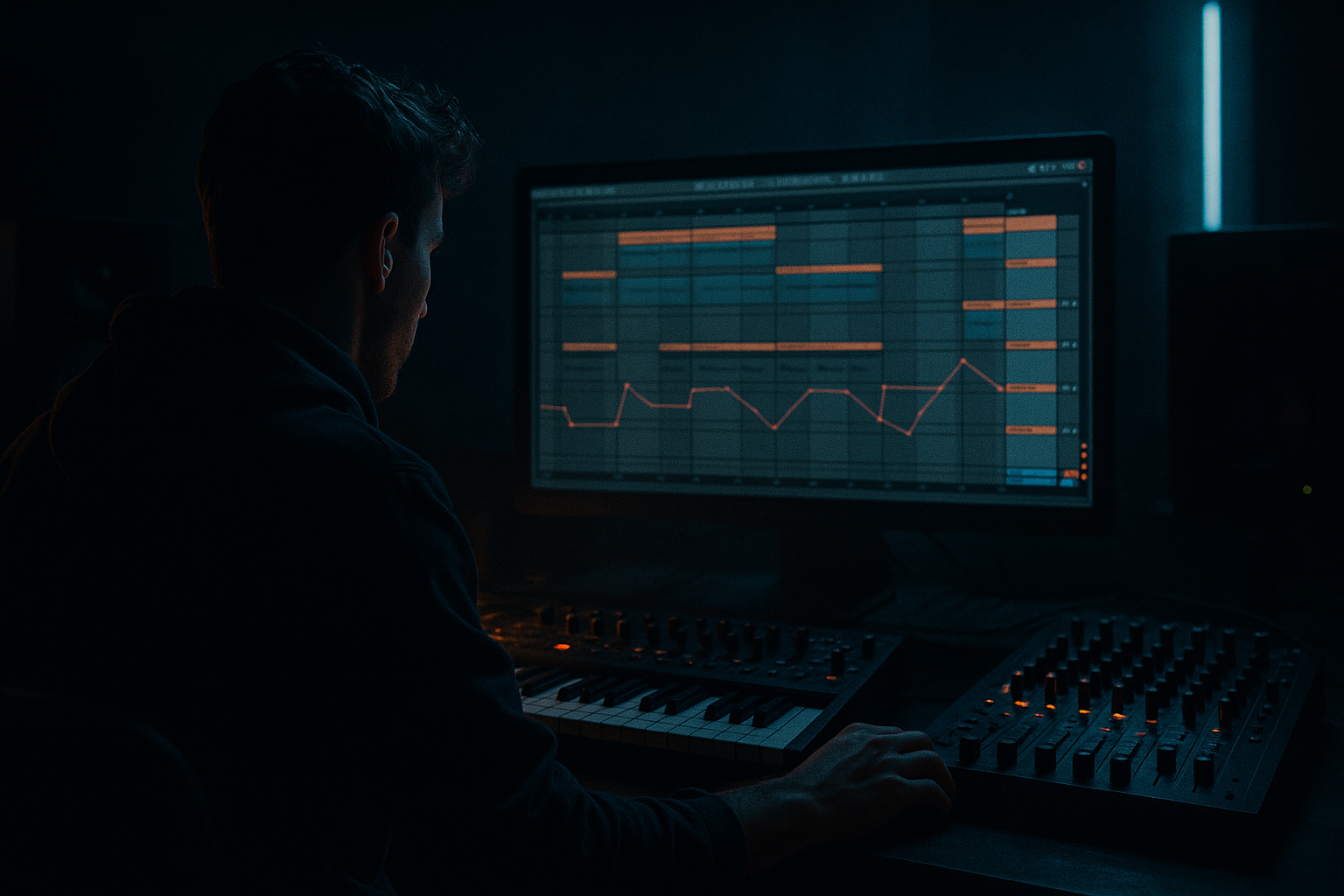
Main tutorial
Micro-fill design: for pirate-radio energy (DnB in Ableton Live) 📻🥁
1. Lesson overview
Micro-fills are tiny bursts of drum edits (usually 1/16–1/32 note moves) that add “live” excitement—like an MC just hyped the crowd and the DJ snapped the fader back in. In drum & bass / jungle, these fills often happen right before a section change (every 4, 8, or 16 bars) and are built from snare ghosts, kick stutters, hat flips, and little FX chops.
In this lesson you’ll learn how to design micro-fills that feel tight, intentional, and pirate-radio energetic—using stock Ableton Live tools.
---
2. What you will build
You’ll build a 2-bar rolling DnB drum loop with:
- A solid kick + snare foundation
- Ghost notes and swing
- A micro-fill at the end of bar 2 (easy to copy to every 8/16 bars)
- A reusable Ableton device chain for punch + grit
- Place snare on beat 2 and 4 in both bars.
- Bar 1: 1.1, 1.3, 3.1
- Bar 2: 1.1, 2.3, 3.1, 3.3
- Main hats: 70–90
- Extra 16ths: 25–55
- Try 1–3 ghost hits in each bar, e.g.:
- Ghost velocity: 10–30
- Shorten note length slightly (doesn’t matter much for one-shots, but helps visually).
- Put a kick on Bar 3: 1.1 (the downbeat of the next loop/section)
- If looping 2 bars, that’s the next cycle’s first beat.
- Drive: 5–15%
- Boom: Off (or very low, 0–10%) unless your kick is thin
- Damp: 10–30%
- Transient: +10 to +30 (more snap)
- Output: match level (avoid clipping)
- Mode: Analog Clip
- Drive: 2–6 dB
- Soft Clip: ON
- Output: adjust to unity gain
- High-pass hats/air layer (if needed): HP at 200–400 Hz
- If snare gets harsh: small dip around 3–6 kHz
- If boxy: dip around 250–450 Hz (small, -1 to -3 dB)
- Decay: 0.3–0.8 s
- Pre-delay: 10–25 ms
- Low Cut: 300–600 Hz
- High Cut: 6–10 kHz
- Send amount: small (micro-fills only if you can)
- Put your main loop for 8 bars
- Add the micro-fill at the end of bar 8
- Copy to bar 16, 24, 32…
- Change one detail each time, e.g.:
- Overfilling: If every 2 bars has a huge edit, the track loses impact. Micro-fills should be micro.
- No velocity shaping: Flat velocities = machine-gun roll (unless that’s the vibe). Use ramps.
- Too much reverb: Makes fills smear and weaken the snare. Keep reverbs short and filtered.
- Clashing low end: Don’t add extra kick hits in the fill unless they’re intentional—DnB needs clean sub space.
- Not leaving a gap: Sometimes the best fill is a tiny mute before the snare/kick returns.
- Pitch one hit down for menace: Duplicate the last snare in the fill and pitch it down -2 to -5 semitones (use Simpler on that pad and adjust Transpose).
- Transient-first thinking: Heavy DnB reads through transients. If things feel weak, try:
- Parallel distortion for edge (stock-only):
- Break layer on the fill only: Add a tiny slice of an Amen-style break just for the last 1/2 beat to inject jungle attitude without cluttering the whole groove.
- Auto Filter “radio sweep” moment:
- Micro-fills in DnB are tiny edits that create energy and momentum—not full drum solos.
- Build them from ghost notes + velocity ramps + small gaps.
- Use Ableton stock tools:
- Arrange fills every 8/16 bars and vary them subtly for that real pirate-radio lift 📻
Target vibe: rolling jungle/DnB with gritty urgency 🔥
---
3. Step-by-step walkthrough
Step 0 — Set up your session
1. Set tempo to 174 BPM (anything 170–176 works).
2. Create a MIDI track named `DRUMS`.
3. Load a Drum Rack (Browser → Instruments → Drum Rack).
4. Choose core samples:
- Kick: short, punchy (not too boomy)
- Snare: loud, cracky (or a jungle break snare)
- Closed hat: tight 909-ish or crisp acoustic hat
- Ride/shaker: optional for roll
Tip: Keep your kick and snare on their own pads so you can process them separately later.
---
Step 1 — Program a classic DnB grid (2 bars)
Open a 2-bar MIDI clip (Ctrl/Cmd+Shift+M to create clip length quickly if needed).
Snare:
- Bar 1: 2.1, 4.1
- Bar 2: 2.1, 4.1
Kick (simple rolling foundation):
Try this as a beginner-safe pattern:
Don’t overthink it—micro-fills work best when the “main loop” is stable.
---
Step 2 — Add hats with swing (instant movement)
1. Add closed hats on every 1/8 note.
2. Then add a second hat layer (or the same hat) on 1/16 notes but lower velocity.
Velocity targets (good starting points):
Groove (Ableton swing):
1. Open Groove Pool (Cmd/Ctrl+Alt+G).
2. Drag in a groove like:
- `Swing 16-65` (or any Swing 16 groove)
3. Apply it to the drum clip:
- Timing: 20–35%
- Velocity: 0–10%
- Random: 5–10%
This gets you that rolling, human push/pull without destroying tightness.
---
Step 3 — Ghost notes (the secret sauce)
Ghost snares make micro-fills feel natural because the groove already “talks.”
Add very quiet snare hits around the main snare:
- 1.4.3 (just before beat 2)
- 3.4.3 (just before beat 4)
Optional: Use a different snare sample for ghosts (a softer rim/foley snap) so they tuck in.
---
Step 4 — Build the micro-fill (end of bar 2)
Now we design the “pirate-radio” moment: a tight stutter + pitchy flick that leads back into the loop or into a drop.
#### Option A: Snare roll + kick tag (clean + effective)
At the end of bar 2, replace some hats with snare edits:
1. Focus on the last half beat of bar 2: 4.3 to 4.4
2. Add a 1/16 snare roll:
- Place snares at: 4.3, 4.3.3, 4.4, 4.4.3
3. Velocity ramp (makes it feel like a DJ pushing energy):
- 4.3 = 35
- 4.3.3 = 45
- 4.4 = 60
- 4.4.3 = 75–90
Then add a kick “tag” to slam the return:
#### Option B: Hat flip + tiny silence (more pirate/rough)
This one creates that “radio cut” feeling:
1. In the last 1/8 note of bar 2 (beat 4.4), delete the hat to create a micro-gap.
2. Add a very short open hat on 4.4 (or a ride chop).
3. Add a snare ghost at 4.4.3 at velocity 25–40.
That tiny silence is powerful—DnB is about contrast.
---
Step 5 — Add “pirate energy” with stock devices (Drum Rack processing)
Now we make it hit harder and sound like it’s coming off a sketchy transmitter 📡
#### A) Drum Buss (glue + smack)
On your DRUMS track (or on a Drum Rack return chain):
#### B) Saturator (grit that reads on small speakers)
After Drum Buss:
#### C) EQ Eight (keep it clean)
#### D) Tiny “radio room” reverb (only on ghosts/fill if possible)
Best workflow: put reverb on a Return inside Drum Rack or on a Send track.
Use Reverb (or Hybrid Reverb if you have it):
Beginner-friendly method: automate send up slightly only during the fill.
---
Step 6 — Arrange micro-fills like a real DnB tune
Micro-fills are most believable when they repeat with variation.
A solid arrangement habit:
- remove the last ghost note
- swap the last snare hit for a rim/wood
- add a tiny reverse cymbal leading into it
- change velocities slightly
Ableton trick: Duplicate the clip (Ctrl/Cmd+D) and edit only the last 1/2 beat.
---
4. Common mistakes
---
5. Pro tips for darker/heavier DnB 🖤
- Drum Buss Transient +20
- reduce reverb tails
- Create a Return track with Saturator (Drive 8–12 dB) + EQ Eight (HP 200 Hz)
- Send snare/fill to it lightly (5–15%)
- Put Auto Filter on drums
- Automate a quick LP dip and snap back during the fill (very subtle)
- Example: cutoff dips to 3–6 kHz for a split second, then returns
---
6. Mini practice exercise (10 minutes) ⏱️
1. Make three different micro-fills for the same 2-bar loop:
- Fill 1: snare 1/16 ramp
- Fill 2: hat flip + micro-gap
- Fill 3: ghost-snare + one pitched-down snare hit
2. Place them at the end of:
- bar 8, bar 16, bar 24
3. Listen in context with a simple bass note (even a placeholder sine) and check:
- Does the fill lead forward?
- Does the downbeat after the fill feel bigger?
Bonus: Bounce the drums to audio (Freeze/Flatten) and try one fill using audio chopping (warp on, slice tiny bits, fade edges).
---
7. Recap
- Groove Pool for swing
- Drum Buss + Saturator for punch/grit
- EQ Eight to keep space clean
- Reverb/Returns for controlled vibe
If you want, tell me what subgenre you’re aiming for (rollers, jump-up, jungle, techstep, neuro-ish) and I’ll suggest 3 fill templates that match it.

