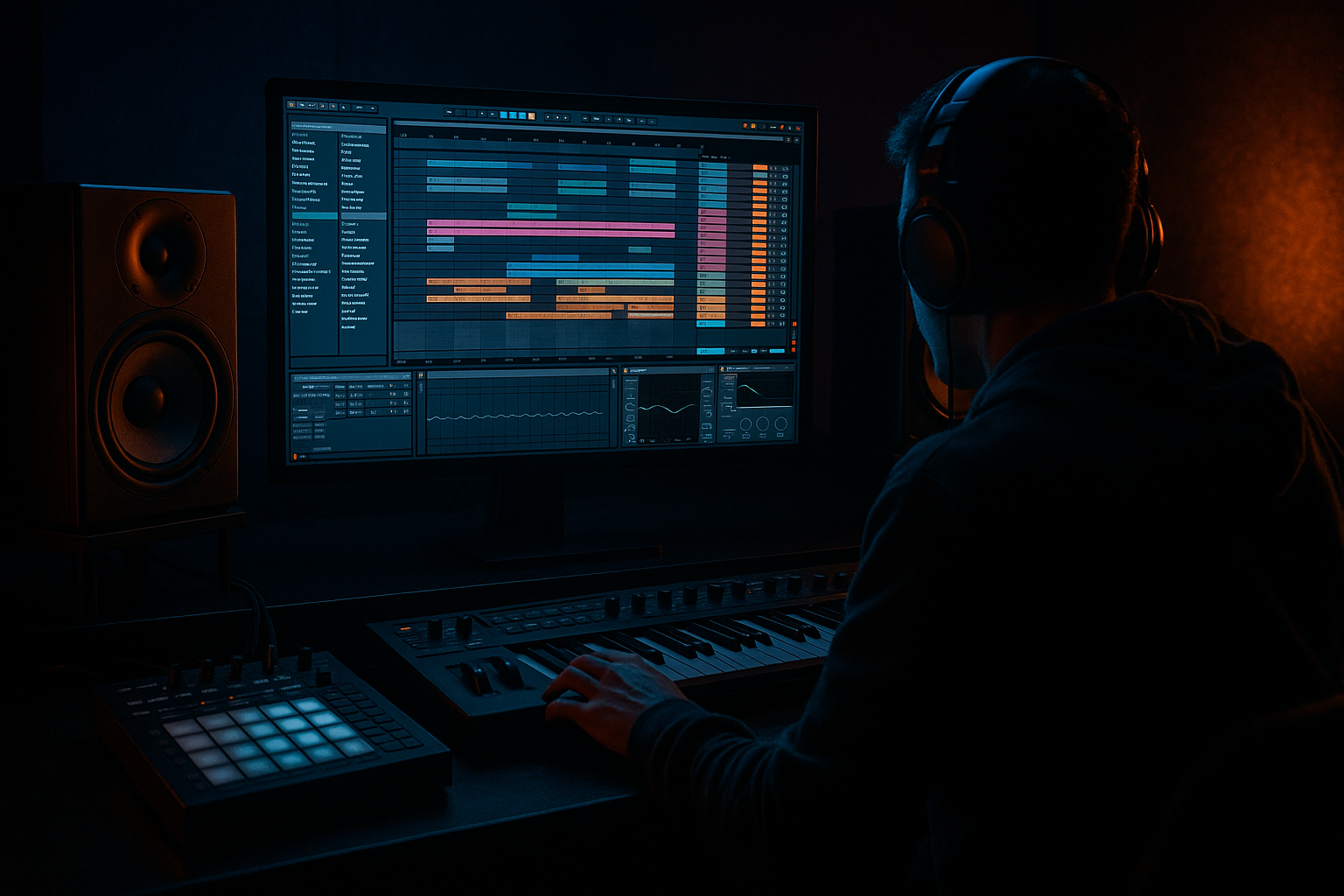
Main tutorial
Micro-fill design (Resampling only) — Advanced DnB Drums in Ableton Live 🥁⚡
1) Lesson overview
Micro-fills are those tiny 1/16–1/64 bar moments that make rolling DnB feel alive: a ghosted snare drag, a chopped kick flam, a stuttered hat burst, a quick reverse suck into the downbeat.
In this lesson, you’ll design micro-fills using resampling only—meaning: you’ll print audio from your existing drums, then slice, warp, reverse, re-pitch, re-envelope, and re-layer the printed audio to create fills that feel “native” to your groove.
Why resampling?
Because it gives you:
- coherent tone (it’s literally your kit) ✅
- happy accidents (warp artifacts, micro clicks, transient smears) ✅
- speed (print → slice → place) ✅
- mix control (fills as audio, easy gain/envelope) ✅
- 1/16–1/32 stutter fill before the snare (classic roller energy)
- reverse “suck” into the downbeat (jungle/DnB tension)
- tape-stop/repitch blip using warp + resample
- a fill lane in Arrangement that you can copy across your track
- Micro fill “lead-in”: last 1/8 or 1/16 before the snare/downbeat
- Fill burst: last 1/4 bar before a drop (but keep it tight)
- Overfilling: If every 4 bars has a fill, your roller loses hypnosis. Use restraint.
- Not matching levels: Fills often come out louder—gain-stage them to sit inside the groove.
- Clicking edits: Micro slices need fades. No exceptions.
- Warp artifacts in the wrong place: If the transient gets smeared, change Warp mode (Beats vs Complex Pro) and reprint.
- Fills fighting the snare: If your fill occupies the same transient slot as the main snare, it can weaken impact. Leave space right on the 2/4 hit.
- Print through distortion, then slice: Heavy DnB fills pop when the resample already has grit. Try:
- Use “negative space” fills: Instead of adding hits, remove a kick or hat for 1/16 then slam back in. Print silence as part of the fill.
- Mono the fill lows: Put Utility on the fill lane:
- Dark pull-ins: Auto Filter low-pass closing into the hit (instead of opening) can feel nastier:
- Transient discipline: For heavier rollers, keep the fill’s sharp transient to hats/ghosts, not the main snare transient—let the snare stay king.
- Resampling-only micro-fills keep your fills tonally consistent with your drum bus and make editing fast. ✅
- Core workflow: Print → Slice/Warp/Reverse → Envelope/Filter → Resample → Library → Arrange.
- Focus on tiny durations (1/16–1/8) and phrase points (every 8/16 bars) for authentic rolling DnB movement.
- Clean edits (fades), good gain staging, and protecting the main snare transient are what separates pro fills from messy glitches.
---
2) What you will build
You’ll build a micro-fill toolkit from one 2-bar DnB drum loop:
End result: a set of 8–16 fill clips you can drop at transitions (every 8/16 bars) without sounding like generic MIDI fills.
---
3) Step-by-step walkthrough
A. Prep: make a solid 2-bar drum foundation
1. In Arrangement View, create your main DnB drum groove (2 bars minimum).
- Typical roller grid: Kick on 1, Snare on 2 & 4, ghost snares, tight hats.
2. Group your drum tracks into one group: `DRUM BUS` (Cmd/Ctrl+G).
3. On the DRUM BUS, keep your processing as you want it in the track (because we’re resampling the real tone). A solid starting chain:
- EQ Eight: HP around 25–35 Hz (gentle), tiny dip 250–400 Hz if boxy
- Glue Compressor: 1–2 dB GR, Attack 3 ms, Release Auto, Soft Clip ON
- Saturator: Soft Clip ON, Drive 1–4 dB (taste)
- (Optional) Drum Buss: Drive 5–15%, Crunch 0–10%, Boom off unless needed
Tip: Micro-fills sound best when printed from a slightly “finished” bus. 🎛️
---
B. Resampling setup (the clean way)
We’ll print fills to audio without exporting.
Method 1 (recommended): Resample track
1. Create a new audio track: `FILL PRINT`.
2. Set Audio From to Resampling.
3. Arm `FILL PRINT`.
4. Turn Monitor to Off (to avoid doubling your master signal).
5. Loop a section that includes the moment you want fills from (e.g., 4–8 bars of drums).
6. Hit record and capture a clean pass of your drums.
You now have an audio file that matches your drum bus tone exactly.
Housekeeping: Consolidate the printed region (Cmd/Ctrl+J) into a neat clip named `DRUMBUS_PRINT_174BPM_2BAR`.
---
C. Slice the resample into micro-fill material
1. Duplicate the resampled clip 3–4 times on new lanes:
- `FILL_STUTTER`
- `FILL_REVERSE`
- `FILL_REPITCH`
- `FILL_GLITCH`
2. For each lane, Crop Clip so you’re only working on the last 1/2 bar → 1/16 bar before a phrase point (e.g., bar 9 going into bar 9.1).
DnB timing targets:
---
D. Fill 1: 1/16–1/32 stutter (rolling energy) 🔁
Goal: a quick machine-gun repeat from your own hats/snares.
1. On `FILL_STUTTER`, open the clip view and enable Warp.
2. Set Warp Mode:
- Beats mode, Preserve: Transients
- Transient Loop Mode: Forward
- Start with Envelope: 30–60 (higher = tighter, clickier repeats)
3. Highlight a tiny region that includes a pleasing transient (often a hat tick or ghost snare).
4. Create the stutter:
- Duplicate that region to 1/16 notes (or 1/32 for intensity).
- Use the Loop brace in clip view to define a super short loop (e.g., 1/16).
5. Commit the stutter (still “resampling only”):
- Resample this lane to another audio track (or record the output again into `FILL PRINT`).
6. Add tight fade shaping:
- In the audio clip, create tiny fades to avoid clicks.
- Optional: Utility gain automation to ramp up the stutter into the hit.
Arrangement idea: Use this fill 1 bar before a drop, but only for the last 1/8 so it doesn’t feel gimmicky.
---
E. Fill 2: Reverse “suck” into the downbeat 🌀
This is classic: reverse a snare/hit tail to pull into the next bar.
1. On `FILL_REVERSE`, isolate a strong transient (snare or crash moment).
2. Right-click the clip → Reverse.
3. Warp settings:
- Try Complex Pro if it’s a dense chunk, or Beats if it’s mostly drums.
4. Place the reversed audio so the end of the reversed clip lands exactly on the downbeat (bar line).
5. Shape it:
- Use clip gain envelope (or track automation) to create a smooth crescendo.
- Add Auto Filter (stock):
- HP filter, Freq 150 → 2k rising into the hit
- Resonance 0.7–1.2 for bite
6. Resample the result to a clean audio clip (print it).
Now you have a reusable reverse pull with consistent length and level.
DnB placement: Great at end of 8/16 bar phrases, especially before a switch or second drop.
---
F. Fill 3: Re-pitch / time-bend blip (warp + resample) 🎚️
This gives that “tape speed” micro moment without plugins.
1. On `FILL_REPITCH`, choose a 1/8–1/4 bar chunk (like the last kick+snare+hat moment).
2. Enable Warp and set mode to Tones (for interesting artifacts) or Complex Pro (smoother).
3. Create pitch motion:
- In Clip View, use Transpose automation via clip envelopes:
- Clip → Envelopes → Clip → Transposition
- Draw a quick ramp: 0 → -12 semitones over the last 1/8 bar
4. Time-bend feel:
- Add a few warp markers and slightly compress time just before the hit (don’t overdo).
5. Resample the processed audio to commit it.
6. Tighten with Limiter (stock) just for safety:
- Ceiling -0.3 dB, small gain if needed
Sound goal: A subtle “falling into the snare” that feels like momentum, not a gimmick.
---
G. Fill 4: Jungle-style micro-chop from your own break print ✂️
Even if you aren’t using a classic Amen, you can get jungle energy via micro-slices.
1. Take `DRUMBUS_PRINT` and duplicate it to `FILL_GLITCH`.
2. Find a moment with multiple transients (hat → ghost → snare tail).
3. Cut 3–6 tiny slices (Cmd/Ctrl+E) at 1/16 or even 1/32 boundaries.
4. Rearrange:
- Swap two slices
- Repeat one slice 2–3 times
- Reverse just one slice (not the whole fill)
5. Fade every slice edge quickly (tiny fades prevent clicks).
6. Resample the result so it becomes one clean “fill file.”
Arrangement tip: Use these micro-chops sparingly in rollers—e.g., one fill every 16 bars, then alternate with subtler fills.
---
H. Build a reusable “Fill Library” lane
1. Consolidate each finished fill into 1-beat or 1/2-beat clips.
2. Name clearly:
- `FILL_01_STUT_1-8`
- `FILL_02_REV_SNARE_1-4`
- `FILL_03_REPITCH_-12_1-8`
3. Drag them into your User Library (or a project folder).
4. In your main arrangement:
- Create a track called `FILL LANE`
- Drop fills at phrase points (bars 9, 17, 33, 49 etc.)
This gives you “arrangement speed” like a pro: pick a fill, place, done. ✅
---
4) Common mistakes
---
5) Pro tips for darker/heavier DnB 🖤
- Saturator (Soft Clip ON) → Drum Buss (Crunch 5–15%) → print → chop.
- Bass Mono 120–200 Hz
- Width 70–100% depending on mix
- LP 8–12 kHz → 1–2 kHz, res ~1.0, then snap open on the downbeat.
---
6) Mini practice exercise (15–25 min) 🎯
At 174 BPM, using only your current drum loop and resampling:
1. Print 8 bars of your DRUM BUS into `FILL PRINT`.
2. Create 5 different micro-fills, each max 1/8 bar long:
- 2x stutters (different source transient)
- 1x reverse pull
- 1x repitch dip (-7 or -12)
- 1x micro-chop rearrangement
3. Place them into an 32-bar arrangement:
- Fill at bar 8, 16, 24, 31.4 (last half-beat before 32)
4. Rule: You must resample/commit each fill to a clean clip before placing (no “live” warp tricks left running).
Deliverable: one “fill lane” track with 5 consolidated clips + placement across the arrangement.
---
7) Recap
If you want, tell me your sub-genre (liquid, neuro, jump-up, jungle) and whether you’re using a break or 2-step kit—I can suggest 10 fill “recipes” that match that vibe exactly.

