Main tutorial
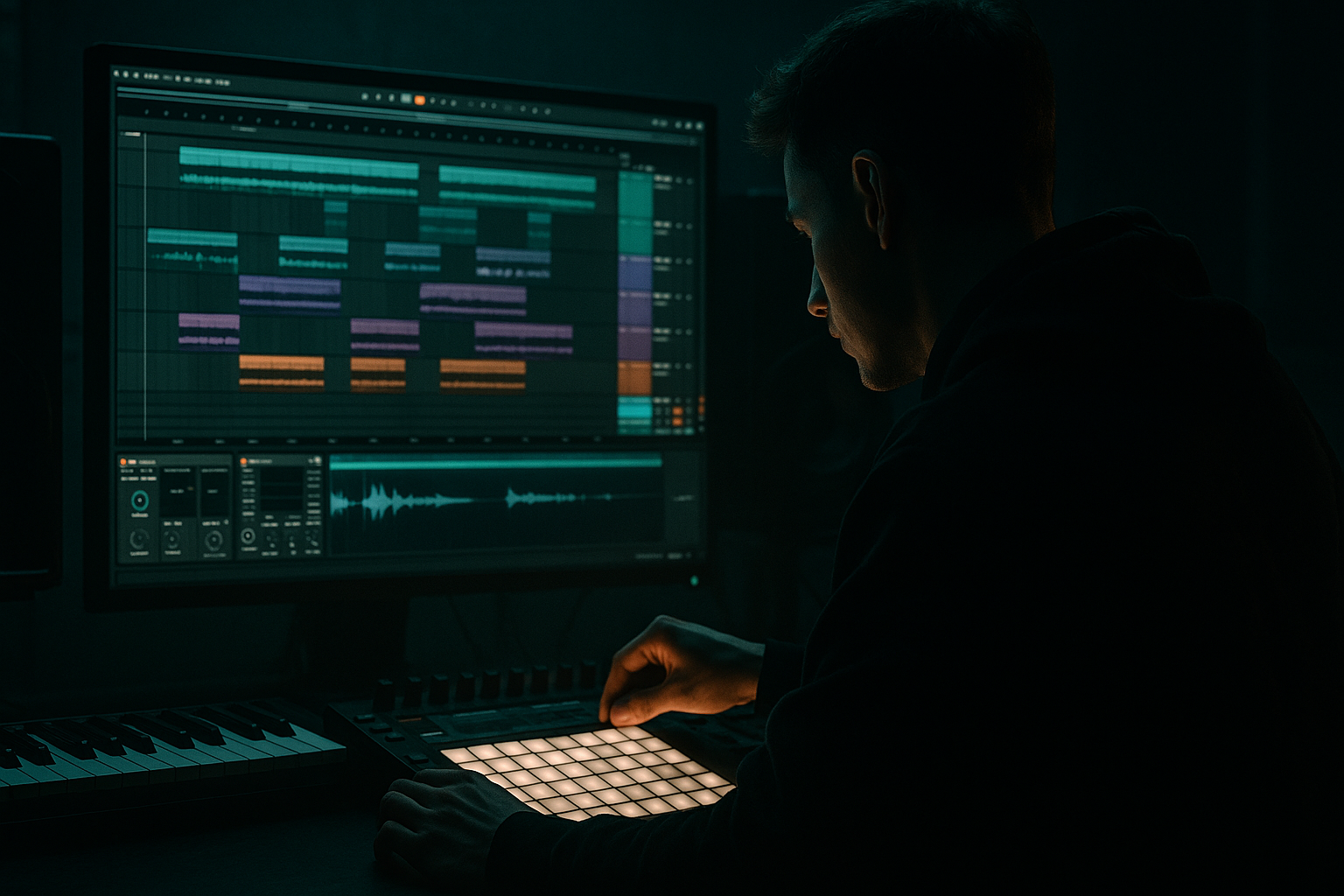
Micro Loop Fills from Break Fragments (DnB in Ableton Live) 🥁🔁
1. Lesson overview
Micro loop fills are those tight, rhythmic “stutter” moments you hear in jungle and rolling DnB—often built from tiny slices of a break (1/16–1/4 bar) that repeat, pitch, or get filtered for tension, then drop back into the groove.
In this lesson you’ll learn a beginner-friendly Ableton workflow to:
- Chop a breakbeat into usable fragments
- Turn fragments into micro loops (1/16, 1/8, 1/4)
- Create fills that sound intentional (not random)
- Control timing and vibe (swing, grit, darkness)
- A Drum Rack loaded with break slices (kick/snare/ghosts/textures)
- 3–5 micro loop fill patterns you can drop into any 16-bar DnB phrase
- A simple fill bus chain (EQ → saturation → glue → limiter) for controlled punch
- Optional resampling workflow to commit fills to audio for extra grit
- Snare hits (strong transient, classic DnB crack)
- Ghost notes (quiet little ticks and shuffles)
- Hat textures (grainy top loops)
- Short “air” bits (room, vinyl, tail)
- “SNARE 1”, “GHOST”, “HAT”, “TAIL”, etc.
- Go to the last 1/2 bar of your phrase.
- Add repeated notes on a snare slice at 1/8 or 1/16 grid.
- Turn on Fixed Grid
- Start with 1/16
- Use Note Length = 1/32–1/16 (short notes often sound cleaner)
- Vary velocity: 120, 95, 110, 85…
- Remove one hit occasionally to create a “catch” moment
- Micro loop for 1/2 bar, then hard cut back to the full break on the drop. Instant tension.
- Every 8 bars: last 1/2 bar gets a micro loop fill
- Every 16 bars: a bigger fill (1 bar), then drop to full beat
- Before a drop: 1/4 bar stutter + filter down + reverb throw on final snare
- Call-and-response: bar 2 and bar 4 have different micro loops to keep interest
- High-pass fills harder than you think:
- Use subtle pitch drops for menace:
- Add controlled distortion, not fizz:
- Gate the room tone for that tight, aggressive chop:
- Parallel smash (DnB classic):
- Slice your warped break using Slice to New MIDI Track → Transients
- Choose a few strong slices (snare/ghost/hat/tail)
- Build micro loops with tight MIDI repeats or Loop Selection on audio
- Use a clean stock chain: EQ Eight → Drum Buss → Saturator → Glue → Limiter
- Automate filter + small reverb throws for tension
- Resample fills for authentic jungle-style “printed” edits
---
2. What you will build
By the end, you’ll have:
---
3. Step-by-step walkthrough
Step 0 — Project setup (fast + DnB-ready) ⚙️
1. Set tempo to 172–175 BPM.
2. In Preferences → Record/Warp/Launch:
- Auto-Warp Long Samples: Off (optional but helps avoid weird warps)
3. Create tracks:
- Audio Track: “Break Source”
- MIDI Track: “Break Rack”
- Audio Track: “Fill Print” (for resampling later)
---
Step 1 — Load a break and warp it correctly
1. Drag a classic break (Amen, Think, Funky Drummer, etc.) onto Break Source.
2. Double-click the clip to open Clip View.
3. Turn Warp: On.
4. Set Warp Mode: Beats.
- Preserve: try 1/16 (tight) or 1/8 (slightly looser)
- Enable Transient Loop Mode if available (Live versions differ)
5. Find the first clean downbeat and right-click → Set 1.1.1 Here.
6. Right-click again → Warp From Here (Straight).
7. Loop a clean section (often 1 bar or 2 bars).
Goal: Your break should loop perfectly in time without flammy timing.
---
Step 2 — Slice the break to a Drum Rack (the core technique)
1. Right-click the warped break clip in Session/Arrangement.
2. Choose Slice to New MIDI Track.
3. Settings:
- Slicing Preset: Built-in → Slice to Drum Rack
- Slice By: Transient (best for breaks)
- If transients are messy, try 1/16 as a fallback
4. Ableton creates a new MIDI track with a Drum Rack full of slices.
Now you can “play” break fragments like one-shots. This is the foundation for micro fills.
---
Step 3 — Identify the best “fill slices”
Open the Drum Rack and audition pads. You’re looking for:
Workflow tip:
Rename a few key pads:
It speeds you up massively later.
---
Step 4 — Build your first micro loop fill (1/8 or 1/16 stutter) 🔁
1. Create a 1-bar MIDI clip on “Break Rack”.
2. Program your normal beat first (optional), or just focus on the fill area.
3. Pick a fill location: classic DnB placement is the last half-beat of bar 4, or the last bar of an 8/16 bar phrase.
Example: 1/8 snare stutter into drop
Settings to make it tight:
Make it musical (not robotic):
---
Step 5 — Create micro loops using clip looping (super fast method) ⏱️
This is the “edit like jungle” trick.
1. Duplicate your break audio clip (or resample a bar of your rack—later).
2. In Arrangement, select a tiny region, like:
- 1/16 note (very glitchy)
- 1/8 note (classic stutter)
- 1/4 note (roll feel)
3. Press Cmd/Ctrl + L to Loop Selection.
4. Drag the loop braces to repeat it for 1/4–1 bar, then drop back to the full groove.
Pro placement idea:
---
Step 6 — Make the fill “DnB” with a simple stock device chain 🧰
Put this chain on the Break Rack track (or on a group/bus for fills only).
#### Device Chain (stock Ableton)
1. EQ Eight
- High-pass at 30–40 Hz (get rid of rumble)
- Optional: small dip around 250–400 Hz if boxy
- Optional: tiny lift at 7–10 kHz for snap/air
2. Drum Buss
- Drive: 5–15% (go gentle first)
- Crunch: 0–10% (adds edge)
- Boom: Off (usually better left to your kick/sub)
- Damp: adjust if it gets fizzy
3. Saturator
- Mode: Analog Clip
- Drive: 1–4 dB
- Soft Clip: On
- This thickens slices and makes the loop feel “printed”.
4. Glue Compressor
- Attack: 3 ms
- Release: Auto
- Ratio: 2:1
- Aim for 1–3 dB of gain reduction on the loudest fill moments.
5. Limiter (safety)
- Ceiling: -0.3 dB
- Only catching peaks—not smashing.
Workflow suggestion:
If the chain is too heavy, remove one device—don’t fight the mix.
---
Step 7 — Add movement: filter + reverb throws (classic fill vibe) 🌪️
To make the fill feel like it “lifts” into the next section:
1. Add Auto Filter
- Mode: Lowpass
- Frequency: automate from 6–10 kHz down to 1–3 kHz, then snap back open
- Add a touch of Resonance (10–20%) for tension
2. Add Reverb (subtle!)
- Decay: 0.8–1.5 s
- Pre-delay: 10–25 ms
- High Cut: 6–10 kHz
- Keep Dry/Wet low: 5–12%
3. Automate Reverb Dry/Wet up only during the last hit or two of the fill.
This is a jungle staple: dry drums, then a quick space splash, then back to dry.
---
Step 8 — Resample your fill for gritty “printed” energy (optional but 🔥)
Resampling makes fills sound like audio edits—very authentic for DnB/jungle.
1. Create a new audio track: Fill Print
2. Set its input to Resampling
3. Arm it and record your fill section
4. Now edit the audio:
- Reverse a tiny slice (right-click → Reverse)
- Fade in/out for click-free cuts
- Add Redux lightly for crunch:
- Downsample: 2–6
- Bit depth: keep near 12–16 (subtle)
---
Step 9 — Arrangement ideas (where to put fills) 🧱
Try these placements in a rolling DnB arrangement:
---
4. Common mistakes (and how to fix them)
1. Timing feels sloppy
- Fix: Re-warp the source break carefully; keep Warp Mode on Beats
- Check transients and ensure 1.1.1 is correct
2. Fills are too loud / destroy the groove
- Fix: Turn down velocities and clip gain
- Use Glue Compressor lightly + Limiter as safety
3. Too many random slices
- Fix: Commit to 2–4 “character” slices (snare + ghost + hat + tail)
- Simpler patterns hit harder in DnB
4. Clicks/pops when looping tiny audio
- Fix: Add tiny fades in Arrangement
- Choose loop points at zero crossings, or use slightly longer fragments (1/8 instead of 1/16)
5. Fill fights the kick/sub
- Fix: EQ Eight high-pass at 80–120 Hz on the fill only (especially if the break has low-end)
---
5. Pro tips for darker/heavier DnB 🖤
For dark rollers, let the sub own the low-end. HP fills at 100–150 Hz can sound cleaner and heavier overall.
On a resampled fill, automate Transpose -1 to -3 semitones over the last 1/4 bar.
Use Saturator (Analog Clip) + EQ after it. If it gets harsh, dip 8–12 kHz slightly.
Add Gate after saturation:
- Threshold: adjust until tails tighten
- Release: 50–120 ms
Great for “clipped” jungle edits.
- Group your breaks
- Add a return chain: Drum Buss (hard) → Glue (4:1) → EQ Eight
- Blend low (5–20%). Instant weight.
---
6. Mini practice exercise (10–15 minutes) 🎯
1. Pick a 1-bar break loop and Slice to Drum Rack.
2. Create a 16-bar drum arrangement with a simple rolling pattern.
3. Make 3 different micro fills, each used once:
- Fill A: 1/16 snare stutter (last 1/2 bar of bar 8)
- Fill B: 1/8 hat micro loop (last 1/4 bar of bar 12)
- Fill C: resampled audio loop + lowpass sweep (last bar into bar 17)
4. Keep your fills quieter than your main backbeat, but still exciting.
5. Export a quick bounce and listen on low volume—do the fills still read? If yes, you nailed it.
---
7. Recap ✅
If you want, tell me what break you’re using (Amen/Think/etc.) and your sub style (roller vs dancefloor), and I’ll suggest 5 specific micro fill patterns that fit it.

