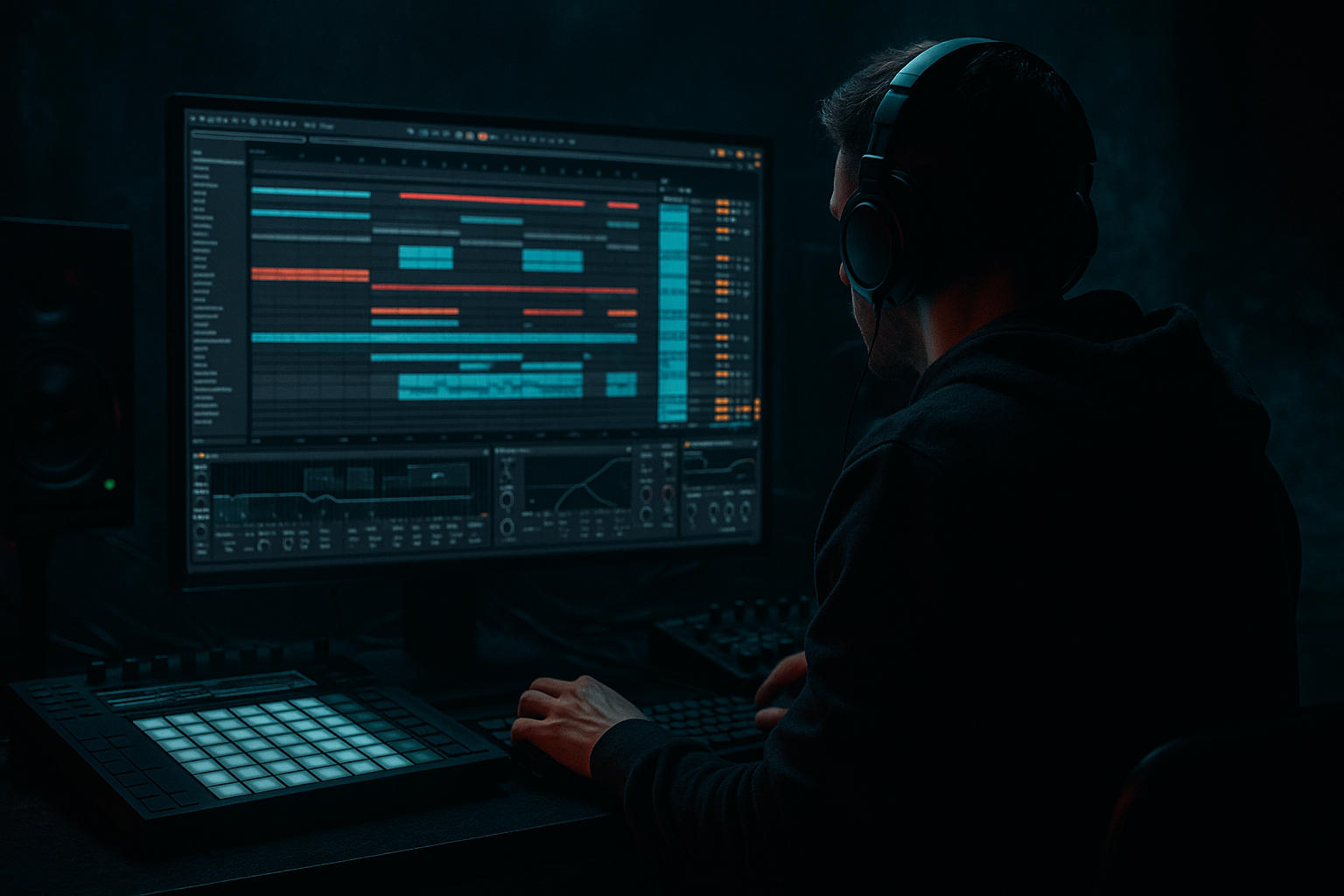
Main tutorial
Micro-sampling Drum Ghosts: for Smoky Late‑Night Moods (DnB in Ableton Live) 🌙🥁
Skill level: Advanced • Category: Sampling
---
1) Lesson overview
“Drum ghosts” are the tiny, almost subconscious fragments of drums—micro hits, air, stick noise, room tails, vinyl ticks, filtered breaks—layered quietly around your main groove. In late-night liquid/rollers or darker jungle, they create depth, swing, and atmosphere without adding obvious new parts.
In this lesson you’ll use micro-sampling + resampling inside Ableton Live to build a ghost layer that:
- breathes between kicks/snares
- emphasizes the shuffle of your hats
- adds smoky texture behind the break
- stays out of the way of the bass and snare
- Micro-sliced break artifacts (5–50 ms slices)
- Filtered tail ghosts (room + tone, no transient)
- Reverse ghosts for inhale/exhale movement
- Vinyl/air grains for midnight haze
- A tight processing chain with EQ Eight, Auto Filter, Saturator, Drum Buss, Utility, Gate, and optional Hybrid Reverb
- A dusty break (Amen-ish, Think, Funky Drummer, tight DnB break edits)
- A clean modern drum loop you already use (for coherent tone)
- Optional: foley (cloth movement, lighter flicks, subway air) for smoke
- Put micro ghosts on:
- Use velocities 15–45. Think “nervous system,” not “drum part.”
- Auto Filter
- Saturator
- Utility
- On the Ghost track, use Track Delay: -5 to -15 ms
- Intro (0:00–0:45): ghosts + atmos + distant break tails (no main drums yet)
- Pre-drop (last 8 bars): increase ghost density (more reverse ghosts, slightly higher reverb)
- Drop A: ghosts minimal but consistent (support groove, don’t clutter)
- Drop B / variation: swap to a different ghost kit (more crunch, different slices)
- Breakdown: bring ghosts forward (automate Utility gain +2 dB, open LP filter)
- Auto Filter LP on Ghost group: 6 kHz → 12 kHz over 16 bars
- Reverb Mix: 6% → 12% in breakdown, back down in drop
- Drum Buss Drive: +1 to +3 in heavier sections
- Ghosts are too loud. If you can “identify the sample,” it’s not a ghost—turn it down.
- Too much low-mid. 200–600 Hz builds mud fast under reese/sub + snare body.
- Transient overlap with snare. Ghosts should sit around the snare, not compete at 2–4 kHz.
- Random timing with no groove intent. Micro-samples need purposeful swing; otherwise it’s clutter.
- Over-reverb. Late-night ≠ washed-out. Keep space short and filtered.
- Make a “Noise Ghost” layer: resample 1 bar of ghosts, then:
- Use erosion carefully (stock device):
- Mono-check constantly. Ghost width is nice, but if it vanishes in mono, rebalance with Utility/EQ.
- Make ghosts “answer” the bass rhythm. If your bass has a 1/8 or 1/16 gate, place ghosts in the holes.
- Resample + re-slice (advanced workflow):
- Micro-sampling drum ghosts = tiny slices + tails + reverse breaths that support the main break.
- Keep them short, filtered, quiet, and sidechained so they live in the gaps.
- Use Ableton stock tools (Simpler, Drum Rack, EQ Eight, Auto Filter, Saturator, Drum Buss, Hybrid Reverb, Compressor, Utility) to sculpt a cohesive smoky layer.
- Treat ghosts as groove atmosphere and as an arrangement lever—more in intros/breakdowns, tighter in drops.
---
2) What you will build
You’ll end up with a reusable “Ghost Drum Rack” that includes:
All synced to a rolling DnB grid (170–176 BPM) and arranged as an A/B layer under your main drums.
---
3) Step-by-step walkthrough
Step 0 — Session setup (so the ghosts behave)
1. Set tempo to 174 BPM (classic roller sweet spot).
2. Create groups:
- DRUMS (MAIN)
- DRUMS (GHOSTS)
- BASS
3. On DRUMS (GHOSTS) group, add:
- Utility: set Width = 80–110% (slightly wide, not huge)
- EQ Eight (we’ll refine later)
4. Keep the ghosts quiet by design: aim for -18 to -24 dB RMS-ish in context. They should be felt, not “heard as a part.”
---
Step 1 — Pick a source to steal ghosts from (breaks + your own drums)
You want material with interesting micro-information:
In Ableton:
1. Drag a break loop to an audio track: BREAK SOURCE.
2. Warp mode:
- For authentic texture: Complex Pro (Formants ~0–20)
- For sharper micro slices: Beats (Preserve = Transients, Envelope 10–30)
3. Right-click clip → Slice to New MIDI Track…
- Slicing preset: Transient
- Create: Drum Rack
- This gives you fast access to micro bits.
---
Step 2 — Build “micro-slices” (5–50 ms) that don’t step on your snare
This is the core technique: grab microscopic pieces that imply motion.
1. Open the sliced Drum Rack. Pick 6–12 pads with:
- hat edges
- snare “air” after the crack
- little kick pre-clicks
- room tone between hits
2. For each chosen pad:
- In Simpler (Slice mode), switch to One-Shot
- Set Start a few ms after the transient (avoid the main crack)
- Set Length short: 10–40 ms
(You want grains, not full hits.)
- Add a fast envelope:
- Attack: 0.0–1.0 ms
- Decay: 40–120 ms
- Sustain: -inf (or 0 with short decay)
- Release: 10–40 ms
DnB placement idea (MIDI):
- 1e / 1a (between kick and snare)
- 2a / 3e (support the roll)
- just before snare on 2 and 4 (like a breath-in)
---
Step 3 — Create “tail ghosts” (room-only, no transient) for smoke
Now we extract only the afterglow.
1. Duplicate BREAK SOURCE audio clip to a new track: TAIL EXTRACT.
2. On the clip:
- Warp: Complex Pro
- Zoom in on a snare hit.
- Move clip start so it begins 20–60 ms after the transient (pure tail)
- Consolidate (Cmd/Ctrl+J) into short tail samples (100–300 ms)
3. Drag these tails into a new Drum Rack (or add to your Ghost Rack).
Processing per tail pad (inside the chain):
- HP: 200–400 Hz (remove low junk)
- LP: 6–10 kHz (soften brightness)
- Resonance: 0.5–1.5 (gentle tone)
- Drive: 1–4 dB
- Soft Clip: On
- Gain: trim so it’s subtle
- Optional: Width 120–160% only on tails
This makes a “room glue” that sits behind your break like cigarette haze.
---
Step 4 — Reverse ghosts (micro “inhales” into snares) 😮💨
Classic for late-night tension without big risers.
1. Take one tail sample (or hat grain).
2. Duplicate it, then Reverse (clip reverse or in Simpler by reversing the sample).
3. Envelope shape:
- Attack: 10–30 ms
- Decay: 80–200 ms
- Release: 20–60 ms
4. Place it 20–60 ms before your main snare (or exactly on the grid but with track delay).
Timing trick:
(makes ghosts feel like they “pull” into the transient)
---
Step 5 — Build the Ghost Bus chain (group processing that makes it cohesive)
On DRUMS (GHOSTS) group, use this stock chain (in order):
1. EQ Eight (cleanup first)
- HP @ 200–350 Hz, 24 dB/oct
- Gentle dip if needed:
- 300–600 Hz: -1 to -3 dB (mud)
- 2–4 kHz: -1 to -2 dB (snare presence zone)
2. Gate (optional, for tightness)
- Threshold: set so it closes between phrases
- Return: keep natural; don’t chop too hard
3. Drum Buss
- Drive: 2–8
- Crunch: 0–10 (low or off for liquid, higher for dark techy)
- Boom: 0 (usually; don’t add low-end)
- Transients: -5 to -20 (soften so they stay ghostly)
4. Saturator (glue)
- Drive: 1–3 dB
- Soft Clip: On
5. Hybrid Reverb (very subtle space)
- Algorithmic or Convolution “Room/Studio”
- Decay: 0.4–1.2 s
- Predelay: 0–15 ms
- High Cut: 6–9 kHz
- Mix: 5–12%
6. Utility
- Gain: final trim
- Bass Mono: On (if you kept any lows—ideally you didn’t)
Goal: ghosts feel like one misty layer, not a bunch of random samples.
---
Step 6 — Sidechain the ghosts from the snare and kick (keep the drop clean)
You want the ghosts to disappear exactly when the main hits land.
1. Add Compressor on DRUMS (GHOSTS) group.
2. Enable Sidechain:
- Input: your Kick+Snare bus (or a dedicated “SC Trigger” track)
3. Settings:
- Ratio: 3:1 to 6:1
- Attack: 0.3–3 ms
- Release: 40–120 ms (match groove)
- Threshold: pull until you see 2–6 dB gain reduction on hits
This keeps impact while maintaining the smokiness between hits.
---
Step 7 — Arrangement: where ghosts live in a DnB track
Use ghosts as an arrangement tool, not just sound design.
Ideas rooted in DnB/jungle structure:
Automation moves (simple but effective):
---
4) Common mistakes
---
5) Pro tips for darker/heavier DnB 🖤
- Warp Texture mode, Grain Size 20–40, Flux 10–25
- Low-pass to 5–8 kHz
- Sidechain hard from snare
This adds sinister motion without new drums.
- Mode: Noise
- Freq: 3–8 kHz
- Amount: 0.2–1.5
Great for gritty air on hats, but keep it subtle.
1. Solo Ghost group → Resample 2–4 bars to audio
2. Slice that recording to Drum Rack
3. Now you’re sampling your own micro-groove (super cohesive)
---
6) Mini practice exercise (15 minutes) ⏱️
1. Load a break, slice to Drum Rack.
2. Pick 8 slices and set them to:
- Start offset after transient
- Length 10–40 ms
- Short decay envelope
3. Program a 2-bar roller pattern:
- Place 6–12 ghost hits between kick/snare
- Velocity range 15–45
4. On Ghost group:
- EQ Eight HP 250 Hz
- Drum Buss Transients -10
- Compressor sidechained from kick+snare (aim 3–5 dB GR)
5. Bounce (resample) 2 bars of ghosts and A/B:
- With ghosts
- Without ghosts
If the groove feels less “alive” without them, you nailed it.
---
7) Recap
If you want, describe your current main drum pattern (kick/snare placement + break type), and I’ll suggest exact ghost placements and a Rack macro mapping tailored to your groove.

