Main tutorial
Lesson overview 🎯
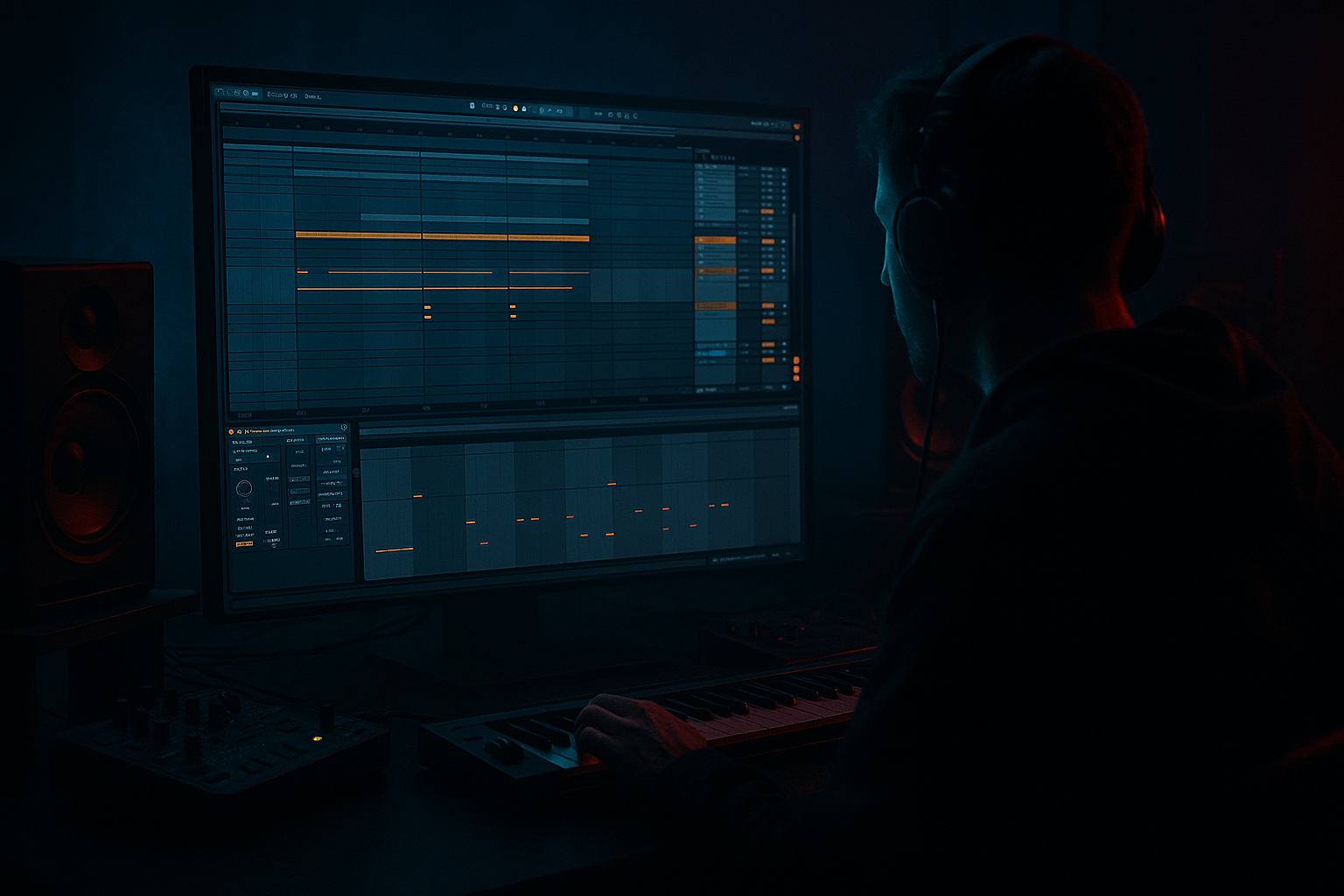
This lesson teaches you how to create convincing microtiming "ghost" snares for drum & bass in Ableton Live. We'll cover precise MIDI nudging, using Ableton's Groove Pool, smart device chains for ghost snares, and practical arrangement tips to get your drums rolling and alive without sounding mechanical. This is aimed at beginners but contains real, actionable settings and workflows you can use immediately.
Tempo context: drum & bass — 170–175 BPM (examples will use 174 BPM).
What you will build 🛠️
A tight DnB drum loop (4 bars) with:
- Punchy main snares on beats 2 and 4
- Several quieter ghost snares around each main snare with purposeful microtiming (early and late)
- A Drum Rack chain for main and ghost snare layers, with stock Ableton devices (Simpler/Drum Rack, EQ Eight, Saturator, Reverb, Compressor, Utility)
- Applied groove (Groove Pool) for humanized timing
- Ghosts too loud: If they compete with the main snare, reduce velocity or lower the chain gain (-6 to -12 dB).
- Over-quantizing: Applying heavy quantize kills groove. Use small Timing % in Groove Pool or nudge manually by 1/64 increments.
- Using identical processing for main and ghost: ghosts should be tonally different (darker, mono, small reverb).
- Phase cancellation with layers: if duplicates are out of phase, flip phase or slightly shift start point in Simpler. Check in mono.
- Too many ghosts: cluttering the rhythm makes the mix muddy. Use sparse, intentional ghosts — less is often more.
- Large ms shifts: shifts over ~60 ms start sounding like separate hits rather than microtiming. Keep offsets in the 10–50 ms range for subtle feel.
- Mono the ghosts: Use Utility Width 0% on ghost chain so the low-mid stays centered, while the main snare can be slightly wider.
- Saturate & compress in parallel: Send snare (and ghosts) to a return with Saturator + Glue Compressor. Blend for weight without smearing transient detail.
- Low-frequency clash: Always high-pass ghosts at 200–300 Hz to leave the subspace for bass.
- Crunch for aggression: Add Redux or Overdrive on a parallel bus; clip it gently and blend at 10–20% for aggression without ruining clarity.
- Shaping attack: Use Transient Shaper (if in your Live version) or use a fast Compressor with sidechain from the snare to tame/shape the attack of the ghost chain.
- Pitch and decay: Pitch ghost snares down a semitone or two and shorten their decay to give low harmonic movement without competing with the main hit.
- Use short gated reverb: For darker DnB fills, send ghosts to a short reverb and then gate it (Gate audio effect) to create a sucked, industrial tail.
- Automation for weight: Automate Drum Buss Drive or Glue Compressor Threshold to pump drums during drop sections.
- Ghost snares are low-velocity hits placed very close (10–50 ms) to main snares to add human groove.
- Use fine MIDI grid (1/64 or 1/96) and nudging to place ghosts early (push) or late (laid-back).
- Groove Pool is a powerful way to apply consistent microtiming and randomness across clips.
- Tone ghosts differently: darker, mono, slight saturation, short reverb — and keep them lower in level.
- For heavier DnB, use parallel saturation, gating, sub-friendly EQ, and subtle transient shaping.
Result: a rolling, musical snare groove that sits in a heavy DnB mix.
Step-by-step walkthrough 🚀
Setup
1. Create a new Live Set and set BPM to 174.
2. Insert a Drum Rack on a new MIDI track. Load your favorite snare sample(s) into two pads:
- Pad A: "Main Snare" — a punchy, bright snare (use Simpler in Classic mode if you want sample controls).
- Pad B: "Ghost Snare" — the same snare or a slightly filtered/rounder version for ghost hits.
Building the bare bones loop
3. Create a 4-bar MIDI clip on the Drum Rack track. Set the clip loop to 4 bars.
4. Program the backbone beat (basic DnB backbeat):
- Place main snare MIDI notes on beats 2 and 4 (bar 1: 1.2 and 1.4 in 1/4 phrasing).
- Use a solid kick pattern or breakbeat to taste. Keep it simple for now so we can focus on snares.
Creating ghost snare pattern (manual method — best for learning)
5. Set MIDI grid resolution small:
- Right-click inside the MIDI editor -> Grid -> 1/64 (or 1/96 if you want even finer control). At 174 BPM, a 1/64 note ≈ 21.5 ms — a useful microtiming increment.
6. Add ghost snare notes around each main snare:
- Example pattern (per main snare): place 3 ghost notes before the main snare at 1/64 increments:
- Ghost 1: -2 × 1/64 (≈ -43 ms) — a noticeable push
- Ghost 2: -1 × 1/64 (≈ -21 ms) — subtle push
- Ghost 3: -1 × 1/128 or small offset if you want an ultra-tight feel (or omit)
- Alternatively, place a quieter ghost slightly after the main snare (+1 × 1/64 ≈ +21 ms) for a delayed/slack feel.
7. Velocity shaping:
- Set main snare velocity high (90–127).
- Ghosts low: first ghost 50–70, subsequent ghosts 30–50. This preserves the ghost as "feel" not a full hit.
- Use Ableton’s Velocity MIDI effect to scale and randomize velocities if you want automated control:
- Add MIDI Effect -> Velocity, set Out Hi to 80 (main) and use a separate chain or adjust per note for ghosts.
Microtiming by nudging (precise ms control)
8. For ultra-precise timing, zoom in and nudge notes by single-grid steps. Each 1/64 step at 174 BPM ≈ 21.6 ms — use that as your microtiming unit.
9. Try these quick test settings:
- Early/pushed ghost: -1 to -2 steps of 1/64 (≈ -21 to -43 ms)
- Late/laid-back ghost: +1 to +2 steps of 1/64 (≈ +21 to +43 ms)
10. Listen in context — small changes (10–30 ms) make a big difference. If it sounds mechanical, reduce the offset.
Using Groove Pool (global microtiming & swing)
11. Open Groove Pool (bottom-left icon or Ctrl+G on Windows / Cmd+G? Note: open the Groove tab in the Browser -> drag a groove to the slot).
12. Drag a groove (try “swing” or “MPC grooves” if available) or extract one from a loop: Right-click audio clip -> Extract Groove.
13. Apply groove to your MIDI clip by selecting it in the Groove Pool and setting these parameters:
- Timing: 30–70% (less for subtle)
- Random: 5–15% (adds human jitter)
- Velocity: 10–30% (makes MIDI velocity follow groove)
14. With the groove applied, tweak Timing until the ghosts feel musical. You can “Commit” the groove to MIDI (Apply) if you want to convert it to fixed note offsets (right-click -> Quantize -> Apply Groove) — useful before exporting or freezing.
Designing an Ableton device chain for ghost snares (stock devices)
15. Create separate chains in Drum Rack (or parallel chains on the snare bus):
- Main Snare Chain:
- EQ Eight: high-pass below 120 Hz (remove low rumble), slight boost 2–4 kHz for snap (+2–3 dB)
- Saturator: Drive 2–4, Curve Soft; Dry/Wet 20–30%
- Compressor (or Glue Compressor): Threshold -6 to -12 dB, Ratio 3:1–4:1, Attack 3 ms, Release 100–200 ms
- Ghost Snare Chain:
- EQ Eight: low-pass around 6–8 kHz to tuck brightness (optional), cut below 200–300 Hz to avoid sub clash
- Saturator: Drive 1–3 (gentler), Dry/Wet 15–25%
- Reverb: Ableton Reverb — Size 5–15%, Decay 0.3–0.6 s, High Damping, Dry/Wet 6–10% (short room to create space)
- Utility: Width 0% (make ghosts mono) — often helps keep low-end focused
16. Balance levels: Ghost chain should be -6 to -12 dB under main snare depending on taste. Use clip automation/volume envelopes to shape.
Mix bus and glue
17. Group all drum tracks to a Drum Bus. Add:
- EQ Eight on Drum Bus: gentle low cut at 30–40 Hz, slight cut around 300–500 Hz if it’s muddy.
- Glue Compressor: Threshold -6 to -10 dB, Ratio 2–3:1, Attack 10 ms, Release 200 ms.
- Optional: Drum Buss (if available): Distortion 8–12, Boom 0–6, Dry/Wet 10–20% for grit.
18. Automate ghost level during arrangements: lower during chorus (for punch), raise slightly during fills and transitions.
Arrangement ideas
19. Use ghosts more in verses and pre-drops to build momentum. Pull them back in full drops to leave space for basslines and synth stabs.
20. For fills, double the ghost density (add extra micro-snaps at 1/128 grid) and automate a short reverb send to give the fill air.
21. Create contrast: remove ghost snares for a bar before a drop, then drop them back in — the return feels like momentum.
Common mistakes (and how to fix them) ❌
Pro tips for darker/heavier DnB 🖤🔥
Mini practice exercise 🧩 (15–30 minutes)
1. Set tempo to 174 BPM, create a Drum Rack with a main snare and ghost snare.
2. Program 4-bar loop:
- Main snares on beats 2 & 4.
- Add 2 ghost snares before each main snare at -1 and -2 × 1/64 grid positions.
3. Set velocities: Main = 110, Ghost1 = 60, Ghost2 = 38.
4. Apply a groove from the Groove Pool with Timing = 40%, Random = 8%, Velocity = 20%.
5. Build the device chains:
- Ghost chain: EQ Eight HP @ 250 Hz, Saturator Drive 2, Reverb Decay 0.4s Dry/Wet 8%, Utility Width 0%.
- Main chain: EQ boost 3 kHz +2 dB, Saturator Drive 3, Glue Compressor threshold -8 dB.
6. Mix ghost -8 dB under main snare. Loop and listen while toggling ghosts on/off. Try nudging Ghost1 +21 ms (1/64) forward or back and hear the difference.
7. Export a 4-bar loop as reference and A/B with/without groove applied.
Recap ✅
Go make those snares roll — small timing moves make huge groove improvements. If you want, send me one of your loops and I’ll mark the exact microtiming tweaks to try. 🎧🔥

