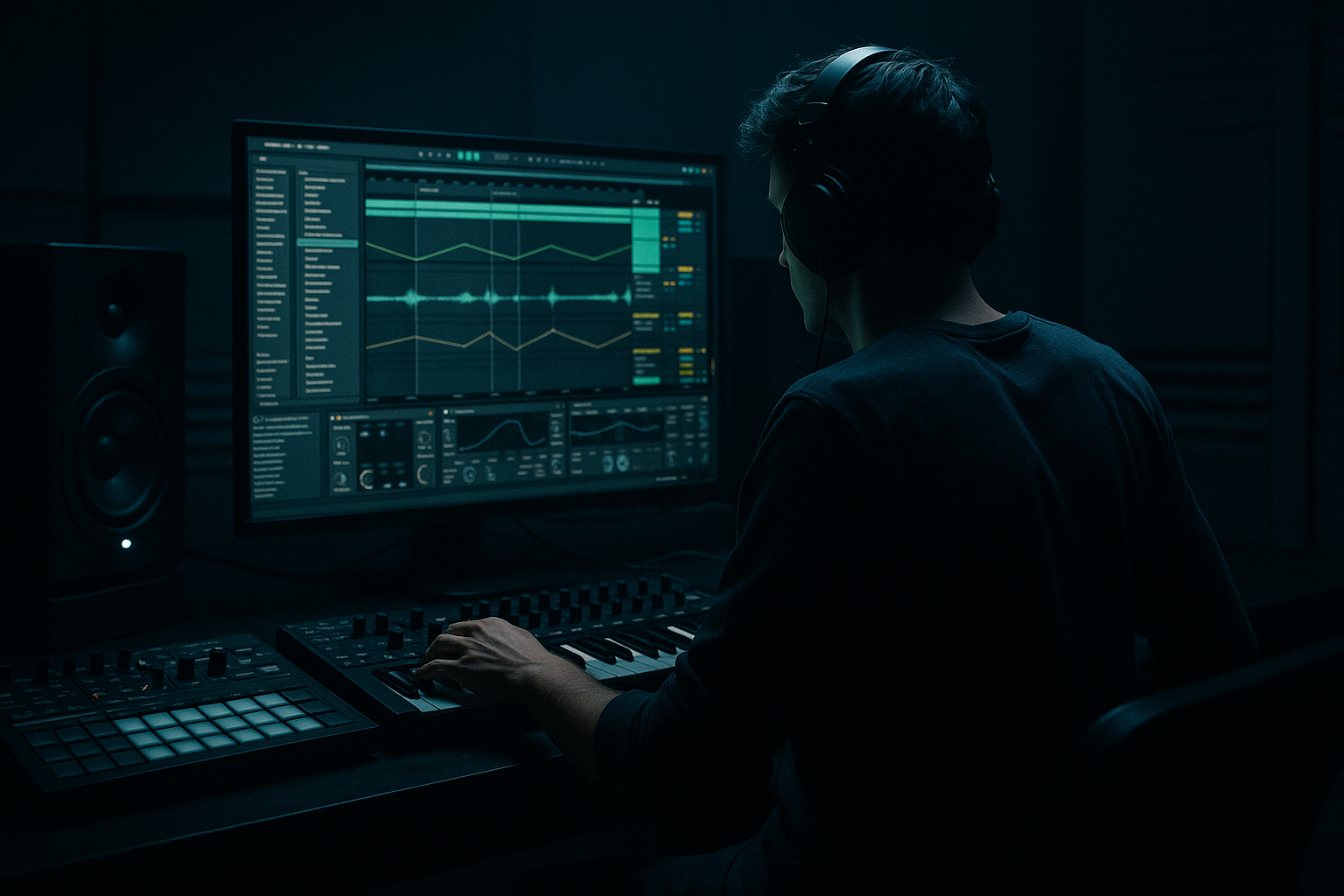
Main tutorial
Mid Bass in Ableton Live 12: Humanize It Using Macro Controls (Oldskool Jungle / DnB Vibes) 🔥🦁
1) Lesson overview
Oldskool jungle and early DnB mid basslines feel alive: tiny timing pushes, note-to-note tone shifts, evolving filter movement, and “performed” distortion. In Ableton Live 12, you can humanize a mid bass by building a Macro-driven performance rack that creates variation without destroying the groove or low-end stability.
This lesson focuses on FX-based humanization (not just MIDI random), using stock Ableton devices and a macro workflow you can play/automate like an instrument.
---
2) What you will build
A reusable “Jungle Mid Bass Humanizer” Audio Effect Rack you can drop on any mid bass channel:
- Macro 1: Push/Pull (micro groove timing feel via delay/phase tricks)
- Macro 2: Bite (distortion drive + pre emphasis)
- Macro 3: Speak (formant-ish movement + resonant filter “talk”)
- Macro 4: Movement (auto-pan/chorus width that stays mono-safe)
- Macro 5: Dirt Type (crossfade between two distortion colors)
- Macro 6: Room/Smear (tiny ambience for “hardware room” vibe)
- Macro 7: Duck (sidechain intensity for rolling bounce)
- Macro 8: Variance (randomized modulation depth for “human” inconsistency)
- Sub stays clean + mono
- Mid is animated + gritty
- You can automate macros per 8/16 bars to get that classic evolving roll.
- Use Frequency Shifter in Fine mode as a micro “phase feel” tool:
- Map Fine to Macro 1:
- Map Frequency Shifter Dry/Wet to Macro 1:
- Saturator
- Map:
- Auto Filter
- Map:
- Chorus-Ensemble
- Map:
- After the rack chain, ensure Utility Width is controlled:
- Chain A: Saturator emphasis (Analog Clip)
- Chain B: Dynamic Tube emphasis (more edge)
- Hybrid Reverb
- Map Dry/Wet: 0% → 12%
- Glue Compressor (sidechain from your drum/break bus)
- Map Glue Threshold to Macro 7 (so you can “more bounce/less bounce”):
- Add LFO and map it to:
- Set LFO:
- Map LFO Amount to Macro 8:
- Bite: low-medium
- Speak: medium (small movement)
- Movement: low
- Duck: medium
- Bite: higher
- Dirt Type: lean Chain B (nastier)
- Room/Smear: almost off
- Variance: low (tight)
- Automate Speak in 2-bar call/response with the snare
- Add small Push/Pull on fills (end of bar 8/16/24)
- Increase Duck slightly (more pump)
- Increase Bite but compensate output to avoid loudness jumps
- Add Movement slightly, but keep Utility Width sane
- Over-randomizing the filter: If Speak or Variance is too deep, the bass stops sounding like a riff and starts sounding like a plugin demo.
- Stereo below ~150 Hz: Don’t widen the low-mids too much. Keep SUB mono; keep MID controlled.
- Too much reverb: Jungle bass “space” is usually tiny and dark. If you hear the tail, it’s probably too much.
- Driving distortion without level-matching: You’ll think it’s better because it’s louder. Map output trims!
- Sidechain too slow: If release is too long, the bass never recovers and the groove feels lazy (unless that’s the intention).
- Pre-emphasis into distortion: Before Saturator, add EQ Eight with a gentle bell at 900 Hz–2 kHz (+2 to +5 dB), then cut that same area slightly after distortion. This makes the grit speak without harshness.
- Multiband dirt (mid-only): Use Multiband Dynamics (or split chains) so distortion hits mostly 200 Hz–2.5 kHz, keeping low-mid punch intact.
- Resonance discipline: Resonant filters can whistle. If it gets sharp, add Limiter or Glue after filter and reduce resonance range.
- Noise layer for tape vibe: Add a super quiet Analog noise (Operator noise oscillator or sample) and sidechain it with the bass—barely audible, but it adds “air”.
- Clip the MID gently: Put Saturator at the end with Soft Clip ON, Drive 1–3 dB to keep peak behavior consistent when macros move.
- Split SUB (clean/mono) and MID (animated) for control.
- Build a Macro-driven FX rack to “play” humanization: Bite, Speak, Movement, Push/Pull, Dirt Type, Room, Duck, Variance.
- Automate macros with arrangement intent (call/response, 8/16-bar evolution).
- Keep the vibe oldskool by staying subtle, mono-safe, and groove-first.
You’ll also set it up so:
---
3) Step-by-step walkthrough
A) Start with a proper mid-bass source (quick but intentional)
You’ll get best results if your “mid” is already separated from sub.
1) Create a bass instrument track (MIDI or Audio).
- If MIDI: use Operator or Wavetable.
2) Make a two-band bass structure:
- Duplicate the track, name:
- SUB (clean)
- MID (movement)
- On SUB: add EQ Eight
- Low-pass around 90–120 Hz (24 dB/oct)
- Keep it mono (use Utility → Width 0%)
- On MID: add EQ Eight
- High-pass around 90–120 Hz (24 dB/oct)
This lesson’s rack goes on MID.
---
B) Build the “Jungle Mid Bass Humanizer” rack (stock devices)
On the MID track, add devices in this order:
1) Audio Effect Rack (Cmd/Ctrl + G)
2) Inside the rack chain, drop:
1. Saturator → 2. Auto Filter → 3. Dynamic Tube → 4. Chorus-Ensemble → 5. Frequency Shifter → 6. Hybrid Reverb → 7. Glue Compressor → 8. Utility
Why this order?
You shape tone → add movement → add character → add controlled space → glue → mono-safe cleanup.
---
C) Macro mapping (the fun part) 🎛️
Open the rack’s Macro Map and map these:
#### Macro 1 — Push/Pull
Goal: tiny perceived timing changes like a human/hardware chain without wrecking transients.
- Set Frequency Shifter:
- Mode: Ring Mod OFF (use Frequency Shift)
- Fine: start at 0.00
- Dry/Wet: 5–12%
- Range: -5.0 to +5.0 (tiny!)
- Range: 3% to 15%
How to use: automate +2 on fills, -2 on “answer” phrases. It creates subtle “push/pull” movement that reads like performance.
> Alternative if you prefer a clearer groove tool: put Delay (simple) before Saturator with Time 1–5 ms, Feedback 0%, Dry/Wet 5–15%, map that to Push/Pull. Keep it tiny.
---
#### Macro 2 — Bite
Goal: that “chewy” midrange aggression that cuts through breaks.
- Type: Analog Clip
- Drive: start 4 dB
- Soft Clip: ON
- Saturator Drive: 2 dB → 10 dB
- Saturator Output: -1 dB → -8 dB (to level-match as you drive)
Pro move: keep the mid bass roughly same loudness as you automate Bite—your ear judges tone better when volume doesn’t jump.
---
#### Macro 3 — Speak
Goal: resonant “formant-ish” filter gestures typical in jungle bass riffs.
- Filter type: MS2 (juicy)
- Frequency: start around 450–1.2 kHz
- Resonance: 25–45%
- Drive (if available in your filter model): gentle
- Auto Filter Frequency: 250 Hz → 2.8 kHz
- Auto Filter Resonance: 15% → 55%
Workflow: automate “Speak” to answer your drums—little openings on snare hits or at the end of 2-bar phrases.
---
#### Macro 4 — Movement
Goal: stereo motion without wrecking mono compatibility.
- Mode: Chorus
- Amount: low to moderate
- Rate: slow-ish
- Width: moderate
- Chorus Amount: 0% → 35%
- Chorus Rate: 0.10 Hz → 0.60 Hz
- Map Utility Width inverse-ish if you want safety:
- 120% → 70% as movement increases (optional)
If your mid bass gets washy, cap Amount at ~25% and increase rate slightly instead.
---
#### Macro 5 — Dirt Type (crossfade between two distortion flavors)
Goal: switch between “warm crunch” and “nasty tube” across sections.
Inside the rack, create two parallel chains:
Steps:
1) In the rack, duplicate the chain (Right click → Duplicate Chain).
2) On Chain A: keep Saturator strong, Dynamic Tube mild.
3) On Chain B: Saturator mild, Dynamic Tube stronger:
- Dynamic Tube:
- Drive: 3 → 12
- Tone: adjust to taste
4) Use the rack’s Chain Selector:
- Map Chain Selector to Macro 5
- Set fades so Macro 5 smoothly blends A→B (not hard switches)
Result: Macro 5 becomes “which box are we running through?”—instant arrangement energy.
---
#### Macro 6 — Room/Smear
Goal: tiny ambience for that “in-a-room” oldskool feel (not big reverb).
- Choose a small algorithm/IR
- Pre-Delay: 0–10 ms
- Decay: 0.3–0.9 s
- High Cut: 2–6 kHz
- Low Cut: 200–400 Hz (important!)
Keep this subtle—just enough to glue the mid to the breaks.
---
#### Macro 7 — Duck
Goal: classic rolling bounce with breaks.
- Sidechain: ON
- Attack: 0.3–3 ms
- Release: Auto or 0.1–0.3 s
- Ratio: 2:1 (or 4:1 for heavier)
- Set threshold for 2–6 dB gain reduction
- Range depends on input; aim for 0–8 dB GR swing.
---
#### Macro 8 — Variance (controlled randomness)
Goal: “human inconsistency” that still sounds intentional.
Use Max for Live LFO (Live 12 Suite) or stock modulation if available in your setup:
- Auto Filter Frequency (small)
- Chorus Amount (small)
- Frequency Shifter Dry/Wet (tiny)
- Wave: Random (S&H) or Smooth Random
- Rate: 1/2 bar to 2 bars
- Depth: subtle (start 5–10%)
- Range: 0 → 25%
Now you can turn “Variance” up in breakdowns/fills and down when the drop needs tightness.
---
D) Arrangement moves (where oldskool vibe really happens) 🧠
Try this 32-bar plan:
Bars 1–8 (intro roll):
Bars 9–16 (drop 1):
Bars 17–24 (variation):
Bars 25–32 (drop 2 / harder):
---
4) Common mistakes
---
5) Pro tips for darker/heavier DnB 🖤
---
6) Mini practice exercise (15 minutes) ⏱️
1) Program a classic 2-bar jungle bass riff (think offbeat stabs + held notes) at 160–170 BPM.
2) Loop 8 bars.
3) Record automation (Arrangement View) for:
- Speak: small moves every 1/2 bar
- Dirt Type: slowly morph over 8 bars
- Push/Pull: only at bar endings (tiny bumps)
4) Duplicate the 8 bars into a 16-bar section.
5) In the second 8 bars, increase Bite by ~20% and reduce Room/Smear to near zero.
6) A/B check in mono:
- Utility on Master → Width 0% briefly
- Make sure the groove stays and the bass doesn’t vanish
Deliverable: a 16-bar bass section that evolves like a performance, not a loop.
---
7) Recap ✅
If you want, share what synth you’re using for the mid (Operator/Wavetable/external resample) and your BPM/style (jungle, rollers, techstep), and I’ll suggest a macro range tuning that matches it.

