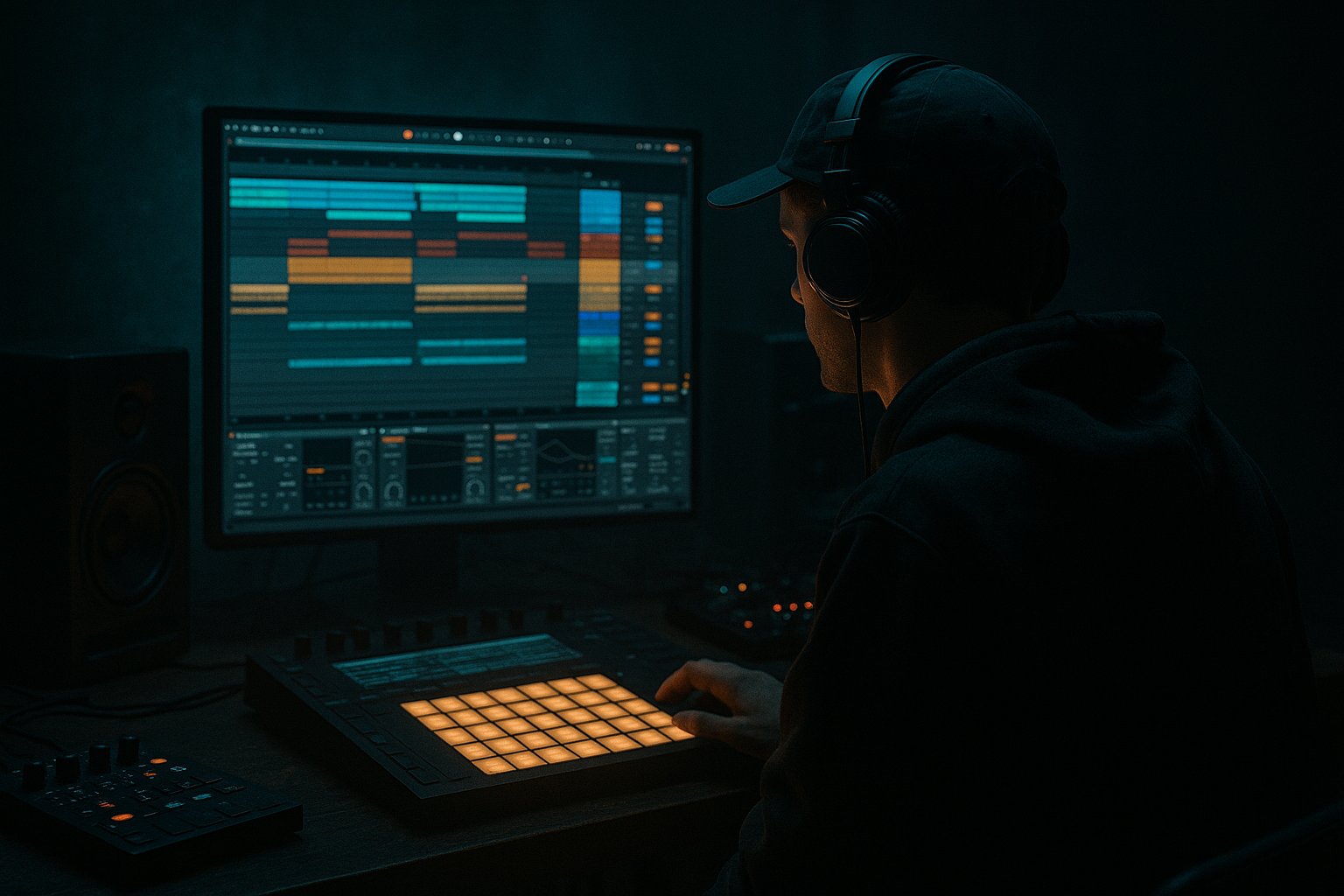
Main tutorial
Mid Bass in Ableton Live 12: Stack It Using Resampling Workflows (Jungle / Oldskool DnB Vibes) 🔥🎛️
1. Lesson overview
This lesson is about building that classic jungle / oldskool DnB mid bass—the gnarly, moving, characterful layer that sits above your sub and locks with breaks. Instead of relying on one “perfect” synth patch, you’ll stack + resample multiple passes into tight, mix-ready mid-bass audio.
You’ll use Ableton Live 12 stock tools to:
- Generate mid bass source tones (Operator/Wavetable or audio)
- Resample processing passes (distortion, filtering, chorus, compression)
- Create multiple complementary mid layers
- Arrange them in a rolling jungle pattern that plays nice with breaks
- Build a DJ-tool style mid-bass rack for quick variations
- Layer A: “Bite” (upper-mid growl presence, 600 Hz–2.5 kHz)
- Layer B: “Body” (mid weight, 150–600 Hz, the chest hit)
- Layer C: “Noise/air” (grit, 2–8 kHz, helps read on small speakers)
- Chop to groove with breaks
- Stretch without CPU pain
- Use clip envelopes for movement
- Create quick DJ-friendly variations (A/B/C versions)
- Algo: A → Output
- Osc A: Saw D (or Saw), Level ~ -10 dB
- Add Osc B: Square, Level ~ -18 dB, Detune +3 to +8 cents
- Filter: ON
- Pitch Env: OFF (we’ll do movement later)
- Root note: F1–A1 range (depends on key)
- Use a 1-bar loop:
- Erosion
- Open Clip View → Envelopes
- Choose Auto Filter → Frequency (if you placed Auto Filter on the track)
- Draw subtle 1-bar or 2-bar motion:
- Record 8 bars where you ride filter frequency with your mouse/controller.
- Consolidate the best moments.
- Create Clip A / Clip B / Clip C and swap them per phrase.
- Bars 1–16: Body only (MID B), keep it rolling but restrained
- Bars 17–32: Add Bite (MID A) for the “drop locks in” moment
- Bars 33–48: Bring in Noise (MID C) sparingly, maybe only last 4 bars of phrase
- Every 8 bars: one resampled “answer” hit (pitch up 3 semitones or reverse a short mid slice)
- Duplicate a mid hit, transpose +7 semitones, shorten it, and place as a call/response right after the snare.
- Pitch the resampled audio down 1–3 semitones after distortion for thicker menace (warp off or Complex/Pro depending).
- Use Roar as a controlled “weight maker”:
- Add sidechain ducking from the snare (not just kick) for that rolling breathing pocket:
- Create a “shadow” mid:
- Break synergy:
- You built mid bass the jungle way: stacked layers + resampled commitment.
- You separated roles: Body / Bite / Noise instead of chasing one monster patch.
- You used Ableton Live 12 stock devices (Operator, EQ Eight, Saturator, Pedal, Auto Filter, Roar, Glue, Utility) with practical settings.
- You created arrangement-ready variations by printing performances and swapping clips per phrase.
Advanced focus: commit early (resample), gain stage, and control phase/mono so your mid bass hits hard without trashing the mix.
---
2. What you will build
A 3-layer resampled mid-bass stack for jungle / oldskool DnB:
All layers come from one or two sources, then become audio clips via resampling so you can:
---
3. Step-by-step walkthrough
Step 0 — Session setup (so this behaves like DnB)
1. Tempo: 165–172 BPM (try 170).
2. Create tracks:
- `SUB (mono)`
- `MID BUS` (group)
- `MID A - Bite`
- `MID B - Body`
- `MID C - Noise`
- `BREAKS`
- `DRUM BUS`
3. On Master, keep it clean. Add only:
- Limiter (Ceiling -0.3 dB, lookahead default) for safety while building.
> You’re building a DJ tool: keep headroom. Aim -6 dB peak on master during sound design.
---
Step 1 — Create a solid mid-bass source (Operator = fastest)
On a new MIDI track (temporary “SOURCE” track), load Operator:
Operator settings (oldskool stable mid):
- Type: MS2 (or PRD for cleaner)
- Freq: ~ 500–900 Hz
- Res: 0.20–0.35
- Drive: 3–8 dB
MIDI pattern (jungle roll idea):
- Notes on 1, 1.2, 1.3.3, 2, 2.3, 3, 3.2, 4
- Add short 1/16 pickups before snares for that “push” feel
Keep notes short (1/16–1/8). Jungle bass is often staccato and reactive to breaks.
---
Step 2 — Pre-shape into “mid-safe” (separate from sub immediately) 🎯
On the SOURCE track, add a utility chain before resampling:
Device chain (SOURCE):
1. EQ Eight
- HP at 90–120 Hz (24 dB/oct) to remove sub (sub lives on its own track)
- Small dip at 250–350 Hz if it’s boxy (optional)
2. Saturator
- Mode: Soft Sine or Analog Clip
- Drive: 3–8 dB
- Output: trim so you’re not clipping
3. Auto Filter
- Type: LP 24
- Freq: ~4–8 kHz (keep it mid-focused)
- Env: small amount for pluck if desired (Env ~10–20)
Now your “mid generator” is already not fighting your sub.
---
Step 3 — Resample pass #1: create MID A (Bite)
Goal: aggressive presence, speaks through breaks.
Method A (fast): Resampling to audio
1. Create a new audio track: `MID A - Bite`
2. Set its input:
- Audio From: SOURCE
- Monitor: Off
- Arm `MID A - Bite`
3. Record 4–8 bars of your MIDI loop.
Now you have audio to mangle.
Process MID A (Bite chain):
1. Pedal (stock)
- Mode: OD or Distortion
- Drive: 15–35%
- Tone: adjust so it bites around 1–3 kHz
2. EQ Eight
- HP 140–180 Hz (keep it out of body)
- Boost wide 900 Hz–2 kHz if needed (+1 to +3 dB)
- Notch harsh resonances (often 2.7–4.5 kHz)
3. Compressor
- Ratio: 4:1
- Attack: 10–30 ms (let transient hit)
- Release: 60–120 ms
- Aim: 2–5 dB GR on peaks
4. Utility
- Width: 0–20% (mostly mono; jungle mids should punch)
Commit it: Freeze + Flatten, or resample again after processing if CPU matters.
---
Step 4 — Resample pass #2: create MID B (Body)
Goal: the “thunk” / weight in the 150–600 Hz zone.
Duplicate your SOURCE track processing (or use the same audio you recorded) and do a different print for body.
1. Create audio track: `MID B - Body`
2. Input: SOURCE, record another pass (or just duplicate MID A raw recording before distortion and reprocess differently).
Process MID B (Body chain):
1. Saturator
- Mode: Analog Clip
- Drive: 2–6 dB
2. Auto Filter
- Type: LP 12
- Freq: 700–1.2 kHz (roll off excessive bite)
- Res: 0.1–0.25
3. EQ Eight
- HP 90–120 Hz
- Gentle bell boost 200–350 Hz if thin (+1–2 dB)
4. Glue Compressor
- Attack: 3 ms
- Release: Auto
- Ratio: 2:1
- Soft Clip: ON
- Just 1–3 dB GR to keep it steady
Commit this layer too (audio is the point).
---
Step 5 — Resample pass #3: create MID C (Noise/air grit)
Goal: a controlled layer that adds edge and “tape/break feel” without harshness.
Two good options:
#### Option 1: Generate noise from the same mid audio
1. Duplicate `MID A - Bite` to `MID C - Noise`
2. Process it:
MID C chain:
1. Redux
- Downsample: 2–8 (tune by ear)
- Bit depth: 6–10
2. EQ Eight
- HP 1.5–2.5 kHz
- LP 7–10 kHz
3. Chorus-Ensemble
- Amount: low (10–25%)
- Rate: slow
4. Utility
- Width: 80–120% (this is where you can add width)
- But check mono compatibility (see mistakes section)
#### Option 2: Use Erosion (great for oldskool rasp)
- Mode: Noise
- Freq: 2–6 kHz
- Amount: 0.2–1.5
Blend quietly. This layer is usually -12 to -24 dB compared to body.
---
Step 6 — Group + Bus process your mids (MID BUS)
Group MID A/B/C into MID BUS.
MID BUS chain (classic tight + controllable):
1. EQ Eight
- HP 90–110 Hz (hard rule: leave sub alone)
- Small dip at 300 Hz if muddy
2. Roar (stock in Live 12) 🔥
- Use it subtly:
- Mode: Warm or Crunch
- Drive: 1–4
- Keep low band clean; distort mids/highs more (multiband if needed)
3. Glue Compressor
- Ratio: 2:1
- Attack: 10 ms
- Release: Auto
- GR: 1–2 dB (just gel it)
4. Utility
- Bass Mono: set around 150 Hz (or use width 0% below via EQ M/S technique)
> If the mid stack starts “shouting,” don’t compress harder—turn down the noise layer first, then re-balance Bite vs Body.
---
Step 7 — Add movement the jungle way (clip envelopes + resample variants) 🧠
Oldskool movement often comes from filtering + performance printing, not endless LFOs.
On each mid audio clip:
- Slight opens on fills
- Small closes right before snare hits (space for crack)
Then resample variations:
This is how you get that “performed” bass without overcomplicating.
---
Step 8 — Arrangement ideas (DJ Tools mindset)
Think in 16-bar phrases like a jungle tune:
Classic jungle trick:
---
4. Common mistakes 🚫
1. Not high-passing mids enough
- If mids overlap sub, you’ll get smeary low-end and weak translation. HP your mids around 90–120 Hz.
2. Over-widening the mid stack
- Wide mids can feel big in headphones and vanish in mono. Keep Body/Bite mostly mono, widen only Noise/air.
3. Too much distortion before EQ
- Distortion multiplies problems. Do corrective EQ first, then distort, then EQ again.
4. Stacking without gain staging
- Resampling hides clipping. Watch levels: keep each layer peaking around -12 to -6 dB before the bus.
5. No space for breaks
- If your bass plays constant 1/16 without dynamics, it will mask ghost notes and snare texture. Use staccato + gaps.
---
5. Pro tips for darker/heavier DnB 🕶️
- Distort mids, keep lows cleaner, and tame highs with its tone shaping.
- Compressor on MID BUS, sidechain from snare track, fast attack, medium release (aim 1–3 dB).
- Duplicate MID B, low-pass to ~300–500 Hz, distort lightly, keep it very low in the mix for density.
- If your break has lots of 200–400 Hz, scoop that area on MID BUS slightly and push 150–220 or 500–700 instead.
---
6. Mini practice exercise (20–30 minutes) ⏱️
1. Build one Operator mid source.
2. Record 8 bars to audio.
3. Create:
- MID A: Pedal + EQ (bite)
- MID B: Saturator + LP filter (body)
- MID C: Redux + HP/LP (noise)
4. Arrange a 32-bar loop:
- 16 bars: Body only
- Next 16: add Bite + occasional Noise (last 4 bars)
5. Print a final resampled MID BUS stem (audio) and mute the individual layers.
Deliverable: one audio stem you can drop into other projects like a DJ tool.
---
7. Recap ✅
If you want, tell me your target vibe (e.g., 1994 Moving Shadow, Metalheadz rollers, ragga jungle), your key, and what break you’re using—and I’ll suggest a specific mid pattern + processing recipe to match it.

