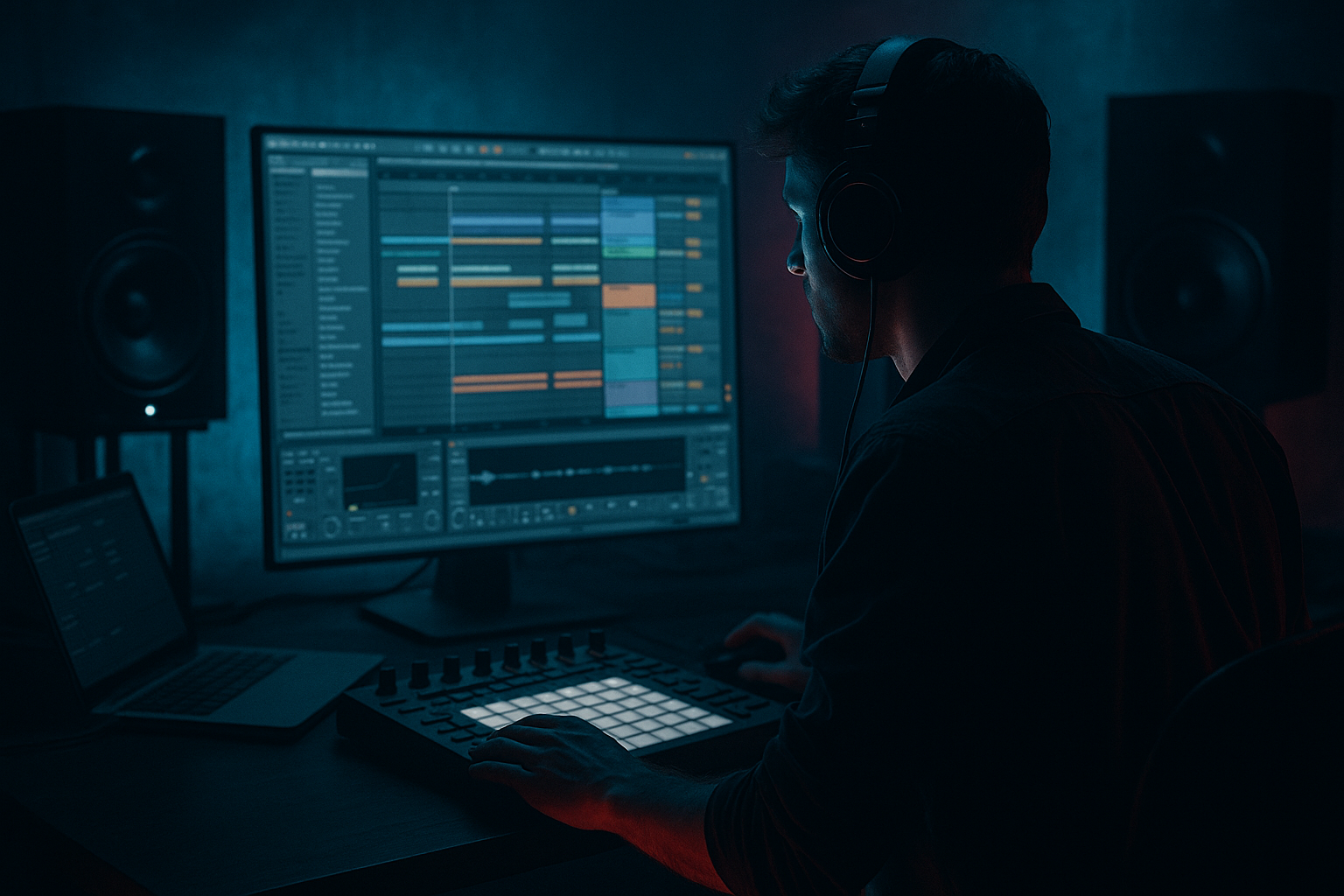
Main tutorial
```markdown
Mid Bass in Ableton Live 12: “Stretch It” Using Groove Pool Tricks (Oldskool Jungle / DnB Vibes) 🥁🔊
1. Lesson overview
This lesson is about making a mid-bass line feel like it’s being “stretched” and pulled by the rhythm, the way classic jungle and early DnB grooves breathe—without turning everything into sloppy timing.
You’ll use Ableton Live 12’s Groove Pool to:
- Apply swing + micro-timing to a mid-bass
- Create push/pull “late” bass that follows breakbeats
- Control timing, velocity, and randomness in a musical way
- Lock the bass to your breaks while still feeling human and rolling
- Sub layer (rigid): dead-on grid for clean low end
- Mid layer (grooved/stretched): gets groove pool timing to create that elastic jungle roll
- A Groove Pool “master” groove extracted from a break (Amen/Think-style)
- A workflow to commit groove at the right stage (without destroying editability)
- Timing: 35–55%
- Random: 3–10%
- Velocity: 0–15% (only matters if you apply it to MIDI; great for expression)
- Base: usually `1/16` for jungle funk (but try `1/8` for heavier lurch)
- Quantize: 0–20% (use this to stop it going too loose)
- Osc A: Sine
- Level: adjust so it’s solid but not clipping
- Voices: 1 (mono bass)
- Add Saturator (subtle):
- Add EQ Eight:
- Wavetable: something with bite (Basic Shapes, or a harsher table)
- Unison: off (keep it punchy and mono-ish)
- Filter: LP24 or MS2 style filter
- Drive: small amount, 2–6% depending on table
- Use short notes (1/16–1/8) with gaps—groove needs space to pull notes around.
- Try a call/response between root and fifth or minor seventh.
- Classic move: hold a note over the barline, then stab a couple of 1/16s.
- If it starts flamming with the drums, reduce:
- Bars 1–8: Break + sub only (tight and teasing)
- Bars 9–16: Bring in grooved mid at 50–70% amount
- Bars 17–24: Increase Groove Amount to 90–110% (more “stretch”)
- Bars 25–32: Pull back groove, automate filter down, add fills
- Bass – Mid Groove Amount
- Auto Filter cutoff (mid layer)
- Saturator drive (tiny moves go a long way)
- editing specific notes
- resampling to audio for further processing
- Duplicate the clip first and label it `MID_BASS_GROOVE_LIVE` vs `MID_BASS_GROOVE_COMMITTED`.
- Use Base = 1/8 for a heavier lurch (less skitter, more stomp).
- Add Roar (Live 12) on the mid layer:
- Create a parallel “Reese smear” bus:
- Make the groove react to fills:
- For menace: pitch automation on 1–2 notes (mid layer only), but keep the sub stable.
- Extract groove from a break to get real jungle micro-timing.
- Keep sub tight; apply groove to mid bass for the “stretched” illusion.
- Use Groove Pool’s Timing + Quantize balance to stay funky but controlled.
- Add velocity groove for talkback with the break.
- Automate Groove Amount in arrangement to make sections evolve.
This is advanced because we’ll be deliberate: choosing what gets grooved, what stays rigid, and how to keep phase/low-end tight while the mid band moves.
---
2. What you will build
A two-layer bass system:
Plus:
---
3. Step-by-step walkthrough
Step 0 — Session setup (fast but important)
1. Set tempo to a jungle/DnB range: 160–172 BPM (try 168 BPM).
2. Create these tracks:
- Drums (break) (Audio)
- Bass – Sub (MIDI)
- Bass – Mid (MIDI)
- Optional: Bass Bus (Audio or Group)
3. Turn on Groove Pool: press `Cmd/Ctrl + Alt + G`.
---
Step 1 — Pick a break and extract a groove 🧬
Goal: get authentic micro-timing from a break.
1. Drop a breakbeat loop onto Drums (break).
2. Double-click the clip → make sure Warp is on.
3. Warp mode:
- For breaks: Complex Pro (or Complex if CPU is tight)
4. Right-click the clip → Extract Groove.
5. Open Groove Pool → find the new groove (it’ll be named after the clip).
Groove Pool settings starting point (in the Groove Pool panel):
✅ DnB mindset: Let the break supply the “human.” Don’t invent swing from scratch unless you have to.
---
Step 2 — Build a clean, controllable bass source (mid + sub split) 🎛️
#### A) Sub layer (tight)
On Bass – Sub, use Operator:
- Drive: 1–3 dB
- Soft Clip: On
- Low-pass around 120–160 Hz (steep-ish, 24/48 dB if needed)
Keep this fully quantized. No groove. This is your anchor.
#### B) Mid layer (character + stretch)
On Bass – Mid, try Wavetable (or Operator for a more classic tone):
Now add a practical DnB mid chain (stock devices):
1. Saturator
- Drive: 4–10 dB (depends on how gnarly you want it)
- Soft Clip: On
2. Auto Filter (for movement)
- Envelope Amount: small negative/positive
- Rate: Off (we’ll automate later)
3. EQ Eight
- High-pass around 120–160 Hz (make room for sub)
- Optional dip around 250–400 Hz if it boxes up
4. Glue Compressor (gentle control)
- Attack: 3–10 ms
- Release: Auto
- Ratio: 2:1
- Aim: 1–3 dB GR max
---
Step 3 — Program a bassline that wants to be grooved 🎹
Write a 1–2 bar pattern on Bass – Sub and duplicate it to Bass – Mid.
Oldskool-friendly tips:
Important: Keep MIDI notes aligned initially. We’ll let Groove Pool do the “stretch.”
---
Step 4 — Apply groove only to the MID layer (the key trick) 🔑
1. Click your Bass – Mid MIDI clip.
2. In Clip View, choose the extracted groove from the Groove dropdown.
3. Adjust:
- Groove Amount: start at 60–80%
4. Hit Commit only later. For now keep it live.
Now the magic: your mid bass will start “lagging” and “snapping” like it’s being played with the break.
Fine control (advanced):
- Groove Pool Timing (e.g., from 55% → 40%)
- Or increase Groove Pool Quantize (e.g., 0% → 10–20%)
✅ Core concept: Sub stays grid-locked. Mid gets elastic timing. That’s the illusion of “stretch” without losing impact.
---
Step 5 — Groove Pool “stretch” trick: exaggerate then tame 🎚️
To get that oldskool rubber-band feel:
1. In Groove Pool, push the groove harder:
- Timing: 55–70%
- Random: 6–12%
2. On the Bass – Mid clip set Groove Amount to 90–110% (yes, over 100 can be interesting).
3. Then tame with:
- Groove Pool Quantize: 10–25%
This gives you big movement but prevents totally off-beat chaos.
---
Step 6 — Make the mid “breathe” with break accents (velocity groove)
If your bass is MIDI-based and responds to velocity (Wavetable/Operator can via mod matrix or filter envelope):
1. In Groove Pool, raise Velocity to 10–25%.
2. On Bass – Mid, map velocity to tone:
- In Wavetable, use Mod Matrix:
- Source: Velocity
- Destination: Filter Freq (small amount) or Amp Level (tiny)
3. Result: when the groove has velocity accents, your mid bass “talks” with the break. 🎙️
---
Step 7 — Lock it with sidechain + phase-aware low end 🧱
Even though the mid is grooved, keep the mix controlled.
1. Put Compressor on Bass – Mid:
- Sidechain from Drums (break) (or kick track if separated)
- Attack: 0.5–3 ms
- Release: 50–120 ms (tempo dependent)
- Aim: 2–5 dB GR on hits
2. If the low end feels weird:
- Make sure Bass – Mid has a high-pass at 120–160 Hz (or higher).
- Keep Bass – Sub mono (Utility → Width 0%).
---
Step 8 — Arrangement ideas (classic jungle energy) 🚀
Try this 32-bar plan:
Automation targets:
---
Step 9 — Commit groove (only when you’re sure)
When the groove feels right:
1. Select the Bass – Mid clip.
2. In Clip View, click Commit.
Now it’s real MIDI timing. Great for:
Pro workflow:
---
4. Common mistakes ⚠️
1. Grooving the sub
- Result: weak/transient-smearing low end.
- Fix: groove only the mid/top bass layer.
2. Too much Random
- It stops sounding like jungle funk and starts sounding broken.
- Keep Random subtle: usually <10%.
3. No Quantize safety
- Timing becomes “late everywhere.”
- Use Quantize 10–20% as a guard rail.
4. Bass notes too long
- Groove has nothing to grab.
- Shorten notes and leave gaps.
5. Warped break groove extracted from a poorly warped clip
- Garbage in, garbage out.
- Make sure the break is warped cleanly before extracting.
---
5. Pro tips for darker/heavier DnB 🖤
- Keep it subtle; use it like “attitude,” not full destruction.
- Follow with EQ Eight to tame harsh bands.
- Send the mid to a return with Chorus-Ensemble + Saturator + Auto Filter
- High-pass the return aggressively (250–400 Hz) so it stays atmospheric.
- For fill sections, automate Groove Amount down slightly so fills punch clean.
---
6. Mini practice exercise (15 minutes) ⏱️
1. Load a classic break loop and Extract Groove.
2. Program a 1-bar bass pattern with 8–12 notes (include rests).
3. Apply groove to mid only:
- Timing: 50%
- Random: 6%
- Quantize: 15%
- Groove Amount: 90%
4. A/B test:
- Groove Amount at 0%, 60%, 100%
5. Commit and manually fix only 2 notes that feel too late.
6. Export an 8-bar loop.
Deliverable: one loop that rolls with the break but still hits hard.
---
7. Recap ✅
If you want, tell me what break you’re using (Amen/Think/other) and whether your bass is more Reese, hoover-ish, or clean mid stab, and I’ll suggest specific Groove Pool values + a matching mid-bass patch.
```

