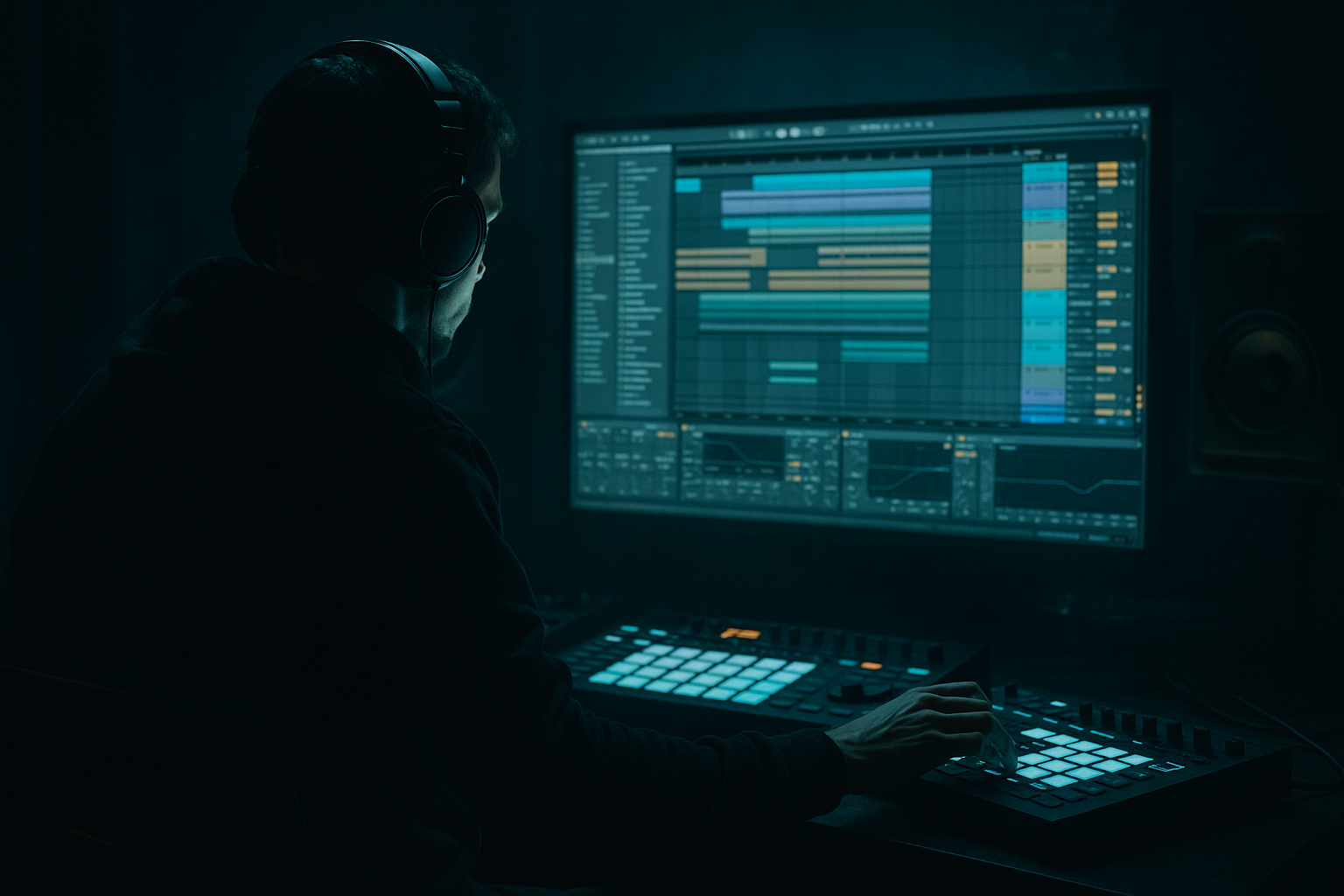
Main tutorial
Mid-bass Texture Layering From Scratch (90s Rave Flavor) — Ableton Live (DnB)
1. Lesson overview
You’re going to build a classic DnB/jungle mid-bass with that 90s rave “hollow/rewired” character—but with modern control. The goal is texture layering: one layer provides solid midrange tone, another provides grit/air, and a third adds movement. You’ll do it using Ableton stock devices (Wavetable/Operator, Saturator, Auto Filter, Chorus-Ensemble, Amp/Cab, Redux, EQ Eight, Glue Compressor) and a tight workflow for DnB arrangement. 🔥
---
2. What you will build
A 3-layer mid-bass rack that sits above your sub:
- Core Mid Layer (Mono-ish, stable): the “body” that survives on small speakers
- Rave Texture Layer (Wide, noisy): chorusy, resampled, slightly broken 90s vibe
- Movement Layer (Rhythmic, filtered): adds “talk”/motion without ruining the groove
- A Macro-controlled Audio Effect Rack
- A DnB-friendly arrangement pattern (call/response, fills, drops)
- A quick resampling workflow for authentic “hardware-ish” grit 🎛️
- Osc 1: Basic Shapes → Square (or saw if you want brighter)
- Osc 2: Basic Shapes → Sine or Triangle
- Unison: OFF (keep stable for now)
- Filter: MS2 (or PRD for sharper)
- Amp Env:
- Use a 2-bar loop.
- Notes: choose something like F (or G) as root.
- Rhythm: short stabs + syncopation (think “engine” pulse). Example:
- Bars 1–4: CORE only (establish groove)
- Bars 5–8: add MOVEMENT (filter automation opens slightly)
- Bars 9–12: bring in RAVE TEXTURE wide layer (make it feel “bigger”)
- Bars 13–16: variation/fill
- Layering without frequency roles: If every layer has 100–400 Hz, you’ll get mud fast. Assign jobs.
- Too much stereo in low mids: Keep width above ~200 Hz; mono your sub and low mids where possible.
- Over-distorting early: Heavy distortion before EQ can explode harsh frequencies. Control with EQ before/after.
- No sidechain / groove interaction: Mid-bass must breathe with kick/snare. Duck it a bit.
- Endless modulation: If every parameter moves, nothing hits. Keep one “main movement” at a time.
- Parallel “monster” chain: Duplicate MOVEMENT chain, distort harder (Amp + Saturator), then band-limit it (e.g., 250 Hz–2.5 kHz) and blend quietly.
- Add subtle pitch instability: In Wavetable, try a tiny LFO to Osc pitch (like 0.03–0.08 semitones) for uneasy movement.
- Use Multiband Dynamics carefully:
- Transient discipline: If the bass stabs click too much, soften with:
- Darkness = controlled highs: Use Auto Filter or EQ Eight to manage 6–12 kHz; let drums own the air.
- You built a mid-bass texture system using three purposeful layers: CORE (body), RAVE TEXTURE (wide grit), MOVEMENT (rhythmic filter + pump).
- You used Ableton stock tools (Wavetable, EQ Eight, Saturator, Chorus-Ensemble, Redux, Auto Filter, Amp/Cab, Glue/Compressor) to get 90s rave flavor without losing modern DnB control.
- You learned a resampling workflow to make it sound more “printed” and authentic.
- You got arrangement moves that feel rooted in rolling jungle/DnB: call/response, gaps, and macro-driven evolution. ✅
You’ll also create:
---
3. Step-by-step walkthrough
Step 0 — Session setup (DnB-friendly foundation)
1. Tempo: 170–175 BPM (start at 174).
2. Create tracks:
- Track 1: `SUB` (keep simple; not the focus here)
- Track 2: `MID BASS (RACK)`
- Track 3: `DRUM BUS` (optional)
3. Group your bass tracks later into a `BASS BUS` for final glue.
Key mindset: mid-bass = character; sub = stability. Don’t blend them into one messy patch.
---
Step 1 — Make a clean “Core Mid” synth (Wavetable)
On `MID BASS (RACK)`, add Wavetable.
Wavetable settings (starting point):
- Position: ~50% (between square/pulse for harmonic richness)
- Level: low (10–20%) just to round it
- Cutoff: ~250–600 Hz (we’ll automate later)
- Res: 10–20%
- Drive: 2–5 dB
- Attack: 0–5 ms
- Decay: 150–300 ms
- Sustain: -6 to -12 dB
- Release: 60–120 ms
MIDI pattern (rolling DnB):
- Bar 1: hits on 1, 1.3, 2, 2.4
- Bar 2: hits on 1, 1.2, 2.3, 3, 3.4
Keep notes short (1/8–1/16) so the bass “talks” with drums.
---
Step 2 — Convert to an Audio Effect Rack with 3 layers
After Wavetable, add an Audio Effect Rack. Create 3 chains:
1. `CORE`
2. `RAVE TEXTURE`
3. `MOVEMENT`
We’ll keep Wavetable feeding all three (same MIDI, different processing).
---
Step 3 — Build the CORE chain (punchy, controlled)
On the `CORE` chain:
1. EQ Eight
- HP filter: 80–120 Hz (so it doesn’t fight the sub)
- Gentle dip: 250–400 Hz if it’s boxy
- Small boost: 700 Hz–1.2 kHz if it needs presence (don’t overdo)
2. Saturator
- Mode: Analog Clip
- Drive: 2–6 dB
- Soft Clip: ON
3. Glue Compressor
- Attack: 3 ms
- Release: Auto
- Ratio: 2:1
- Aim for 1–3 dB GR on peaks
✅ Result: a solid, “always audible” mid layer.
---
Step 4 — Build the RAVE TEXTURE chain (90s chorus + grit)
This is where the rave flavor lives. 🎚️
On the `RAVE TEXTURE` chain:
1. EQ Eight (pre)
- HP: 200–350 Hz
- This layer is not for weight—keep it out of low-mids.
2. Chorus-Ensemble
- Mode: Chorus
- Rate: 0.25–0.60 Hz (slow swirl)
- Amount: 30–60%
- Width: 120–200%
- Mix: 25–45%
3. Redux (for “old sampler / crushed edges”)
- Downsample: 2.0–6.0
- Bit Reduction: 6–10 bits (start at 8)
- Keep it subtle; the goal is texture, not total destruction.
4. Auto Filter
- Type: Bandpass
- Frequency: 700 Hz–2.5 kHz
- Resonance: 20–40%
- Envelope: tiny (or none)
- Add a little motion later with LFO if you want.
5. Utility
- Width: 140–180%
- Bass Mono: (if available) set to 150–250 Hz
✅ Result: airy, swirly, crunchy “rave” top—wide but not muddy.
---
Step 5 — Build the MOVEMENT chain (rhythmic talk + automation)
On the `MOVEMENT` chain:
1. EQ Eight (pre)
- HP: 120–200 Hz
2. Auto Filter
- Type: Lowpass 24
- Cutoff: 300–1.5k Hz (we’ll automate)
- Resonance: 15–30%
- Drive: a touch if needed
- Turn LFO ON
- Rate: 1/8 or 1/4 (sync)
- Amount: 10–25%
3. Amp (for mid growl)
- Mode: Blues or Rock
- Gain: 10–25%
- Bass: low, Mid: moderate, Treble: to taste
4. Cabinet
- 4x12 or 2x12
- Mic: On-axis if you want bite; Off-axis if harsh
5. Compressor (sidechain from kick/snare bus or kick track)
- Sidechain: Kick (and optionally snare if you want it to duck on 2&4)
- Ratio: 4:1
- Attack: 1–3 ms
- Release: 60–120 ms
- Aim: 2–5 dB ducking
✅ Result: a moving, pumping layer that locks into the drums.
---
Step 6 — Macro controls (make it playable)
Map these to Rack Macros:
1. Macro 1: “Texture Blend”
- Map chain volumes for `RAVE TEXTURE` and `MOVEMENT` (inverse-ish)
2. Macro 2: “Mid Bite”
- Map CORE Saturator Drive (2 → 8 dB)
3. Macro 3: “Rave Swirl”
- Map Chorus Mix (20% → 50%) + Width (120% → 200%)
4. Macro 4: “Talk Filter”
- Map MOVEMENT Auto Filter cutoff (300 Hz → 2 kHz)
5. Macro 5: “Crush”
- Map Redux bits (10 → 6) and downsample (2 → 6)
Now you can perform the bass like an instrument, which is very DnB.
---
Step 7 — Resampling for authentic 90s vibe (optional but recommended) 🎞️
90s rave character often comes from printing audio and reprocessing.
1. Create an Audio track called `MID RESAMPLE`.
2. Set its input to: Resampling.
3. Record 8 bars of your mid-bass playing with macro movement.
4. Now process the audio clip:
- Warp mode: try Beats (Transient Loop) for crunchy artifacts, or Texture for smear
- Add EQ Eight to trim harshness (often 3–6 kHz)
- Add Saturator (Soft Clip ON)
- Add Auto Pan very subtly for width motion:
- Rate: 1/2 or 1 bar, Amount: 10–20%, Phase: 180°
Then you can slice the resample and rearrange like old-school jungle edits.
---
Step 8 — Arrangement ideas (rolling + rave-call response)
A classic DnB approach is call/response between bass phrases and drum fills.
Try this 16-bar drop structure:
- mute bass for 1/4 bar before bar 16
- or do a quick macro “Crush” spike for a rave stab moment
Add 1-bar gaps occasionally—DnB loves negative space for impact.
---
4. Common mistakes
---
5. Pro tips for darker/heavier DnB 🖤
- Use it as a gentle shaper, not a loudness cheat.
- Keep lows stable; control low-mid bloom around 150–300 Hz.
- a tiny Attack in the amp env (2–5 ms)
- or a micro fade-in on the resampled audio clip
---
6. Mini practice exercise (15–25 minutes)
1. Build the rack as described (3 chains).
2. Write a 2-bar bass loop that works with an Amen-style break or modern DnB drum loop.
3. Automate:
- Macro 4 “Talk Filter” over 8 bars
- Macro 1 “Texture Blend” to introduce width in the second half
4. Resample 8 bars and slice the audio:
- Make one bar of “rave stab” by crushing + bandpass
- Insert it as a fill every 8 bars
Deliverable: a 16-bar drop sketch with evolving mid-bass but consistent sub space.
---
7. Recap
If you tell me what sub style you’re using (pure sine, reese sub, or 808-ish), I can suggest the best crossover points and sidechain behavior so the mid-bass locks even harder.

