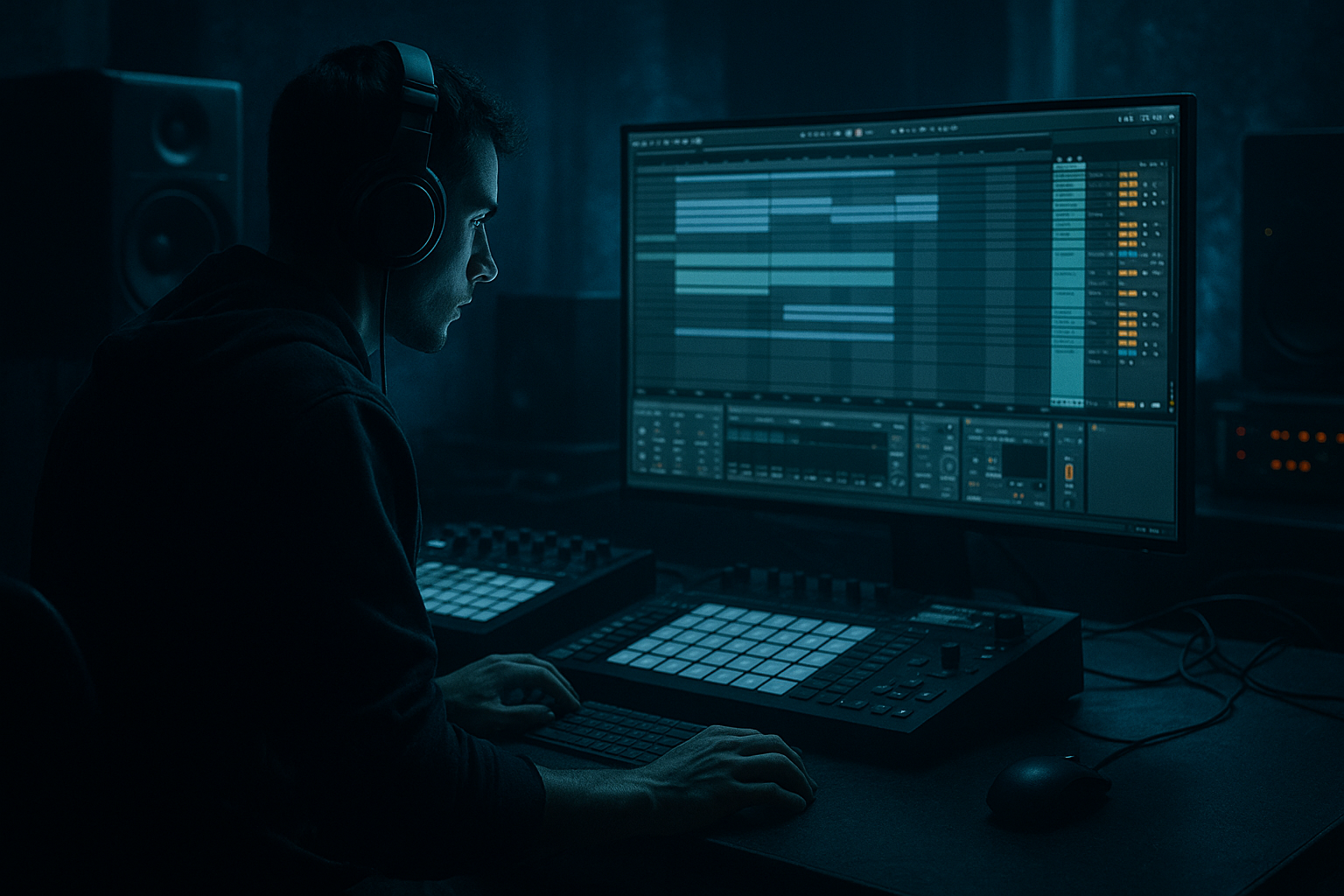
Main tutorial
Mid-bass Texture Layering Using Session View (Ableton Live)
Intermediate • Basslines • Drum & Bass focused 🎛️
---
1. Lesson overview
Session View isn’t just for jamming drums—it’s amazing for building mid-bass texture layers quickly and musically. In drum & bass, your mid-bass is often the “character” layer: reese grit, growl movement, metallic edge, distortion tone, or vocal-ish formants—while the sub stays clean and stable.
In this lesson you’ll use Session View to:
- Rapidly audition multiple mid-bass textures against the same sub + drums
- Build layered racks that stay phase-safe and mixable
- Capture your best combinations into Arrangement for a rolling DnB drop
- Track A: Sub (clean + mono)
- Track B: Mid-bass “Body” (reese/steady harmonics)
- Track C: Mid-bass “Texture” (grit, air, metallic, movement)
- A shared MIDI clip (so all layers play the same rhythm)
- A Bass Bus group with glue + sidechain + final tone shaping
- Try MPC 16 Swing 57 at 10–20%.
- Wavetable
- Saturator
- Amp
- EQ Eight
- Operator
- Corpus
- Overdrive
- EQ Eight
- Analog
- Auto Filter
- Erosion
- Redux (optional)
- Width: 120–170% (texture only)
- Then add EQ Eight to high-pass so stereo doesn’t touch low end.
- 16 bars: Body only (tease)
- 16 bars: Add texture chain “Grit”
- 8 bars: Switch to “Metal” for tension
- 8 bars: Drop back to “Grit” + add small movement automation
- End phrase: quick “Air” burst + fill
- Letting mid layers leak into sub range
- Too many distortions stacked
- Stereo bass below ~150 Hz
- Resonance whack-a-mole
- Auditioning in solo
- Build “controlled aggression” with parallel distortion
- Use Multiband Dynamics as a tone shaper (carefully)
- Automate texture density, not just filter cutoff
- “Snare gap clarity” trick
- Resample to commit
- Use Session View to rapidly audition and perform mid-bass texture layers against drums.
- Keep the system clean: Sub = mono + pure, Mids = high-passed + character.
- Build a texture rack with chains (Grit/Metal/Air), then switch textures via Scenes or a Chain Selector Macro.
- Group to a Bass Bus, apply gentle glue + sidechain, and record your performance into Arrangement for a DnB-ready drop. ✅
---
2. What you will build
A 3-layer bass system designed for rolling/heavy DnB:
…and you’ll control all layers with:
Result: a mid-bass that can go from classic rolling reese to modern neuro-ish texture by launching clips and swapping racks in Session View. 🚀
---
3. Step-by-step walkthrough
Step 0 — Project setup (DnB ready)
1. Set tempo to 174 BPM (or 172–178).
2. Create a simple drum loop (or drop in a break + kick/snare):
- Aim for a steady 2-step or rolling pattern.
3. Add a Utility on your Drum Bus and leave headroom:
- Gain: -6 dB (rough starting point)
---
Step 1 — Build a “Master MIDI” clip in Session View
This is the key to fast layering: one bassline pattern drives multiple layers.
1. Create a MIDI Track named `BASS - MIDI`.
2. Load an empty Instrument Rack (or leave it blank).
3. Create a MIDI clip in a Session slot, 2 or 4 bars.
4. Write a DnB-friendly rhythm, for example:
- Notes around F–G–Ab (or your track key)
- Use 1/8th notes with occasional 1/16th pushes before snare hits
- Leave gaps (DnB bass breathes)
Groove tip: Add a touch of swing via Groove Pool (subtle):
---
Step 2 — Create Sub track (clean foundation)
1. Create MIDI Track named `SUB`.
2. Add Operator:
- Osc A: Sine
- Level: ~0 dB (adjust later)
- Add subtle saturation later, but keep it clean for now
3. Add Utility after Operator:
- Width: 0% (mono)
- Optional: Bass Mono: On if you use it elsewhere
4. Feed the same MIDI into SUB:
- Set `SUB` MIDI From → `BASS - MIDI`
- Monitor: In (or Arm it)
5. Add EQ Eight:
- Low-pass around 120–160 Hz (24 dB slope)
- Tiny dip if needed at 50–70 Hz if it’s too boomy (context dependent)
✅ Your sub is now stable and won’t fight your mid textures.
---
Step 3 — Create Mid “Body” track (reese/solid mid harmonics)
1. Create MIDI Track named `MID - BODY`.
2. Add Wavetable (or Operator if you prefer):
- Wavetable: Basic Shapes
- Osc 1: Saw-ish (or square-saw blend)
- Unison: 2–4 voices, Amount low (don’t smear too hard)
3. Add Saturator:
- Mode: Analog Clip
- Drive: 2–6 dB
- Soft Clip: On
4. Add EQ Eight:
- High-pass: ~120 Hz (keep out of sub region)
- Gentle dip around 250–400 Hz if it’s boxy
5. Add Auto Filter:
- Filter: LP24
- Map cutoff to a Macro later (optional)
6. Route MIDI from `BASS - MIDI` same as Sub.
✅ This layer is your “weight in the mids”—it should feel stable even without fancy texture.
---
Step 4 — Create Mid “Texture” track (the fun one) 😈
1. Create MIDI Track named `MID - TEXTURE`.
2. Add Instrument Rack (this becomes your texture “slot machine” in Session View).
3. Inside the rack, create 3 Chains (right-click → Create Chain):
- `Grit`
- `Metal`
- `Air`
Now build each chain with stock devices.
#### Chain 1: GRIT (dirty, present, rolling)
- Osc 1: more complex wavetable (try “Modern” category)
- FM amount: small to moderate
- Drive: 6–10 dB
- Soft Clip: On
- Type: Heavy (or Rock)
- Drive: to taste (don’t flatten completely)
- High-pass: 150–200 Hz
- Low-pass: 6–10 kHz (avoid fizzy mess)
#### Chain 2: METAL (neuro edge / comb tone)
- Use FM pairs lightly (A modulated by B)
- Preset idea: start with something metallic
- Tune: try aligning with root note
- Dry/Wet: 10–30%
- Drive: 20–50%
- Tone: adjust so it bites at 1–3 kHz
- Notch any painful resonance (sweep with a narrow band)
#### Chain 3: AIR (high-mid buzz + movement)
- Simple saw or pulse
- Band-pass or high-pass
- LFO Amount: small, Rate: 1/8 or 1/16 (sync)
- Mode: Wide Noise (or Sine for metallic)
- Amount: subtle (too much gets harsh fast)
- Downsample slightly for bite (don’t destroy it)
✅ These chains give you fast, DnB-appropriate “character” options without third-party plugins.
---
Step 5 — Use Session View to audition texture layers fast
Here’s the Session View power move:
1. Make multiple Scene rows:
- Scene 1: “Roll - Clean”
- Scene 2: “Roll - Grit”
- Scene 3: “Roll - Metal”
- Scene 4: “Roll - Air”
- Scene 5: “Drop - Combo”
2. In each Scene row:
- Use the same MIDI clip on `BASS - MIDI`
- Swap which chain is active in `MID - TEXTURE`
- Easiest method: use Chain Activator buttons
- Better method: use Chain Selector and map it to a Macro (see next step)
3. Launch Scenes and listen against drums:
- You’re choosing which mid texture cuts through your drum loop—fast.
---
Step 6 — Macro control + “one-knob” performance
On `MID - TEXTURE` Instrument Rack:
1. Map Chain Selector to Macro 1:
- Macro 1 name: `TEXTURE SELECT`
2. Map other useful parameters:
- Macro 2: `FILTER` (Auto Filter cutoff)
- Macro 3: `DRIVE` (Saturator/Overdrive drive)
- Macro 4: `MOVEMENT` (Auto Filter LFO amount or rate)
- Macro 5: `WIDTH` (Utility width above 200 Hz only—see next step)
Pro workflow: Put a Utility at the end of the texture rack:
---
Step 7 — Group and bus the whole bass system
1. Select `SUB`, `MID - BODY`, `MID - TEXTURE` → Group → name it `BASS BUS`.
2. On `BASS BUS`, add:
- Glue Compressor (gentle “gel”)
- Attack: 3 ms
- Release: Auto
- Ratio: 2:1
- Aim: 1–3 dB of gain reduction max
- EQ Eight
- Tiny dip at 200–350 Hz if muddy
- Tiny shelf around 2–5 kHz if you need presence (careful!)
- Limiter (safety, not loudness)
- Just to catch spikes while designing
---
Step 8 — Sidechain the mids (cleaner rolling groove) 🔥
DnB bass usually breathes around the kick/snare.
1. On `MID - BODY` and `MID - TEXTURE`, add Compressor:
- Sidechain: On
- Audio From: your Kick/Snare bus (or full drums bus)
2. Starting settings:
- Ratio: 4:1
- Attack: 1–5 ms
- Release: 60–120 ms (tempo dependent)
- Threshold: adjust until groove pumps but doesn’t vanish
Tip: Keep SUB sidechain lighter than mids (or not at all), depending on style.
---
Step 9 — Capture your best Session performance into Arrangement
1. Hit Global Record (top transport).
2. Launch Scenes and tweak macros live:
- Switch textures every 4 or 8 bars
- Increase movement before fills
- Pull texture down during vocal phrases or busy drums
3. Stop recording → you now have a performed bass arrangement.
Arrangement idea (classic rolling DnB):
---
4. Common mistakes
High-pass your mid layers (120–200 Hz) so the sub owns the floor.
If you distort three layers + the bus, it turns to fizz. Pick one main distortion stage per layer.
Wide lows = weak translation in clubs. Keep sub mono and control low-mid width carefully.
Corpus/Erosion/Redux can create harsh peaks. Use EQ Eight narrow cuts when needed.
Mid textures must be judged with drums. In DnB, drums are the reference.
---
5. Pro tips for darker/heavier DnB
Duplicate `MID - BODY`, distort the copy harder, then low-pass it around 3–6 kHz and blend quietly.
On `MID - TEXTURE`, try subtle upward compression in the mids to make texture consistent. Don’t overdo it.
Automate:
- Saturator Drive
- Erosion Amount
- Redux Downsample
- Corpus Dry/Wet
This gives that evolving neuro/tech feel.
Place a tiny dip (dynamic if you like) around 180–300 Hz on bass during snare hits using sidechain compression/EQ movement so snare body punches through.
Once you find a sick combo: resample `BASS BUS` to audio, then cut/reverse/retrigger for jungle-style edits.
---
6. Mini practice exercise 🎯
Goal: Make 6 variations of the same rolling bassline using Session View.
1. Create 6 Scenes:
1) Body only
2) Body + Grit
3) Body + Metal
4) Body + Air
5) Grit + Air (no Body)
6) Metal burst (1 bar) → back to Grit (7 bars)
2. Record a 32-bar performance into Arrangement:
- Switch scenes every 4 or 8 bars
- Automate Macro `DRIVE` up slightly in the last 8 bars
3. Export a quick bounce and listen on:
- headphones
- small speakers
Check: Does the sub stay stable? Does the mid texture remain audible without harshness?
---
7. Recap
If you tell me your target vibe (classic reese roller, jungle techstep, modern neuro, deep minimal), I can suggest specific rack chains + macro mappings tailored to that style.

