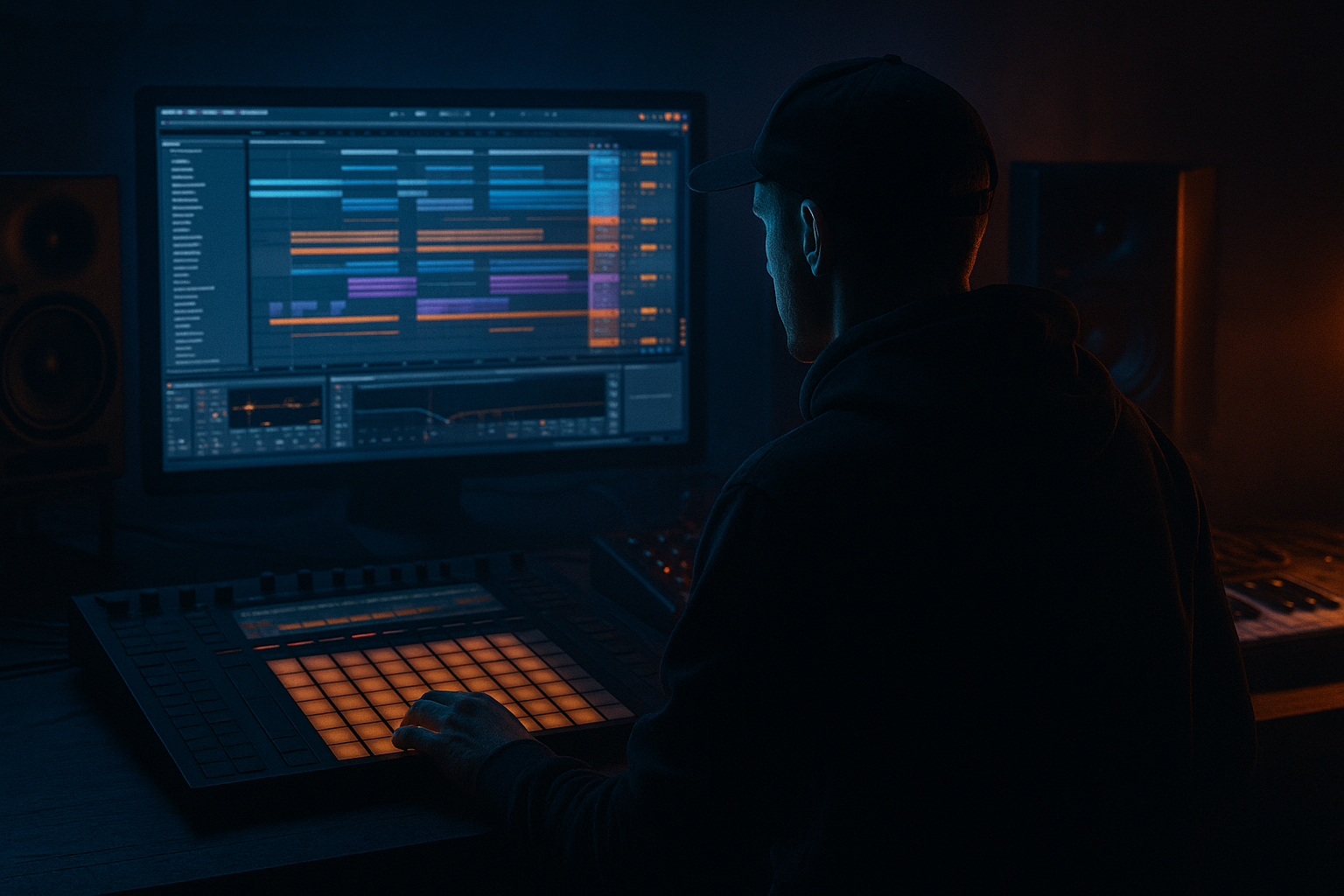
Main tutorial
Mid-track Breakdown Development — Drum & Bass in Ableton Live
Energetic, clear, and practical — this lesson walks you through building a powerful mid-track breakdown for drum & bass/jungle/rolling bass music in Ableton Live. You’ll get concrete device chains, settings, arrangement ideas, and hands-on steps so you can craft tension, contrast, and a killer re-entry into the drop.
---
1) Lesson overview
What this teaches you:
- How to design a breakdown that creates contrast and tension while maintaining sonic momentum.
- Practical Ableton workflows for chopping, processing, and automating elements (drums, bass, pads, vocals, FX).
- Device chains and settings using Live stock devices (Auto Filter, EQ Eight, Glue Compressor, Drum Rack, Simpler, Wavetable, Reverb, Beat Repeat, Grain Delay, Utility, Saturator, etc.).
- Arranging the breakdown into a 16–32 bar section and transitioning back to the drop.
- A well-made breakdown keeps listeners engaged, makes the drop hit harder, and gives you space for storytelling within a DnB track. ⚡️
- Removes full breakbeat energy, leaving sparse percussive motion,
- Introduces atmospheric pads/ambience and vocal/FX chops,
- Uses filtering, automation, and glitch tools (Beat Repeat / Grain Delay) to evolve textures,
- Reintroduces drums and bass with a tension-building pre-drop (risers, cuts, snare rolls),
- Lands back into a heavy rolling drop.
- A breakdown arrangement map (bars noted),
- A reusable device chain for atmos/bass/drums,
- A transition blueprint to return to a heavy drop.
- Bars 1–4: Strip main drums, keep hat / light percussion + low-volume sub hold.
- Bars 5–8: Introduce pad/atmo, filtered bass stabs, start sweeps.
- Bars 9–12: Introduce half-time or stuttered percussion, vocal chops, FX glitching.
- Bars 13–16: Build tension — snare roll, automation cuts, rising filter + reverb tail → drop.
- Duplicate your main Drum Rack/Breakbeat track.
- Mute the full break, leave only: 1) hi-hats/ride (light), 2) a tight rim/snare at low intensity, 3) a ghosted kick/sub hold as a long sustain (low volume).
- On this duplicate add: Auto Filter (lowpass) → EQ Eight → Glue Compressor.
- Rationale: keeps groove alive without competing with the drop.
- Use Wavetable (or Simpler with long sample):
- Send chain: Send to Return A = Reverb; Return B = Grain Delay.
- Automation: slowly open lowpass and increase reverb send by +3–6 dB across the breakdown.
- Duplicate your bass track into an “FX bass” track; set to Simpler or Operator/Wavetable.
- Program short stabs that emphasize mid-bass (say, 100–600 Hz).
- Device chain: EQ Eight → Auto Filter (Bandpass mode) → Saturator → Utility.
- Drag a vocal sample into Simpler (Slice mode or Classic with a short loop).
- Create a MIDI clip with off-grid chops: use random velocities, transpose clip envelope (Pitch +2 to -12 st for interest).
- Use Beat Repeat on a return channel or as an insert:
- Add a small reverb + delay return to glue vocal bits.
- White noise sweep: use a noise sample or Operator—sine->noise oscillator, filter highpass, automate cutoff. Chain: EQ Eight (HP 300 Hz) → Auto Filter (resonant) → Reverb (decay long 3–5s, dry/wet 30–40%). Automate volume from -12 dB to 0 dB across the build (bars 12–16).
- Pitch riser: take a short saw loop, duplicate, warp in Beats mode, automate Transpose in Clip Envelope +24 st over 4 bars.
- Use Utility to automate stereo width: slowly narrow to mono right before the drop (prevents spatial smearing).
- Snare roll: create 1.5 bar snare roll using a drum rack/snare sample. Program MIDI with 16th notes, shorten note length toward the end, raise velocity slightly, then increase rate (double the note grid) in last bar.
- Add Glue Compressor or Drum Buss to the snare roll:
- Automation: Add a cutout (full-band EQ Eight, gain -inf) for 1/8–1/4 bar directly before drop for a dramatic silence, then snap full band back for impact.
- Set up two Return tracks: A = Reverb, B = Delay (Ping Pong or Simple Delay), C = Beat Repeat/Grain Delay optional.
- Automate Send A/B levels to gradually increase atmosphere and delay tails into the drop. Example: Send A from -12 dB to -4 dB across bars 9–16.
- Resample the breakdown region to an audio track (set track input to Resampling), record 8 bars.
- Use Simpler (Slice) or the Sample Clip Warping to chop and rearrange. Apply Frequency Shifter (tiny detune) and Redux for bit-crush on a few slices for grit.
- This creates unique transitional risers or fills.
- Use clip envelopes for fine control: automate Transpose in MIDI clips (easier for pitch risers), or Volume Envelope for micro-fades.
- Use locators and color-coded regions: mark “Breakdown Start / Mid-Point / Build / Drop Return”.
- Duplicate the Breakdown track and experiment with destructive edits (warp, reverse, re-pitch) on the duplicate so your original is preserved.
- Muddy low end: Reverb on pads bleeding into sub. Fix: EQ Eight high-pass at 120–250 Hz on return reverb; keep sub frequencies out of atmospheric returns.
- Over-long breakdown: DnB thrives on momentum. >32 bars risks losing energy — keep most breakdowns 8–32 bars and ensure micro-movement.
- Static automation: One filter sweep is not enough. Automate multiple parameters (cutoff + reverb + delay feedback + width) to create evolving interest.
- Too much FX layering: Multiple large reverbs and delays can wash everything. Use sends and moderate wet levels (20–40%).
- Losing the groove: Completely removing all rhythmic hints can make the re-entry jarring. Keep some percussion or bass ghost to hint the groove.
- Clipping and over-compression: Watch master meters when using saturation/distortion — cut or lowpass before the master if needed.
- Sub control: Keep a dedicated mono sub track with an EQ Eight high-pass bypassed (no reverb); mute this during the breakdown sparingly (e.g., low-level hold) so the drop hits heavy when it returns.
- Distortion chain for grit: use Saturator > Overdrive (or Redux) > EQ Eight (to tame harsh highs). Saturator Drive 3–7, Curve Soft Clip.
- Bandpass layering: Use a narrow bandpass (Auto Filter Bandpass) around 200–600 Hz with high resonance to create a “vowel” mid-bass stab; automate cutoff rhythmically for a menacing vocal-like texture.
- Frequency Shifter for alien textures: subtle detune (0.1–4 Hz) to create a warped feel; Automate Shift amount for evolution.
- Drum Buss and Transient shaping: For snare roll and fills, use Drum Buss with Transient control +12 to accent attack; add Glue Compressor bus for cohesion.
- Half-time trick: Switch to half-time for 2–4 bars (use pitch -> +12 st or convert breakbeat to Beats warp mode) to create a heavier contrast then snap back to full-time. Use Beat Repeat to double up fills as you return to full-time.
- Parallel Compression for weight: Duplicate bass to a bus, compress hard (Glue: Ratio 10:1, Attack 1 ms, Release fast), mix in parallel 10–20% for density during the breakdown.
- Sidechain reverb: Put reverb on a return and sidechain it to the kick/snare so reverb breathes and doesn’t mush transient details.
- A strong DnB breakdown is about contrast: remove full energy, retain groove hints, add atmosphere, modulate bass and FX, then rebuild tension to maximize drop impact.
- Use Ableton Live stock tools: Auto Filter, EQ Eight, Glue Compressor, Drum Buss, Wavetable/Simpler, Beat Repeat, Grain Delay, Reverb, Utility, Saturator, and resampling workflows.
- Automate multiple parameters (filter, reverb, delay, width, sends) for evolving textures; keep low-end clear and the groove hinted at so the re-entry hits hard.
- Practice: create a 16-bar breakdown from your track, follow the practice exercise, and iterate using resampling and destructive edits on duplicates for unique sounds.
Why it matters:
---
2) What you will build
A 16–32 bar mid-track breakdown for a DnB tune that:
You’ll end up with:
---
3) Step-by-step walkthrough
This is a practical timeline for a typical 16-bar breakdown that sits between two drops. Tempo: 170–176 BPM.
Preparation: Duplicate your arrangement scene (CMD/CTRL+D) and work on the copy so you don’t lose your original drop.
A. Overall structure (example: 16 bars)
B. Step-by-step tasks (with device chains and specific settings)
1) Create a “sparse drum glue”
- Auto Filter (filter type: Lowpass) settings: Cutoff start 6 kHz, end 900 Hz across 8 bars; LFO off. Resonance: 30–40%. Drive: 0–3%.
- EQ Eight: High-pass at 40 Hz (slope 24 dB to protect sub), gentle boost +2–3 dB at 200–400 Hz for warmth.
- Glue Compressor: Threshold -10 dB (adjust by ear), Ratio 4:1, Attack 10 ms, Release 0.2–0.4 s, Make-up gain to taste.
2) Design an atmospheric pad/ambience
- Wavetable: OSC1 = triangle or spectral pad wavetable, OSC2 detune slightly - 0.04 st, Filter: Lowpass 24 dB, cutoff start 200 Hz and slowly open to 2.5 kHz across bars 1–8 (automation).
- Global Unison: 2 voices, detune small.
- Reverb (Ableton Reverb): Decay 3.5–4.5 s, Pre-Delay 20 ms, High Cut ~6 kHz, Low Cut 250 Hz (remove mud), Dry/Wet 30–40% on return.
- Grain Delay: Sync = 1/8 (or 1/4 dotted), Spray 25–35, Pitch 0, Feedback 20–30%, Dry/Wet 20–30% — automate Wet up for movement.
3) Create filtered/bandpass bass stabs
- Auto Filter: Bandpass, cutoff around 250–600 Hz, resonance 35–50% for ringing. Automate cutoff movements in sync with pads (e.g., jump every 2 bars).
- Saturator: Drive 3–5, Soft Clip on. Post-EQ: High-pass under 30–40 Hz to preserve sub on main bass only.
- Utility: Width automate from 60% → 100% to widen for the breakdown or narrow to mono for the drop entrance.
4) Vocal chops / FX chops (rhythm and texture)
- Beat Repeat settings for glitch: Interval 1/4 or 1/8, Grid 1/16 or 1/8, Chance 60%, Gate 1/16, Repeat set to 2–8, Filter OFF or slight HP.
- Automate Beat Repeat chance or interval to create bursts on bars 10–12.
5) Create tension risers and sweeps
6) Prepare pre-drop drum/bass re-entry
- Drum Buss: Drive 4–6, Boom at 0–2 for low thump, Transient shape +10–20 for punch.
7) Automate returns and sends for movement
- Ping Pong Delay: Sync dotted 1/8 or 1/16, Feedback 20–30%, Delay time adjust to taste.
8) Resampling/Freeze and Slice for unique texture
C. Implementation tips: clip automation, snapshots
---
4) Common mistakes
---
5) Pro tips for darker/heavier DnB
---
6) Mini practice exercise (30–60 minutes)
Goal: Make a 16-bar DnB breakdown that leads back into a drop.
Start project:
1. Tempo: 174 BPM. Duplicate your working project version.
2. Mark the region: Set a 16-bar loop.
3. Drums:
- Duplicate Drum Rack; keep only hats + light snare. Insert Auto Filter (lowpass). Automate cut from 6 kHz → 900 Hz over bars 1–8. (Use breakpoints.)
4. Atmos:
- Create a pad with Wavetable. Lowpass cutoff set to 200 Hz. Automate open to 2.5 kHz by bar 8. Send to Reverb (Decay 3.5s, Dry/Wet 30%).
5. Bass stabs:
- Place 1 bar MIDI pattern of short bass stabs on beats 1 + the “&.” Use Simpler, Bandpass (Auto Filter), Resonance 40%. Automate cutoff per stab ±200 Hz.
6. Vocal chop:
- Put vocal into Simpler, make 4 chops across 8 bars, add Beat Repeat on the Simpler track: Interval 1/4, Grid 1/16, Chance 60%. Tweak until you hear glitch bursts.
7. Build:
- Make a white noise sweep: HP filter automated from 300 → 8000 Hz over bars 12–16, send to Reverb with long decay + Ping Pong Delay (1/8 dotted).
8. Pre-drop:
- Make snare roll on bars 14–16: 16th note pattern with increasing velocity and shortened length; add Drum Buss (Drive 5).
- Create a 1/8 bar cutoff open-to-closed filter kill at bar 16 (set EQ Eight Gain to -inf then back to 0 at bar 16.1).
9. Render a loop of the breakdown, test transitions into your drop, refine automation and send levels.
Deliverable: Save the Live Set with the breakdown loop and make a short export of the 16 bars to review.
Emoji hint: start with a simple idea and escalate — small changes add big tension. 🔥
---
7) Recap
Go make something dark, rolling, and memorable. If you want, paste in your current Live set’s breakdown section (or screenshots) and I’ll give targeted tweaks and device settings to make it heavier. 🎛️🔥

