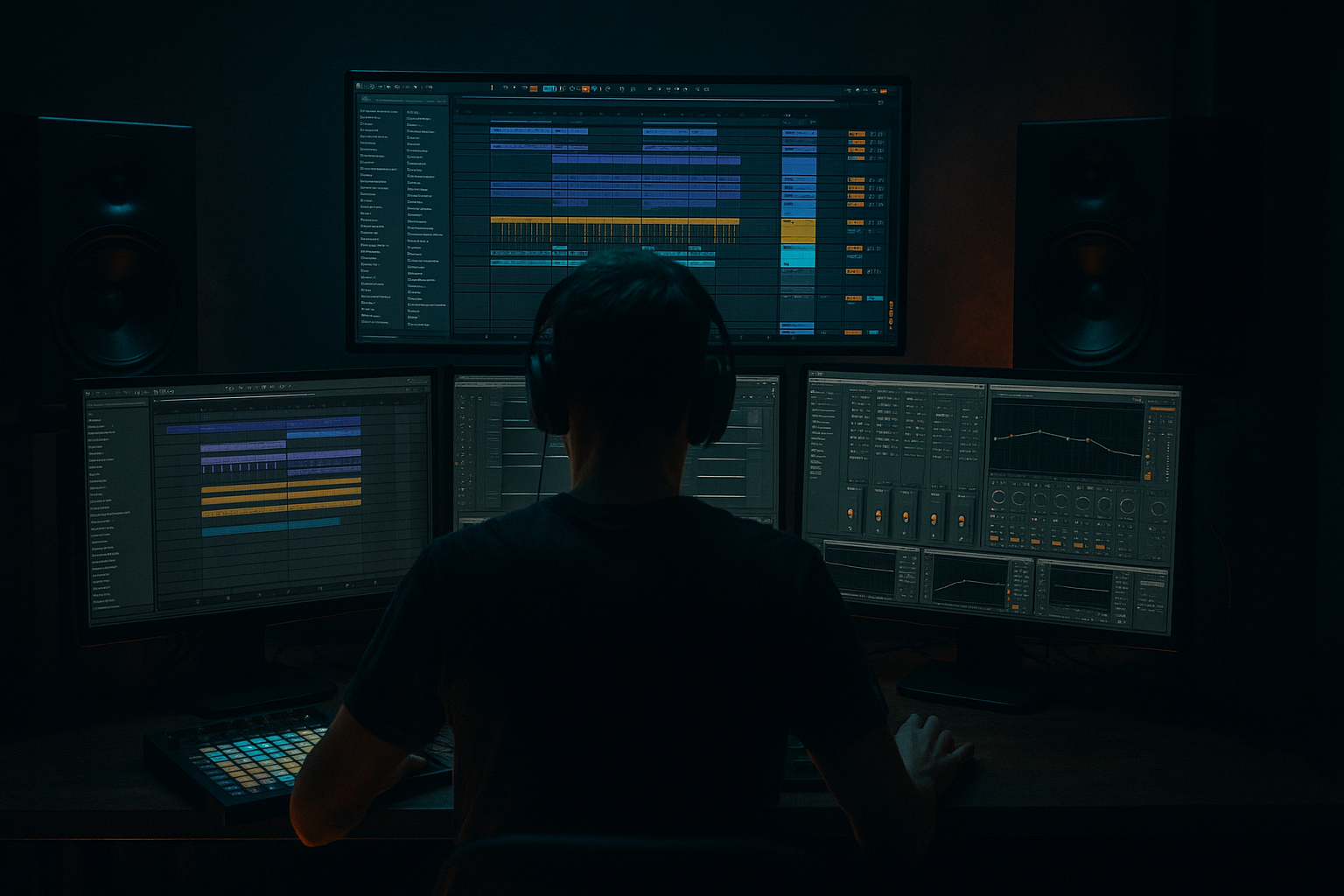
Main tutorial
Mid‑Track Fake Drop Design Masterclass (Resampling Only) — Ableton Live DnB Arrangement 🔥
1) Lesson overview
A mid‑track fake drop is that “YES—oh wait…not yet” moment: you tease the listener with drop energy, then pivot into a short, controlled detour (usually 4–16 bars) that resets tension and makes the real drop hit harder.
This masterclass is specifically for drum & bass / jungle / rolling bass in Ableton Live, and the key constraint is resampling only: you’ll create the fake drop using printed audio from your own session (no new synth patches required). You’ll learn a repeatable workflow to:
- Print hype material quickly
- Chop it into fake‑drop phrases
- Build tension with audio processing + arrangement
- Re‑impact into the real groove with maximum weight 💥
- Bar 1–4: Drop tease (half‑bar impact, bass hint, drums “about to go”)
- Bar 5–12: Fake drop section (deceptive groove + tension loop + reese “ghost”)
- Bar 13–16: Rebuild + snare roll + pre‑impact
- Then back into full drop with a stronger slam
- Solo nothing (full mix playing)
- Record 8 bars into `PRINT_RESAMPLE`
- Rename clip: `FULL_DROP_8`
- Solo drums group (kick/snare/hats/break layers)
- Record 8 bars
- Rename: `DRUMS_8`
- Solo bass group
- Record 8 bars
- Rename: `BASS_8`
- Take a strong transient from `FULL_DROP_8` (a kick+snare moment or downbeat hit).
- Place it at Bar 1 beat 1.
- Then add 1/8 to 1/4 beat of silence right after.
- From `DRUMS_8`, take the first 1 bar of full groove.
- Immediately reduce it to a tease:
- From `BASS_8`, grab a 1‑bar phrase.
- Insert EQ Eight:
- Add Saturator (soft clip) for audibility without sub.
- Keep it quiet—it’s a ghost.
- Use `DRUMS_8` but slice to a pattern:
- Make it feel like it’s “dropping” but wrong for the track.
- Use `DRUMS_8` and set clip to Warp: Beats
- Chop 1–2 beat bits and repeat them to create a stuttery loop.
- Keep it filtered so it doesn’t steal from the real drop.
- Take a spicy 1/2‑bar from `FULL_DROP_8` (something with movement: hats + bass mid + fx).
- Put it on `FD_TENSION_LOOP`.
- Warp it:
- Now create tension via automation:
- On `FD_BASS_GHOST`, place short bass stabs from `BASS_8`.
- Processing chain (stock):
- At the end of bar 12, do a 1 beat cut:
- Create a reverb throw on a drum hit or vocal.
- Route sends to `LONG_VERB`.
- Resample the return:
- Place that tail into `FD_FX_IMPACTS` and reverse it:
- Fade in to bar 13 for a vacuum‑suction feel.
- Grab a clean snare hit from `DRUMS_8`
- Duplicate into a roll (1 bar or 2 bars)
- Increase density:
- Add Drum Buss:
- Take a hat loop from `DRUMS_8`
- High‑pass it hard (EQ Eight, HP at 3–6 kHz)
- Add Reverb (big), then Resample it
- Reverse the resampled clip and fade in over 2–4 bars
- Add Auto Filter LP opening upward for lift
- Use a resampled kick+sub hit from the real drop (or just the kick if you want restraint).
- Place it on the last beat before the drop.
- Add Saturator (Soft Clip ON) for perceived loudness.
- Remove sub for 1–2 beats (or thin it) so the return is huge
- Narrow stereo (Utility width down to 70–90%) then snap back to 120%
- Pull back the drum bus by 1–2 dB for 1 bar, then restore
- Make sure there’s a clean transient (don’t smear it with too much pre‑drop reverb)
- If you used heavy filtering/Redux in the fake drop, the clean full‑band return will feel monstrous
- Fake drop is too long: If it’s not evolving, 16 bars can feel like a mistake. Add automation every 2–4 bars.
- Too much sub during the fake: If the sub is already present, the real drop loses impact. Keep fake bass mostly midrange.
- No clear “rug pull”: You need a deliberate cut, reverse tail, or pattern flip so the listener understands it’s intentional.
- Over-warping full mixes: Complex Pro is powerful, but too much can blur transients. Use drums-only prints for rhythm clarity.
- Cluttered transitions: Too many fills, too many risers. Pick 1–2 hero transition ideas and commit.
- Make the fake drop feel “corrupted”
- Neuro-style tension with resampled bass
- Use reverb as a weapon
- Keep kick/snare identity consistent
- Add “airless” moments
- A great mid‑track fake drop is arrangement + contrast: tease → deny → rebuild → slam.
- Resampling-only workflows are fast and cohesive because you’re rearranging your own sonic identity.
- Key tools in Live: Resampling input, EQ Eight, Auto Filter, Saturator, Redux, Utility, Drum Buss, Reverb.
- Make it DnB by keeping energy high, chopping rhythmically, and controlling sub so the real drop wins every time.
---
2) What you will build
A 16‑bar mid‑track fake drop (works great around 2:00–3:00) consisting of:
All created using resampled audio from your existing drop elements (drums, bass, fx, vocals) and stock Ableton devices.
---
3) Step‑by‑step walkthrough
A. Session setup: make resampling painless ✅
1. Create a “PRINT” audio track
- Track name: `PRINT_RESAMPLE`
- Input: Resampling
- Monitor: Off
- Arm the track.
2. Set your loop region
- Loop the strongest 8 bars of your drop (the part you want to “fake”).
- We’ll print: drums, bass, and “full mix” variations.
3. Create 3 return tracks (optional but useful)
- `A: SHORT_VERB` → Reverb (short, tight room)
- `B: LONG_VERB` → Reverb (large hall, long decay)
- `C: DELAY_THROW` → Ping Pong Delay or Delay device
Keep sends low; you’ll resample the throws later.
---
B. Print your core materials (3 fast resamples) 🎛️
You want options to chop. Print these:
#### 1) Full drop print
#### 2) Drums-only print
#### 3) Bass-only print
Workflow tip: After each print, Consolidate (`Cmd/Ctrl + J`) so each clip is clean and starts on bar.
---
C. Create a dedicated Fake Drop Audio Group 📦
1. Make an Audio Group: `FAKE DROP BUS`
2. Inside it, add these audio tracks:
- `FD_FULL_CHOPS`
- `FD_DRUM_CHOPS`
- `FD_BASS_GHOST`
- `FD_FX_IMPACTS`
- `FD_TENSION_LOOP`
Drag your printed clips into these tracks (duplicate as needed).
---
D. Design the “Drop Tease” (Bars 1–4) ⚡
Goal: convince the listener the drop is arriving, then deny it at the last moment.
1) Impact + micro‑silence trick
- You can cut the clip and leave a gap.
- Or use Utility automation (mute) for clean silence.
2) “Almost-drop drums”
- Keep kick + snare only or
- High‑pass the drums so they feel “thin”:
- Add EQ Eight
- Enable HP filter around 180–300 Hz, 24 dB/oct
- Optional: add Auto Filter with slight resonance (0.7–1.2) and automate cutoff down.
3) Bass hint (but no sub)
- High‑pass around 90–130 Hz (steep)
---
E. Build the fake drop section (Bars 5–12): deception + tension 🧠
#### 1) The “fake groove”: half‑time or broken jungle illusion
DnB fake drops often work best when you switch the drum grammar.
Pick one:
Option A: Half‑time stomp
- Snare on beat 3 (half‑time)
- Sparse kick placements
Option B: Micro‑chopped break tease (jungle nod)
- Preserve: 1/16
- Transients: around 60–80
#### 2) Create a “tension loop” from resampled audio (the secret weapon) 🔁
This is where resampling shines.
- Warp Mode: Complex Pro (good for full mix textures)
- Formants: 0 to +20 (taste)
- Envelope: ~80–120
- Add Auto Filter
- Filter: LP24
- Resonance: 0.9–1.4
- Drive: 3–8 dB
- Automate cutoff from ~8–12 kHz down to 500–1k over 4–8 bars
- Add Redux (very lightly):
- Downsample: 2–6
- Bit reduction: 0–2
- Automate increasing toward bar 12 to “trash” it slightly
- Add Utility:
- Automate Width from 120% → 60% (narrowing builds pressure)
This gives you a loop that feels like the drop is “trying to break through.”
#### 3) Bass “ghost” layer (midrange only)
1. EQ Eight: HP at 120 Hz
2. Overdrive: Drive 10–25%, Tone 4–7 kHz
3. Auto Filter: automate cutoff to “talk”
4. Limiter (optional): tame peaks
Keep it midrange so the real drop sub still feels like a reveal.
---
F. Fake drop “rug pull” moment (Bar 12–13) 🧨
You need a clear pivot that says: “Nope.”
1) Hard stop
- Silence everything for 1/4–1 beat, OR
- Leave only reverb tail
2) Resampled reverb tail (classic)
- Solo the return or just record resampling while it plays
- Right‑click clip → Reverse
---
G. Rebuild into the real drop (Bars 13–16): snare roll + rising noise 🥁
All resampled, no new synth required.
#### 1) Make a snare roll from your own snare
- Bar 13: 1/8 notes
- Bar 14: 1/16
- Bar 15: 1/32 bursts (or triplets for jungle edge)
- Drive: 5–15
- Crunch: 10–30
- Boom: 0–10 (careful pre-drop)
#### 2) Build a “noise riser” by resampling hiss
#### 3) Pre-drop impact
---
H. Make the real drop hit harder (contrast tactics) 💥
This is the whole point.
Right before the real drop:
On the real drop downbeat:
---
4) Common mistakes
---
5) Pro tips for darker/heavier DnB 🖤
- Use Redux subtly + Auto Filter resonance sweeps
- Add Pedal (if available in your Live version) or Overdrive to trash mids
- Chop bass midrange phrases, then automate filter cutoff + Saturator drive
- Gate it rhythmically by manual chops (audio cuts) instead of sidechain—keeps it “printed and brutal”
- Print long reverb tails and reverse them into key hits (snare, vocal, foghorn FX)
- Even if the fake groove flips to half-time, keep the snare tone recognizable so the track still feels like itself.
- Automate Utility Gain down 1–3 dB and Width down before the drop; return to full for maximum slam.
---
6) Mini practice exercise (20 minutes) ⏱️
1. Pick an existing 32‑bar drop from your project.
2. Resample:
- `FULL_DROP_8`, `DRUMS_8`, `BASS_8`
3. Create a 8‑bar fake drop:
- Bars 1–2: drop tease (impact + micro‑silence)
- Bars 3–6: half‑time fake groove using drum resample
- Bars 7–8: snare roll + reversed reverb tail
4. Rule: you may only use audio clips from your resamples (no new MIDI instruments).
5. Bounce the section and A/B it:
- Does the real drop feel bigger after it?
- If not, remove more low end in the fake, and add a stronger rug pull.
---
7) Recap
If you want, tell me your subgenre (roller / dancefloor / neuro / jungle) and tempo, and I’ll propose a specific 16‑bar fake drop storyboard with exact bar-by-bar drum and bass moves.

