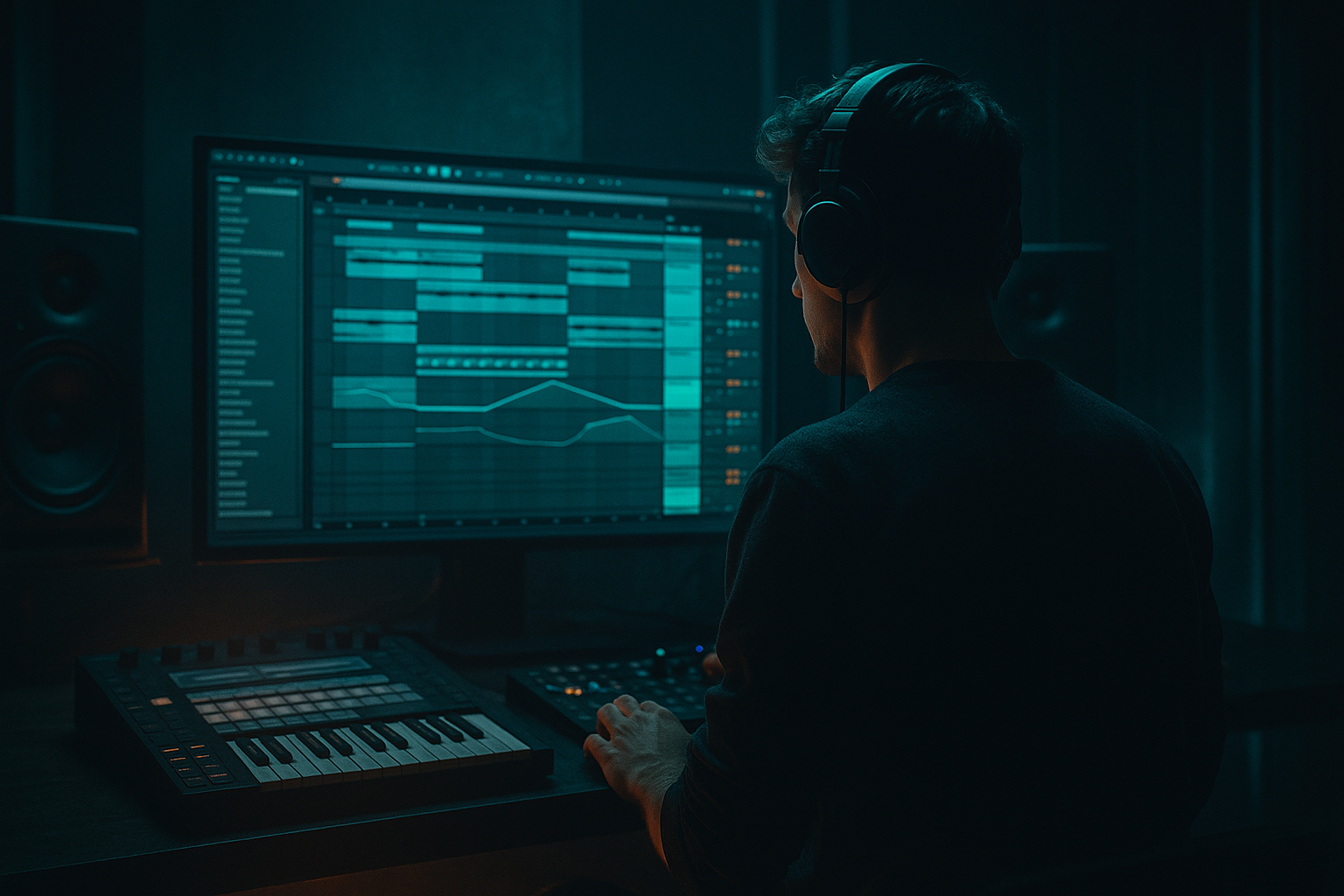
Main tutorial
MIDI Motif Variation (DnB in Ableton Live) 🎛️🥁
Skill level: Beginner • Category: Composition • Focus: Turning one simple MIDI idea into multiple DnB-ready variations (without losing the groove)
---
1. Lesson overview 🚀
In drum & bass, the best tunes often come from a small, memorable musical idea (a “motif”) that evolves over time. The trick is: change it enough to stay exciting, but not so much that it stops feeling like the same tune.
In this lesson you’ll learn a practical workflow in Ableton Live to create variations of a MIDI motif using:
- Rhythm changes (syncopation, gaps, pickups)
- Note changes (inversions, octave jumps, passing tones)
- Automation + articulation changes (velocity, filter, FX)
- Ableton tools (MIDI Transformations, Random/Velocity, Scale, Arpeggiator)
- A 4-bar MIDI motif (keys/pad/lead—your choice)
- 3 variation clips that feel connected but evolve:
- Wavetable
- Analog
- Bars 1–2: a short call phrase
- Bars 3–4: a response phrase
- Notes that land just before the snare (the “pickup” feeling)
- Spaces on strong beats to let drums punch
- Put a note on 1.1
- Add a note around 1.3.3 (syncopation)
- Add a note just before snare: 1.1.4 or 1.2.4 style placements (depending on grid)
- Repeat with a slight twist in bars 3–4
- Main notes: ~90–110
- Ghost notes: ~40–70
- `Motif A - Base`
- `Motif B - Rhythm`
- `Motif C - Melody`
- `Motif D - Energy`
- Add a groove like Swing 16-XX (subtle!)
- Apply at 10–20% to avoid turning it into house swing.
- Take one 3-note part and reorder it:
- Drums minimal (hats + tops)
- Use `Motif A - Base` with a filter (low-pass it)
- Add noise riser or atmosphere
- Full drums + bass
- Bars 1–16: `Motif A - Base`
- Bars 17–32: switch to `Motif B - Rhythm` (keeps it rolling)
- Pull drums back
- Use `Motif D - Energy` with automation (filter opens + more delay)
- Bring in `Motif C - Melody` for lift (octave/inversion changes)
- Final 8 bars: mix `Motif B` + `Motif D` energy tricks (stutters, automation)
- Use minor 2nd tension: Add a note 1 semitone above your root occasionally (very sparingly) for menace.
- Call/response with bass: Let the motif play for 1 bar, then leave a gap where the bass does a growl/yee.
- Resample and re-chop:
- Make variations with FX, not notes:
- Darker space:
- Auto Filter (movement + DJ-style sweeps)
- Saturator (weight + aggression)
- Echo (dark rhythmic space)
- Redux (grit, very subtle)
- Drum Buss (for drum weight; keep Boom controlled)
- A motif is a small musical identity—DnB tracks live on how you develop it.
- Build variations by changing:
- Use Ableton tools: Scale, Random, Velocity, Groove Pool, Auto Filter, EQ Eight, Saturator, Echo.
- Arrange with intention: 8/16/32-bar phrasing keeps it feeling like real drum & bass.
All examples are geared toward rolling DnB / jungle / darker steppy vibes. 🖤
---
2. What you will build 🧱
You’ll create:
1) Base motif (recognizable hook)
2) Rhythmic variation (more syncopation/space)
3) Melodic variation (octaves/inversions/passing notes)
4) Energy variation (same notes, different delivery via velocity + automation)
Then you’ll place them into a simple DnB arrangement (intro → drop → 16-bar development → mini break → second drop).
---
3. Step-by-step walkthrough ✅
Step 0 — Session setup (fast and clean)
1. Tempo: set 174 BPM (classic DnB range: 170–176).
2. Create tracks:
- MIDI Track 1: `Motif Synth`
- MIDI Track 2: `Bass (optional)`
- Audio/MIDI Track: `Drums` (or use Drum Rack)
3. Add a basic drum groove so you compose in context:
- Use a Drum Rack and program:
- Kick on 1
- Snare on 2 and 4
- Hi-hats: 1/8 or 1/16 with some velocity movement
Tip: Motif variation is easier when you hear it against a proper DnB pocket. 🥁
---
Step 1 — Choose a simple, DnB-friendly sound
On `Motif Synth`, load one of these stock options:
Option A (clean + modern):
- Osc 1: Basic Shapes (saw/square blend)
- Filter: LP24, cutoff ~ 3–6 kHz, slight drive
- Add Unison: 2–4 voices (keep subtle)
Option B (classic + warm):
- Two saws, slight detune
- Filter LP with a little envelope
Device chain suggestion (stock):
1. Wavetable/Analog
2. EQ Eight
- High-pass around 120–200 Hz (leave room for bass/sub)
3. Saturator
- Drive 2–5 dB, Soft Clip ON (listen for edge, not harshness)
4. Delay (or Echo)
- 1/8 or dotted 1/8, low feedback (10–20%), filter the repeats
5. Reverb
- Short (Decay ~1.2–2.0s), low mix (5–12%), high-pass the reverb
---
Step 2 — Write the base motif (4 bars)
We’ll use a minor key that suits darker DnB.
Try F minor (easy and moody).
1. Create a 4-bar MIDI clip on `Motif Synth`.
2. Set Grid to 1/16 (right-click in MIDI editor).
3. Keep it simple: aim for 5–7 notes total across 4 bars.
Example motif (notes idea, not mandatory):
A DnB-friendly rhythm often includes:
Quick rhythm recipe:
Velocity:
This will matter later when you vary the feel. 🎯
---
Step 3 — Duplicate clips to create variations (the pro workflow)
In Session View, duplicate the clip 3 times:
Now you can A/B them instantly.
---
Step 4 — Variation 1: Rhythm (same notes, different groove) 🥁
Goal: Keep pitch mostly the same so it still feels like the motif, but make it roll differently.
In `Motif B - Rhythm`:
1. Delete 1–2 notes (space = impact in DnB).
2. Move 1–2 notes earlier by 1/16 (or later for drag).
3. Add one pickup note right before a snare hit (common DnB tension move).
4. Add a short stutter at the end of bar 4:
- Duplicate a note to create a 1/16–1/16–1/8 pattern
Ableton tool: Groove Pool
DnB tip: Keep the motif rhythm interlocking with hats/percussion. If drums are busy, your motif should leave holes.
---
Step 5 — Variation 2: Melody (same rhythm, new contour) 🎹
Goal: The listener still recognizes the rhythm, but pitch changes create development.
In `Motif C - Melody`:
1. Keep 80–90% of the rhythm identical.
2. Change 2–3 notes max:
- Move one phrase up an octave for lift (classic “second 8 bars” energy).
- Use passing tones (notes between chord tones) sparingly.
3. Use a scale constraint to stay safe as a beginner:
- Add Scale (MIDI Effect) before the synth
- Set it to map everything into F minor (or your chosen key)
Optional: Inversion trick (easy win):
- If it goes low → mid → high, try mid → high → low.
---
Step 6 — Variation 3: Energy (same notes, new articulation) 🔥
Goal: Same motif, but it feels like it’s ramping up to a drop or filling space in a breakdown.
In `Motif D - Energy`:
1. Velocity shaping:
- Accents on offbeats (e.g., 1.2, 1.4 areas) → velocity 105–120
- Ghost notes lower 35–60
2. Add note length variation:
- Make some notes shorter (pluck feel)
- Let the final note of bar 4 ring longer (mini “hook” moment)
3. Add controlled movement with automation:
- Automate synth Filter Cutoff to rise over 4 bars
- If using Wavetable: automate Filter Frequency or Env Amount
4. Add MIDI modulation with stock devices:
- Velocity (MIDI Effect): set to Compress slightly so soft notes aren’t too quiet
- Random (MIDI Effect): set Chance 10–20%, Choices 1–2 very subtle (good for humanized repeats)
Good DnB use: This is perfect for pre-drop tension or the second half of a 16-bar phrase.
---
Step 7 — Arrange it like a real DnB track (simple template) 🧩
Move to Arrangement View and lay out:
Intro (16 bars):
Drop 1 (32 bars):
Mini break (8 bars):
Drop 2 (32 bars):
Ableton workflow tip: Color-code the clips (Base = blue, Rhythm = green, Melody = purple, Energy = red). Your future self will thank you. 🎨
---
4. Common mistakes ⚠️
1. Changing too much at once
If rhythm and melody and sound design all change, it stops feeling like a motif. Vary one main dimension at a time.
2. Ignoring the bass/sub space
Motif notes too low will fight the sub. High-pass with EQ Eight and keep your motif mostly mid/high.
3. Over-swinging the groove
DnB swing is usually subtle. Too much Groove Pool swing can make it feel off.
4. No phrase structure
DnB often speaks in 8/16-bar sentences. If you loop 4 bars forever, it’ll feel unfinished.
5. Velocity all the same
Flat velocities = flat vibe. Accents and ghosts create roll. 🥁
---
5. Pro tips for darker/heavier DnB 🖤
- Freeze/Flatten your motif, then slice the audio for glitchy jungle-style edits.
- Automate Auto Filter (HP/LP), Redux (tiny amount), or Frequency Shifter (very subtle) for movement.
- Reverb: keep it short, filter lows out (Reverb has built-in EQ).
- Delay/Echo: filter heavily so it doesn’t smear the mix.
Stock devices that shine here:
---
6. Mini practice exercise 🧠
Do this in 15–20 minutes:
1. Write a 2-bar motif in F minor (keep it super simple).
2. Duplicate it into 4 clips.
3. Create variations:
- Clip 1: Base
- Clip 2: Remove 2 notes + add 1 pickup
- Clip 3: Same rhythm, move 2 notes up an octave
- Clip 4: Same notes, automate filter + change velocities dramatically
4. Arrange: 8 bars intro → 16 bars drop using at least two variations.
Goal: When you switch clips, it should feel like the same tune evolving, not a different loop.
---
7. Recap ✅
- Rhythm (syncopation, space, stutters)
- Melody (octaves, inversions, passing tones)
- Energy (velocity, note length, automation)
If you want, tell me your preferred substyle (liquid, jump-up, rollers, neuro) and I’ll give you a motif blueprint (rhythm + note approach + device chain) tailored to it.

