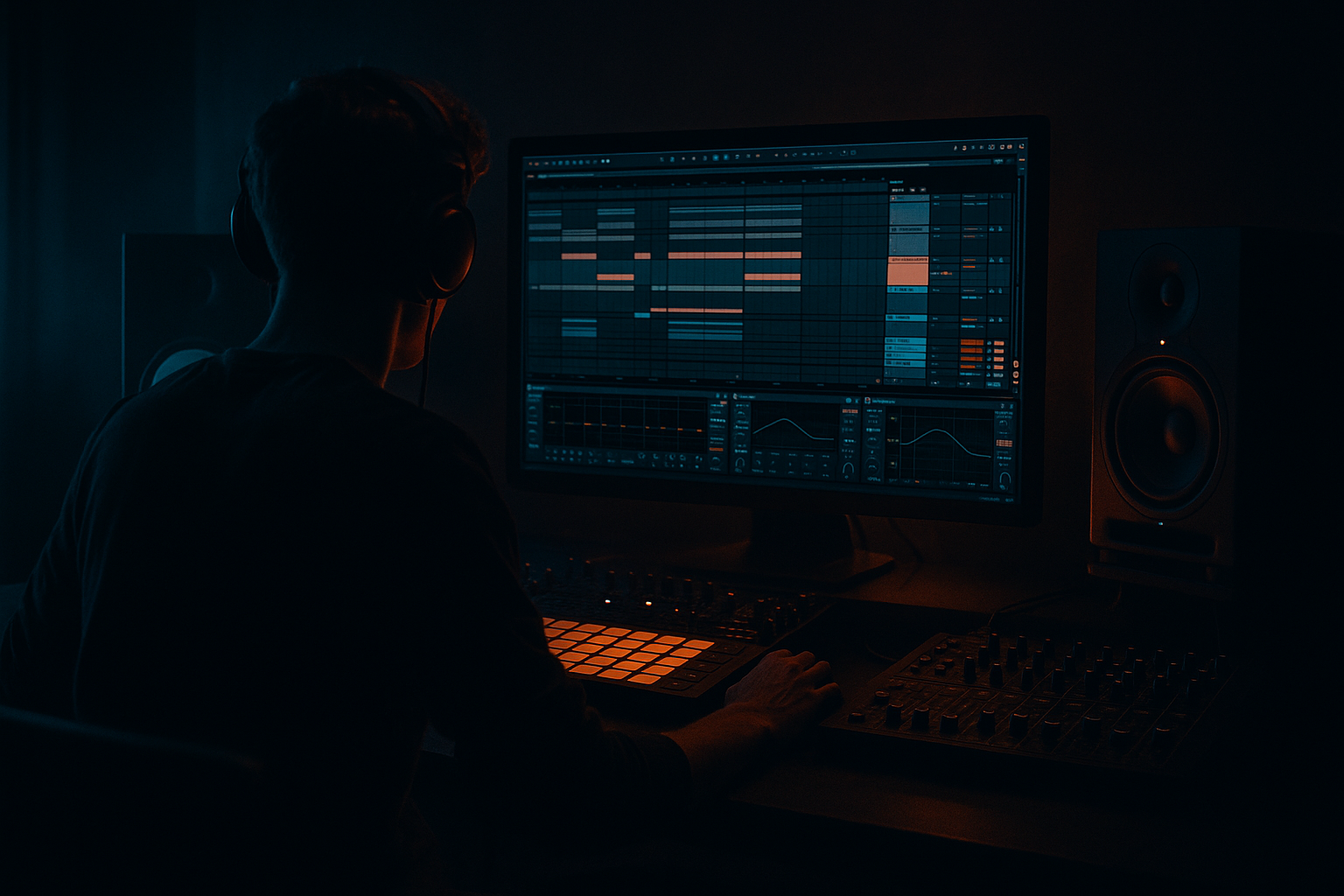
Main tutorial
Midnight Amen: Ableton Live 12 Breakbeat Course From Scratch
Category: Drums | Skill Level: Intermediate | Drum & Bass / Jungle / Rolling Bass Music 🥁
---
1. Lesson overview
In this lesson, you’ll build a dark, gritty amen-style breakbeat from scratch in Ableton Live 12, then shape it into something that actually works in a modern drum and bass / jungle / halftime-adjacent production.
We’re not just looping a break and calling it done. We’ll go through:
- finding and preparing an amen break
- slicing and re-sequencing it in a way that feels musical
- adding punch, swing, ghost notes, and variation
- processing it with stock Ableton devices
- making it sit in a midnight DnB context with sub-bass and atmosphere in mind
- a 1-bar or 2-bar amen pattern
- with a tight kick/snare backbone
- ghost hits and shuffle for movement
- controlled distortion and compression
- layered top-end texture
- a version that works for:
- jungle energy
- modern DnB punch
- dusty break texture
- slightly aggressive transient bite
- enough space for a sub and bassline
- Drum Rack
- Simpler
- Auto Filter
- EQ Eight
- Drum Buss
- Saturator
- Glue Compressor
- Utility
- Transient shaping via envelope edits / clip controls
- optional: Beat Repeat, Echo, Hybrid Reverb
- Drag a classic amen-style break into an audio track first.
- Then right-click and choose:
- kick
- snare
- closed hats
- open hats
- ride/metallic accents
- ghost snare hits
- raise its Gain a little if it feels weak
- add a touch of Start Offset if the transient is late
- keep the snare punchy, not washed out
- kick: strong but not clipping
- snare: slightly louder than kick in many DnB breaks
- ghosts: much lower level, around -8 to -14 dB below main hits depending on context
- Snare on 2 and 4
- Kick on the “and” of 1 and/or 3
- Add a few hat slices between
- Beat 1: kick
- Beat 2: snare
- Beat 3: kick or ghost hit
- Beat 4: snare
- quick ghost notes before the snare
- hat slice on offbeats
- one or two extra break hits for motion
- slight timing offsets
- velocity variation
- different sample lengths
- small gaps
- highlight notes in the MIDI clip
- use Velocity lane
- lower ghost notes dramatically
- leave some hits at full velocity for impact
- Delay some hats slightly late
- Push some ghost notes earlier
- Leave the main snare mostly locked
- High-pass below 25–35 Hz
- Small cut around 200–400 Hz
- Gentle boost around 3–6 kHz
- Optional shelf above 8–10 kHz
- Drive: 5–20%
- Crunch: low to moderate
- Boom: very careful
- Transients: slightly up for snap
- Soft Clip: ON
- Drive: 2–6 dB to start
- Output: compensate gain so you’re not just tricking yourself with volume
- try Analog Clip or a slightly harder curve
- don’t overdo it or the snare will get splatty
- Attack: 10–30 ms
- Release: Auto or 0.1–0.3 s
- Ratio: 2:1 or 4:1
- Aim for 1–3 dB gain reduction
- control overall level
- check mono compatibility
- narrow or widen if needed
- Bar 2: remove one kick
- Bar 4: add a quick snare roll
- Bar 6: insert a reversed break slice or fill
- Bar 8: strip back to kick/snare only for a transition
- Bars 1–2: minimal groove
- Bars 3–4: add hats and ghost notes
- Bars 5–6: introduce variation/fill
- Bars 7–8: intensify, then drop back
- Add tiny snare hits before main backbeats
- Keep velocity low:
- Shorten note length for a tighter tick
- fast snare doubles
- triplet bursts
- hat flurries
- tiny reversed slices before the downbeat
- duplicate a clip
- zoom in and place quick note clusters
- use 1/16 or 1/32 grid when needed
- clean kick
- crisp snare/clap layer
- or a subby tom for weight
- EQ Eight
- Saturator
- maybe Transient shaping by shortening the sample or using Simpler envelope
- consistency
- punch
- mix translation on small speakers
- Use EQ Eight on the drums to avoid overloading the 50–90 Hz region if your bass owns that zone.
- If your kick is strong down low, make sure the sub bass isn’t fighting it.
- Use sidechain compression on the bass with Compressor or Glue Compressor triggered by the kick/snare if needed.
- drums: punch and texture
- bass: controlled sub + mid aggression
- atmosphere: wide but not muddy
- Hybrid Reverb
- Echo
- Auto Filter
- Bars 1–4: stripped break, atmosphere
- Bars 5–8: add hats, ghost notes, bass tease
- Bars 9–12: full breakbeat + bassline
- Bars 13–16: fill, drop, or breakdown turn
- automate Auto Filter cutoff
- automate Drum Buss drive slightly up for build sections
- automate reverb send on fills
- automate Utility width on top percussion
- tension
- transition
- bounce
- texture
- roll off some top end on the break if it’s too bright
- add subtle saturation instead of over-compression
- use short dark rooms on select hits
- Drum Buss with light crunch
- a small boost around 2–4 kHz
- layered noise or vinyl texture very quietly
- Auto Filter low-pass
- high-pass sweeps
- short echo throws on snare fills
- kick
- snare center
- sub bass center
- hats
- room ambiance
- effects
- change one ghost note
- swap one hat
- mute one kick
- add a reversed slice
- basic amen groove
- no fills
- one ghost note only
- add one extra hat slice
- slightly stronger saturation
- remove one kick
- add a snare pickup into bar 4
- add a quick fill or roll
- automate reverb send for the last snare hit
- use only stock Ableton devices
- keep the break punchy and dark
- leave space for a hypothetical bassline
- keep the loop playable at 172 BPM
- a real DnB phrase
- not just a chopped sample loop
- something you could place under a bass drop or intro
- Slice the break cleanly with Drum Rack / Simpler
- Program a strong kick-snare backbone
- Use ghost notes, swing, and variation
- Shape the sound with EQ Eight, Drum Buss, Saturator, Glue Compressor, Utility
- Leave space for the sub and bassline
- Use arrangement and automation to make the loop evolve
- exact MIDI placements
- device settings
- an 8-bar drum arrangement
- and a matching bass design section.
By the end, you’ll have a rolling, haunted, high-energy break that can sit under a dark bassline or drive an intro/drop on its own. 🌑
---
2. What you will build
You’ll create:
- intro tension
- main drop
- breakdown / build variation
Target sound
Think:
Core tools in Ableton Live 12
We’ll use:
---
3. Step-by-step walkthrough
Step 1: Set up the project
1. Open a new Live Set.
2. Set tempo to 170–174 BPM for classic DnB/jungle.
- Start at 172 BPM if you want a solid modern midpoint.
3. Create a MIDI track for drums.
4. Drop in a Drum Rack.
Why Drum Rack?
It gives you fast control over each slice, lets you process individual hits, and makes it easy to build variations.
---
Step 2: Find and load your amen
You have two good options:
#### Option A: Use a looped amen sample
- Slice to New MIDI Track
- Slicing preset: Transient
- This creates a Drum Rack with slices.
#### Option B: Use your own drum hits
If you want full control, build your own “amen-inspired” break using:
For this tutorial, use Option A to get the authentic break feel faster.
---
Step 3: Clean and prepare the slices
After slicing:
1. Open the Drum Rack.
2. Rename key pads:
- Kick
- Snare Main
- Ghost Snare
- Hat
- Break Tail / Ride if present
3. Check each slice in Simpler:
- Set mode to Classic if needed for more control.
- Turn on Snap if the transients feel messy.
- Shorten long tails if they overlap too much.
#### Important tuning move
For the main snare slice:
#### Practical cleanup
Use Clip Gain or Simpler volume to balance slices:
---
Step 4: Build the core groove
Now program a simple DnB break pattern.
#### Start with a 1-bar pattern:
Example rough placement:
Then fill in:
#### Keep it musical
A classic amen feels alive because it’s not perfectly rigid.
Use:
In Live:
---
Step 5: Add swing and human feel
A dark breakbeat lives or dies by groove.
#### Use Groove Pool
1. Open the Groove Pool.
2. Drag in a groove like:
- MPC swing
- 16th swing
3. Apply lightly:
- Timing: 10–30%
- Velocity: 5–15%
- Random: very subtle
#### Or do it manually
Rule of thumb:
Keep the backbeat strong and stable, let the ornamentation dance.
---
Step 6: Process the break for weight and grit
Now we shape it into a proper DnB drum bus.
Create a Drum Bus group for the rack or route the rack to a return track if you prefer modular control.
#### Suggested stock chain on the drum group:
1. EQ Eight
2. Drum Buss
3. Saturator
4. Glue Compressor
5. Utility
---
#### EQ Eight
Use EQ to clean and focus:
- removes unnecessary sub rumble
- if the break is boxy
- for snare crack and stick attack
- if the hats need air
Keep it subtle. Over-EQing breaks kills character.
---
#### Drum Buss
This is one of your best friends for DnB drums.
Suggested starting points:
- set boom frequency around 50–70 Hz
- only use if the kick needs extra low-end character
Use it to add density and excitement, not to destroy the break.
---
#### Saturator
Great for making the break feel louder and rougher.
Suggested settings:
If you want a darker tone:
---
#### Glue Compressor
For cohesion and punch.
Starting point:
This makes the slices feel like one drum performance instead of separate sounds.
---
#### Utility
Use Utility to:
For a heavy DnB break, keep the low end mono and let width come from hats, room, and FX.
---
Step 7: Add variation across 4 or 8 bars
A loop alone gets boring fast. Make a phrase.
#### Simple variation ideas:
#### Good DnB arrangement habit
Use this structure:
This is especially useful for dark intro loops and build sections.
---
Step 8: Create ghost notes and fills
Ghost notes are essential in jungle and darker rolling DnB.
#### How to program them
- around 15–45 depending on the sample
#### Fill ideas
Use:
In Live, you can:
Don’t make fills too busy unless the bassline and arrangement have room.
---
Step 9: Layer the break with a supporting drum hit
For modern DnB, it’s often smart to reinforce the break.
#### Add a supporting kick or snare layer
Create a second drum track with:
Process it lightly:
#### Why layer?
Because the original break gives movement, but the layer gives:
Keep the layer subtle. The break should still feel like the star.
---
Step 10: Create space for the bassline
A strong amen break must leave room for the sub and reese.
#### Carve space
#### Practical DnB balance
If your drums are too wide and messy, the bassline will disappear in the fog.
---
Step 11: Add dark atmosphere around the break
For “Midnight Amen” vibes, context matters.
Try a send with:
#### Example return chain:
1. Hybrid Reverb
- short dark room or small plate
- decay: short to medium
- low cut: fairly high
2. Auto Filter
- low-pass to keep reverb dark
3. Utility
- maybe widen the return slightly
Send only selected snare hits or fills to this return.
That gives you eerie space without washing out the groove.
---
Step 12: Commit to arrangement
Turn the loop into a proper DnB section.
#### A simple 16-bar arrangement idea:
#### Automation ideas
Even small automation makes the break feel alive and intentional.
---
4. Common mistakes
1. Over-processing the amen
A classic error is stacking too much compression, saturation, and EQ.
Fix:
Use processing with a purpose. If the break sounds dead, back off and restore the transient shape.
---
2. Too much low end in the break
The amen can carry muddy low frequencies that conflict with the bassline.
Fix:
High-pass the break gently and keep the true sub reserved for the bass.
---
3. Mechanical timing
Perfectly rigid breaks sound sterile.
Fix:
Use swing, subtle offsets, and velocity variation. Leave the snare backbone solid, but humanize the extras.
---
4. Overcrowding the groove
Too many slices, fills, and hats can make the break lose its impact.
Fix:
Make sure every extra hit has a job:
If it doesn’t serve the groove, remove it.
---
5. Ignoring the mix with the bass
A great break can still fail if it fights the bassline.
Fix:
Check the arrangement with bass present early. Don’t design the drums in isolation for too long.
---
5. Pro tips for darker/heavier DnB
Use darker sample treatment
To get a midnight feel:
Make the snare slightly ugly
A great dark DnB snare isn’t always clean.
Try:
Create tension with filtered percussion
Automate:
Use mono discipline
Keep:
Use width for:
Add micro-variation
Every 2 or 4 bars:
That tiny movement is what makes a break feel like a performance.
Try resampling
Once you like the break:
1. Record it to audio.
2. Chop the audio version again.
3. Process the resampled audio with new effects.
This is very common in jungle and modern DnB workflows. It gives you a more “finished” and aggressive character. 🔥
---
6. Mini practice exercise
Exercise: Build a 4-bar Midnight Amen loop
Create a 4-bar breakbeat with these rules:
#### Bar 1
#### Bar 2
#### Bar 3
#### Bar 4
Constraints
Goal
When you listen back, it should feel like:
---
7. Recap
You’ve now built a from-scratch amen break workflow in Ableton Live 12 for dark drum and bass.
Key takeaways
The real magic in DnB drums is not just the sample — it’s the way you sequence, process, and arrange it. Get that right, and even a simple amen becomes a proper midnight weapon. 🥁🌘
If you want, I can turn this into a full Ableton Live 12 project blueprint with:

