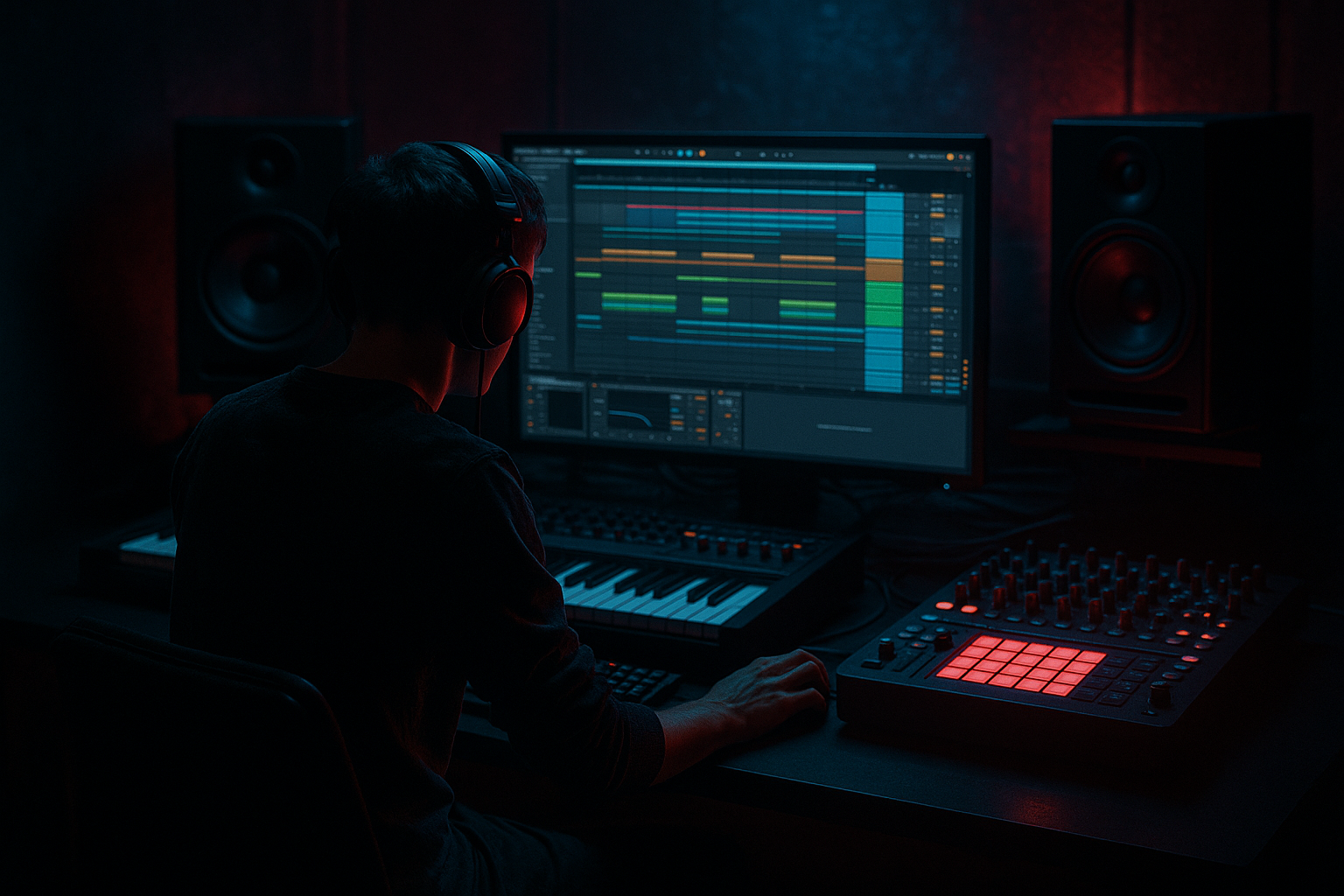
Main tutorial
Lesson Overview
The Midnight Amen approach is all about turning a vocal or amen-derived chop into a dark, vinyl-worn rhythmic texture that sits inside a jungle / oldskool DnB arrangement like it’s always belonged there. In Ableton Live 12, this means building a chopped-vinyl vocal texture that feels grainy, ghostly, and percussive, then shaping it so it can function as:
- a hooky texture layer in the intro
- a call-and-response motif after the drop
- a transition device between 8- or 16-bar phrases
- a lo-fi atmospheric glue over breaks and bass
- a chopped vocal texture with short, punchy syllables
- a vinyl-style degraded tone with controlled hiss, crackle, and midrange bite
- a pulsing rhythmic shape that can follow a jungle break or roller groove
- a version that works as:
- Making the vocal too intelligible
- Leaving too much low-mid buildup
- Overusing reverb
- Too much distortion too early
- Ignoring rhythmic placement
- Mixing the vocal louder than the drum groove
- Pair the vocal chop with a restrained reese bass
- Use micro-pitch movement
- Add a parallel dirt lane
- Mute the first hit of a phrase sometimes
- Use short delays for ghost call-and-response
- Keep the stereo width controlled
- Blend with break ambience
- Automate filter movement on 8-bar phrases
- chop for groove, not full lyrical clarity
- shape tone with EQ Eight, Saturator, Auto Filter, and light degradation
- place the chops in call-and-response with the break
- automate movement over 8- and 16-bar phrases
- keep the sound dark, controlled, and mix-friendly
Why it matters in DnB: jungle and oldskool-inspired drum & bass relies on movement, memory, and rhythmic character. A chopped vocal or “Amen-adjacent” texture can create that classic haunted energy without crowding your drums or bass. Done right, it adds identity without adding mud. Done wrong, it becomes a messy sample loop that fights the break and masks the sub.
In this lesson, you’ll build a Midnight Amen texture shape inside Ableton Live 12 using stock devices only, with a workflow designed for intermediate producers who already understand clips, warping, and basic mixing. We’ll focus on making the vocal behave like a vinyl-sampled rhythmic instrument — not a lead vocal, not a pad, but a gritty, usable DnB texture. 🖤
What You Will Build
By the end, you’ll have a playable Ableton rack or audio track setup that produces:
- a 16-bar intro layer
- an 8-bar tension loop
- a drop switch-up before a bass answer
- a breakdown ghost texture with automation
Musically, think of it as a half-heard vocal memory sitting in the pocket with your drums — something like a late-night radio fragment, an old rave sample, or a chopped record phrase that has been recontextualized for modern DnB.
Step-by-Step Walkthrough
1. Choose the source vocal and chop for rhythmic character, not clarity
Start with a short vocal phrase, spoken line, chant, or a single sung word with attitude. For this style, the best source is usually:
- a dry mono vocal
- a crowd chant
- a radio-style phrase
- a sample with strong consonants
Avoid pristine full-length vocal hooks at first. You want something that can be broken down into usable fragments.
In Ableton Live 12, drag the vocal into an audio track and use Warp if needed, but don’t over-polish it. For a midnight jungle vibe, imperfect timing is often part of the charm.
Good starting chop lengths:
- 1/8 note for tighter rhythmic stabs
- 1/16 note for frantic oldskool energy
- 1/4 note for sparse, eerie calls
Use Clip View to set a loopable region and experiment with cutting the vocal into 3–8 tiny slices. You’re not making a pop vocal edit here — you’re building a texture rhythm.
2. Build the “vinyl” layer with Simpler or Slice mode
Drop the chopped vocal into Simpler on a MIDI track. Use:
- Slice mode if you want each vocal fragment triggered by MIDI
- Classic mode if you want one-shot style control over a single chop
For this lesson, Slice mode is ideal because it gives you that “played from vinyl” feeling.
Suggested settings:
- Warp mode: Complex Pro only if the source really needs it; otherwise keep it simple and preserve transients
- Attack: 0–5 ms
- Decay: short, around 100–250 ms for stabs
- Voices: 1–4 if you want monophonic cutoff behavior
- Transpose: try -3 to -7 semitones for a darker feel, or leave pitch neutral if the phrase already has attitude
Map the slice root notes across a MIDI clip and play them like drums. The goal is to make the vocal groove with the break, not float above it.
Why this works in DnB: jungle and oldskool DnB often feel powerful because the ear hears rhythmic fragments rather than full melodic statements. Chopped vocals behave like percussion with personality, so they can lock into the break while adding a human edge.
3. Shape the tone with stock EQ, saturation, and degradation
Add an effects chain after Simpler:
- EQ Eight
- Saturator
- Redux or a gentle Erosion layer
- Auto Filter
Start with EQ Eight:
- High-pass around 120–180 Hz to keep low-end clear
- Slight cut around 250–450 Hz if the chop feels boxy
- If needed, a narrow dip around 2.5–4.5 kHz to tame harsh vocal spikes
Then add Saturator:
- Drive: 2–6 dB
- Soft Clip: On
- Try Analog Clip or Warmth style coloration through small drive increases
For grime and vinyl dirt, add Redux very lightly:
- Bit reduction: subtle; don’t annihilate the source
- Downsample just enough to roughen the top end
If you want hiss-like edge, Erosion is excellent:
- Mode: Noise
- Frequency: somewhere around 5–10 kHz
- Amount: very low, just enough to create a cracked texture
Finally, use Auto Filter to make the texture breathe:
- Filter type: Band-Pass or Low-Pass
- Resonance: moderate
- Map cutoff to automation for movement across phrases
Keep the texture dark enough to feel “midnight,” but not so filtered that it disappears.
4. Turn the vocal into a vinyl-like rhythmic instrument with envelope shaping
The key to the Midnight Amen feel is that the vocal should have a hit-and-fade shape similar to a sampled chop from a record.
In Simpler:
- Shorten Release so the chop doesn’t smear into the next transient
- Use the Volume Envelope to make each slice feel like a quick strike
- If the source has too much tail, reduce the Fade or trim the sample start/end in the clip
Try this envelope behavior:
- Attack: 0 ms
- Decay: short
- Sustain: low or off, depending on the phrase
- Release: short enough to avoid overlap, but not so short it clicks
Then add Shaper or Glue Compressor if the chops need more consistent punch:
- Glue Compressor:
- Ratio: 2:1 or 4:1
- Attack: 10–30 ms
- Release: Auto or around 0.1–0.3 s
- Aim for only 1–2 dB of gain reduction
The idea is to make the chops feel like they’re being played from a dusty sampler, not pasted on top of the mix.
5. Lock the chops to the drums with groove and call-and-response
Load or program a classic jungle break underneath — think Amen-style motion, but any fast, syncopated break will do. The vocal texture should either:
- mirror the break’s accents
- or answer the break between kick/snare hits
In Ableton, use the Groove Pool to add swing from a drum break or a subtle MPC-style feel. For a darker oldskool vibe:
- Start with around 55–58% swing
- Keep timing adjustments subtle
- Preserve the break’s natural forward motion
Write the vocal MIDI so it behaves like a drum phrase:
- Put chops on the off-beats
- Leave space on strong snare moments
- Repeat a 2-bar idea, then alter the last bar
Example arrangement context:
- Bars 1–8: intro with filtered vocal texture and break only
- Bars 9–16: bass enters, vocal chop becomes more sparse
- Bars 17–24: vocal answers the snare and reese
- Bars 25–32: drop switch-up with a chopped vocal fill before the next phrase
This is the classic DnB principle of phrasing by contrast: when the drums and bass are busy, the vocal should be short and precise; when the arrangement opens up, the texture can become more expressive.
6. Create movement with automation instead of adding more layers
Once the core chop works, make it evolve over time. In DnB, especially jungle and rollers, a repeating texture becomes powerful when it changes just enough each phrase.
Automate:
- Auto Filter cutoff for intro-to-drop movement
- Saturator drive to intensify later sections
- Reverb send for occasional ghost tails
- Delay send for call-and-response fragments
- Transpose for occasional pitch jumps or one-bar lift
Useful automation ranges:
- Cutoff sweep from 400 Hz to 4 kHz
- Delay feedback in the 10–25% range for short echoes
- Reverb send kept low, then briefly pushed at phrase endings
A very effective trick: automate the vocal chop to be more filtered during drum-heavy moments, then open it up during the last half of a 16-bar phrase. That gives the listener a sense of release without needing a new sound.
If your vocal chop is on an audio track instead of Simpler, you can also use Clip Envelopes to automate gain or filter movement per clip. This is especially useful for quick arrangement decisions.
7. Place it in the mix like a texture, not a lead
This is where many DnB vocal textures fail: they sit too loud and steal focus from the break and bass.
Keep the vocal chop tucked:
- Lower than the snare in perceived energy
- Clear enough to be heard when soloed, but not dominating the drop
- More present in the mids than the sub region
Mix checks:
- High-pass the vocal texture so it doesn’t touch the sub lane
- Keep mono compatibility clean
- If the sound is wide, make sure the center stays controlled
Ableton tools to use:
- Utility to check mono
- EQ Eight for carving
- Spectrum to see if the vocal is fighting the snare crack or bass harmonics
Try sidechaining the vocal texture lightly to the kick or drum bus if needed:
- Use Compressor with sidechain
- Keep it subtle; you want space, not pumping
This keeps the texture moving around the drums instead of flattening the groove.
8. Resample the whole texture for final control
Once the chain feels good, resample it. This is a very DnB-friendly workflow because it freezes your decisions and lets you treat the vocal as a finished sample source.
In Ableton:
- Route the vocal texture track to a new audio track
- Record a few bars of the performance
- Consolidate the best moments into loopable clips
Then you can:
- reverse one chop at the end of a 16-bar section
- create a short fill before the drop
- pitch a one-bar texture down for breakdown weight
- slice the resampled audio again for more variation
This is especially effective for oldskool jungle phrasing because resampling gives you the sense that the sound came from a one-off sampler performance, not a perfectly edited modern loop.
Common Mistakes
Fix: chop shorter, filter more, and treat it like rhythm first. If you can understand every word, it may be too front-facing for this technique.
Fix: high-pass around 120–180 Hz, then cut mud in the 250–450 Hz area if needed.
Fix: use short sends or pre-delay, and keep the chop dry enough to stay punchy. In DnB, too much reverb can smear the break.
Fix: add saturation gradually. The texture should feel worn, not destroyed.
Fix: make the vocal answer the snare or fill gaps in the break. If it lands randomly, it won’t feel like jungle phrasing.
Fix: the break and bass are the engine. The vocal is the character layer.
Pro Tips for Darker / Heavier DnB
Let the vocal occupy upper mids while the reese stays wide but controlled. This contrast makes the texture feel bigger without clutter.
Small transpose changes on selected chops can create unease. Try one chop up +2 semitones, another down -3 semitones, then return to the root.
Duplicate the vocal texture and crush the copy with Redux + Saturator + EQ Eight, then blend quietly underneath. This gives weight without sacrificing clarity.
Leaving space before the vocal enters can make the next chop feel much heavier. Great for drop impact.
A very short delay throw on one chop can make it feel like an echoed record fragment moving through the room.
If you widen the texture, keep the low-mid center stable. Use Utility or subtle mid/side EQ thinking so the vocal doesn’t blur the bass foundation.
If you have room tone, vinyl crackle, or break noise, layer it quietly so the chop feels like part of the same dusty source universe.
Darker DnB thrives on motion. Small cutoff moves can make a repetitive chop feel alive across a whole drop.
Mini Practice Exercise
Spend 10–20 minutes building a Midnight Amen texture using only stock Ableton devices.
1. Pick a vocal phrase or spoken sample with attitude.
2. Slice it into 4–6 fragments in Simpler.
3. Program a 2-bar MIDI pattern that places chops around the snare gaps.
4. Add EQ Eight, Saturator, and Auto Filter.
5. Apply one of these tonal directions:
- Darker: high-pass at 150 Hz, saturate lightly, low-pass the top end
- More aggressive: add a touch of Redux and use band-pass filtering
6. Automate the filter over 8 bars.
7. Resample 4 bars and re-cut the best section into a short fill.
8. Check the sound in mono with Utility and make sure it still works against a break.
Goal: create one loop that could sit in a jungle intro or a drop switch-up without needing extra instruments.
Recap
The Midnight Amen approach turns a chopped vocal into a vinyl-worn DnB texture that acts like rhythm, atmosphere, and identity all at once. The key moves are:
If it feels like a haunted record fragment that pushes the track forward without stealing the drums, you’re on the right path.

