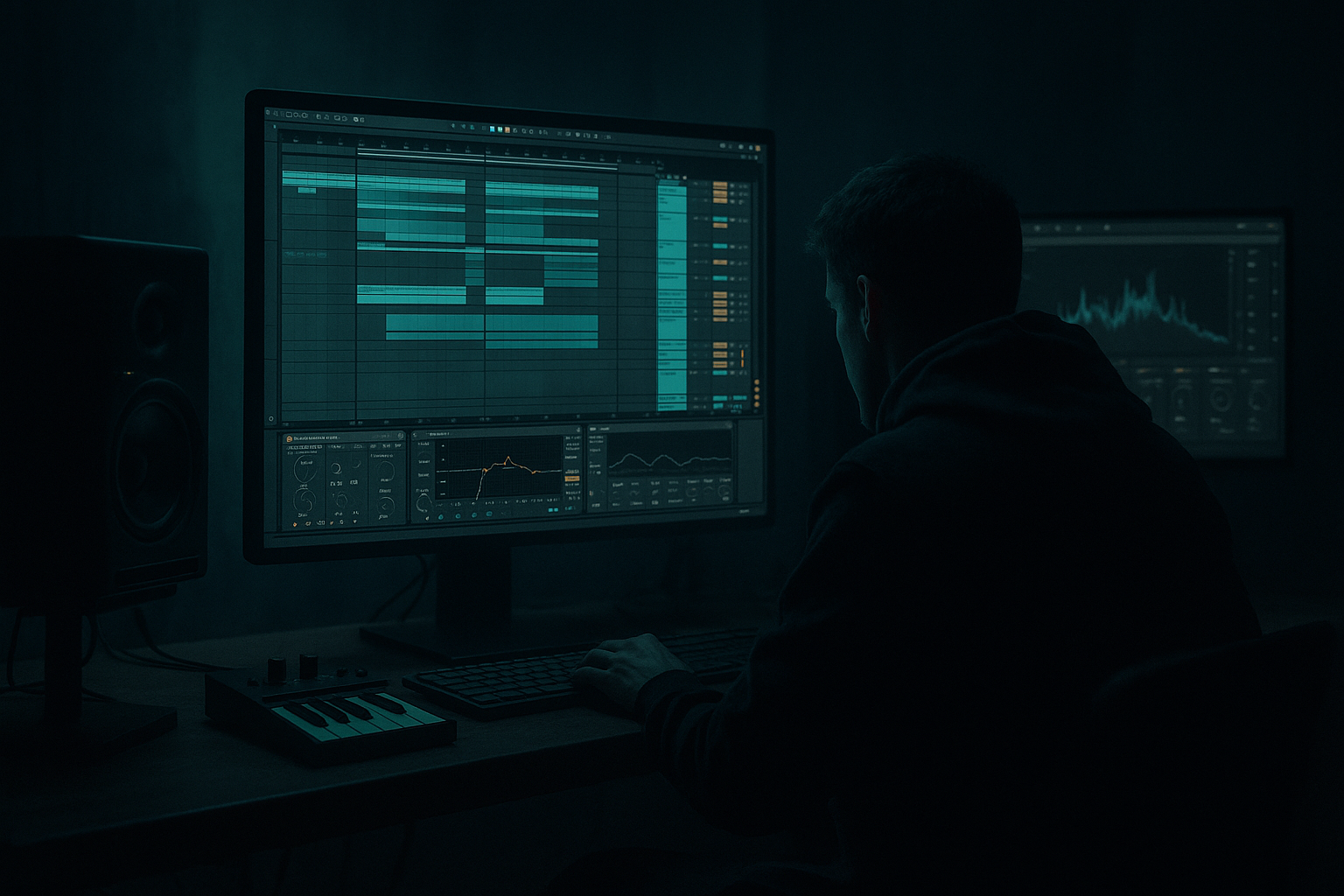
Main tutorial
Lesson Overview
This lesson is about building a Midnight Amen edit that opens like a warehouse tape: stripped, murky, and DJ-friendly, then gradually reveals the groove before the drop lands. The focus is a jungle / oldskool DnB intro route inside Ableton Live 12, using a classic Amen-led identity but shaping it for a modern club system.
This matters because intro design in DnB is not just “atmosphere before the drop.” It is where you establish tempo, weight, space, and tension without giving away the full drum/bass payoff too early. In a warehouse-style intro, the listener should feel the track arriving through fog: break fragments, distant hits, bass stabs, filtered noise, and a sense that the actual engine is still behind a door.
Musically, this technique lives in the first 16 to 32 bars of a track, especially in:
- Jungle / oldskool rollers
- Dark halftime or steppy DnB with breakbeat DNA
- Amen-heavy edits that need a cinematic but functional opening
- DJ-intro versions for mixing into a set
- a convincing warehouse mood
- a clear Amen identity without full drum overload
- a bass presence that feels ominous, not muddy
- a structure that works in a DJ set and survives a club system
- dusty break fragments
- filtered room tone and noise
- short bass stabs or a sub pulse
- worn, gritty, low-mid texture
- occasional reverse or delay tails for motion
- broken, syncopated, and intentionally incomplete
- enough swing and ghosting to hint at the full groove
- a gradual increase in drum clarity rather than a sudden jump
- intro before the main drop
- DJ mix-in friendly
- tension builder that previews the identity of the tune
- a route that can later be adapted into the outro or second-drop intro
- not final-master polished, but clear enough to sit in a rough arrangement
- low-end controlled enough to keep the drop powerful
- stereo effects used carefully so the mono core survives club playback
- Use break debris as texture, not just rhythm. A chopped Amen tail pitched slightly down and tucked under the groove can add menace without needing another bass layer. Keep it low in the mix and high-pass it so it stays as grit, not mud.
- Create weight through phrasing, not constant sub. A sub pulse on the off-beats or the end of a 2-bar phrase often feels heavier than a sustained note because the gap lets the kick breathe.
- Drive the break before EQing it hard. A small Saturator push before EQ can create the harmonic edge that makes a filtered Amen still feel alive. Then EQ the ugly resonances after the tone is established.
- Use a short reverb on selective hits, not the whole break. A snare hit with a compact room can make the warehouse feel physical. Keep decay modest so the groove stays punchy; the goal is depth, not wash.
- Keep the top end disciplined. Dark DnB intros often fail because hats and air noise become tiring. If the atmosphere is bright, let the drums stay darker; if the drums are crisp, keep the ambience veiled.
- Resample your favorite intro moment. If bars 13–16 accidentally create magic, bounce them and re-edit the audio. Printed audio lets you carve the tension more aggressively and commit to the character instead of endlessly tweaking MIDI.
- Think in DJ mix energy. An intro that sounds slightly underpowered in solo can be perfect in a transition. If the groove is clear and the low end is controlled, it will often feel stronger once it is layered with another tune.
- Use only stock Ableton devices
- Use one Amen break source
- Use one atmosphere layer
- Use one bass hint layer only
- No more than 6 total tracks
- a 16-bar intro with:
- Can you mute the atmosphere and still hear the groove?
- Does the bass stay mono and controlled?
- Does the last bar create more tension than the first bar?
- Does the section feel like it belongs in a real DnB arrangement, not just a loop?
Technically, it matters because an intro can easily become either too empty to feel like a track, or too busy to leave room for the drop. The goal is a controlled build that suggests the main groove before it fully appears. By the end, you should be able to hear:
A successful result should feel like this: cold, rhythmic, and suspenseful, with enough groove to move the head, but enough restraint to make the drop feel inevitable.
What You Will Build
You will build a 32-bar intro route in Ableton Live that starts with atmosphere and break texture, introduces an edited Amen motif, and then tightens into a pre-drop tension lane. The finished result should sound like a warehouse tape intro with oldskool jungle character, not a generic ambient lead-in.
Sonic character:
Rhythmic feel:
Role in the track:
Mix-ready level:
In plain terms: you are building an intro that feels like it was found in a locked warehouse room and cut into a modern DnB arrangement.
Step-by-Step Walkthrough
1. Set the project up like a DJ-facing intro, not a loop sketch
Start with a 174 BPM project in Ableton Live 12. Put down a 32-bar arrangement lane and mark the key sections: bars 1–8 atmosphere, bars 9–16 break emergence, bars 17–24 bass hint, bars 25–32 pre-drop tightening. That phrasing gives you room to reveal the groove without rushing it.
Load your main break source first. If you have an Amen sample, place it on an audio track and warp it cleanly so it locks to the grid without sounding over-quantised. For this style, do not force every slice perfectly rigid; the charm comes from a slightly human break feel. You want the kick/snare relationship to stay recognisable, but the micro-edits can breathe.
If the intro will be used in a real mix, leave a few bars of simple material at the very start so another track can blend in. A DJ-friendly intro usually benefits from a slower reveal than your own production instincts might want.
What to listen for: the break should already imply forward motion even before the full pattern appears. If it feels static, you probably need more ghost hits or a better placement of the first snare accent.
2. Build the core Amen edit by slicing for groove, not by chopping randomly
Use Slice to New MIDI Track or manually cut the Amen into a Drum Rack. For an intermediate workflow, Drum Rack is the fastest way to control the edit. Keep the key hits on separate pads: kick, snare, hat tick, and any break tail fragments you want to reuse.
Start with a very simple 2-bar cell:
- bar 1: kick + snare identity
- bar 2: answer phrase with a break roll or pick-up
- leave small gaps so the intro breathes
The goal is not a full jungle beat yet. It is an edited fragment that sounds like a break record being pulled apart and reassembled in a warehouse.
Useful range: trim the most aggressive transient material on some slices by a few milliseconds if they are spiking too hard, and keep longer tail fragments for later. A tiny fade on clipped slice edges can save the groove from clicks.
Why this works in DnB: Amen-based intros feel authentic because the break provides both rhythm and texture. You are not just programming drums; you are referencing an entire lineage of jungle and early DnB phrasing. The listener reads the break as “real” immediately.
3. Shape the break with a stock device chain that preserves punch
Put a simple processing chain on the break track or Drum Rack group. A reliable starting chain is:
EQ Eight → Saturator → Drum Buss
EQ Eight:
- high-pass very lightly if needed around 25–35 Hz to remove unnecessary rumble
- dip any boxy buildup around 250–400 Hz if the break feels congested
- if the snare bark is harsh, make a small cut around 2.5–5 kHz rather than flattening the top
Saturator:
- use a subtle drive, often in the 1–4 dB zone
- keep the output compensated so you are hearing tone, not just volume
- if the break is too polite, a gentler analog-style curve can add bite without trashing transients
Drum Buss:
- use modest Drive and Boom settings
- keep Boom disciplined; if the intro is already thick, too much low enhancement will cloud the bass entrance later
- use Transients to help the snare crack through the haze
What to listen for: the break should feel closer and dirtier without losing the shape of the snare. If the kick starts smearing, back off the saturation before reducing the transient shape.
4. Create the warehouse bed with atmosphere that supports the drums, not competes with them
Add a second audio track for atmosphere: field noise, room tone, vinyl hiss, distant machinery, rain, air-con rumble, or a heavily processed sample. Keep it low in the mix and loop it under the first 8 to 16 bars.
Process that layer with:
- Auto Filter to sweep from dark to slightly open over time
- Reverb with a long decay if you want size, but low wet level
- Utility to keep the low end mono or narrower than the drums
A practical move is to high-pass the atmosphere around 150–300 Hz so it never steals the sub lane. If the intro feels too clean, add a touch of grain through Saturator or a very subtle Overdrive-style push.
A useful decision point:
- Option A: wide and eerie — keep the atmosphere stereo, but thin it hard in the lows. This gives a cinematic warehouse halo.
- Option B: narrow and brutal — keep the atmosphere more central and dry, which makes the drums feel heavier and more “in the room.”
Choose A if you want haunting space. Choose B if the tune needs a more oppressive, close-up vibe.
5. Introduce the sub/bass hint like a threat, not a full statement
For a Midnight Amen intro, the bass should often arrive as a hint before it becomes the main low-end statement. Use a simple bass stab, sub pulse, or reese fragment on a dedicated bass track. Keep it sparse: one note or two-note answer phrases are enough in the intro.
A solid chain for a bass hint is:
Operator or Wavetable → Saturator → Auto Filter
If you are using Operator, build a clean sine or near-sine sub with a short amp envelope. If you are using Wavetable, choose a darker source and keep the movement restrained. Then:
- Saturator: subtle drive, enough to make the bass audible on smaller systems
- Auto Filter: automate a low-pass opening slowly across 8 or 16 bars
Useful ranges:
- sub note length: short and deliberate, often under 1 beat in the intro
- filter sweep: roughly from very closed to moderately open, not full brightness
- bass level: low enough that it implies pressure, not full drop energy
What to listen for: the bass hint should feel like it is under the break, not on top of it. If the kick disappears, the bass is too long, too wide, or too loud.
Mix-clarity note: keep the sub part mono. Use Utility to collapse it if needed. Anything decorative can widen later, but the core weight must survive in mono.
6. Program tension through phrase length and call-and-response
Now write the intro like a conversation. Do not let every bar say the same thing. A strong warehouse intro often works in 4-bar statements:
- bars 1–4: atmosphere and fragment
- bars 5–8: first Amen identity
- bars 9–12: answer phrase with a bass hint
- bars 13–16: a small rise in density
- bars 17–24: more drum clarity and a stronger low-end cue
- bars 25–32: pre-drop tightening and a final tease
Keep the call-and-response logic simple:
- break phrase answers itself
- bass stabs answer the snare
- noise swells answer the gaps
This is where arrangement matters more than more sounds. If you want the intro to feel professional, let silence and contrast do part of the work.
A useful listening cue: if you mute the atmosphere, the groove should still make sense. If you mute the drums, you should still feel a sinister pulse from the bass and effects. If neither check passes, the arrangement is probably over-reliant on one layer.
7. Use automation to reveal the track in a controlled way
Automate only a few key parameters so the intro feels intentional:
- Auto Filter cutoff on the break or atmosphere
- reverb send amount for selected hits
- delay feedback on rare throws
- bass filter opening
- overall drum group dryness
Keep automation moves musical and measurable. For example:
- open a filter from dark to slightly brighter over 8 bars
- raise delay feedback briefly on the last snare of a phrase
- shorten reverb decay as the drop approaches so the groove feels tighter
- nudge a snare’s send up only on a transition hit
If the build becomes too obvious, reduce the number of automated moves. This style works best when the listener feels the change more than they can name it.
Stop here if the intro already carries tension and the arrangement reads clearly. Do not keep layering just because the section feels unfinished in solo mode. In DnB, clean tension often beats decorative density.
8. Check the intro in context with drums and bass before polishing further
At this point, audition the intro alongside the first drop or a drum-heavy section. This is where you find out if the warehouse route actually leads somewhere. If your intro sounds great alone but weak against the drop, it is probably too bright, too full, or too rhythmically resolved.
Listen for:
- whether the last 4 bars create expectation
- whether the drum hierarchy stays clear when the bass arrives
- whether the first drop still feels bigger than the intro
If the intro is stealing too much impact from the drop, pull back the brightness or remove one layer from bars 25–32. If it feels too weak, add one more short snare pickup or a filtered bass pickup before the drop instead of thickening everything.
Workflow efficiency tip: once the intro balances well, freeze or bounce key atmospheric and bass hint elements to audio if they are becoming CPU-heavy or if you want to commit to the vibe. Printing the move can help you stop endless tweaking and move into arrangement faster.
9. Choose your flavour: rawer Amen grit or cleaner club pressure
This is the key A versus B decision for the route.
A: Raw jungle tape flavour
- keep more break texture
- allow some transient roughness
- use darker filtering and looser edges
- preserve a slightly worn, sampled feel
B: Cleaner warehouse pressure
- tighten break edits more
- control the top end with gentler EQ
- let the bass hint read more clearly
- reduce noisy tails so the drop hits harder
Both are valid. Choose A if the track is leaning toward oldskool jungle energy, breakbeat nostalgia, or dusty roller menace. Choose B if the track needs club-function clarity and a more modern mix path while keeping the Amen identity.
The best answer is often genre-dependent: a pirate-radio-inspired intro can afford more grit; a label-ready dancefloor roller may need cleaner separation.
10. Polish the intro’s ending so the drop lands with authority
The final bar before the drop needs tension, not clutter. Consider one of these endings:
- a snare roll that gets slightly denser
- a reverse crash leading into the drop
- a final bass stab that cuts off early
- a filtered drum pickup that opens into the first kick of the drop
Keep the last transition short and readable. In warehouse DnB, the listener should feel the drop “snap in,” not drift in.
A strong ending often uses less than you think:
- one snare accent
- one filtered tail
- one bass cue
- one deliberate gap
That gap is the punch. If everything is active right up to the drop, the entrance loses authority.
Common Mistakes
1. Making the Amen edit too busy too early
- Why it hurts: if the intro starts with full break density, there is nowhere for the arrangement to grow.
- Fix: strip the first 8 bars back to key fragments and reintroduce ghost notes later in the phrase.
2. Letting the bass hint occupy full sub length
- Why it hurts: long sub notes blur the groove and steal weight from the drop.
- Fix: shorten the bass envelope or clip the note length so it behaves like a cue, not a full phrase.
3. Over-processing the break with too much low-end enhancement
- Why it hurts: Drum Buss Boom or heavy saturation can make the intro muddy and reduce kick/snare definition.
- Fix: reduce the low-end enhancement, high-pass the layer earlier, and restore punch with Transients instead of more boom.
4. Using wide stereo on the core groove
- Why it hurts: wide low-mid content can collapse badly in mono and weaken club translation.
- Fix: keep the sub mono with Utility and narrow the break’s low frequencies; let only top atmospheres spread wide.
5. Automating too many things at once
- Why it hurts: the intro starts sounding like a technical demo instead of a musical ramp.
- Fix: choose one main reveal parameter per 8-bar phrase, usually filter or density, and keep the rest stable.
6. No contrast before the drop
- Why it hurts: if the intro is constantly full, the drop does not feel larger.
- Fix: create a last-bar reduction. Remove a layer, thin the atmosphere, or leave a gap before the first impact.
7. Ignoring the intro in context with the drop
- Why it hurts: soloed intro decisions often overestimate how much presence is needed.
- Fix: audition the last 8 bars against the first drop section and remove anything that competes with the downbeat.
Pro Tips for Darker / Heavier DnB
Mini Practice Exercise
Goal: Build a 16-bar Midnight Amen intro that feels like a warehouse opener and leads cleanly into a drop.
Time box: 15 minutes
Constraints:
Deliverable:
- 4 bars of atmosphere
- 4 bars of break introduction
- 4 bars of bass hint and tension
- 4 bars of pre-drop tightening
Quick self-check:
If the answer to any of those is no, fix that before adding more sounds.
Recap
The Midnight Amen warehouse intro is about controlled revelation: break texture first, groove second, bass hint third, and drop tension last. Keep the Amen edit readable, the sub mono, the atmosphere filtered, and the arrangement phrased in clear 4-bar ideas. Use Ableton’s stock tools to shape tone, movement, and contrast, but do not overfill the space. The strongest result feels dark, functional, and inevitable — like the track has been waiting in the building all night and finally steps out.

