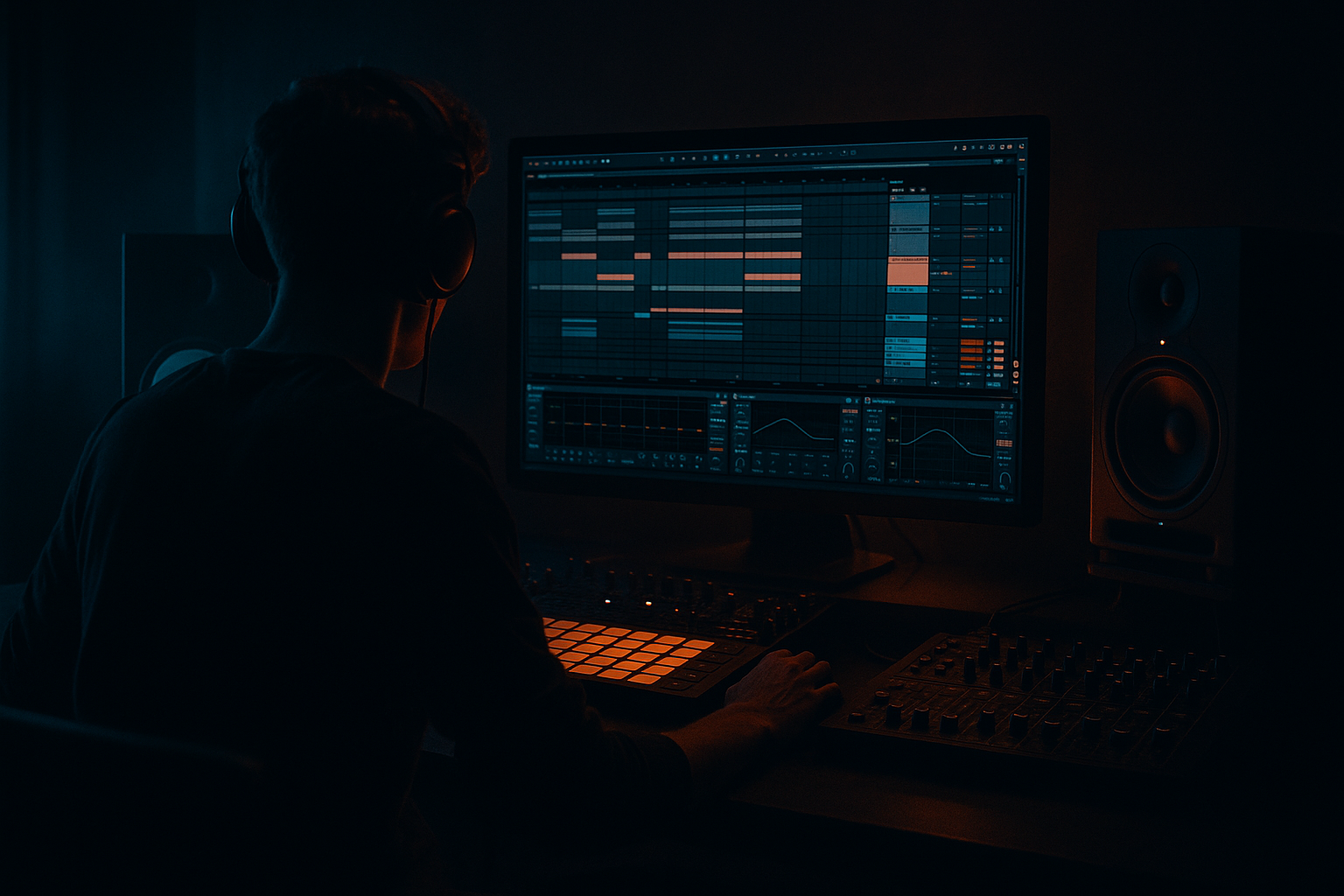
Main tutorial
Lesson Overview
In this lesson, you’ll build a Midnight Amen hoover stab stack and make it feel alive using Groove Pool tricks in Ableton Live 12. This is a classic DnB move: you take a short, aggressive stab sound, layer it into a stack, then push it with timing and swing so it sits like a proper DJ tool — something you can drop in an intro, use as a tension builder before the break, or fire as a call-and-response motif in the drop.
This matters in Drum & Bass because a plain stab can sound flat very quickly. The groove is what makes it feel human, dangerous, and dancefloor-ready. In darker DnB, jungle, rollers, and neuro-adjacent styles, tiny timing shifts and velocity changes are often the difference between “loop” and “serious weapon.” Groove Pool in Ableton Live 12 is perfect for this because it lets you borrow the feel from breakbeats, push your stabs behind the grid, and create motion without destroying the tightness of the mix.
We’ll keep this beginner-friendly, but still very real to how DnB producers work in the studio. You’ll use stock Ableton devices like Wavetable, Simpler, Auto Filter, Saturator, Echo, EQ Eight, Drum Buss, Utility, and Compressor to build a stack that feels gritty, controlled, and DJ-friendly. 🔥
What You Will Build
By the end of this lesson, you’ll have:
- A 3-layer hoover stab stack with a dark, tense character
- A Midnight Amen-style groove that pulls against the grid in a musical way
- A DJ tool loop that works as an intro tension element, breakdown phrase, or drop switch-up
- Clean low end discipline so the stack doesn’t fight the sub or kick
- A simple Ableton Live 12 Groove Pool setup using swing from an amen-type break
- Making the stack too long
- Too much groove amount
- Leaving low end in the stab layers
- Using one identical layer three times
- Overusing reverb
- Ignoring mono compatibility
- Use less brightness than you think
- Layer attack, not just thickness
- Resample the stack
- Automate groove feel sparingly
- Use call-and-response
- Keep one version drier
- Build your hoover stab stack from 3 simple layers with different roles.
- Keep the stabs short, dark, and rhythmically intentional.
- Use Groove Pool to borrow feel from an amen-style break and make the phrase breathe.
- Process the stack with stock Ableton devices like EQ Eight, Saturator, Drum Buss, Utility, and Compressor.
- Keep the low end clean, the stereo controlled, and the arrangement DJ-friendly.
- In DnB, groove is not decoration — it’s what makes the stab stack feel alive.
The final result should feel like a short, looping stab phrase with enough movement to keep a crowd locked in. Think: dark warehouse intro, 16-bar tension builder, or a quick four-bar drop weapon before the bassline opens up.
Step-by-Step Walkthrough
1. Set the project up for a DnB DJ-tool workflow
Open Ableton Live and set the tempo to 174 BPM. If you prefer a slightly heavier half-time feel, 172–174 BPM is still the sweet spot for modern DnB and jungle-influenced rollers.
Create three MIDI tracks:
- Track 1: Hoover Layer A
- Track 2: Hoover Layer B
- Track 3: Hoover Layer C
Also create one return track for Echo or use a send later if you want space. For now, keep it simple.
Why this works in DnB: fast tempos need fast decisions. A focused 3-layer stack gives you enough thickness without turning into a messy synth wall. This is especially useful for DJ tools, where you want something that reads clearly over drums and bass.
2. Build the base hoover sound with stock Ableton instruments
On Hoover Layer A, load Wavetable. Choose a bright saw-based starting point. If you don’t want to dive deep, start with a saw-heavy preset and simplify from there.
Suggested starting settings:
- Oscillator 1: Saw
- Oscillator 2: Saw or Square
- Unison: 4–7 voices
- Detune: small to medium amount
- Filter: Low-pass, cutoff around 1.5–4 kHz
- Filter envelope amount: moderate, enough to give bite
Add Saturator after Wavetable:
- Drive: 2–6 dB
- Soft Clip: On
Add EQ Eight:
- High-pass around 120–180 Hz
- If it gets harsh, dip 2.5–5 kHz by a few dB
This first layer is your core stab. Keep it solid, not huge. You want it to cut through the drums without stealing the sub’s job.
3. Create a second layer for movement and tension
On Hoover Layer B, duplicate Layer A or start another Wavetable instance. This layer should be slightly different so the stack feels wide and energetic, not duplicated in a boring way.
Try these changes:
- Detune a little more than Layer A
- Shift the filter cutoff slightly higher, around 2–5 kHz
- Add a very short Amp Envelope if the sound is too long
- Pan slightly left or right using the track pan, or keep it centered if the sound is already wide
Add Auto Filter after Wavetable:
- Mode: Band-pass or Low-pass
- LFO amount: very subtle, just enough to make the stab “breathe”
- If using envelope control, keep it subtle so the motion is felt more than heard
This layer is where the “midnight” vibe starts to appear. It adds edge and movement so the stack doesn’t feel static.
4. Add a gritty top layer for attack and DJ-tool presence
On Hoover Layer C, use Simpler instead of Wavetable. Load a short stab-like sample if you have one, or use a resampled synth hit from your own project. Keep it short and punchy.
If you want to synthesize it instead:
- Use a short noise burst or a sharper oscillator-based stab
- Keep the decay short
- High-pass it aggressively so it adds texture, not low end
Add Drum Buss:
- Drive: 5–15%
- Crunch: low to moderate
- Transients: slightly up if needed
- Boom: Off or very low
Add Utility:
- Width: 80–120% depending on how wide the layer feels
- Use mono if the top layer gets too smeary
This third layer gives you the “click” and “bite” that helps the stab stack read on club systems, especially when drums are busy.
5. Write a simple stab phrase with DnB phrasing in mind
Create a 2-bar MIDI clip on all three tracks and place the same notes on each layer so they stack together.
Start with a simple rhythm such as:
- Beat 1: stab
- Offbeat after beat 2
- Beat 3: stab
- Quick pickup before beat 4
Keep the notes short. A DnB stab often works best when it leaves space for the break and bassline. If everything is held too long, the groove gets cloudy.
Try a musical context like this:
- Bars 1–2: sparse stabs, almost like an intro tool
- Bars 3–4: add one extra stab on the last offbeat before the drop
- Drop section: use the phrase as a call-and-response with the kick/snare
Why this works in DnB: DnB is built on tension and release. Short stabs in strategic gaps let the break breathe. That space is what makes the groove hit harder when the full drum pattern returns.
6. Use the Groove Pool to give the stabs a broken-beat feel
Now the key part: give the stab stack a groove that feels borrowed from a breakbeat.
Open the Groove Pool in Ableton Live 12 and choose a groove from a drum break or swing-based groove. If you have an amen-style loop in the project, extract its groove or use its timing feel.
Apply the groove to your MIDI clip and start with these kinds of settings:
- Timing: around 20–55%
- Velocity: around 5–25%
- Random: keep low at first, around 0–10%
- Base: usually leave it near default unless the groove feels off
The goal is not to make the stabs sloppy. The goal is to make them sit like they were played against a live break. Small timing shifts help the stab stack feel glued to the drum movement instead of sitting perfectly robotic on the grid.
Tip: If the groove makes the first stab late enough to feel sluggish, reduce the timing amount. For beginners, less groove usually works better than more.
7. Humanize the stack with velocity and note length
Open the MIDI clip and adjust note velocities so not every stab hits the same.
Good beginner approach:
- Main accent stabs: higher velocity
- Ghost stabs or pickup notes: lower velocity
- Keep some notes slightly shorter than others
You can also vary the note length a little:
- Shorter notes for sharper hits
- Slightly longer notes for the main phrase-ending stab
If you want extra movement, duplicate the pattern and make small changes:
- Remove one stab in the second bar
- Shift one note slightly earlier or later
- Lower the velocity on the repeat
This is a classic DnB workflow: repetition with variation. It keeps the loop hypnotic, especially in rollers and darker bass music.
8. Process the full stack on a group bus
Select all three hoover layers and group them into an Instrument Rack or Group Track so you can process them together. This is where the stack starts feeling like one instrument instead of three separate parts.
On the group bus, try:
- EQ Eight: high-pass around 100–150 Hz to protect the sub region
- Compressor: light glue, 1–2 dB gain reduction
- Saturator: subtle drive for density
- Optional Echo on a send or return, set very short and filtered
If the stabs are fighting the kick/snare, reduce the low-mid range around 200–400 Hz slightly. That area can quickly get boxy in dark DnB stacks.
Keep the stack mono-compatible. Use Utility to check width if it starts sounding huge but vanishes in mono. In DnB, mono discipline is essential because the sub and kick need a stable center.
9. Automate for arrangement and DJ-tool usefulness
Make the stack useful beyond one loop. A proper DJ tool needs movement over time.
Automate:
- Filter cutoff up/down over 8 or 16 bars
- Saturator drive for buildup intensity
- Echo feedback for transition moments
- Reverb send only on the final stab before a section change
Arrangement ideas:
- Intro: stabs filtered and sparse, 8–16 bars for mixing
- Pre-drop: increase groove amount or filter openness
- Drop: full stack with tighter drums
- Switch-up: mute the top layer for 4 bars, then bring it back hard
A DJ-friendly approach is to make the first 8 bars clean enough for beatmatching, then gradually reveal the hoover stack. This gives the track proper utility in a set.
10. Check the balance against the drums and bass
Put the stab stack in context with your kick, snare, break, and sub.
Use these checks:
- If the stabs mask the snare crack, lower the 2–5 kHz range a little
- If they fight the sub, high-pass more aggressively
- If they feel weak, add a touch more saturation instead of just volume
- If they sound too wide and floaty, narrow the width or reduce reverb
A good DnB stab stack should feel like it is riding on top of the rhythm, not swallowing it. You want energy, not clutter.
Common Mistakes
- Fix: shorten the MIDI notes and the synth envelopes. DnB stabs usually need space.
- Fix: reduce Groove Pool timing to a smaller percentage. If it feels lazy, it’s probably too swung.
- Fix: high-pass all hoover layers. Let the sub and kick own the bottom.
- Fix: vary cutoff, detune, or wave shape so each layer has a role.
- Fix: use short, filtered reverb or a send effect. Long reverb can blur the groove fast in fast-tempo music.
- Fix: check Utility and keep core energy centered. Wide is good; disappearing is not.
Pro Tips for Darker / Heavier DnB
- A darker hoover often feels bigger in a club than a super-bright one. Roll off harsh top end if needed.
- One layer can be about body, one about movement, and one about transient bite. That separation keeps the mix clean.
- Once it sounds right, record it to audio and chop it. This is a great jungle/DnB workflow for making unique DJ tools and fills.
- Even small changes in note timing or velocity between sections can make a drop feel more alive.
- Let the stab stack answer the snare or a bass hit. This is a classic darker DnB arrangement trick because it creates conversation, not just repetition.
- For the drop, a dry, tight stack often hits harder. Save the wetter version for the intro or breakdown.
Mini Practice Exercise
Spend 10–20 minutes making a simple DJ-tool stab loop:
1. Create a 2-bar MIDI clip at 174 BPM.
2. Build a 2- or 3-layer hoover stack using Wavetable, Simpler, Auto Filter, Saturator, and EQ Eight.
3. Write only 3–5 stabs per bar.
4. Apply a Groove Pool groove from an amen-style break.
5. Adjust timing to around 20–40% and velocity to around 10–20%.
6. High-pass the stack so it doesn’t touch the sub range.
7. Loop it with your drums and sub for 4 minutes.
8. Make one version with more groove and one version with less groove.
9. Compare which one feels more “midnight” and more dancefloor-ready.
10. Bounce the better one to audio and listen back on headphones.
Goal: make a version that could sit in a dark intro, then carry into a drop without needing extra clutter.

