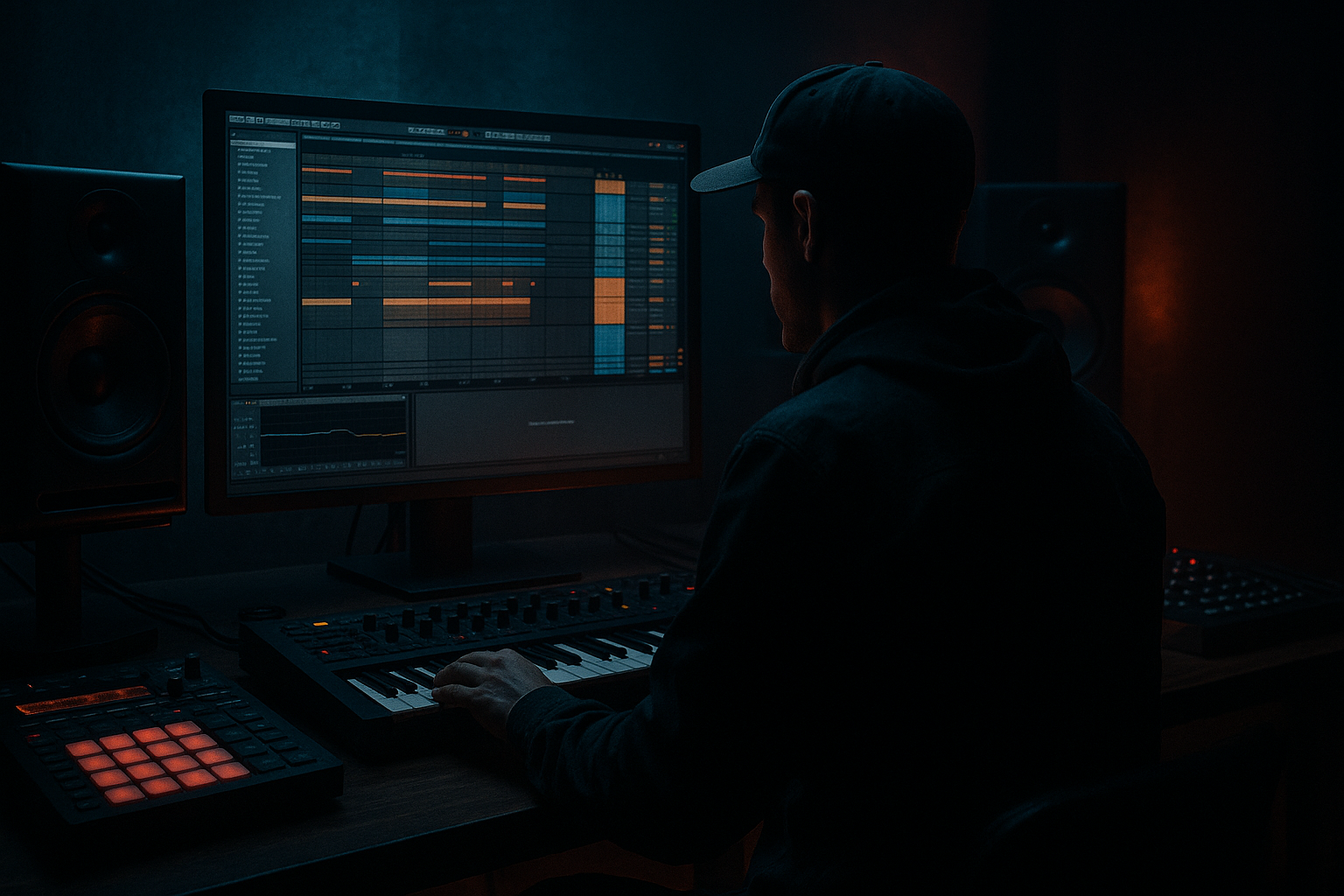
Main tutorial
```markdown
Midnight Amen Intro Route Approach (Ableton Live 12, Stock Devices Only) 🌙🥁
Skill level: Advanced
Category: Sampling (DnB/Jungle)
---
1. Lesson overview
This lesson is about building a “Midnight Amen” intro route—a dark, tension-building DnB intro that features the Amen break as a textural, evolving motif rather than the full-on drop beat.
You’ll create a progressive intro chain where the Amen is:
- filtered + time-stretched + re-pitched for mood
- resampled into controlled slices
- reintroduced via automation and FX “routes” (returns, resample bus, parallel smash)
- morphed into a tight ramp that hands off cleanly into the drop
- Track A (Amen Source): long-form Amen loop, warped and moody
- Track B (Amen Slices): tighter, playable slices for fills + foreshadowing
- Track C (Resample Print): audio printed from FX/returns to create one-off textures
- Return FX: “Midnight Space” (dub delay + reverb), “Parallel Smash” (crunch + glue)
- Automation route: filter opening, reverb send bloom, pitch drops, beat-repeat-like stutters, and final “signal clarity” into the drop
- Send A (Space): -18 to -6 dB depending on how cinematic
- Send B (Smash): -24 to -12 dB for controlled aggression
- Bars 1–4: 1 hit every 2 bars
- Bars 5–8: 1–2 hits per bar (end-of-bar stabs)
- Bars 9–12: add quick 1/16 pickup before bar lines
- Bars 13–16: short roll / stutter into drop
- Auto Filter Frequency: ~300 Hz → 8–12 kHz over 16 bars
- Auto Filter Resonance: 1.0 → 0.4 near the drop (less whistly = more professional)
- Redux Dry/Wet: 10% → 25–35% (then pull back slightly right before drop)
- Drum Buss Drive: 6 → 12–18 (escalation)
- Send A (Space): bloom at phrase ends (e.g., bars 4, 8, 12, 15)
- Send B (Smash): increase in bars 9–16, but mute it 1/2 bar before drop for impact contrast
- Grain Delay
- Kill most reverb/delay sends
- Reduce Redux a bit
- Slightly widen with Utility (or do the opposite—collapse to mono for impact)
- Add a short riser made from Amen noise:
- Bring in your main drums (kick/snare) clean and forward
- Keep the Amen either:
- Over-warping the Amen: Complex Pro can smear transients—great for intro texture, terrible for a punchy drop layer. Switch to Beats when you need snap.
- Too much reverb into the drop: If the drop feels small, it’s usually because your intro reverb tail is stepping on it. Hard automate the send down.
- Parallel smash muddying low mids: High-pass the Smash return and avoid adding “Boom” on Drum Buss in the intro.
- No contrast: If everything is distorted and wide from bar 1, you have nowhere to go. Build escalation in stages.
- Pitch automation is your friend: Automate clip Transpose down gradually (even -2 semitones over 16 bars) for “sinking” energy.
- Use erosion-style grit with stock tools:
- Mid/Side control with EQ Eight:
- Resample everything that feels good: The most “authentic” jungle texture often comes from committing audio and re-chopping it. Live loves this workflow.
- Treating the Amen as texture first, groove later
- Designing Space and Parallel Smash returns for cinematic depth + aggression
- Resampling your own FX performance into unique, rearrangeable audio
- Using automation as the “route” that evolves mood and energy
- Creating controlled contrast so the drop lands with authority
All stock Ableton Live 12 devices. No third-party plugins, no external samplers beyond Live.
---
2. What you will build
A 16–32 bar DnB intro (170–176 BPM) containing:
Result: a cinematic, rolling jungle/DnB intro with controlled chaos 😈
---
3. Step-by-step walkthrough
Step 0 — Set the session for DnB control
1. Set tempo to 174 BPM (good midpoint for modern DnB).
2. Set Global Quantization to 1 Bar (so resampling + clip launching stays tight).
3. Create groups now to stay organized:
- DRUMS (Intro) group
- FX/Resample group
Workflow tip: Label everything early. You’re going to be routing and resampling—clarity saves time.
---
Step 1 — Load and warp the Amen (the “Midnight” source)
1. Drag an Amen break loop onto an Audio Track: `Amen Source`.
2. In Clip View:
- Warp: ON
- Warp mode:
- Start with Complex Pro for “ghostly” stretched texture
- Formants: 0 (neutral), Envelope: 80–120 (adjust to taste)
- If you want tighter transient integrity later, you can switch to Beats—but for the intro, Complex Pro gives vibe.
3. Set clip to loop 1–2 bars (classic Amen length), and consolidate if needed: `Cmd/Ctrl + J`.
Goal: Make the Amen feel like a haunted memory, not the main drum groove yet.
---
Step 2 — Build the “Midnight Amen” device chain (stock-only)
On `Amen Source`, add this chain (in order):
#### Device Chain: “Midnight Amen Intro”
1. Auto Filter
- Type: Lowpass (24 dB)
- Freq: start around 250–450 Hz
- Resonance: 0.70–1.10 (enough to whistle slightly)
- Drive: 2–6 dB (subtle bite)
- Envelope: small amount (5–10) if you want transient movement
2. EQ Eight
- HP filter at ~80–120 Hz (get rid of low rumble; save sub for bass later)
- Dip 300–500 Hz if it’s boxy
- Gentle shelf down around 8–12 kHz if it’s too bright for “midnight”
3. Redux (for grain + early-90s grit)
- Bit Reduction: 10–14 (don’t overdo yet)
- Downsample: 1.5–4.0
- Dry/Wet: 10–30%
4. Drum Buss
- Drive: 5–20 (depends how crunchy you want)
- Crunch: 0–20 (careful: it can get fizzy fast)
- Boom: 0 (you’ve already high-passed—keep intro clean)
- Damp: 3–8 kHz area (tames harshness)
5. Utility
- Width: 70–100% (keep controlled; intros can be wide, but don’t lose mono compatibility)
- Gain: set so peaks aren’t slamming (you’ll parallel smash later)
Why this works: You’re shaping tone first (filter/EQ), then adding intentional degradation (Redux), then weight and cohesion (Drum Buss).
---
Step 3 — Create two Return tracks: Space + Smash
#### Return A: “Midnight Space” 🌌
Add:
1. Echo
- Time: 1/8 Dotted or 1/4
- Feedback: 35–55%
- Filter: HP around 250–500 Hz, LP around 6–9 kHz
- Mod: small (2–6%) for movement
- Dry/Wet: 100% (it’s a return)
2. Reverb
- Size: 40–70%
- Decay: 3–7 s
- Pre-delay: 10–25 ms
- Low Cut: 250–500 Hz
- High Cut: 7–10 kHz
- Dry/Wet: 100%
3. EQ Eight after Reverb
- Notch any harsh ringing frequencies (often 2–4 kHz)
- Roll off highs above 10–12 kHz if needed
#### Return B: “Parallel Smash” 💥
Add:
1. Saturator
- Mode: Analog Clip
- Drive: 6–12 dB
- Soft Clip: ON
2. Glue Compressor
- Attack: 3 ms
- Release: Auto
- Ratio: 4:1
- Threshold: aim for 5–10 dB GR
- Make-up: taste
3. EQ Eight
- HP at 120–200 Hz (keep smash from muddying low-end)
- Optional: small boost around 1–3 kHz for crack/snare presence
Send the `Amen Source` to these returns:
---
Step 4 — Resample routes (turn FX into new ammo) 🎛️
You’ll print selective moments of the Amen (with sends and automation) into fresh audio you can rearrange.
1. Create a new Audio Track called `Amen Resample Print`.
2. Set Audio From to:
- If you have a dedicated drum group: choose that group
- Or simply set to Resampling (captures master output)
Pro workflow: Use Resampling only while printing so you don’t accidentally bake in other elements.
3. Arm `Amen Resample Print`.
4. Play the intro and perform:
- Increase Space send at phrase ends
- Push Smash send on certain hits
- Move Auto Filter cutoff in real time (or automate; we’ll do automation next)
5. Record 8–16 bars of “performance,” then pick the best chunks and consolidate them into 1-bar and 2-bar textures.
Now you’ve got unique, printed Amen atmospheres—very jungle/DnB-authentic.
---
Step 5 — Build playable Amen slices (foreshadowing the drop)
1. Duplicate `Amen Source` to a new track: `Amen Slices`.
2. Right-click the clip → Slice to New MIDI Track.
- Slicing preset: Transient
- Create one Drum Rack with slices
3. In the Drum Rack:
- Add Simpler controls per slice (optional quick settings):
- Set Fade In tiny (0–5 ms) to avoid clicks
- Use Filter per slice if you want darker tails
4. Program a sparse MIDI pattern over 8–16 bars:
- Use only 1–3 slice hits per bar at first (like ghost calls)
- Increase density every 4 bars (classic tension ramp)
Arrangement idea (16 bars):
---
Step 6 — Automate the “Intro Route” (the actual midnight journey) 🛣️
This is where it becomes a route approach: the Amen travels through clarity → haze → aggression → clarity.
#### Automation targets (start values → end values)
On `Amen Source`:
On Sends:
Key move: In the last bar before drop, reduce Space send hard and open the filter—you want the drop to feel like the room suddenly “snaps into focus.”
---
Step 7 — Create stutters without Beat Repeat (stock-only, cleaner control)
You can do this two ways—both are stock and very “producer practical”:
#### Method A: Clip Envelopes (surgical)
1. Duplicate a 1-bar clip of `Amen Resample Print`.
2. In Clip View → Envelope:
- Choose Mixer → Track Volume
- Draw fast on/off gates (1/16 or 1/32) in the last 1/2 bar
3. Combine with a quick Transpose envelope (-2 to -7 semitones) for a dive.
#### Method B: Grain Delay “glitch blur” (sparingly)
On `Amen Source` (automate on/off):
- Dry/Wet: automate 0% → 15–30% for short moments
- Pitch: -12 or -7
- Frequency: 1–3 kHz
- Random Pitch: low
This gives that warped, late-night edge without losing groove.
---
Step 8 — Make the handoff into the drop hit hard
Right before the drop (last 1/2 bar):
- Duplicate a printed texture
- Reverse it
- Add Auto Filter sweeping up
- Print it again if needed
Then at drop:
- as a tight top layer (Beats warp mode, transient-preserving), or
- as fills only (call-and-response with main drum groove)
---
4. Common mistakes
---
5. Pro tips for darker/heavier DnB 😈
- Try Redux + Saturator combo, but keep one subtle and the other doing the heavy lift.
- Put EQ Eight in M/S mode on the Space return.
- Roll off some highs on the Side channel to keep the center threatening and focused.
---
6. Mini practice exercise 🎯
Goal: 8-bar mini intro with 3 escalating states.
1. Bars 1–2: `Amen Source` lowpassed at 300–500 Hz, Space send light.
2. Bars 3–6: Open filter to 2–4 kHz, add Redux to 20%, add a few `Amen Slices` hits.
3. Bars 7–8: Print a resample, reverse a tail into the downbeat, add stutter gating in the last 1/2 bar, then hard-cut Space send to near zero right before bar 9.
Export and listen: Does bar 9 (imagined drop) feel bigger than bar 8? If not, reduce reverb tail and restore some clarity right before the transition.
---
7. Recap ✅
You built a Midnight Amen intro route using stock Ableton Live 12 devices by:
If you want, tell me your target vibe (classic jungle, modern roller, neuro-leaning, halftime fakeout), and I’ll suggest a specific 16- or 32-bar arrangement map and automation lanes to match.
```

