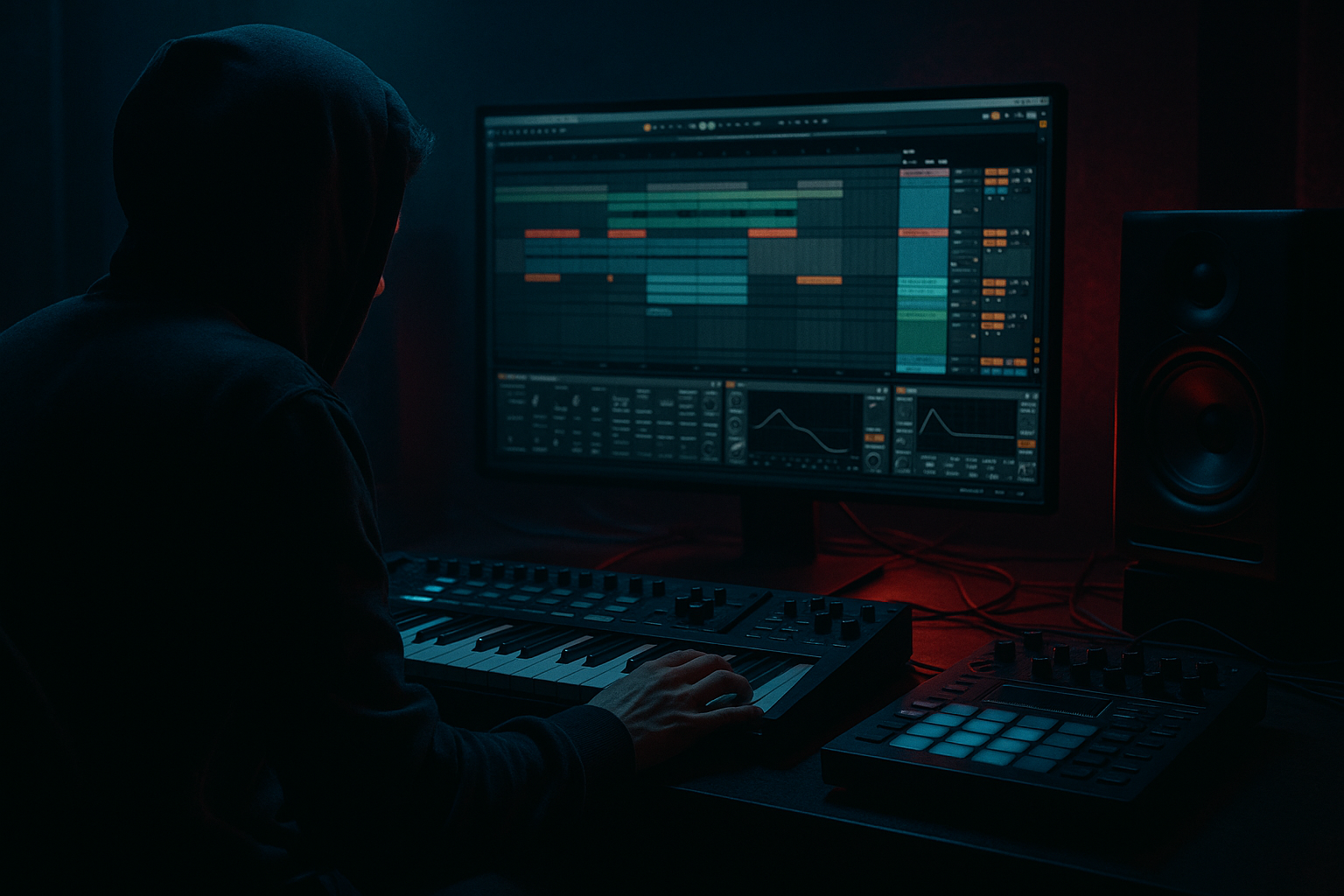
Main tutorial
Midnight Amen Jungle Riser: Saturate + Arrange in Ableton Live 12 (Advanced Drums) 🌙🥁
1) Lesson overview
You’re going to turn a classic Amen break fragment into a midnight jungle riser: tight, gritty, and unmistakably DnB. The focus is controlled saturation, frequency staging, and arrangement automation so the riser pulls tension without wrecking your headroom.
This is not “throw a filter on it and pray” — we’ll build a repeatable Ableton workflow that hits hard in a modern rolling/jungle context.
---
2) What you will build
A 4–8 bar riser made from an Amen slice that:
- Speeds up in perceived intensity using gated repeats + transient shaping
- Gets darker, dirtier, and more urgent via multi-stage saturation
- Uses automation lanes (filter, drive, send FX, width, pitch) to lift energy
- Drops cleanly into your next section (no smeared transients, no blown low end)
- Add Auto Filter after EQ (or use EQ Eight’s filter).
- Settings:
- Optional: automate resonance slightly up near the end for tension.
- If using audio: add Shifter or automate Clip Transpose carefully.
- Try:
- Jungle trick: do the opposite for dread—downward pitch (-2 st) while filter opens, creates a “falling into the drop” illusion.
- Use Utility:
- Keep the riser’s low mids tight; if it gets phasey, widen only the highs:
- Return A: Reverb (short, dark room)
- Return B: Delay (dubby tension)
- Gradually increase send to Reverb through bars 1–3.
- Pull reverb down sharply right before the drop (last 1/8–1/4 bar) for a clean impact.
- Increase Echo send near the end for that jungle “spiral” effect.
- Bar 1: recognizable Amen groove, dark filter, low drive
- Bar 2: Beat Repeat starts to show up, slightly brighter, more send FX
- Bar 3: more density, more saturation, slight pitch creep
- Bar 4: fastest grid stutters, widest stereo, peak drive
- In the final beat:
- Over-saturating the highs → harsh hiss instead of grit. Fix: darken with EQ/filters, drive mids more than highs.
- Letting low-end build up (especially with reverb) → the drop loses punch. Fix: HP your riser and HP your reverb returns.
- Too random Beat Repeat settings → sounds like a glitch preset, not jungle. Fix: automate with intention; keep variation low.
- No release strategy → riser ends with a wall of noise into the drop. Fix: last 1/4 bar = reduce reverb, tighten width, remove lows.
- Warp artifacts → flamming and transient blur. Fix: Beats mode tuning, or render/slice to MIDI.
- Parallel “filth bus”:
- Midrange focus = heavier perception:
- Use gating for aggression:
- Texture layer:
- Clip-to-drop contrast:
- You built a jungle/DnB riser from an Amen by increasing density, drive, and space over time.
- The “midnight” vibe came from dark filtering, mid-focused saturation, and controlled stereo growth.
- The pro difference is the exit plan: pulling reverb/width/lows right before the drop so the impact lands clean.
Final deliverable: A single consolidated audio riser you can drag into any project.
---
3) Step-by-step walkthrough
A) Prep the Amen for “riser duty”
1. Choose a strong Amen hit/phrase
- Grab a clean Amen loop (or your own break recording).
- Ideal: a 1-bar Amen at ~160–174 BPM, or warp it.
2. Warp settings
- Drop the loop into an audio track.
- Set Warp = ON
- For break manipulation, start with:
- Beats mode
- Preserve: Transients
- Transient Loop Mode: Forward
- Envelope: 60–80%
- If it gets too clicky, reduce Envelope; if it smears, increase.
3. Slice to MIDI for control (optional but powerful)
- Right-click clip → Slice to New MIDI Track
- Slicing preset: Transient
- Now you have a Drum Rack with Amen slices. Great for building rising patterns.
Why this matters: a riser wants tight articulation, not flabby warp artifacts.
---
B) Build the rhythmic “riser engine” (repeat + density)
You’ve got two solid approaches. Use either depending on your vibe.
#### Option 1: Audio clip + Beat Repeat (fast and nasty)
1. Keep Amen on an Audio Track.
2. Add Beat Repeat (stock device) after the clip.
3. Suggested starting settings:
- Interval: 1 Bar (or 1/2 for faster “panic”)
- Grid: start at 1/8, automate down to 1/32
- Chance: 0% (then automate up to 30–60% as it rises)
- Gate: 25–45%
- Variation: 0–15% (keep it controlled)
- Pitch: Off for now (we’ll do pitch later more intentionally)
4. Automation idea across 4 bars:
- Bar 1: Grid 1/8, Chance 0–10%
- Bar 2: Grid 1/16, Chance 15–25%
- Bar 3: Grid 1/24 or 1/32, Chance 30–45%
- Bar 4: Grid 1/32, Chance 50–60%, Gate shorter for “machine-gun”
#### Option 2: Drum Rack pattern (surgical jungle)
1. Use your sliced Drum Rack.
2. Program a 1–2 bar pattern, then duplicate and increase density:
- Bar 1: core hits (kick/snare accents)
- Bar 2: add ghost notes (light velocities)
- Bar 3: add rapid hats/slices (1/16 → 1/32 bursts)
- Bar 4: controlled chaos (fills, stutters, reversed slice)
Pro move: Use velocity as your “human grit” dial—keep ghosts around 30–60 velocity, accents 90–120.
---
C) Create the “Midnight Saturation Stack” (clean → dirty → controlled)
We’ll build a chain that adds aggression without losing punch. Put this chain after Beat Repeat (or after Drum Rack output).
#### Device Chain (in order)
1. EQ Eight (pre-shape)
- HP filter: 24 dB/oct @ 90–140 Hz (depending on how much low you want in the riser)
- Small cut: -2 to -4 dB @ 250–400 Hz (mud control)
- Optional presence: +1 to +3 dB @ 3–6 kHz if it gets too dull
2. Roar (main character saturation) 🔥
Roar is perfect for “jungle grime” because it can do multiband drive + movement.
- Mode: start with Tube or Dirt
- Drive: 10–25% (automate upward)
- Tone: slightly dark (don’t over-brighten yet)
- If using multiband:
- Low band: mild drive, keep tight
- Mid band: most drive (this is where Amen attitude lives)
- High band: lighter drive to avoid brittle fizz
- Add a touch of Dynamics inside Roar if transients get too spiky.
3. Drum Buss (punch + crunch)
- Drive: 5–15%
- Crunch: 5–20% (be careful: it can hiss)
- Boom: Off (usually) for risers; or very subtle if you want a low throb
- Damp: adjust to prevent harshness
- Transient: +5 to +20 if saturation softened attacks too much
4. Saturator (final glue)
- Mode: Soft Sine (smooth) or Analog Clip (harder)
- Drive: 2–8 dB
- Soft Clip: ON
- This is your “don’t let peaks explode as we automate intensity” safety net.
5. Glue Compressor (optional, but great for tension)
- Attack: 3–10 ms (let transients through)
- Release: Auto or 0.1–0.3 s
- Ratio: 2:1 to 4:1
- Aim for 1–3 dB GR until final bar (maybe 4 dB tops)
6. Limiter (only if needed for control during sound design)
- Don’t mix into it permanently unless you know why.
- Use it to prevent ear-shredding surprises while you automate.
---
D) “Midnight Movement”: automate filter, pitch, width, reverb sends
Here’s how you make it rise without sounding like a generic EDM sweep.
#### 1) Filter automation (dark → open)
- Filter type: LP24
- Start cutoff: 600–1.2 kHz
- End cutoff (last bar): 8–14 kHz
- Resonance: 10–25% (don’t whistle)
#### 2) Pitch creep (subtle menace)
- Start: 0 st
- End: +2 to +5 st over 4–8 bars
#### 3) Stereo width (mono → wider)
- Start Width 0–30% (mono-ish)
- End Width 90–120%
- Use Audio Effect Rack → split bands with EQ Eight filters, widen the high band only.
#### 4) Send FX for atmosphere (the “midnight space”) 🌫️
Create two return tracks:
- Hybrid Reverb (Convolution or Algorithm)
- Decay: 0.6–1.2s
- Pre-delay: 10–25 ms
- Low cut: 250–400 Hz
- High cut: 6–10 kHz
- Echo
- Time: 1/8 dotted or 1/4
- Feedback: 15–35%
- Mod: subtle
- Filter: roll lows + tame highs
Automation:
---
E) Arrange it like a DnB record (not a sound demo)
Let’s place this in a typical rolling/jungle structure.
#### 4-bar riser into a drop (classic)
- Last 1/2 bar: cut lows, reduce reverb, tighten stereo
- Last 1/8 bar: hard mute or tape stop-style drop-out for impact
#### Transition trick: “pre-drop vacuum”
- Utility gain dip: -3 to -6 dB very briefly
- HP filter sweeps up quickly (removes body)
- Then drop hits with full low-end restored
---
F) Print + cleanup (important for pro sessions)
1. Resample the riser to audio (new track → set input to “Resampling”).
2. Consolidate (Cmd/Ctrl+J).
3. Cleanup pass:
- EQ Eight: cut rumble < 80–120 Hz
- Fade in/out tiny clip fades to prevent clicks
4. Now you can treat it like a single “riser asset” in your arrangement.
---
4) Common mistakes
---
5) Pro tips for darker/heavier DnB 🖤
Duplicate the Amen riser track → on the duplicate, go extreme (Roar + Drum Buss + heavy EQ) → blend at -12 to -20 dB under the main.
A controlled push around 700 Hz – 2.5 kHz can feel meaner than adding more sub.
Try Gate after reverb return (sidechain from the dry Amen) for that chopped, tense jungle space.
Layer a very quiet noise/hiss vinyl or jungle ambience, then automate it up into the last bar (keep it subtle).
Make the riser slightly “boxy/dark” so the drop feels brighter and larger without needing extra loudness.
---
6) Mini practice exercise (15–20 minutes) 🎯
1. Make a 4-bar Amen riser using Beat Repeat.
2. Automate:
- Beat Repeat Grid: 1/8 → 1/32
- Roar Drive: 10% → 25%
- Auto Filter cutoff: 800 Hz → 12 kHz
- Utility Width: 20% → 110%
- Reverb send: rise until bar 3, then drop to near zero right before the downbeat
3. Print to audio and check:
- Does the last hit before the drop feel tight and intentional?
- Is the riser exciting without being louder than the drop?
Bonus: Do a second version where pitch goes down instead of up.
---
7) Recap ✅
If you want, tell me your project BPM and whether you’re going for 90s jungle rawness or modern rollers, and I’ll suggest a specific 8-bar automation map + exact Roar mode choices for that vibe.

