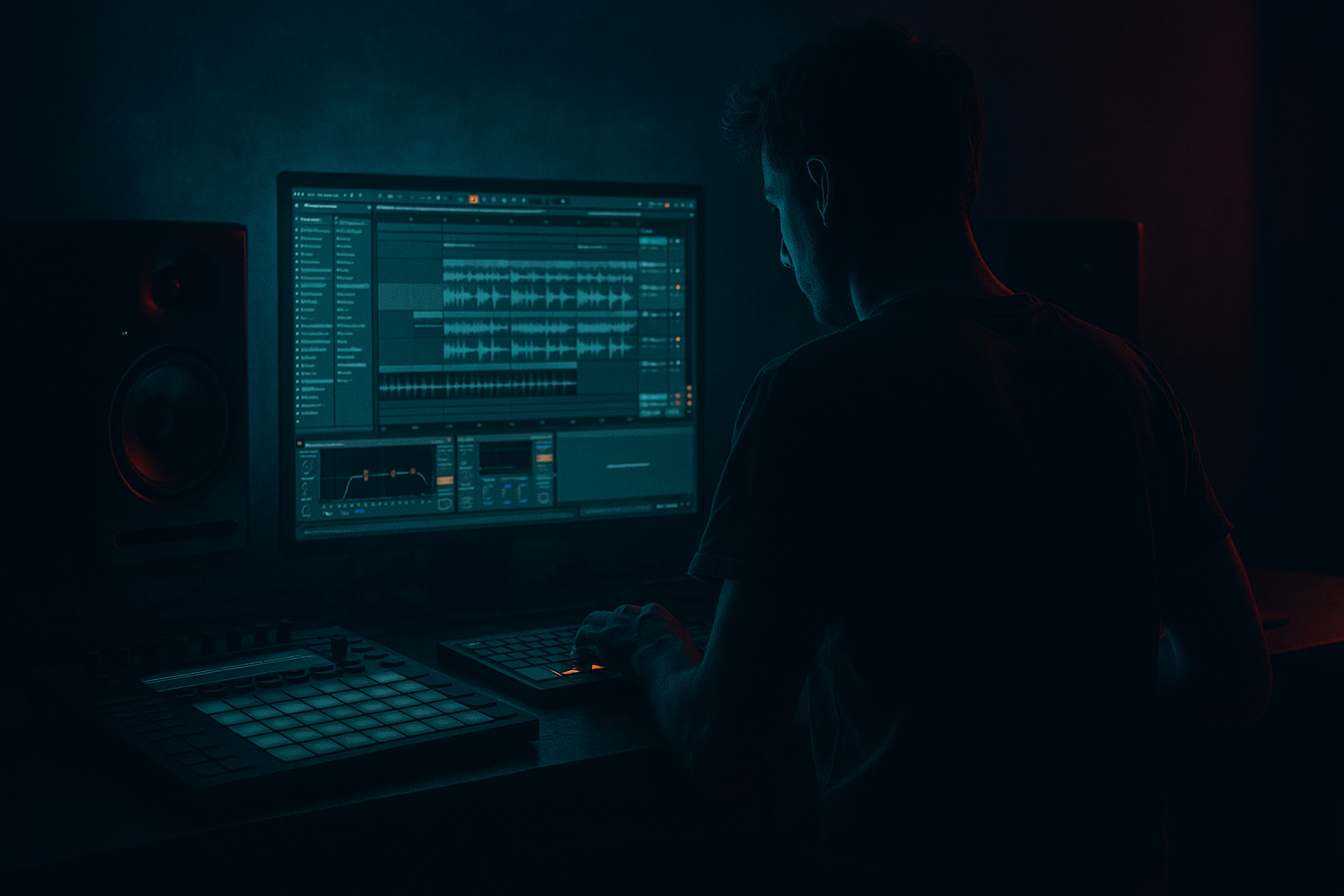
Main tutorial
```markdown
Midnight Amen Jungle Transition: Color + Arrange in Ableton Live 12 🌙🥁
Skill level: Beginner
Category: Breakbeats (Jungle / DnB)
Goal: Build a clean, high-impact “midnight” transition using an Amen break, then color-code + arrange it like a real DnB track in Ableton Live 12.
---
1. Lesson overview
In jungle and rolling drum & bass, transitions live and die on break edits: small, intentional variations that build tension and release. Today you’ll take an Amen break and create a classic midnight-style transition:
- break gets darker + more filtered
- space opens with reverb/delay
- a short “drop marker” fill
- the beat slams back in clean
- Bars 1–4: Rolling Amen groove (your “A” loop)
- Bars 5–6: Tension build (filter down, reverb up, small edits)
- Bar 7: “Midnight moment” (stutter/retrigger + big tail)
- Bar 8: Pre-drop silence/impact hit (or drumless breath)
- Next section: Full drop with clean, punchy Amen + bass
- A color-coded session (Drums, Bass, FX, Music, Vocals)
- Arrangement locators for Intro / Build / Transition / Drop
- Drums / Breaks: Red / Orange
- Bass: Deep Blue
- FX: Purple
- Atmos / Pads: Dark Green
- Vox / Shots: Yellow
- Right-click track header → Assign Track Color
- Also rename tracks clearly: `AMEN MAIN`, `AMEN FX`, `FX RETURN`, etc.
- Hybrid Reverb
- Echo
- Reverb send: `-18 to -12 dB`
- Delay send: `-inf to -18 dB` (we’ll automate up later)
- Filter Type: Low-pass (LP)
- Slope: `24 dB`
- Resonance: `10–20%` (don’t whistle)
- Drive: `0–3 dB` (optional)
- Bars 5–6: Slowly move cutoff from ~`12 kHz` down to `1.5–3 kHz`
- Bar 7: Dip even further briefly (~`800 Hz`) to make it feel “underwater”
- Reverb send: rise from `-12 dB` → `-6 dB` by bar 7
- Delay send: rise from `-18 dB` → `-8 dB` by bar 7
- Option 1 (classic): silence the Amen for the first half bar
- Option 2: leave only reverb tail
- Add an audio track with a crash/impact
- Put Reverb on it (Hybrid Reverb) for length
- EQ out lows below `150 Hz` so it doesn’t fight the kick/bass
- Create a MIDI track named `SECTIONS`
- Drop empty MIDI clips spanning each section
- Color them (Intro = dark green, build = purple, drop = red)
- Disable or reset the Auto Filter automation so the break returns full-spectrum
- Pull reverb/delay sends back down to earlier levels
- Optional: automate Drum Buss Drive slightly up on the first bar of the drop (tiny bump)
- Parallel distortion on breaks:
- Make the transition “sink” into darkness:
- Add a sub-drop or pitch fall at bar 8:
- Use gated reverb tails for horror jungle energy:
- Mono the low end:
- Warped and cleaned an Amen break
- Used stock devices (EQ Eight, Drum Buss, Glue, Auto Filter, Hybrid Reverb, Echo)
- Automated filter + sends for tension
- Added a short stutter edit and pre-drop breath
- Organized the Arrangement with colors + locators for speed and clarity
And you’ll do it with a pro workflow: coloring tracks and sections so your Arrangement looks like a readable map, not chaos. 🎛️
---
2. What you will build
You’ll end with an 8-bar transition you can paste into any jungle/DnB arrangement:
You’ll also have:
---
3. Step-by-step walkthrough
Step 0 — Set up the project (tempo, grid, and warping)
1. Set tempo: `165–170 BPM` (try 168 BPM to start).
2. Create these tracks:
- Audio Track: `Amen Break`
- Return Track A: `Short Verb`
- Return Track B: `Dub Delay`
- Optional: `Impact FX`, `Sub Bass`, `Atmos`
3. Drag an Amen break (any classic Amen sample) onto the Amen Break audio track in Arrangement.
4. Warp settings (important for break feel):
- Click the clip → enable Warp
- Try Beats mode
- Set Preserve: `Transient`
- Turn on Loop and set loop length to 1 bar or 2 bars depending on your sample
✅ Tip: If your Amen feels “smeared,” reduce the warp stretching by ensuring the first downbeat is correctly set (right-click transient → Set 1.1.1 Here).
---
Step 1 — Color code your tracks like a pro 🟦🟥🟩
This is the “midnight discipline” part: clean visuals = faster arranging.
Suggested DnB color scheme:
In Live 12:
✅ Workflow suggestion: Create a group called `DRUMS` and put your Amen track inside. Group color = red; individual drum tracks slightly different shades.
---
Step 2 — Build the main Amen groove (bars 1–4)
1. Duplicate your loop so it plays for 4 bars.
2. Add a simple device chain on the Amen track:
Device chain (stock devices):
1. EQ Eight
- HP filter: `24 dB/oct` at ~`30 Hz` (remove rumble)
- Small dip: `-2 to -4 dB` around `250–400 Hz` if it’s boxy
2. Drum Buss
- Drive: `5–15%`
- Crunch: `0–10%` (subtle)
- Boom: `0–10%` (careful—breaks get muddy fast)
3. Glue Compressor (optional but great for jungle)
- Attack: `3 ms`
- Release: `Auto`
- Ratio: `2:1`
- Aim for `1–3 dB` of gain reduction
✅ Keep this section fairly “clean” so the transition has somewhere to go.
---
Step 3 — Add returns for space (Short Verb + Dub Delay) 🌫️
Create Return Tracks and put these on them:
Return A — Short Verb
- Algorithmic
- Decay: `0.6–1.2 s`
- Pre-delay: `10–25 ms`
- High Cut: `6–9 kHz`
- Wet: `100%` (because it’s a return)
Return B — Dub Delay
- Time: `1/8` or `1/4` (try `1/8 dotted` for bounce)
- Feedback: `20–35%`
- Filter: HP around `200 Hz`, LP around `6–8 kHz`
- Mod: low/subtle
- Wet: `100%`
Now send the Amen track lightly:
---
Step 4 — Create the “midnight” transition (bars 5–8) with automation 🎚️🌙
Duplicate your 4-bar loop to create another 4 bars (bars 5–8). This is your transition zone.
#### A) Filter the break down (tension)
Add Auto Filter before Drum Buss (so saturation reacts differently as it filters).
Auto Filter settings:
Automation idea:
#### B) Push reverb/delay sends up (space + drama)
Automate your sends:
✅ This creates that late-night cavern vibe without destroying the main groove earlier.
#### C) Add a short stutter/retrigger moment (bar 7)
Beginner-friendly method: clip duplication + tiny loop
1. Split the Amen clip at the start of bar 7 (`Cmd/Ctrl + E`).
2. In the bar 7 clip, enable Loop and set loop length to something like:
- `1/8` for classic stutter
- `1/16` for more frantic jungle energy
3. Let it run for 1 beat or 2 beats, then return to normal playback.
✅ Keep it short. Jungle edits are effective because they’re quick and intentional.
#### D) Create a pre-drop breath (bar 8)
At bar 8, do one of these:
- Split at bar 8, then mute/delete the first `1/2 bar`
- automate the track volume down while sends are still up
Add an Impact (optional):
---
Step 5 — Add Arrangement Locators + section colors 🧭
In Arrangement View:
1. At key points (Intro / Build / Transition / Drop), right-click the ruler → Add Locator
2. Rename them:
- `INTRO (ATMOS)`
- `ROLL (AMEN A)`
- `MIDNIGHT TRANSITION`
- `DROP`
Color your sections:
Live allows you to color clips/tracks; a clean trick is to also use empty MIDI clips on a “MARKERS” track as colored blocks:
This gives you a visual timeline like pro DnB projects.
---
Step 6 — Make the drop hit harder (simple contrast trick) 💥
Right at the drop (after bar 8):
Contrast = impact. The drop should feel cleaner and louder even if it’s the same sample.
---
4. Common mistakes
1. Over-warping the Amen
If it sounds phasey or blurry, re-check the first transient and Warp mode (try Beats/Transient).
2. Too much reverb on the break
Jungle needs punch. Put reverb mostly on sends, and filter the return.
3. Filter resonance whistling
Keep resonance moderate; automate cutoff smoothly.
4. Stutter lasting too long
The edit should feel like a “wink,” not a new loop.
5. No visual organization
Beginners get lost fast. Color + locators = faster decisions.
---
5. Pro tips for darker/heavier DnB 🕯️🔊
Duplicate the Amen track → low-pass it to ~`3–5 kHz` → add Saturator (Drive `4–8 dB`) → blend quietly under the clean break.
Automate EQ Eight to slightly reduce highs (`-2 to -6 dB shelf at 8–12 kHz`) during bars 5–7.
Use a simple synth (Operator) or sample, pitch down `-12` over 1 beat. Keep it short and controlled.
Put Gate after Hybrid Reverb on Return A.
- Threshold so it clamps after the hit
- This keeps the vibe dark without washing out the drums.
On the Drum Group, use Utility and keep lows stable (avoid wide low frequencies).
---
6. Mini practice exercise (10 minutes) ⏱️
1. Make two different 8-bar transitions using the same Amen:
- Version A: Low-pass filter + reverb swell
- Version B: High-pass filter + delay throw (HP at `150–300 Hz`, push Echo send on last snare)
2. In both versions:
- Add 3 locators
- Create a `SECTIONS` marker track with colored clips
3. Export both as audio and compare:
- Which one feels more “midnight”?
- Which one hits harder at the drop?
---
7. Recap
You built a jungle/DnB transition that’s actually usable in a real arrangement:
If you want, tell me your BPM and whether you’re aiming for 1994 jungle, modern rollers, or dark halftime, and I’ll suggest a matching 16-bar arrangement template and transition variations.
```

