DNB COLLEGE

AI Drum & Bass Ableton Tutorials

LESSON DETAIL

Mikey B blueprint: sequence a rave-piano stab run in Ableton Live 12 for bright drum and bass tension (Beginner · Edits · tutorial)

An AI-generated beginner Ableton lesson focused on Mikey B blueprint: sequence a rave-piano stab run in Ableton Live 12 for bright drum and bass tension in the Edits area of drum and bass production.

Free plan: 0 of 1 lesson views left today. Premium unlocks unlimited access.

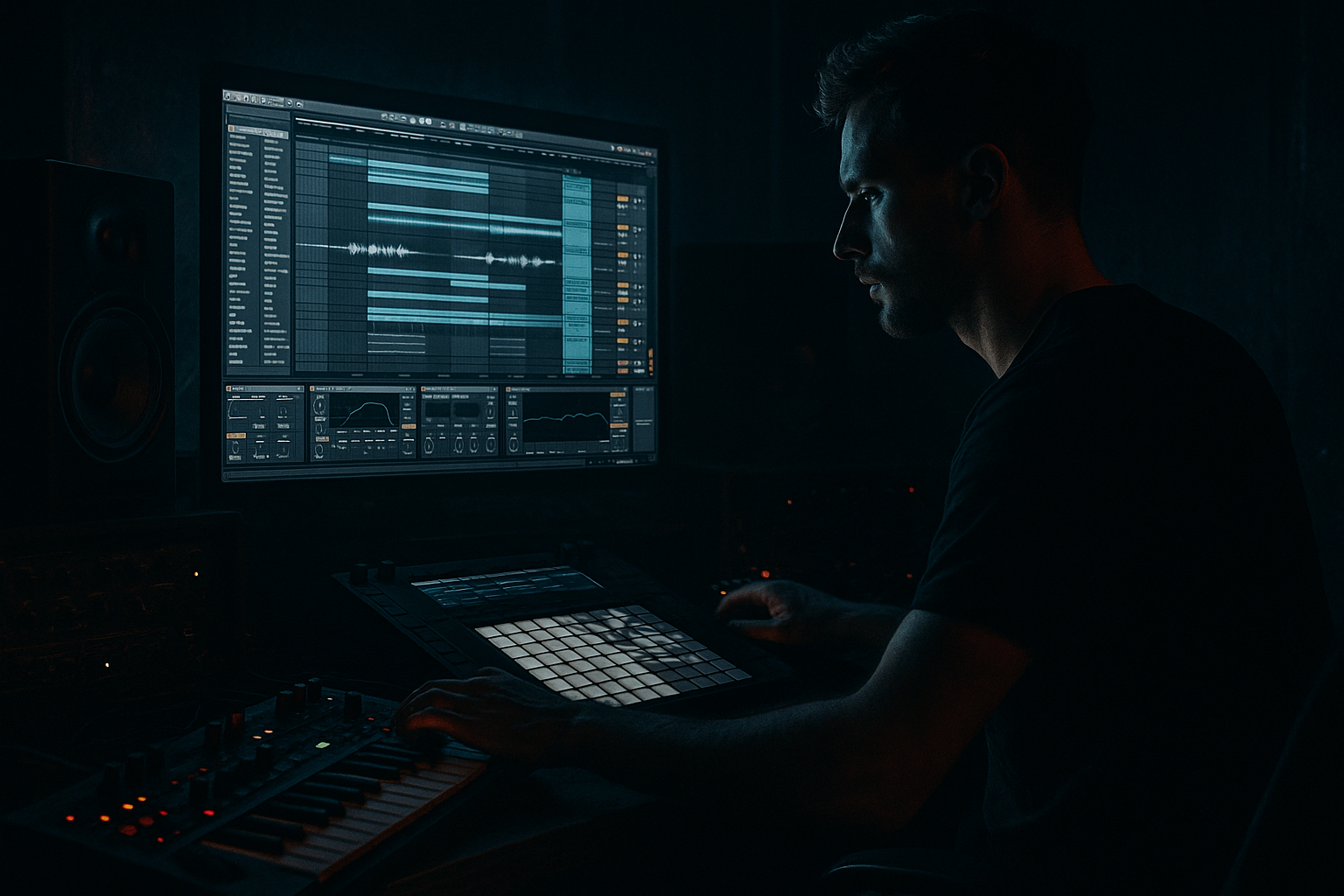
Mikey B blueprint: sequence a rave-piano stab run in Ableton Live 12 for bright drum and bass tension (Beginner · Edits · tutorial) cover image

Narrated lesson audio

The voice track includes the tutorial plus extra teacher commentary.

Open audio file

Main tutorial

1. Lesson Overview

"Mikey B blueprint: sequence a rave-piano stab run in Ableton Live 12 for bright drum and bass tension" — a hands‑on beginner lesson showing how to program a short, punchy piano stab run that creates bright harmonic tension in a DnB context. We’ll use Ableton Live 12 stock devices (Sampler/Simpler, MIDI clip editing, EQ Eight, Saturator, Compressor/Glue, Reverb, Utility) and a clear, repeatable workflow so you can drop the run into your own edits and DJ tools.

2. What You Will Build

  • A 1–2 bar rave‑piano stab run (ascending 16th/32nd pattern) tailored for 174 BPM drum & bass.
  • A polished channel strip using only Live stock devices: Sampler (or Simpler), EQ Eight, Saturator, Compressor (with sidechain option), short Reverb, and Utility.
  • A MIDI clip with velocity shaping, tiny humanization, and optional glide for legato feels.
  • A ready-to-drop audio or MIDI loop that sits bright and tense in a full mix.
  • 3. Step-by-Step Walkthrough

    Note: keep Ableton Live 12 set to 174 BPM (a common DnB tempo) while you follow this walkthrough.

    Step 1 — Create the Instrument Track

  • Create a new MIDI track (Cmd/Ctrl+Shift+T).
  • Drop a Sampler onto the track. If you only have Simpler, use Simpler in "Classic" mode and follow the simplified envelope steps.
  • Load a short piano sample: either Ableton stock "Grand Piano" sample (from Packs/Presets) or a single piano note sample. Aim for a medium‑bright sample with clear attack.
  • Step 2 — Configure Sampler for a stab sound

  • In Sampler, set the amplitude envelope: Attack = 0–5 ms, Decay = 120–220 ms, Sustain = -inf (or very low), Release = 30–60 ms. This makes a tight stab rather than sustained keys.
  • Turn off any long loop points; set sample start to keep the attack.
  • If you want slide/glide: enable Glide (or Portamento) in Sampler; set Mode = Mono or Legato and Glide Time small (8–40 ms). This is useful if you want connected runs; otherwise keep poly mode for clean stabs.
  • Step 3 — Shape tone for brightness

  • Add EQ Eight after Sampler. High-pass at 80–120 Hz (to cut sub-energy). Boost around 2.5–5 kHz by 2–4 dB with a wide Q to give presence. Slight dip at 300–500 Hz if muddy.
  • Add Saturator after EQ with Drive = 1–3 dB, Mode = "Analog Clip" or "Soft Sine". Use “Dry/Wet” to taste (30–60%) to add harmonics and perceived brightness.
  • Step 4 — Add transient and space control

  • Place Compressor or Glue Compressor after Saturator. If you will sidechain to a kick/snare later, set it up now: enable Sidechain > choose the drum bus and use a fast attack, medium release to carve space.
  • Add Reverb (return or on-channel): use a short plate/room, Decay 0.3–0.6 s, Predelay 10–20 ms. Keep dry/wet low (5–20%) for stab clarity.
  • Add Utility for stereo width: set Width = 85–100% to keep piano centered but with a bit of stereo spread. Avoid >110% to keep low-frequency mono.
  • Step 5 — Create the MIDI Clip and choose scale/key

  • Double-click an empty clip slot to make a MIDI clip (1 bar or 2 bars). Set clip grid to 1/16 or 1/32 for fast runs.
  • Choose a key that matches your track (C minor is a common rave choice). Use the Scale MIDI effect if you want to lock notes to a scale.
  • Step 6 — Sequence the run (the heart of the blueprint)

  • For bright DnB tension, build an ascending run: start on the chord root or a chord tone, then move up using 1/16th triplets or 1/32nd notes. Typical patterns:
  • - 1 bar: root (1/16), 3x 1/32 ascending (e.g., C, D#, F, G)

    - Or 8 x 1/16 ascending chromatic/diatonic run finishing on a higher chord tone

  • Draw short notes to match the Sampler envelope so they don’t overlap unless you enabled Glide.
  • Vary velocities: strong on the downbeat stab (velocity 100–127), slightly lower on passing notes (70–95). This emphasizes the leading tone.
  • Add slight negative timing humanization: nudge a couple of off-beat notes back 8–12 ms to create tension without sounding sloppy. Keep the main hits quantized.
  • Step 7 — Add expression: pitch bend and subtle modulation

  • For a signature run wobble, use MIDI Pitch Bend automation in the clip: small upward slides (+10 to +40 cents) on the last note to accent the lead‑into drop.
  • Alternatively use the Sampler’s pitch envelope: map a tiny pitch envelope to add a quick upward flick on attack (Envelope Amount small; Decay very short).
  • Step 8 — Glue it into the mix

  • Drop Drum Buss or a gentle sidechained Compressor to make space for the drums. Sidechain the piano to the kick/snare bus with a medium ratio and fast release so the stab breathes with the beat.
  • Test in context with your drum loop at 174 BPM. Adjust EQ and Saturator if the piano is lost or too harsh.
  • Step 9 — Export or bounce loop

  • When satisfied, you can freeze and flatten the instrument to audio or export the loop (File > Export Audio/Video) as a 1‑bar or 2‑bar WAV for use as an edit sample.
  • Important: The exact phrasing and velocity detail in the MIDI clip is the essential part of the "Mikey B blueprint: sequence a rave-piano stab run in Ableton Live 12 for bright drum and bass tension" — focus on short staccato hits, ascending motion, tuned brightness, and tight processing.

    4. Common Mistakes

  • Using long decay/reverb: makes the run muddy and kills the punch.
  • Too much low-end in the piano: will clash with bass/drums. Always HPF below ~80–120 Hz.
  • Identical velocities: makes runs lifeless; vary velocities to create movement.
  • Overwide stereo on low mids: can smear the center image and cause mono collapse on club systems.
  • Excessive saturation: introduces harshness; use subtle drive and EQ after saturator.
  • 5. Pro Tips

  • Layer a subtle bright synth stab (an Operator saw or Analog patch) an octave higher with low volume to fatten the top end without muddying the piano.
  • Use a very short pre-delay on reverb (10–20 ms) to give separation between the attack and the tail.
  • Duplicate the piano track and create a "wet" version with longer reverb/pad to automate in at transitions for drama.
  • Use the Scale device to quickly test different modal versions (Dorian, Minor, Harmonic Minor) for different flavors of tension.
  • Save the Sampler preset and the MIDI clip as a template clip you can drag into future sessions.
  • 6. Mini Practice Exercise

    Create two 2-bar variations at 174 BPM:

    A) TIGHT RUN: one-bar ascending 1/16 run, all notes short, Sampler mono off, no glide, minimal reverb. Save as MIDI clip A.

    B) LEAD RUN: 1.5 bar ascending 1/32 run that ends with a pitch-bend on the final note and slight glide enabled; add 15% reverb and a separate wet layer. Save as MIDI clip B.

    Export both as WAVs and compare how they sit under a standard DnB amen/break loop. Adjust velocities and EQ until each sits clearly with the drums.

    7. Recap

    You’ve followed the "Mikey B blueprint: sequence a rave-piano stab run in Ableton Live 12 for bright drum and bass tension" by:

  • Setting up Sampler/Simpler with a short amp envelope,
  • EQing and saturating for presence,
  • Sequencing an ascending short-note MIDI run with velocity/humanization,
  • Adding subtle pitch and glide for expression,
  • And integrating the stab into the mix with sidechain and short reverb.

Use the MIDI clips and export workflow to build a small library of stab runs you can drop into edits, mixes, and DJ tools. Practice the mini exercise to internalize the velocity and timing choices that create that bright, tense DnB feel.


Ask GPT about this lesson

Chat with the lesson tutor, get follow-up help, or use quick actions.

Bigup 👽 Ask me anything about this lesson and I’ll answer in context.

Narration script

Show spoken script
[Intro]
Welcome. This lesson is called “Mikey B blueprint: sequence a rave‑piano stab run in Ableton Live 12 for bright drum and bass tension.” It’s a hands‑on beginner walkthrough showing how to program a short, punchy piano stab run that cuts through at 174 BPM and creates that bright, tense DnB vibe. We’ll use only Ableton Live 12 stock devices and a simple, repeatable workflow so you can drop these runs into edits and DJ tools.

[What you will build]
By the end of this lesson you’ll have:
- A one to two bar rave‑piano stab run—an ascending 16th/32nd pattern designed for 174 BPM drum & bass.
- A polished channel strip using Sampler or Simpler, EQ Eight, Saturator, Compressor or Glue, short Reverb and Utility.
- A MIDI clip with velocity shaping, tiny humanization and optional glide for legato feels.
- A ready‑to‑drop audio or MIDI loop that sits bright and tense in a full mix.

[Before we start]
Set Ableton to 174 BPM. Use Sampler if you have it; if not, use Simpler in Classic mode and follow the simplified envelope steps.

[Step 1 — Create the instrument track]
Create a new MIDI track. Drop Sampler onto the track, or Simpler in Classic mode. Load a short piano sample—Ableton’s Grand Piano or a single piano hit. Aim for a medium‑bright sample with a clear attack.

[Step 2 — Configure Sampler for a stab sound]
Set the amplitude envelope for a tight stab: attack between zero and five milliseconds, decay around 120 to 220 ms, sustain very low or off, release 30 to 60 ms. Turn off long loop points and keep the sample start near the attack. If you want glide, enable Glide or Portamento on the Sampler, set Mode to Mono or Legato, and choose a small glide time—eight to forty milliseconds. If you prefer clean stabs, keep it polyphonic.

[Step 3 — Shape tone for brightness]
Add EQ Eight after Sampler. High‑pass around 80 to 120 Hz to remove sub energy. Lift between roughly 2.5 and 5 kHz by two to four dB with a wide Q for presence. If it’s muddy, dip around 300 to 500 Hz. Next, add Saturator with one to three dB of drive. Try “Analog Clip” or “Soft Sine.” Use dry/wet around 30 to 60 percent so you add harmonics without harshness.

[Step 4 — Add transient and space control]
Place a Compressor or Glue Compressor after Saturator. If you plan to sidechain to drums, enable sidechain now, pick the drum bus, and use a fast attack with a medium release to carve space. Add a short reverb—plate or small room—decay between 0.3 and 0.6 seconds, predelay 10 to 20 ms, and keep the send or wet level low, five to twenty percent. Finish with Utility to control width—keep width around 85 to 100 percent so the piano stays centered with a touch of spread.

[Step 5 — Create the MIDI clip and choose key]
Create a one or two bar MIDI clip and set the grid to 1/16 or 1/32. Choose a key that fits your track—C minor is a classic rave choice. If you want to lock notes to a scale, add Ableton’s Scale device.

[Step 6 — Sequence the run]
This is the heart of the blueprint. For bright DnB tension build an ascending run. Start on the root or a chord tone, then move up with 1/16th or 1/32nd notes. Example patterns:
- One bar: a downbeat 1/16 root followed by three ascending 1/32s.
- Or eight 1/16 ascending notes, diatonic or chromatic, finishing on a higher chord tone.

Draw short notes to match the Sampler envelope so they don’t overlap unless you want legato with glide enabled. Vary velocities—hit the downbeat hard, velocity 100 to 127, and make passing notes lower, around 70 to 95, to emphasize leading tones. For humanization, nudge a couple of off‑beat notes slightly back, eight to twelve milliseconds, to create tension but keep main hits quantized.

[Step 7 — Add expression: pitch bend and subtle modulation]
Add a small pitch bend on the final note—ten to forty cents upward—to give a little wobble or pull into the next section. Alternatively, use Sampler’s pitch envelope with a tiny amount and a very short decay for a quick upward flick at attack.

[Step 8 — Glue it into the mix]
Use Drum Buss or a gentle sidechained compressor to make space for drums. Sidechain the piano to the kick/snare bus with a medium ratio and fast release so the stab breathes with the beat. Test the run with your drum loop and adjust EQ and Saturator until the piano sits clear and bright.

[Step 9 — Export or bounce the loop]
When you’re happy, freeze and flatten the instrument to audio or export the loop as a one or two bar WAV. Save dry and wet versions if you can—dry for edits, wet for transitions.

[Common mistakes to avoid]
- Long decay or too much reverb: this muddies the stab and kills punch.
- Too much low end: always HPF around 80 to 120 Hz to avoid clashing with bass and drums.
- Identical velocities: runs sound lifeless without velocity variation.
- Overwide stereo in low mids: can cause mono collapse on club systems.
- Excessive saturation: adds harshness—use subtle drive.

[Pro tips]
- Layer a subtle bright synth an octave up very low in level to fatten the top end without adding mud.
- Use a short reverb pre‑delay of 10 to 20 ms to separate attack from tail.
- Duplicate the piano into a wet version with longer reverb for transitions and automate it in when needed.
- Try different modal flavors with the Scale device—Dorian or harmonic minor change the tension.
- Save your Sampler preset and the MIDI clip as a template for quick reuse.

[Mini practice exercise]
Create two two‑bar variations at 174 BPM.
A) TIGHT RUN: a one‑bar ascending 1/16 run, short notes, no glide, minimal reverb. Save as MIDI clip A.
B) LEAD RUN: a one and a half bar ascending 1/32 run ending with a pitch bend and slight glide; add 15 percent reverb and a separate wet layer. Save as MIDI clip B.
Export both as WAVs and drop them under a standard DnB amen or break. Compare how they sit and tweak velocities and EQ until each is clear with the drums.

[Recap]
You set up Sampler or Simpler with a short amp envelope, EQed and saturated for presence, sequenced an ascending short‑note MIDI run with velocity and tiny timing humanization, added pitch and glide for expression, and integrated the stab into the mix with sidechain and short reverb. Save your MIDI clips and exported loops so you can build a small library of stab runs for edits and DJ tools.

[Final coaching note]
Think of the piano stab as a percussive lead: its job is to cut through and create harmonic tension, not to be a full chordal instrument. At 174 BPM, short envelopes and tight timing are essential. Trust your ears—small tweaks to decay, velocity and timing are what turn a lifeless stab into a club‑ready run. Practice quick variations and save your best presets for fast edits.

That’s the Mikey B blueprint. Go build, tweak, and drop it into your edits.

Mickeybeam

Go to drumbasscd.com for +100 drum and bass YouTube channels all in one place - tune in!

Premium Unlimted Access £14.99

Any 1 Tutorial FREE Everyday
Tutorial Explain
Generating PDF preview…