Main tutorial
```markdown
Minimal melody for drum-led tracks (DnB) — Ableton Live 12 Stock Packs 🎛️🥁
1. Lesson overview
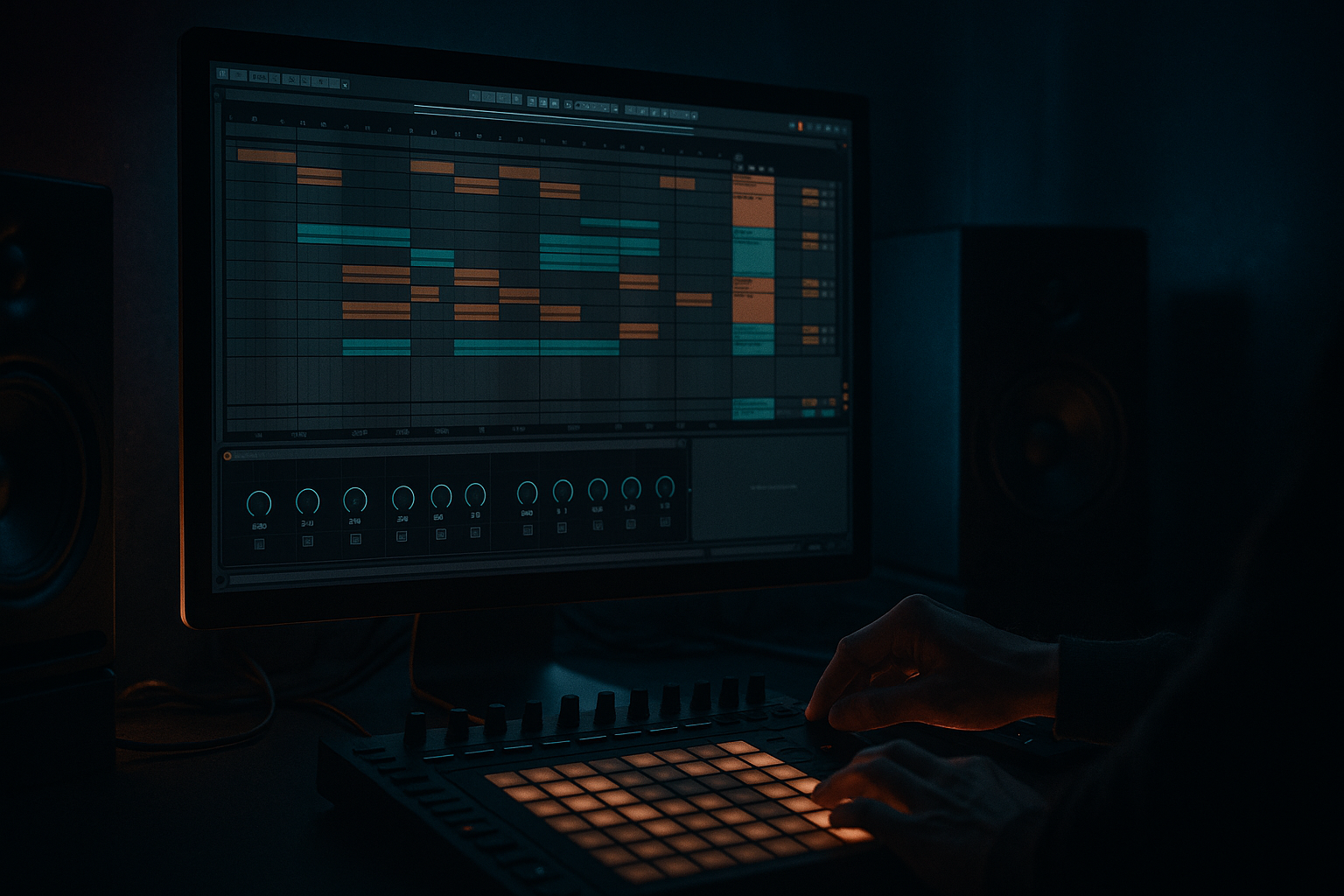
In drum & bass, the drums and bassline are the melody most of the time. But a minimal melodic hook—a two-note motif, a texture chord, or a call-and-response stab—can make a drum-led track feel finished without stealing energy from the groove.
In this lesson you’ll build a simple, repeatable melodic idea that:
- fits a rolling DnB/jungle context,
- stays out of the bass and kick,
- evolves across a full arrangement,
- uses only Ableton Live 12 stock devices + stock packs.
- Drum-led groove (break + tops) at 170–175 BPM
- Sub + mid bass doing most of the “musical” work
- A minimal melodic layer (stab/pluck/pad texture) that:
- From Packs > Drum & Bass (or any Live 12 stock DnB-oriented pack), grab:
- Snare/clap on 2 and 4.
- Hats: 1/8s or 1/16s with intentional gaps.
- Add ghost notes (low-velocity snare hits) around the main snare to get that rolling pressure.
- Operator:
- Add Saturator:
- Add Sidechain Compression (Compressor):
- Two oscillators slightly detuned
- Unison: 2–4 voices (not 8 unless you want chaos)
- Filter: lowpass around 200–800 Hz depending on aggressiveness
- Add Auto Filter or Wavetable filter envelope for motion
- Add Chorus-Ensemble lightly for width (watch mono compatibility)
- Add EQ Eight to carve room for the minimal melody (more later)
- F minor, G minor, A minor, C minor are common.
- Use only 2 notes (e.g., F and Eb in F minor).
- Put stabs on offbeats, especially after the kick and between snare hits.
- Bar 1: hits on 1.2, 1.4, 1.4.3 (a quick pickup)
- Bar 2: hits on 2.2, 2.3.4, 2.4
- Main hits: 90–110
- Ghost/pickups: 40–70
- A clip: sparse (intro/first drop)
- B clip: slightly busier (second half / second drop)
- HP 200–350 Hz
- If it fights snare snap, dip 1.5–3.5 kHz slightly
- If it’s too “pokey,” dip 5–7 kHz
- Make a gentle dip where the stab’s core sits (often 700 Hz–2 kHz)
- Sidechain input: Snare (or full DRUMS for pumping)
- Ratio 2:1 to 4:1
- Attack 1–10 ms
- Release 80–160 ms
- Aim: 1–3 dB ducking so the snare stays dominant.
- Bars 1–16: A clip (sparse), low-pass the melody slightly
- Bars 17–32: open the filter + slightly more reverb/echo
- Bars 33–48: switch to B clip (extra pickup notes)
- Bars 49–64: remove melody for 4 bars, then bring back for impact
- Drift/Wavetable Filter Cutoff (most important)
- Echo Dry/Wet (for “space lift”)
- Reverb Dry/Wet (tiny moves, 2–5% changes)
- Utility Gain (0.5–1.5 dB for section energy)
- Saturator Drive (small push in second half)
- Use minor 2nds and tritones sparingly for menace:
- Resample the stab (Freeze/Flatten) and reprocess:
- Create tension with reverb tails:
- Layer an atmo note one octave up:
- Use Roar (if available in your Live 12 edition):
- In drum-led DnB, minimal melody is about placement and evolution, not complexity.
- Build drums + bass first, then add a 2–4 note motif that avoids snare clashes.
- Shape it with EQ, sidechain, and automation using stock devices.
- Arrange with A/B clips and filter/FX movement so the melody “grows” across the drop.
We’ll focus on: register, rhythm, repetition, and automation—the four keys to minimal DnB melody.
---
2. What you will build
A 32–64 bar loop/section featuring:
- is only 2–4 notes,
- hits on offbeats or between snares,
- gets more intense through automation and arrangement.
---
3. Step-by-step walkthrough
Step 0 — Session setup (fast + clean) ⚙️
1. Set tempo to 172 BPM (classic rolling DnB pocket).
2. Set global quantization to 1 Bar (you’ll still add swing manually).
3. Make these tracks:
- DRUMS (Audio or Drum Rack)
- BASS (Sub)
- BASS (Mid/Reese)
- MELODY (Minimal)
- FX/Atmos (optional)
Workflow tip: Color-code early. You’ll iterate faster.
---
Step 1 — Build a drum-led foundation first 🥁
Minimal melody only works if the drums are already exciting.
#### A) Choose a break + punchy one-shots (stock packs)
- 1 breakbeat loop (Amen-style or tight roller)
- a clean kick
- a snare with body
- crisp hats/tops
#### B) Drum chain (stock devices)
On the DRUMS group, try this starter chain:
1. EQ Eight
- HP filter around 25–35 Hz (steep 24/48 dB if needed)
- Small dip 250–400 Hz if boxy
2. Drum Buss
- Drive: 5–15%
- Boom: Off or very low (DnB subs live in the bass track)
- Crunch: 5–20% depending on grit
3. Glue Compressor
- Attack: 3 ms
- Release: Auto
- Ratio: 2:1
- Aim for 1–2 dB GR for glue, not squashing
4. Utility
- If your break is wide: set Bass Mono (if available) or reduce width slightly.
#### C) Groove: classic roller placement
Micro-swing trick: In the MIDI Clip, nudge some hats slightly late (5–15 ms) rather than relying only on Groove Pool.
---
Step 2 — Bass does the heavy musical lifting 🎚️
Before melody, lock a bass that implies harmony.
#### A) Sub bass (simple = powerful)
On BASS (Sub) use Wavetable or Operator:
- Osc A: Sine
- Envelope: short-ish release (80–140 ms) to avoid overlap mud
- Drive 2–6 dB, Soft Clip On
- Sidechain from kick (or drum group)
- Ratio 4:1
- Attack 0.2–1 ms
- Release 60–120 ms
- Adjust threshold to taste (DnB wants clear kick movement)
Keep sub mostly mono (Utility Width 0–20%).
#### B) Mid bass / Reese (for movement)
On BASS (Mid/Reese) use Wavetable:
---
Step 3 — Pick the role of your minimal melody 🎯
In drum-led DnB, minimal melody usually fits one of these roles:
1. Offbeat stab (most common in rollers)
2. Two-note call/response with the bass
3. Texture pad that “glues” sections
4. Jungle-style riff (short, sampled-feel, repetitive)
For this lesson, we’ll build an offbeat stab + a 2-note motif that can evolve.
---
Step 4 — Create the minimal melodic instrument (stock only) 🎹✨
On MELODY (Minimal), make a stab that’s tight, mid-focused, and not too pretty.
#### Option A: Drift (fast, characterful)
1. Add Drift
2. Set:
- Voices: 1 (keep it mono-ish)
- Filter: Lowpass, cutoff around 1–3 kHz
- Envelope: short decay 200–400 ms, low sustain
3. Add Amp Envelope:
- Attack 0–5 ms
- Decay 150–350 ms
- Sustain 0–20%
- Release 60–120 ms
Then add this device chain:
1. EQ Eight
- HP at 180–300 Hz (stops fighting bass)
- Small dip around 2–4 kHz if harsh
2. Saturator
- Drive 2–8 dB
- Soft Clip On
3. Echo
- Time: 1/8 or 1/4 (try 1/8 dotted for bounce)
- Feedback: 15–35%
- Filter: HP 300–600 Hz, LP 4–8 kHz
- Dry/Wet: 8–18% (keep subtle)
4. Reverb
- Decay: 0.8–1.8 s
- Pre-delay: 10–25 ms
- Low cut: 300–600 Hz
- Dry/Wet: 5–12%
5. Utility
- Width 70–120% (watch mono; keep lows mono with HP anyway)
DnB rule: A stab can be wide, but its low-mids should be controlled.
---
Step 5 — Write a 2–4 note motif that fits the drums 🧠
#### A) Choose a key center (keep it simple)
Pick a minor key that suits darker DnB:
#### B) MIDI pattern: minimal but effective
Create a 2-bar clip on MELODY (Minimal).
Try this template:
Example rhythm (2 bars):
Keep velocities varied:
Why this works: It creates a “hook” without turning into a lead line. The drums remain front and center.
---
Step 6 — Make it talk with the bass (call/response) 🔁
Now we lock the melody to the bass groove.
1. Solo DRUMS + BASS + MELODY.
2. If the stab hits during a busy bass moment, remove that hit.
3. If the stab feels late/early, nudge timing:
- Move one note 5–15 ms early for urgency, or
- 5–20 ms late for swagger.
Pro workflow: Duplicate the melody clip and create two versions:
---
Step 7 — Carve space so the melody doesn’t fight the mix 🧼
Minimal melody still needs proper mixing.
#### A) EQ carving
On MELODY:
On MID BASS:
#### B) Sidechain the melody to the drums
Add Compressor on MELODY:
---
Step 8 — Arrange it like DnB (energy automation) 📈
A minimal melody shines through arrangement changes, not constant notes.
#### A) 64-bar drop roadmap (simple and effective)
#### B) Automation targets (stock devices)
Automate over 8–16 bars:
DnB move: In the last 2 bars before a switch, crank Echo feedback briefly (automation spike), then cut it hard at the drop.
---
4. Common mistakes ❌
1. Writing a lead line instead of a motif
If it has constant 1/8 notes, it’s not minimal anymore—pull notes out.
2. Too much low-mid energy (200–600 Hz)
This kills the roll. High-pass and keep the stab lean.
3. Melody stepping on the snare
If the stab hits right on 2 or 4, it often weakens the snare. Offset it.
4. Over-wide or phasey processing
Chorus + reverb + unison can smear. Check mono compatibility (Utility Width to test).
5. No evolution across the arrangement
A 2-note hook is fine—but automate it or it becomes wallpaper.
---
5. Pro tips for darker/heavier DnB 🕶️
- In F minor, a quick Gb grace note into F can sound nasty.
- Add Redux lightly (Downsample small amount) for grit
- Add Auto Filter with envelope for “wah” movement
- Long-ish reverb but high-passed (500 Hz+) so it doesn’t cloud the mix.
- Very quiet, wide, filtered—just to add air and dread.
- Subtle distortion modes + dynamics can make a tiny motif feel huge without adding notes.
---
6. Mini practice exercise 🧪
Goal: Make three versions of the same minimal motif that feel like different sections.
1. Start with a 2-note motif (2-bar loop).
2. Duplicate it twice:
- Version A (Intro): filter cutoff lower, less echo
- Version B (Drop): normal cutoff, tight echo 1/8, slightly louder
- Version C (Second half): add one extra pickup note + more saturation
3. Arrange:
- 8 bars A → 16 bars B → 8 bars (no melody) → 16 bars C
Check: Can you still hum the hook after you mute it? If yes, it’s doing its job.
---
7. Recap ✅
If you want, tell me your preferred sub key (e.g., F minor or G minor) and whether you’re going roller, jungle, or neuro-leaning, and I’ll give you a specific 16-bar MIDI motif + automation map that fits that sub/bass groove.
```

