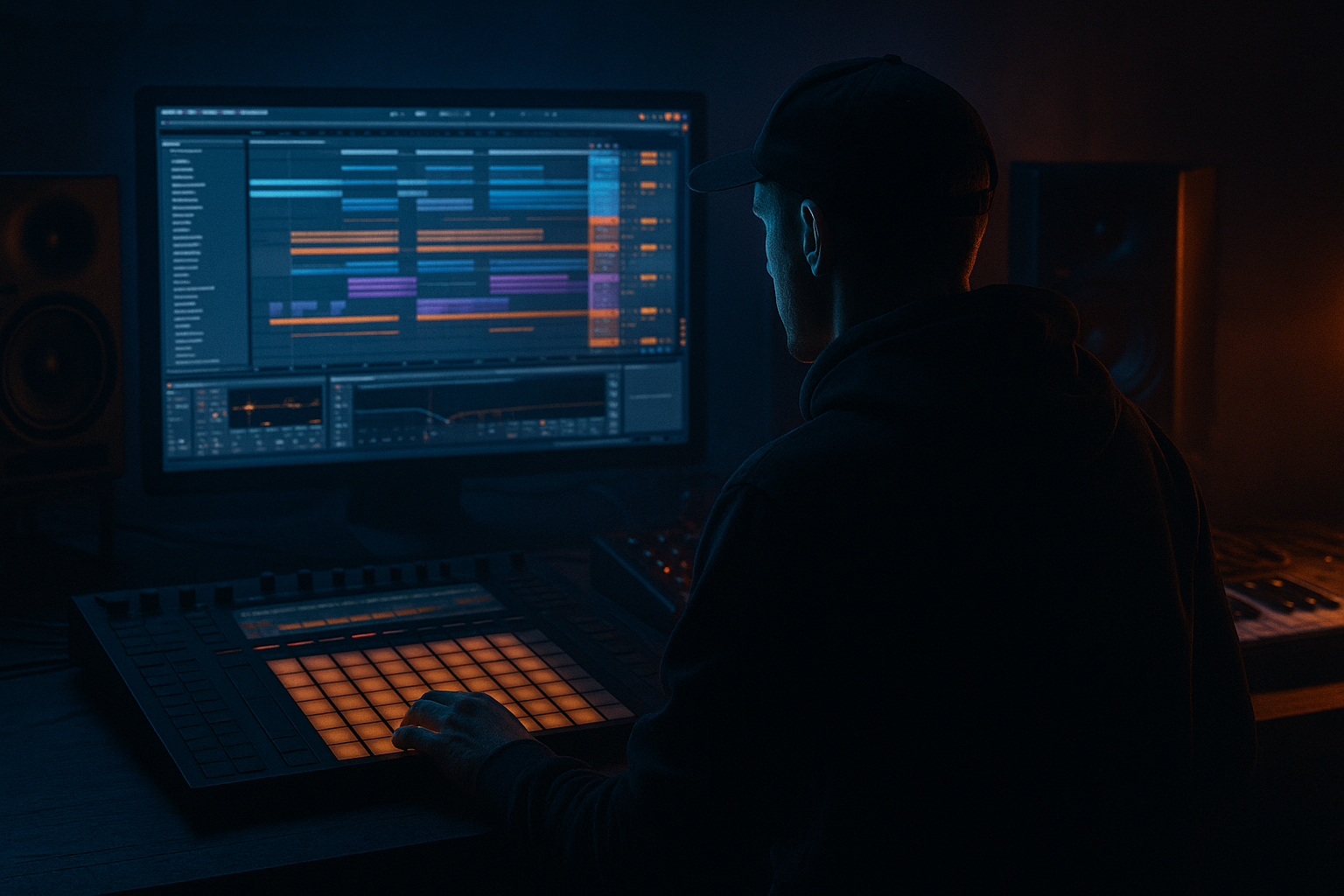
Main tutorial
```markdown
Mixing Atmospheric Hiss So It Feels Intentional (DnB in Ableton Live) 🌫️🥁
1) Lesson overview
Atmospheric hiss (tape noise, vinyl crackle, air noise, mic room, synth noise, foley “spray”) can instantly make drum & bass feel wider, older, grittier, and more emotional—or it can sound like a lazy “noise layer” that steals headroom, masks hats, and makes your mix feel cheap.
In this lesson you’ll learn how to make hiss feel designed:
- It sits behind the drums instead of fighting them
- It supports groove and movement (sidechain + modulation)
- It stays out of the sub and the snare crack
- It changes with the arrangement so it feels “scored”, not pasted
- Tone shaping (HP/LP + notch) to avoid harshness and masking
- Dynamic control (multiband + transient‑aware ducking)
- Stereo strategy (wide in highs, stable in mids)
- Intentional movement (auto pan, subtle filter drift, clip‑to‑clip automation)
- Arrangement logic (intro/verse/drop switches, fills, breakdown air)
- Record a real noise floor or use a long sample.
- Goal: steady, nostalgic, “glued”.
- Operator: use Noise oscillator, filter it.
- Goal: controllable, modern, “engineered”.
- Field recording: rain, air vent, crowd, room tone.
- Goal: cinematic and organic.
- High-pass:
- Low-pass (often overlooked):
- Notch the pain (typical harsh zones):
- Mode: Soft Sine or Analog Clip
- Drive: +2 to +6 dB (go subtle)
- Output: trim to match level
- Turn on Soft Clip if it helps density
- Low band (below ~300 Hz): basically dead (you already HP’d, but this catches residual rumble)
- Mid band (~300 Hz – 6 kHz): keep stable so it doesn’t mask snare tone
- High band (6 kHz+): smooth spikes, keep it airy but controlled
- Turn on Bass Mono (if available in your Live version) or manually ensure low band is mono via EQ.
- Width: 120–160% (start at 130%)
- If it starts pulling focus, automate width down in the drop.
- Set one EQ Eight to Mid, one to Side (or use the built-in M/S mode).
- On Sides, HP even higher (e.g., 600–1k) so stereo is mostly “air.”
- Enable Sidechain
- Input: Drum Bus (or specifically your kick + snare group)
- Start settings:
- Faster release = more “pumping” (can be cool for jungle energy)
- Slower release = smoother “pad-like” duck (great for rollers)
- Amount: 10–25%
- Rate: 0.05–0.15 Hz (slow drift) or sync to 2–4 bars
- Phase: 90–120° (not full 180 unless you want dramatic width)
- Move LP from 12 kHz → 10.5 kHz over 8 bars in breakdowns
- Or open slightly on fills to lift energy
- More hiss + more width
- LP slightly lower (warmer)
- Add Reverb (stock) very subtle for distance:
- Automate hiss up +1 to +2 dB
- Open LP slightly (e.g., 11 kHz → 13 kHz)
- Increase sidechain a touch so it “breathes” with snare rolls
- Often: reduce hiss level a bit (counterintuitive but pro)
- Keep ducking active so drums stay punchy
- Narrow width slightly if the mix gets busy
- Bring hiss forward again and add a tiny chorus-like spread:
- In the drop, the hiss bus often sits around -24 to -18 LUFS short-term equivalent perception (don’t overthink numbers—use your ears).
- If you mute it and the mix collapses, it’s right.
- If you hear it as a “track,” it’s too loud.
- Band-limit the hiss aggressively for neuro/dark rollers:
- Rhythmic gating for menace:
- Parallel distortion for “industrial air”:
- Use Drum Buss subtly on hiss (yes, really):
- Automate sidechain amount by section:
- Intentional hiss is designed texture, not a random layer. 🌫️
- The winning formula in DnB: EQ for space → saturation for character → multiband for control → stereo discipline → sidechain breathing → arrangement automation.
- In drops, less hiss (but smarter ducking) often hits harder than more hiss. 🥁
Everything here is Ableton Live stock (with optional third‑party mention only as “if you have it”).
---
2) What you will build
You’ll build a reusable “Atmos Hiss Bus” for rolling DnB / jungle that includes:
End result: hiss that feels like part of the track’s world—not a mistake. ✅
---
3) Step-by-step walkthrough
Step 0 — Choose the right hiss source (start with character)
Pick one of these sources depending on the vibe:
A) Vinyl/tape style
B) Synth noise
C) Foley air
DnB tip: For rollers, a steady hiss often works best—movement comes from mixing (ducking + modulation), not from random crackles everywhere.
---
Step 1 — Route it like a pro (bus workflow)
1. Create an Audio Track called `HISS`.
2. Route all hiss layers to a Return Track or Group Bus called `ATMOS BUS`.
- If you want track-by-track control: put them in a Group.
- If you want global control across multiple atmos layers: use a Return.
Why this matters: You’ll mix hiss like a system—easy to automate per section and easy to tame globally.
---
Step 2 — Build the core device chain (stock Ableton)
On `ATMOS BUS`, use this chain:
1) EQ Eight
2) Saturator (or Pedal)
3) Multiband Dynamics
4) Utility
5) Compressor (sidechain ducking from drums)
6) Auto Pan (optional, subtle movement)
7) Limiter (safety only)
Let’s dial it in.
---
Step 3 — EQ Eight: make space for drums and sub (non-negotiable)
Open EQ Eight and do this first:
- Filter type: 24 dB/oct
- Frequency: 250–500 Hz (start at ~350 Hz)
- Purpose: hiss must not crowd low mids or bass harmonics.
- Filter type: 12 dB/oct
- Frequency: 10–14 kHz depending on harshness
- If your hats live at 8–12 kHz, don’t let hiss dominate that exact band.
- Try a narrow cut around 7–9 kHz if it’s “fizzy”
- Or a small dip around 3–5 kHz if it’s “spitty” and steps on snare presence
Workflow tip:
Solo hiss, shape it, then unsolo and mix into the drums at low volume. Your ears will lie if you EQ in full mix only or solo only—do both.
---
Step 4 — Saturation: give it identity (not just “white noise”)
Add Saturator:
Why: Saturation introduces harmonic structure so hiss feels like “tape air” instead of sterile static.
If it gets too gritty, back off and let movement/ducking do the work.
---
Step 5 — Multiband Dynamics: control the hiss like a mix element
Add Multiband Dynamics and treat it like a “texture stabilizer.”
A good starting approach:
- Downward compress hard or reduce gain -inf to -12 dB
- Gentle compression: Ratio 2:1, Attack 10–30 ms, Release 80–200 ms
- Ratio 2–3:1, Attack 1–10 ms, Release 50–150 ms
Key idea: We want hiss present but not “spitty” on loud moments.
---
Step 6 — Stereo strategy: wide air, stable center 🎛️
On Utility:
DnB context: Wide hiss makes the groove feel bigger without adding more percussion. But if it’s wide in the wrong band, it can blur your snare snap.
Advanced move:
Use EQ Eight in M/S mode:
---
Step 7 — Make it “breathe” with the drums (sidechain ducking)
This is where it becomes intentional.
Add Compressor (stock) after Utility:
- Ratio: 4:1
- Attack: 1–5 ms
- Release: 80–160 ms (time it to groove)
- Threshold: adjust for 2–6 dB gain reduction on hits
Goal: Every kick/snare hit “pushes the air back,” so your drums stay forward and the hiss feels like room tone reacting to impact.
DnB timing note:
---
Step 8 — Add controlled motion (subtle, musical modulation) 🌊
Add Auto Pan very subtly:
Alternative motion: automate EQ Eight low-pass by tiny amounts:
Keep it classy: Motion should feel like “air moving,” not like an LFO plugin demo.
---
Step 9 — Arrangement: make the hiss tell the story 🎚️
This is the difference between “noise layer” and “intentional atmosphere.”
Try these DnB arrangement moves:
Intro (8–16 bars):
- Decay: 1.2–2.5s
- Low cut: 400–800 Hz
- Dry/Wet: 5–12%
Build (last 4 bars before drop):
Drop:
Breakdown:
- Use Chorus-Ensemble at very low mix (5–10%)
- HP before it to avoid mid smear
---
Step 10 — Gain staging: keep it below “obvious”
A practical target:
Fast check: Turn monitors down. If hiss is the main thing you hear, it’s too loud.
---
4) Common mistakes
1. No high-pass filtering → low-mid fog, weak bass impact.
2. Hiss competing with hats → metallic harshness, fatigue at 7–12 kHz.
3. Static level across the entire track → feels pasted-on and amateur.
4. Too wide in midrange → smears snare and vocal/synth lead focus.
5. Over-saturation → turns into fizzy distortion that triggers limiter/pumping.
6. Sidechain from kick only → snare still gets masked; use kick+snare or drum bus.
---
5) Pro tips for darker/heavier DnB 🖤
- HP 500–900 Hz, LP 8–11 kHz
- This creates “pressure” without bright sparkle.
Put a Gate before the reverb:
- Sidechain Gate from a ghost hat pattern or shaker
- Keeps texture moving but not washing the mix
Duplicate hiss track:
- One clean + wide
- One distorted + mono-ish (Utility width 0–50%)
Blend the distorted one super low for grime.
- Drive: very low (1–5)
- Crunch: 0–10%
Gives it a “compressed room” vibe if you don’t overdo it.
Drops often need more ducking than intros to keep punch at high master loudness.
---
6) Mini practice exercise (15–20 minutes) ⏱️
1. Load a clean rolling DnB loop (kick, snare, hats, bass).
2. Add a white noise sample or Operator Noise and loop it for 16 bars.
3. Build the chain: EQ Eight → Saturator → Multiband Dynamics → Utility → Compressor (SC).
4. Set sidechain to your Drum Bus and aim for ~4 dB GR on snare hits.
5. Automate:
- Hiss volume: +1.5 dB into the drop, then -1 dB at drop start
- LP filter: 10.5 kHz in intro → 13 kHz pre-drop → 11.5 kHz in drop
6. A/B:
- Mute hiss: does the track feel smaller/flatter?
- Unmute: does it feel like a space around the drums without stealing attention?
If you can make it felt more than heard, you nailed it.
---
7) Recap
If you want, tell me your subgenre (liquid, jungle, jump up, neuro, deep roller) and what’s currently masking (hats? snare? vocal?)—I’ll suggest exact EQ targets and ducking timings for your tempo and drum pattern.
```

