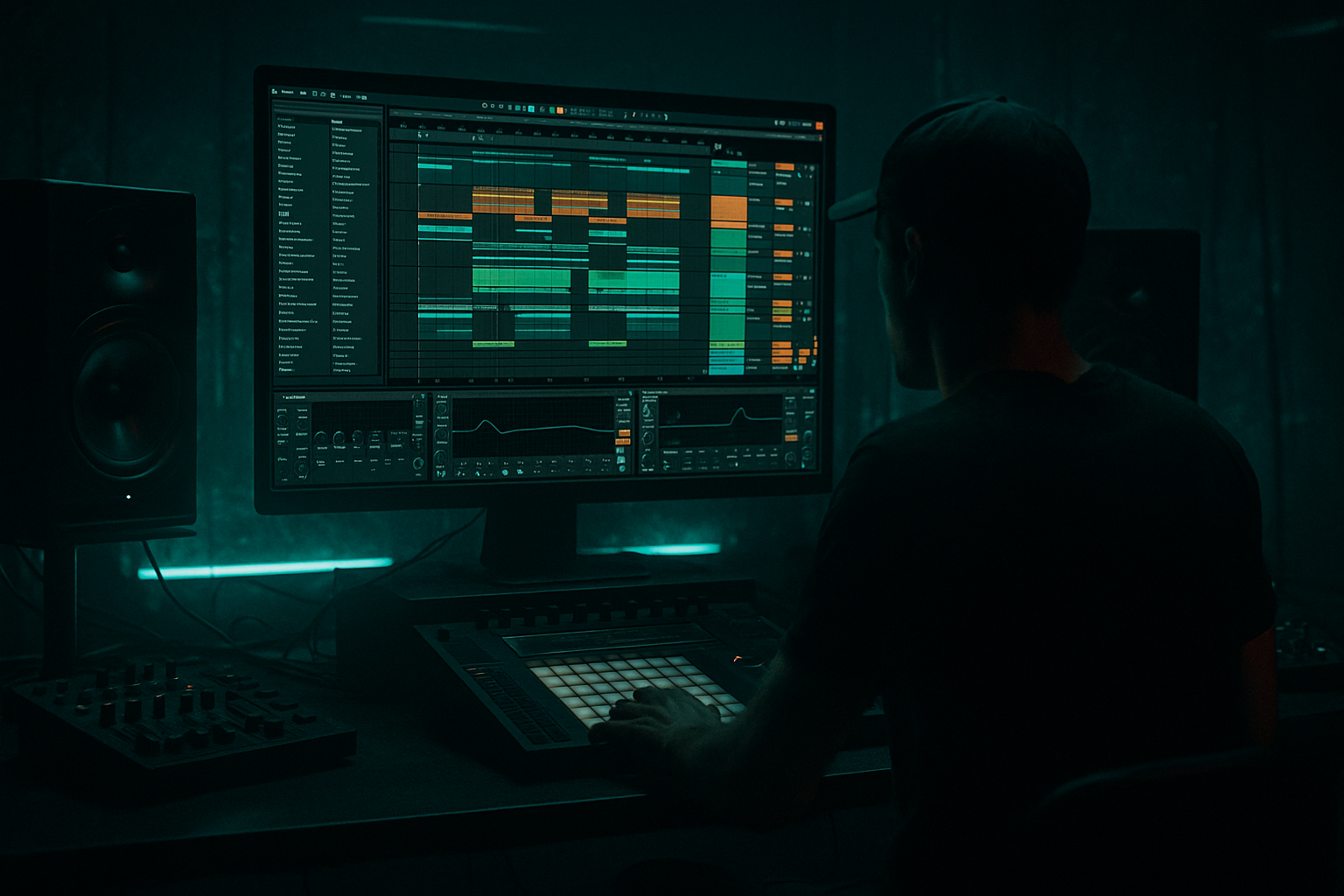
Main tutorial
Modal Color for Darker Tracks Masterclass (Session View) — Drum & Bass in Ableton Live 🎛️🌑
1. Lesson overview
This lesson is about injecting dark, emotional “modal color” into drum & bass using Ableton Live Session View—so you can jam ideas fast, capture happy accidents, and build tension without relying on generic minor-scale loops.
You’ll learn how to:
- Pick modes that sound darker than basic natural minor
- Build a modal chord/pad bed that supports rolling bass
- Write bass motifs that “prove” the mode (not just the key)
- Use Session View scenes to audition progressions, drops, and breakdowns
- Lock your drums/bass to the vibe with stock Ableton devices
- 4 Scenes: Intro → Build → Drop → Breakdown
- A modal harmonic loop (2–4 bars) with dark tension notes
- A rolling Reese/sub bass line that emphasizes modal tones
- A DnB drum rack with tight groove + fills
- A quick resample/print workflow to commit ideas into Arrangement
- Phrygian: b2 = instant menace (e.g., A Phrygian: A Bb C D E F G)
- Phrygian Dominant: exotic + aggressive (great for neuro-ish stabs)
- Dorian: still dark but “driving” (good for rollers)
- Harmonic minor: cinematic tension (strong leading tone)
- Wavetable (or Analog) → choose a smooth wavetable (Basic Shapes works)
- Osc 1: Sine/Triangle-ish
- Osc 2: slightly detuned (3–8 cents)
- Filter: LP24, cutoff ~ 400–1.2k (depending on brightness)
- Add Unison: 2–4 voices, Amount low (10–25%) to keep it controlled
- Bar 1: A + Bb + E (that Bb is the mood)
- Bar 2: G + A + Bb (cluster = dark haze)
- Notes: A → Bb → A → G → A
- Rhythm: leave tiny gaps for drum punch (don’t fill every 16th)
- Bass A: simplest (drop-ready)
- Bass B: extra Bb hits (darker)
- Bass C: call-and-response (space for fills)
- Kick: beat 1 + sometimes a pickup
- Snare: beat 2 and 4
- Hats: 1/16 with velocity variation
- Ghost snare: around 1.3 / 3.3 (very low velocity)
- Instrument: Simpler with a one-shot stab sample or Operator (quick synth stab)
- Algo: 1 (simple)
- Osc A: Saw
- Filter: ON (LP), cutoff 1–4 kHz
- Amp envelope: short decay (150–400 ms), low sustain
- Stab idea: hit Bb power-stab right before the snare to create tension.
- Or alternate: A → Bb as a call.
- Pad: Variation 1 (no strong rhythm)
- Drums: minimal hats / filtered break
- Bass: OFF or very soft sub hits
- FX: noise sweeps
- Pad: Variation 2 (more Bb)
- Stabs: bandpassed, rhythmic tease
- Drums: add ghost notes + ride
- Bass: Bass B (more modal movement)
- Drums: full kit
- Bass: Bass A (most solid)
- Pad: simplified (don’t overcrowd)
- Stab: occasional, not constant
- Drums: half-time or sparse break
- Pad: widest, most reverb
- Bass: sub only, long notes (A to Bb tension swell)
- Edit transitions
- Automate filter cutoff / reverb throws
- Tighten fills
- You picked a mode but never featured its signature note.
- Pads eating the sub.
- Too many chord tones in the drop.
- Sidechain not tuned to groove.
- Everything wide.
- Use “modal drones”: hold A + Bb quietly under the whole drop (very low, filtered). It subliminally keeps darkness present.
- Pitch automation into the b2: quick riser FX that lands on Bb before the drop = instant dread.
- Resample bass movement:
- Use subtle dissonance, not constant dissonance:
- Drum Buss on reese mids only:
- Jungle edge: layer a quiet, high-passed break (Amen-style) with your clean drums to add urgency without clutter.
- Modal color in dark DnB comes from highlighting signature notes, not just picking a scale.
- Session View is perfect for building clip variations + scenes and recording a performance into structure.
- For darker rollers, Phrygian (b2) is a cheat code—but only if you use the b2 intentionally.
- Keep the mix functional: pads high-passed, sub mono, sidechain tuned, drums punchy.
Target vibe: deep/techy roller, jungle-leaning darkness, minimal but intense.
---
2. What you will build
A Session View sketch with:
You’ll end with a playable Session View “performance rig” you can record into a full track.
---
3. Step-by-step walkthrough
Step 0 — Project setup (fast + DnB-ready)
1. Tempo: 172–176 BPM (try 174 BPM).
2. Global Quantization: 1 Bar (top-left) so scene launches are tight.
3. Create tracks:
- Drums (MIDI)
- Bass (MIDI)
- Pad/Atmos (MIDI)
- Stab/Chord (MIDI)
- FX/Resample (Audio)
4. Color-code tracks (you’ll thank yourself later).
---
Step 1 — Choose a dark mode (and why it works)
Instead of “A minor”, choose a mode with a signature note that creates instant darkness/tension:
#### Dark mode picks for DnB
✅ For this masterclass: A Phrygian (easy on bass instruments and super moody).
Important: Modal writing = you must feature the b2 (Bb) often enough that it’s not just A minor.
---
Step 2 — Build a modal “scale lock” in Session View (so you don’t drift)
On your Pad/Atmos MIDI track:
1. Drop MIDI Effect → Scale
2. Set:
- Base: A
- Use Phrygian preset if available, or manually enable notes:
- A, Bb, C, D, E, F, G
3. Put another Scale on the Bass and Stab/Chord tracks too.
This lets you jam safely while still sounding intentional. 🎯
---
Step 3 — Create the modal pad bed (dark but not muddy)
On Pad/Atmos, load:
Wavetable settings (starting point):
Device chain (stock):
1. Wavetable
2. Auto Filter (LP, gentle movement)
- Rate: 1/8 or 1/4 (sync)
- Amount: subtle
3. Echo
- Time: 1/8D or 1/4
- Feedback: 15–30%
- Filter: roll off lows below ~200 Hz
4. Reverb
- Decay: 3–6s
- Low Cut: 250–400 Hz (keep sub clean!)
5. Utility
- Width: 120–160% (pad wide)
- Bass Mono: enable if needed (or simply keep lows cut)
#### Write a 2-bar modal loop (simple but modal)
Create a clip (2 bars) and start with pedal A (root) + modal tension note Bb.
Example pad tones (not strict chords—more like “beds”):
Tip: Don’t over-voice. Dark DnB loves space.
Duplicate the clip and create 2–3 variations for different scenes.
---
Step 4 — Build a proper rolling bass that “proves” Phrygian
On Bass track, make a rack that covers sub + mid cleanly.
#### Option A: One instrument + split with EQ (fast)
Instrument: Wavetable (or Operator)
Bass chain (stock):
1. Wavetable
- Osc 1: Sine (sub foundation)
- Osc 2: Saw (mid grit), level lower than sub
- Filter: LP24, drive 5–20%
2. Saturator
- Drive: 2–6 dB
- Soft Clip: ON
3. EQ Eight
- High-pass mids layer if needed (or keep lows clean)
4. Compressor (sidechain from kick)
- Ratio: 4:1
- Attack: 1–5 ms
- Release: 60–140 ms (tune to groove)
5. Utility
- Width: 0% below ~120 Hz (mono sub)
#### Write a 1-bar or 2-bar bass motif (DnB roller)
Create a 1-bar clip first, then expand.
Core concept: Hit A often, but repeatedly “lean” into Bb as a passing or landing note. That’s the Phrygian fingerprint.
Example 1-bar pattern (16ths feel):
Groove tip: Use note lengths as much as notes—short mid notes, slightly longer sub anchors.
#### Lock with Session View variations
Make 3 bass clips:
Assign them to different scenes so you can audition energy levels instantly.
---
Step 5 — Drums: rolling DnB foundation that supports the mode 🥁
Harmony is useless if drums fight the vibe. Build a tight kit quickly:
1. Create Drum Rack on the Drums track.
2. Core slots:
- Kick (punchy, short tail)
- Snare (crack + body)
- Closed hats (shuffle)
- Ride / shaker layer
- Ghost snare / rim
- Break layer (optional but very jungle)
#### Basic DnB pattern (2-step base)
Add movement:
#### Glue the drum bus (stock chain)
On Drum Rack or drum group:
1. EQ Eight
- Cut mud: 200–400 Hz if needed
2. Drum Buss
- Drive: 5–20%
- Boom: low (or off) for tight rollers
- Transients: +5 to +20 (for snap)
3. Glue Compressor
- 1–3 dB gain reduction max
4. Saturator (optional, subtle)
DnB trick: If your track feels “too musical,” your drums might be too clean. Add controlled grit.
---
Step 6 — Make modal stabs that cut through the drop
On Stab/Chord track:
Operator stab (fast recipe):
Stab chain:
1. Operator / Simpler
2. Redux (very light, 2–4 bits or slight downsample)
3. Auto Filter (bandpass for telephone vibe during build)
4. Reverb (short, 0.6–1.2s)
5. Utility (widen or narrow depending on role)
Modal note choice: Use Bb and C prominently.
---
Step 7 — Build Scenes like a DJ: Intro / Build / Drop / Breakdown
This is where Session View becomes a composition weapon.
Create four scenes (name them clearly):
#### Scene 1 — Intro (Atmos + hints)
#### Scene 2 — Build (increase tension with b2!)
#### Scene 3 — Drop (clarity + weight)
#### Scene 4 — Breakdown (reset ears)
Pro workflow: Use Scene Launch to audition energy curves. If the drop feels weaker than the build, remove elements from the build (don’t always add more).
---
Step 8 — Capture it into Arrangement (commit the performance)
1. Hit Global Record (top transport).
2. Launch scenes in order like a DJ.
3. Jam clip mutes and clip swaps (bass variations especially).
4. Stop. Go to Arrangement View and you’ve got a structure.
Now you can:
This is one of the fastest ways to write DnB that feels performed rather than programmed. 🔥
---
4. Common mistakes
If you’re in Phrygian and you barely use b2, it’ll just sound like minor.
Always high-pass pad/atmos (often 250–400 Hz) for DnB.
Heavy DnB drops usually want bass + drums first, harmony second.
If release is wrong, bass feels like it’s “ducking weird” instead of bouncing.
Keep sub mono, keep core drums fairly centered.
---
5. Pro tips for darker/heavier DnB 🖤
Freeze/Flatten or resample to audio, then use Warp → Complex Pro and micro-chop for nasty fills.
Save the harshest cluster voicings for builds/breakdowns so the drop hits cleaner.
Split bass into sub/mid (Audio Effect Rack with EQ splits) and distort mids harder while keeping sub clean.
---
6. Mini practice exercise (15–25 minutes)
Goal: Make 3 modal scenes that all feel “A Phrygian” but with different energy.
1. Choose A Phrygian and put Scale on Pad + Bass.
2. Create three 2-bar pad clips:
- Clip 1: mostly A
- Clip 2: A + Bb emphasis
- Clip 3: more cluster (A, Bb, C)
3. Create three 1-bar bass clips:
- One simple (A anchors)
- One with more Bb
- One with a G→A→Bb tension run
4. Launch combinations in Session View and record 2 minutes into Arrangement.
Checkpoint: If you mute the pad, does the bass still sound Phrygian? If not—add Bb movement.
---
7. Recap
If you want, tell me the vibe (deep roller / techstep / jungle / neuro) and I’ll suggest two mode options + a 4-scene chord/bass blueprint tailored to that style.

