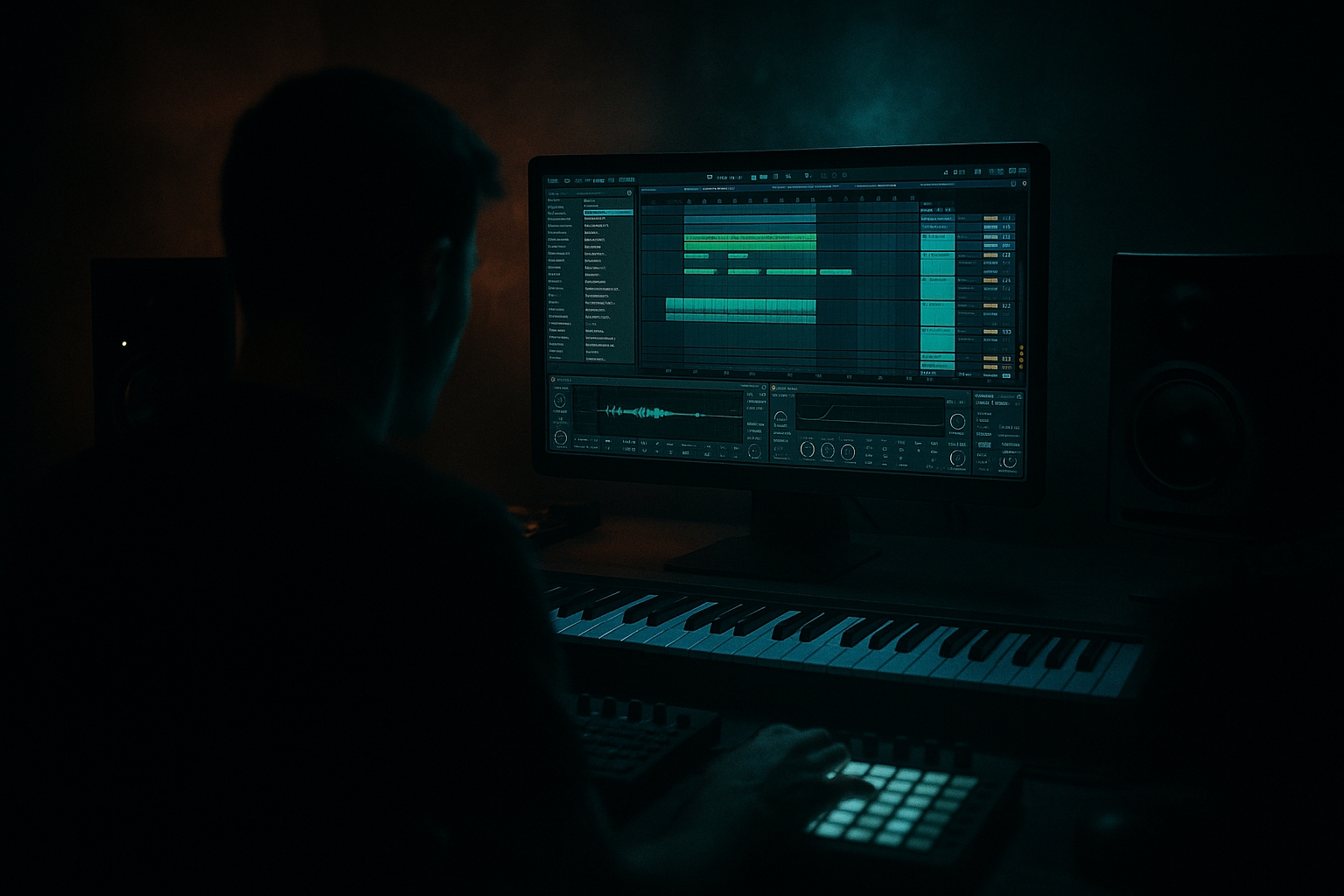
Main tutorial
Lesson Overview
This lesson is about building a darkside intro that moves like a DJ tool, then evolving it into a proper jungle / oldskool DnB entry point without losing the mix function. The goal is not just “a cool intro sound” — it’s an intro that can sit on a club rig, give the DJ something usable to blend, and still feel like it belongs to a heavy, modern DnB track.
In a real DnB arrangement, this technique lives in the opening 8, 16, or 32 bars before the drop, and often again as the post-drop reset or second-drop lead-in. For jungle-leaning and oldskool-flavoured DnB, the intro needs movement, menace, and enough rhythmic identity to hint at the groove without giving away the full impact too early. That means modulation, filtering, break fragments, and atmosphere — but controlled so the low end stays readable and the DJ can mix over it.
Why it matters musically: a static dark intro gets boring fast. A DJ-friendly intro gives the track identity while still leaving space for the incoming tune. Why it matters technically: if the intro is overfilled, stereo-wobbly, or too sub-heavy, it becomes unusable in a mix and makes the drop feel smaller when it arrives.
By the end, you should be able to hear an intro that feels like it is constantly breathing and shifting, but still has a clear downbeat, obvious phrasing, and a clean path into the drop. The successful result should feel like a haunted tunnel opening up before the rhythm locks in.
What You Will Build
You’re building a dark, evolving intro with oldskool/jungle character that is:
- atmospheric but rhythmically anchored
- modular enough to work as a DJ intro
- modulated with controlled filter and amplitude movement
- supported by break edits and short FX phrases
- polished enough to sit in a near-finished arrangement
- Use modulation that changes density, not just brightness. Opening a filter is obvious; subtly increasing harmonic grit or break activity often feels darker and more sophisticated.
- Keep one “anchor” element stable through the intro — usually a recurring snare ghost, reverse pulse, or low-mid motif. That anchor helps the listener stay oriented while everything else shifts.
- If the intro needs menace, saturate the midrange texture more than the sub region. The ear reads 500 Hz to 3 kHz movement as aggression without wrecking low-end clarity.
- For a more underground feel, allow one imperfect detail: a slightly off-grid ghost hit, a rough reverse tail, or a clipped ambience stab. Perfect symmetry can sound too polished for jungle-leaning material.
- Use a tiny amount of delay throw on isolated hits rather than flooding the whole intro with reverb. Long reverb can turn to fog fast; controlled echoes keep momentum.
- If you want the intro to feel like it belongs to oldskool jungle, lean on break phrasing and sample texture. If you want it darker and more modern, lean on tighter low-mid movement and more disciplined space.
- In a heavy track, less information in the last 2 bars before the drop often hits harder than adding a final riser. The void becomes part of the impact.
- use only stock Ableton devices
- only two musical layers plus one break edit
- no sub below the intro
- automate only two parameters
- an 8-bar arrangement with a dark bed, a chopped break fragment, and one transition hit into bar 9
- can you count the phrase cleanly in 4s or 8s?
- does the intro change by bar 5 or bar 9 without feeling busy?
- does the final bar leave space for the drop to feel bigger?
Sonically, expect a textured bed of noise, reese fragments, or detuned harmonic material, plus chopped break accents, reverse tails, and filtered impacts. Rhythmically, it should pulse in 2-, 4-, or 8-bar phrases, with enough negative space for mixing. In the track, it acts as the tension-builder before the drop and as a transition platform between sections.
Success sounds like this: the intro feels dark and alive, the groove is implied before it fully hits, and when the drums and bass arrive, it feels earned rather than dropped in from nowhere.
Step-by-Step Walkthrough
1. Start with the DJ function first, not the sound design
In Ableton Live, set up an 8-, 16-, or 32-bar arrangement section where the intro will live. For a darkside DnB track, 16 bars is often the sweet spot: enough time for tension and movement, short enough to stay DJ-friendly. Put a clear marker where the drop will land and decide what the DJ needs in those bars — usually a stable pulse, a recognizable downbeat, and enough high/mid content to cue the incoming blend.
Build a simple reference grid: first 8 bars for atmosphere and motif, next 8 bars for escalation. If you want a longer intro, make sure something changes every 4 or 8 bars: break density, filter opening, percussion addition, or a new FX layer. The important thing is that the intro feels structured, not like a loop that got stretched.
Why this works in DnB: DJs need phrasing they can count and mix against. A dark intro with clean 16-bar architecture is much easier to blend than an abstract texture cloud.
2. Build the core dark layer with a restrained harmonic source
Create one MIDI track and load a stock instrument that can generate a dark harmonic bed. A simple route is Wavetable, Simpler, or Analog depending on how raw you want it. For a jungle/oldskool flavour, lean toward a reese-ish or detuned saw foundation rather than a clean pad.
Keep the note content minimal: one or two notes, often a root and a fifth or root plus octave movement. Avoid writing a full chord progression at this stage; the intro should suggest harmony, not dominate it. If you want more danger, use a minor 2nd or tritone touch in an upper layer, but keep the sub region clean.
Useful starting points:
- low-pass filter cutoff somewhere around 200–900 Hz, depending on brightness
- slight oscillator detune, not extreme
- filter resonance modest, just enough to add bite without whistling
- envelope decay in the 300 ms to 1.5 s range for movement
- Saturator Drive around 1–4 dB for edge, not destruction
Add Auto Filter after the instrument for controlled motion. Set a slow LFO or envelope sweep so the sound opens slightly over 4 or 8 bars. If the sound is too static, automate the cutoff manually rather than relying on one fixed modulation shape.
What to listen for: the layer should feel ominous and mobile, not like a pad that fills space evenly. If it sounds pretty, airy, or too wide, you’re drifting away from darkside utility.
3. Split the intro into three roles: bed, rhythm, and punctuation
Don’t let one layer do everything. Create:
- a bed layer: atmospheric harmonic or noise texture
- a rhythm layer: chopped break, gated percussion, or filtered top loop
- a punctuation layer: reverse hit, impact, snare ghost, or short stab
A strong stock-device chain for the bed:
- Wavetable or Simpler
- Auto Filter
- Saturator
- EQ Eight
A strong chain for the rhythm layer:
- Simpler with a break slice or short loop
- Drum Buss or Saturator for grit
- EQ Eight to carve low end
- Auto Pan very subtly if needed for movement, but keep the low end mono
The punctuation layer can be built from an audio hit or break fragment in Simpler, then processed with Reverb and Auto Filter for reverses and tails.
Why this works in DnB: jungle and oldskool intros usually feel convincing when the ear can identify separate functions. If every element has the same decay, same width, and same density, the intro becomes mush.
4. Edit a break fragment to create the jungle motion
Pull in a classic break or your own break edit and place it under the dark layer. Don’t instantly full-loop it; instead, use short slices that answer the harmonic material. In Simpler, switch to Slice mode if needed and map the break to transient slices, or manually chop the audio clip for more control.
Build a 2-bar or 4-bar break phrase with ghost notes and occasional fuller hits. Keep the snare placement clear enough that the listener can feel the grid, but allow a bit of push-pull through tiny timing offsets. A few milliseconds late on a ghost hit can help the swing feel more human; too much and it sounds sloppy.
Suggested treatment:
- high-pass the break around 120–200 Hz if the kick/sub conflict is getting messy
- tame harsh top with EQ Eight around 6–10 kHz if hats start tearing
- use Drum Buss lightly for transient snap and glue
- reduce low-mid clutter around 250–450 Hz if the break clouds the intro
What to listen for: the break should imply forward motion without stealing the drop. If the break sounds like the main event already, pull it back and leave more room for the actual drum entry.
5. Use modulation to make the intro breathe, not wobble aimlessly
This is the heart of the lesson. The goal is not random movement — it’s controlled evolution. Use automation or rack macro movement to gradually alter:
- filter cutoff
- reverb send or wet amount
- distortion amount
- stereo width on the upper layer only
- delay feedback on brief punctuation sounds
A clean Ableton workflow is to group your bed layer into an Instrument Rack or Audio Effect Rack and map 2–4 macros:
- Macro 1: Filter Cutoff
- Macro 2: Saturator Drive
- Macro 3: Reverb Size or Wet
- Macro 4: Width / Pan movement on the top layer only
Over 8 or 16 bars, automate those macros so the intro opens and destabilizes slightly. Keep the movement gradual: small shifts every 2 bars, bigger opening near the last 2 bars before the drop.
A versus B decision point:
- A: slow, slowly opening modulation for a dread-heavy, ritualistic feel
- B: sharper, more audible automation changes for a raw jungle reload energy
Choose A if the track is intended for deep mixing and atmosphere. Choose B if the intro needs to feel like a set-up for a sudden heavy drop.
6. Shape the stereo field deliberately
Dark intros can get huge very quickly, which is dangerous in DnB because the drop needs to feel bigger. Keep the sub and most of the rhythmic foundation mono or near-mono. Use width mainly on upper harmonics, reverbs, and noise tails.
A practical approach:
- keep anything below roughly 120 Hz centered and clean
- use Utility on the bed layer if width is getting too broad
- if using Reverb, high-pass the return so the low end doesn’t smear
- let the break tops spread a little, but don’t widen the transient body
If the intro is too wide, the drop collapses on arrival. If it’s too narrow, it can feel lifeless. The target is controlled breadth: wide enough to feel cinematic, solid enough to translate on mono club systems.
Stop here if the intro already feels exciting but the kick/bass entrance is not yet designed. Save this section, bounce a rough render, and test the transition against your drop idea before adding more sound.
7. Add DJ-friendly phrasing and transitional utility
The intro must be mixable. That means giving DJs a stable cue point and enough clean room to blend. For a 16-bar intro, a useful structure is:
- bars 1–4: atmosphere and faint rhythm
- bars 5–8: break presence and harmonic motion
- bars 9–12: increased modulation and FX tension
- bars 13–16: final lift or strip-back before the drop
If the track is more oldskool/jungle in spirit, leave a few bars with lighter texture and less sub so the incoming DJ can ride the blend. If it’s darker and more modern, you can keep more tension in the midrange, but still avoid full low-end occupation.
Insert a small fill or reversed hit into bar 15 or 31 to signal the drop. Keep it short. A one-beat or half-beat event is usually enough. If the intro has a long tail, the drop loses impact.
One useful check: play your intro against a simple kick-snare loop from the drop. If the intro already masks the backbeat or muddies the snare arrival, it is not yet DJ-safe.
8. Commit the right parts to audio for speed and realism
When a modulated intro starts getting complex, don’t keep everything live forever. Commit the bed or break layer to audio if the movement is right and you’re mostly editing phrase shape now. This speeds up workflow and lets you cut reverses, mute specific tails, and re-time hits with precision.
A good resampling move:
- solo the bed plus movement FX
- record 8 or 16 bars to audio
- then chop and re-place selected tails into the arrangement
- keep the original MIDI version muted but saved in case you need to revisit the harmony
This is especially useful if the intro has evolving filter sweeps, delay throws, or reverb blooms that are easier to edit as audio than as live automation. Commit this to audio if the modulated layer is clearly working and the only remaining task is arrangement shaping.
9. Check the intro in context with the drop, not in isolation
Bring in the first bar of your drop drums and bass and audition the transition. This is where the truth shows up. If the intro is too dense, the drop will not feel like a release. If it is too sparse, the drop will feel disconnected.
Listen for two things:
- whether the snare or break into the drop lands with enough contrast
- whether the bass feels larger because the intro has stepped back in the right place
If the transition is weak, remove one element from the final 2 bars before the drop rather than adding more. In DnB, negative space before impact is often more effective than another fill.
10. Final polish: make the intro mix-ready and versionable
On the intro bus, do the minimum necessary:
- EQ Eight to clean mud around 200–400 Hz if the layers are stacking up
- gentle saturation if the intro feels too polite
- small gain trims so the intro sits below the drop in perceived energy
- check mono compatibility, especially if you used width tricks on the upper layer
Your intro should not be louder than the drop in emotional weight. It should create expectation. If you find yourself pushing the intro level up to make it “work,” the issue is usually arrangement or frequency balance, not volume.
Name your versions clearly: `intro_dread_A`, `intro_breakier_B`, `drop_alt` — whatever helps you compare quickly. A workflow that encourages versioning keeps you from overworking one idea and losing the good first take.
Common Mistakes
1. Making the intro too full too early
Why it hurts: the drop has nowhere left to go, so the tune feels flat instead of explosive.
Ableton fix: mute one layer in bars 13–16, or high-pass the final 2 bars more aggressively so the entry breathes.
2. Letting the sub live in the intro
Why it hurts: it muddies DJ blends and steals the low-end punch from the drop.
Ableton fix: use EQ Eight or Auto Filter to remove deep low frequencies from the intro layers; keep true sub reserved for the drop.
3. Using wide stereo effects on everything
Why it hurts: mono compatibility suffers and the intro loses focus on club systems.
Ableton fix: keep the foundational layer centered with Utility, and reserve width for tops, reverbs, and non-essential FX.
4. Too much random automation
Why it hurts: movement feels nervous instead of intentional, which weakens the dark atmosphere.
Ableton fix: automate in phrase-length arcs, usually 2, 4, or 8 bars, and make each change serve a clear escalation or reset.
5. Over-editing the break until it sounds chopped up and lifeless
Why it hurts: jungle energy depends on flow as much as detail.
Ableton fix: keep a few longer break sections intact and use smaller edits only as punctuation; compare your chopped version against a simpler loop.
6. No contrast between intro and drop
Why it hurts: the drop doesn’t feel like a payoff.
Ableton fix: strip the final intro bar back, reduce reverb tail, and leave the drop’s first kick/snare pair exposed.
7. Ignoring the DJ blend window
Why it hurts: the track may sound exciting solo but become awkward to mix.
Ableton fix: test the intro with a simple incoming beat and make sure there is a clean 4–8 bar blend zone without hard clutter.
Pro Tips for Darker / Heavier DnB
Mini Practice Exercise
Time box: 15 minutes
Goal: build a DJ-friendly 8-bar dark intro that can lead into a jungle/DnB drop.
Constraints:
Deliverable:
Quick self-check:
Recap
A strong darkside intro in DnB is not just atmosphere — it’s structured tension with DJ utility. Build it in phrases, keep the low end disciplined, separate bed/rhythm/punctuation, and modulate with intention rather than random motion. Check it against the drop early, commit to audio when the movement is right, and always protect the contrast that makes the drop hit.

