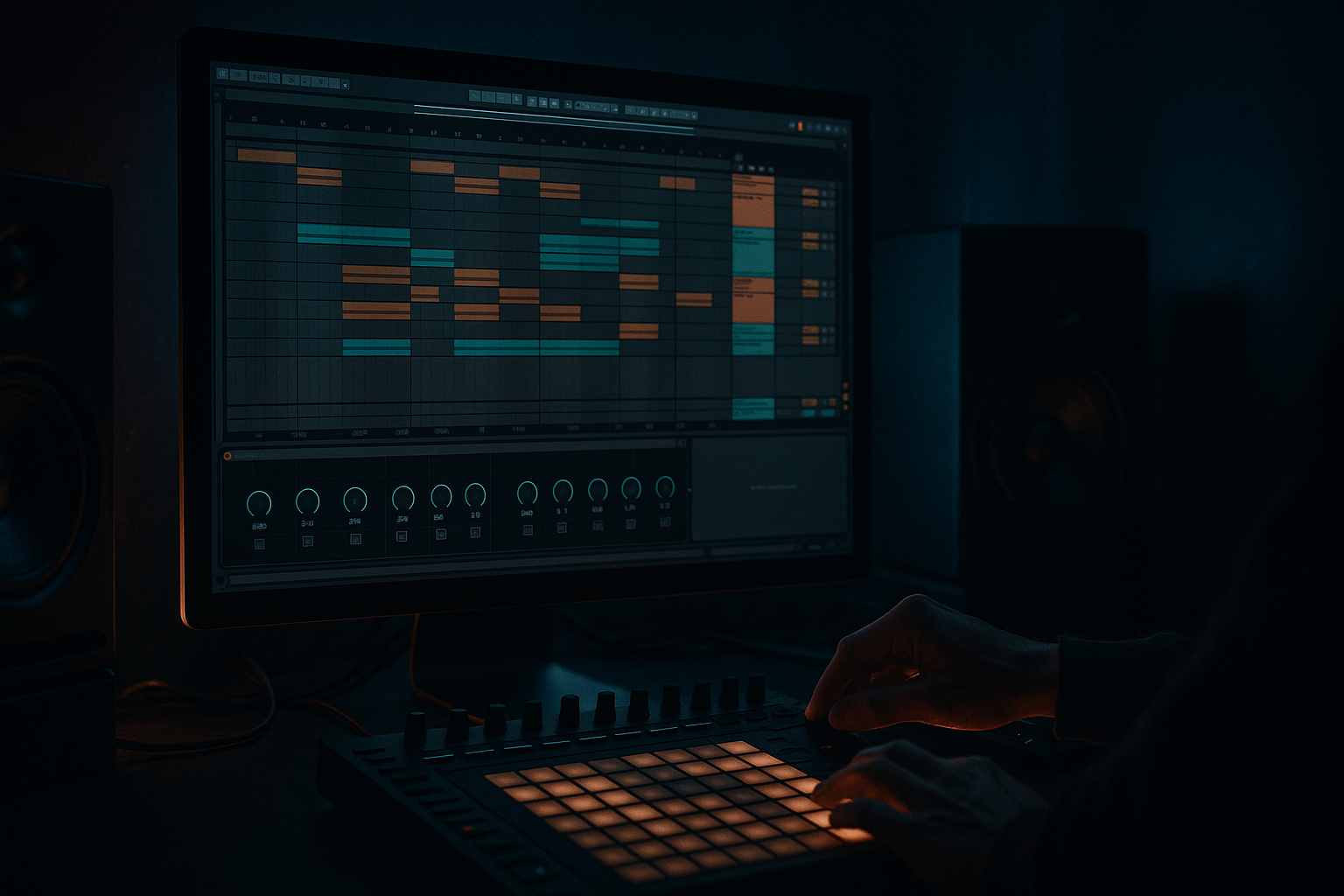
Main tutorial
Lesson Overview
This lesson is about turning a plain warehouse-style intro into something that feels alive: modern in its punch, but with enough vintage soul to hint at old jungle, early rollers, and gritty UK dancefloor energy. In practice, that means modulating a loop, stab, atmos pad, or sampled texture so it evolves across the intro without losing its identity or blurring the low end.
In a DnB track, this technique usually lives in the first 8, 16, or 32 bars before the drop, or in the space between the second breakdown and the final impact. It matters because intros have a specific job in Drum & Bass: they must create tension, establish key and mood, and leave room for the DJ to mix in the next tune, all while keeping enough rhythmic motion that the track already feels like it’s moving at 174+ BPM.
Musically, the goal is to stop the intro from sounding like a static pad loop pasted on top of drums. Technically, the goal is to create movement using stock Ableton Live 12 tools in a way that stays usable in a real arrangement: mono-safe where it needs to be, clean in the low end, and strong enough that the drop still feels like a payoff.
This is best suited to darker DnB, halftime-to-full-time hybrid intros, rollers, neuro-intro atmospheres, jungle-influenced textures, and club-oriented tracks where the intro needs personality without stealing the drop’s job. By the end, you should be able to hear a warehouse intro that breathes, shifts, and grooves in a controlled way — something that feels like it was designed to pull a crowd forward, not just fill space.
What You Will Build
You will build a 16-bar intro element: a gritty warehouse texture or chord stab that evolves through filtering, micro-automation, resampling, and rhythmic modulation. The result should feel like a dark industrial space slowly coming to life: metallic, roomy, slightly worn, but still tight enough to sit over DnB drums.
Sonically, it should have:
- a muted, heavy opening
- movement in the mids and upper mids
- occasional vintage-style warble or grain
- enough transient edge to cut through drums
- low-end discipline so the kick and sub remain dominant
- Use saturation for density, not just loudness. A subtle Saturator push can make an intro feel more aggressive without flattening the transient shape. If the source is thin, try adding drive before EQ trimming so the new harmonics have something to work with.
- Keep the sub lane clean by designing the intro above it. In darker DnB, menace often comes from what is not playing in the low end. A restrained intro with strong mids can feel heavier than a full-spectrum wash.
- Add tension through limited harmonic motion. A repeating minor interval, a single-note pedal with evolving texture, or a two-note stab can feel more dangerous than a busy chord progression.
- Use short dark echoes instead of long reverbs when the track needs club pressure. A long tail can smear the groove; a short, filtered reflection adds size while staying tight.
- If the intro needs old-jungle soul, introduce slight instability in the repeat: a tiny change in decay, start point, or filter opening every 4 bars. That creates human feel without losing modern punch.
- For heavier tracks, keep the most aggressive texture centered and let the stereo information live in a filtered upper layer. That preserves weight in mono and makes the intro hit harder on systems.
- Resample a version with slightly different automation intensities. One take can be more restrained, another more intense. You can then choose the one that supports the drop instead of overcommitting to a single version.
- Use only stock Ableton devices.
- Use one source sound only: a stab, chord, or texture.
- Use no more than two active modulation moves.
- Keep everything below 250 Hz out of the intro element.
- a 16-bar intro bounce or arrangement section with at least three distinct stages of movement
- a final 4-bar pre-drop section that feels the most open and tense
- Can you still hear the snare clearly when the intro plays with drums?
- Does the intro feel darker in bars 1–4 and more urgent by bars 13–16?
- Does the sound remain understandable in mono?
Rhythmically, it should support the groove rather than fight it. Think of it as a 2- or 4-bar phrase that repeats with subtle evolution: small filter lifts, tone changes, chopped tails, or note emphasis that push the listener toward the drop.
Its role in the track is to create tension and atmosphere while remaining DJ-friendly. It should be polished enough to feel mix-ready, but not so over-processed that it becomes brittle or too busy. A successful result sounds like a warehouse intro that has weight, motion, and attitude — one where every 4 bars feels intentional, and the transition into the drum/bass section feels earned.
Step-by-Step Walkthrough
1. Choose a source that already suggests a warehouse mood
Start with something simple but characterful: a minor-key stab, a short chord hit, a sampled ambient hit, a detuned synth brass, or a gritty break-derived texture. In Ableton Live, you can begin with a stock instrument like Wavetable, Analog, or a Simpler-loaded sample. The key is that the sound should have enough raw character to survive modulation.
If you’re using a synth patch, keep the waveform structure relatively plain at first. For example, in Wavetable or Analog, use a saw or square-based tone with a short amp envelope and some detune, then print it to audio later. If you’re using a sample, pick one with room tone, a metallic edge, or an obvious transient.
Why this matters in DnB: warehouse intros work because they feel like fragments of a larger world. A sound with a slightly industrial or old-school character gives you something to modulate without ending up in generic trance-pad territory.
What to listen for:
- Does the sound already suggest physical space, grit, or tension?
- If you mute the drums, does it still feel like it could belong in a dark club track?
2. Strip out the low end before you modulate anything
Put EQ Eight first in the chain and high-pass the intro element so it doesn’t compete with the kick or sub. A realistic starting point is somewhere between 120 Hz and 250 Hz, depending on the source. If it’s a stab or texture with no intentional bass role, go higher. If it’s a lower chord or sample that needs body, keep more of the chest but still leave room for the kick and sub.
If the source is stereo and wide, check it in Utility and narrow it if the low-mids feel messy. A good warehouse intro often benefits from a controlled, centered core with width only in the upper layers.
This is the first mix decision, and it matters because DnB low-end arrangement is unforgiving. If the intro element is bloated, the drop will feel smaller by comparison.
A useful rule: if your intro sound changes when you turn it to mono, the part of it under about 150 Hz is probably too active. Fix that before adding movement.
3. Build motion with a filter envelope and slow automation
Add Auto Filter after EQ Eight. Use a low-pass or band-pass shape depending on the source. Start the cutoff fairly closed — often somewhere in the 200 Hz to 1.5 kHz range for a darker intro element — then automate it opening over 8 or 16 bars.
Two effective movement shapes:
- A slow linear opening over the entire 16 bars for a long tension ramp
- A stepped automation that opens slightly every 4 bars, so the intro feels like it is waking up in sections
For a more vintage soul feel, add a little resonance, but keep it controlled. Too much resonance can make the intro whistle and fight the snare zone around 180–250 Hz and 2–5 kHz.
What to listen for:
- Does the filter opening make the groove feel like it is moving forward?
- Does it reveal useful character, or just harshness and fizz?
If it gets sharp too early, reduce resonance or start the cutoff lower and open it more gradually.
4. Add controlled movement with LFO-style modulation or clip automation
If the sound is still too static, modulate a single parameter rather than everything. In Ableton, use LFO-like movement through Auto Filter automation, Wavetable’s position controls, or by editing a MIDI clip’s note velocities and lengths if the source is MIDI-based.
A strong DnB move is to modulate the filter cutoff or wavetable position very subtly in time with the bar. Keep it shallow: think of movement that you feel more than clearly hear. A small wobble or slow swell can make a warehouse intro feel alive without turning it into wobble bass.
For a vintage soul flavour, use a tiny amount of pitch drift or sample warble. If you’re on a Simpler sample, slightly vary start position or use a gentle modulation source if the sample itself supports it. The goal is imperfection, not obvious chaos.
A versus B decision point:
- A: slow, continuous modulation for a hypnotic, mechanical warehouse feel
- B: rhythmic, stepped modulation for a more chopped, urgent, old-jungle energy
Choose A if the track is more deep, rolling, or neuro-dub influenced. Choose B if the intro needs more swing, tension, and human grit.
5. Shape the groove with timing and note-length decisions
If your intro is MIDI-based, use note length and placement to give it a pocket against the drums. At 174 BPM, even small timing choices are audible. Shortening a stab by a few ticks can create more space for the snare and ghost break details; slightly lengthening it can make it feel more haunting and sustained.
In the Clip View, try one of these two rhythmic approaches:
- Off-beat stab placement: hits on the “and” of the beat to leave room for the kick/snare grid
- Call-and-response phrasing: a hit on bar 1, a smaller answer on bar 2, then a variation on bar 4
For a warehouse intro, this works best when the pattern feels like a loop that is already in motion before the drums fully arrive. Use the grid, but do not make everything perfectly quantized if the source has human swing or break-derived timing.
Check it with drums here. Loop the intro over a basic DnB drum pattern: kick, snare, hats, and a break layer if you have one. If the intro sound masks the snare transient or crowds the hat groove, shorten the notes or reduce the upper-mid level.
6. Add grit and density with a stock Ableton processing chain
A solid stock-device chain for this kind of intro is:
EQ Eight → Saturator → Auto Filter → Chorus-Ensemble or Echo → Utility
Saturator is your first choice for weight and attitude. Start with Soft Clip on, and use a modest Drive amount — often around 1 to 4 dB is enough for texture. The goal is to thicken the midrange and create a more physical presence, not to flatten the sound into distortion mush.
If you want more vintage soul, use a touch of Echo with a short, dark delay time and low feedback so the tail feels like a room reflection rather than a dub effect. For example, keep feedback low, filter the repeats darker than the dry signal, and mix it in lightly. That gives the intro a sense of space without washing out the front edge.
If you want more modern punch, use Chorus-Ensemble very sparingly, and keep the width above the low mids. That gives the texture a broader halo while leaving the central punch intact.
What to listen for:
- Does the texture feel denser and more expensive, or just more distorted?
- Can you still make out the rhythmic shape after saturation?
If the answer is no, back off the drive or place EQ after Saturator to remove the mud it created around 200–500 Hz.
7. Resample the strongest pass and edit the performance
Once the intro movement feels good, commit it to audio. This is where the part starts becoming a real DnB arrangement tool instead of a loop you keep tweaking forever. In Ableton, resample or freeze/flatten the track so you can cut, reverse, and arrange the best moments.
Now you can:
- chop the first bar so the intro begins with a cleaner pickup
- reverse a tail into the next phrase
- duplicate a strong 2-beat moment to create a rising sense of momentum
- remove any weak mid-phrase material that slows the energy
Stop here if the loop already has the right emotional tone. If the idea is strong, over-editing can kill it. Commit to audio when the movement and tone are right, then shape the arrangement surgically.
This is a workflow efficiency tip too: printing the result locks in the personality and helps you move the track forward instead of endlessly polishing a loop.
8. Add automation that maps onto the arrangement, not just the sound
The intro should evolve in 4-bar units because DnB phrasing is often heard that way on dancefloors and in DJ mixes. Automate one or two things per section:
- filter opening
- reverb amount
- delay feedback
- Saturator drive
- Utility width
A practical 16-bar structure:
- Bars 1–4: muted, narrow, mostly texture
- Bars 5–8: more mids, slightly more stereo detail
- Bars 9–12: clearer transient edge, stronger rhythmic presence
- Bars 13–16: widest and brightest point, then pull back or strip down before the drop
For a second-drop evolution, reverse the logic later in the track: start with more information, then strip it away so the final impact feels even harder.
Make sure the intro still leaves DJ-friendly space. If you want this to work in a blend, avoid full-spectrum brightness right away. The intro should create pressure, not overcrowd the mix.
9. Check the intro against the drums and bass, then make one final balance decision
Bring in the kick, snare, hats, and sub-bass to test the intro in context. This is where the idea either proves itself or gets exposed. The intro should sit around the drum pattern, not on top of it.
Decide between two valid outcomes:
- Option 1: the intro is a foreground feature, with more midrange presence and a stronger rhythmic identity
- Option 2: the intro is a background tension layer, quieter and darker, used mainly to support the drums and lead into the drop
Choose Option 1 if your track needs a memorable opening identity. Choose Option 2 if the bassline, break, or vocal hook is the main event.
Listen specifically for:
- the snare transient staying clear
- the kick feeling punchy and unmasked
- the bassline entering with more impact than the intro layer
- the intro still making sense in mono
If the intro gets lost, raise its upper-mid presence slightly around 1.5–4 kHz rather than just turning it up. If it dominates too much, reduce width or cut 200–400 Hz before lowering the overall level.
10. Final polish: tighten the groove and protect mono compatibility
Use Utility to check width and mono compatibility. A warehouse intro can feel huge in stereo, but if the core disappears in mono, it may cause translation issues on club systems and DJ booths. Keep the fundamental movement centered or mostly centered, and let stereo effects live higher up.
If the intro has a lot of chorus or stereo smear, narrow it slightly until the central pulse becomes clearer. A good target is a sound that still feels dimensional when mono, even if it becomes less glamorous.
One strong test: mute the drums, then unmute them, then collapse the intro to mono. If the sense of forward motion survives all three states, you’ve likely built something usable.
The final result should feel like the intro is breathing with the track’s momentum, not merely decorating it.
Common Mistakes
1. Leaving too much low end in the intro sound
Why it hurts: it fights the kick and sub, making the drop feel smaller and less focused.
Fix in Ableton: use EQ Eight high-pass filtering before saturation and keep checking the intro with the sub playing.
2. Modulating too many parameters at once
Why it hurts: the intro turns into unstable soup and loses its warehouse discipline.
Fix in Ableton: automate one main control first, usually filter cutoff, then add only one secondary movement like width or delay.
3. Over-brightening the intro too early
Why it hurts: the section peaks too soon and leaves nothing for the drop.
Fix in Ableton: keep the first 4–8 bars darker, then open the upper mids gradually with Auto Filter or EQ automation.
4. Making the rhythm too busy for DnB phrasing
Why it hurts: the intro steals attention from the drums and interrupts DJ-friendly momentum.
Fix in Ableton: simplify note lengths, remove off-grid clutter, and test the phrase against a basic 2-step or break loop.
5. Using too much stereo width on the main body
Why it hurts: the intro can feel impressive in headphones but weak on systems and in mono.
Fix in Ableton: use Utility to narrow the core, and keep width mostly in the upper texture layer.
6. Not committing to audio soon enough
Why it hurts: you keep adjusting instead of arranging, and the track never develops momentum.
Fix in Ableton: once the movement sounds right, resample or freeze/flatten and edit the printed audio.
7. Forgetting the intro’s arrangement job
Why it hurts: the section becomes a loop rather than a transition into the drop.
Fix in Ableton: automate a clear 4-bar or 8-bar buildup and make sure the drop arrives with contrast, not more of the same.
Pro Tips for Darker / Heavier DnB
Mini Practice Exercise
Goal: build a 16-bar warehouse intro that evolves clearly every 4 bars and still leaves space for a DnB drop.
Time box: 15 minutes.
Constraints:
Deliverable:
Quick self-check:
Recap
A strong warehouse intro in DnB is not just atmosphere — it is controlled movement with arrangement purpose. Start with a source that already has character, strip the low end, create motion with one or two focused modulations, and shape the phrase in 4-bar units. Keep the drums and sub in charge, commit to audio when the idea works, and use contrast so the drop lands harder. If the intro feels like a dark room slowly opening its eyes without stepping on the groove, you’re in the right place.

