Main tutorial
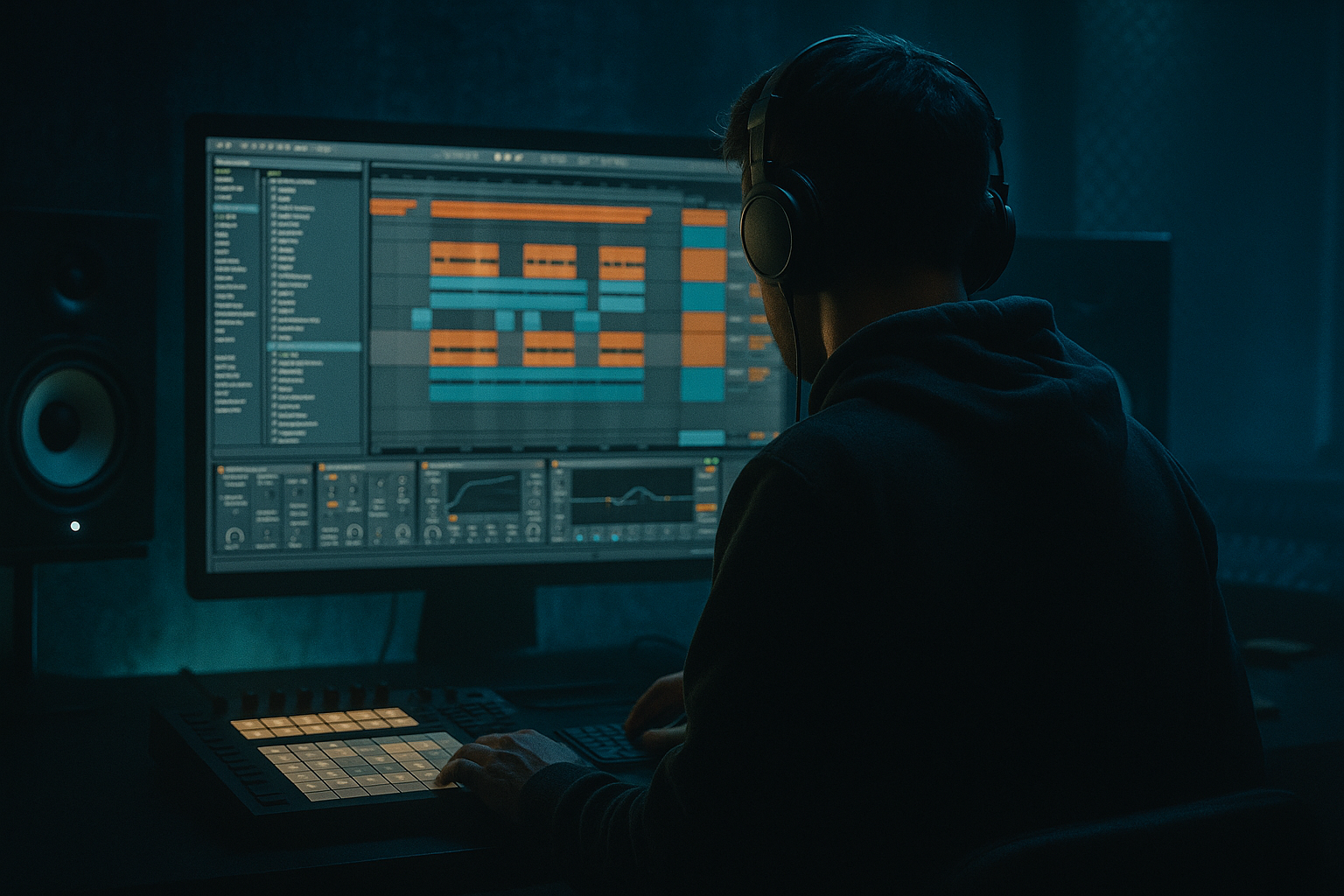
Modulate Oldskool DnB Break Roll with Crunchy Sampler Texture in Ableton Live 12
1. Lesson overview
In this lesson, you’ll build a modulated break roll in the spirit of classic jungle / oldskool DnB, then make it feel more aggressive and alive by layering in a crunchy sampler texture. The goal is not just “adding distortion,” but creating a moving percussive texture that evolves through the roll and helps the drums feel raw, unstable, and exciting. 🔥
This is an advanced FX workflow for Ableton Live 12, and it’s especially useful if you want:
- break rolls that feel more alive and unstable
- gritty texture without losing drum definition
- evolving fills for drops, transitions, and turnarounds
- a more authentic jungle / techstep / dark rolling DnB edge
- Drum Rack
- Simpler
- Auto Filter
- Saturator
- Drum Buss
- Grain Delay or Echo
- Redux
- Shaper or Envelope Follower style modulation ideas
- Utility, EQ Eight, and Glue Compressor for control
- repeated ghosted hits
- velocity variation
- pitch and time modulation
- filter movement
- short fills that build energy into the bar
- gritty transient smear
- sampled noise / aliasing / bit reduction
- movement tied to the roll
- stereo instability and dirt
- a “hardware sampler” kind of character
- Amen-style breaks
- Think break
- funky drummer variants
- chopped 160–174 BPM loops with audible hats and ghost notes
- Use a 1-bar loop
- Program the main snare/clap accents first
- Fill around them with ghosted ghost snare hits, hats, and chopped kicks
- Add faster note repeats near the end of the bar
- Bar start: kick + snare foundation
- Beat 3 or 4: snare accent
- Last 1/2 bar: 1/8 and 1/16 note roll buildup
- Final 1/8: denser retriggers or triplet bursts
- Change velocities per hit
- Offset some hits slightly ahead or behind the grid
- Don’t make every repeat identical
- vinyl hiss
- rimshot fragment
- break tail
- smashed snare transient
- crunchy percussion one-shot
- tiny vocal chop or metal hit
- Classic mode for more playback character
- One-shot or Trigger
- short amp envelope:
- Redux
- Saturator
- Auto Filter
- Filter type: Band-Pass or Low-Pass
- Cutoff: start fairly closed
- Resonance: 10–30%
- Drive: if needed, 1–3 dB
- Start dark and narrow
- Open slightly on the final retriggers
- Close again before the drop hits
- Use Utility to automate gain
- Or draw clip volume automation
- 0 to -12 dB at the start of the bar
- rise to 0 dB or slightly above at the climax
- drop sharply at the end
- Auto Filter cutoff
- Redux downsample amount
- Saturator drive
- Grain Delay dry/wet
- Utility gain
- Macro 1 = “Sampler Bite”
- Delay Time: very short
- Pitch: small random movement if desired
- Frequency: moderate
- Feedback: low to medium
- Dry/Wet: 5–20%
- Mode: Ping Pong off if you want mono grit
- Time: 1/16 or synced subdivision
- Feedback: low
- Modulation: subtle
- Noise / Drive: small amounts
- Drive: 5–20% depending on how aggressive you want it
- Crunch: a little goes a long way
- Boom: usually keep low for this use case
- Transients: adjust carefully
- Damp: use to tame top-end fizz if needed
- High-pass around 120–200 Hz on the texture layer so it doesn’t fight the kick/bass
- Cut any harshness around 3–6 kHz if the crunch gets nasty in a bad way
- Shelf down ultra-high fizz if the Redux is too present
- reverse specific fragments
- gate the tail
- pitch down the final hit
- add a stop-time before the drop
- re-chop the resampled result into smaller fills
- Start with the clean break
- Introduce crunch texture only in the last 2 beats
- Open filter cutoff over the final 1/2 bar
- Cut everything right before the drop
- Bar 1: sparse ghost notes and light texture
- Bar 2: denser retriggers, higher saturation, more filter opening
- Final hit: chopped stop + reverb tail or impact
- First half: clean break roll
- Second half: destroyed sampler version
- Alternate every 2 bars for variation
- Width: 0–70% depending on the role of the layer
- Saturator drive
- Drum Buss crunch
- filter cutoff
- send amount into Grain Delay
- the break is speeding up emotionally
- the sampler layer is breaking apart at the end
- the drop hits harder because of the contrast
- Start with a strong chopped break and make the roll musical first
- Layer a gritty sampler texture using Simpler, Redux, Saturator, and Auto Filter
- Use modulation to make the texture evolve with the fill
- Keep the low end clean and control the transient
- Resample when the moment feels right
- Use arrangement contrast so the effect lands harder
- a device chain recipe
- a Drum Rack macro map
- or a bar-by-bar MIDI example for a full 174 BPM DnB roll
We’ll use a combination of:
---
2. What you will build
You’ll create a 2-part FX system:
A. Oldskool break roll
A chopped break, arranged into a roll with:
B. Crunchy sampler texture layer
A secondary layer that adds:
By the end, your break roll will sound like it’s being re-triggered through a battered sampler, rather than just copied and pasted. That’s the vibe we want for jungle-inflected DnB.
---
3. Step-by-step walkthrough
Step 1: Choose and prep the break
Pick a break with clear transient detail. Good candidates:
Workflow:
1. Drag your break into an audio track.
2. Warp it carefully:
- If it’s a classic break, start with Beats warp mode
- Turn Preserve to around 1/16 or 1/8 depending on how clean you want the transients
3. Slice it to a new MIDI track:
- Right-click the clip → Slice to New MIDI Track
- Slice by Transient for the most flexible editing
This gives you a Drum Rack made from individual break hits, which is perfect for roll programming.
---
Step 2: Build the roll in Drum Rack
Now you’ll create the roll pattern. Think of this as the “performance” layer before sound design.
#### Suggested MIDI approach:
For example:
#### Humanize it:
Tip: In Live 12, use the MIDI editor’s tools to vary velocity fast and cleanly. The roll should feel performed, not mechanically stamped out.
---
Step 3: Add a “crunchy sampler” layer using Simplers
Now create a second track or a second Drum Rack chain that adds texture to the break roll.
#### Option A: Layer a noise-ish sampler hit
Use Simpler with a short sample:
Set Simpler to:
- Attack: 0 ms
- Decay: very short
- Sustain: 0
- Release: short
Then process it with:
- Downsample: subtle to moderate
- Bit reduction: 8–12 bits if you want obvious grit, 12–16 bits if you want texture only
- Drive: 2–6 dB
- Soft Clip: On
- HP or BP mode
- Moderate resonance
- Automate cutoff for motion
#### Option B: Resample your break and degrade it
This is the more authentic, oldskool approach.
1. Resample the break roll to audio.
2. Duplicate the audio track.
3. Put the duplicate into a texture chain:
- Simpler: load the resampled audio slice
- Redux
- Erosion or Frequency Shifter
- Drum Buss
- EQ Eight
This gives you a “samplerized” version of the roll that can be pushed harder than the main drums.
---
Step 4: Build the modulation movement
This is where the lesson gets interesting. The crunchy texture should modulate with the roll, not just sit on top of it.
#### Method 1: Filter envelope movement
On the texture layer, use Auto Filter:
Automate the cutoff so it opens as the roll intensifies:
This creates a classic “pressure buildup” feeling.
---
#### Method 2: Volume shaping with Utility or Volume automation
You want the crunchy layer to appear like a ghosty swarm during the roll.
Suggested contour:
That makes the dirt bloom into the groove rather than masking the main break.
---
#### Method 3: Use Envelope Follower or Macro-style control
If you want a deeper Live 12 workflow, map several parameters to a macro or automation lane:
Then automate the macro through the fill.
A practical macro idea:
- Redux downsample
- Saturator drive
- Filter cutoff
- Noise amount or send level
Automating one macro is faster and keeps the movement musical. 🎛️
---
Step 5: Add rhythmic destruction with Grain Delay or Echo
For a more modern jungle-dub mutation, add a subtle time-based effect to the texture layer.
#### Grain Delay settings:
This can smear the high-end fragments in a way that feels like a busted sampler or tape head wobble.
#### Echo settings:
Keep it restrained. The goal is texture, not a wash that blurs the break roll into mush.
---
Step 6: Glue the layer with Drum Buss and saturation
A break roll often needs to feel like one hybrid instrument, especially in DnB where transient consistency matters.
#### On the crunchy texture bus:
Add Drum Buss:
Then add EQ Eight:
A good principle:
Main break = punch and groove
Crunch layer = grit and movement
---
Step 7: Resample and edit the result
One of the best DnB workflows is to print the effect.
1. Route the break roll and texture bus to a new audio track.
2. Record the performance.
3. Consolidate the strongest moments.
4. Cut the best bar(s) into arrangement.
Now you can:
This is where the track starts sounding composed, not just looped.
---
Step 8: Arrangement ideas for DnB/jungle structure
Here are a few practical arrangement moves:
#### 1. 1-bar tension fill into drop
#### 2. 2-bar rising roll
#### 3. Call-and-response fill
This keeps the arrangement from becoming repetitive, while maintaining that rolling DnB momentum.
---
4. Common mistakes
1. Over-processing the break
If the crunch layer is too loud or too wide, the break loses its swing and identity.
Fix: Keep the texture layer lower in level than you think. Let it enhance, not replace.
2. Too much low end in the texture
Break textures often carry unwanted low frequencies, especially after saturation.
Fix: High-pass the texture bus around 120–200 Hz.
3. Flat velocity programming
If every retrigger is the same velocity, the roll sounds robotic and weak.
Fix: Alternate velocities and accent the final notes of the roll.
4. Excessive reverb or delay
Oldskool DnB is gritty, but the drum roll still needs punch.
Fix: Use short, controlled ambience. Keep the transient front edge clear.
5. Destroying the transient with too much Redux
Bit reduction can make the roll sound cheap and thin if pushed too far.
Fix: Blend it in parallel or use automation to increase crunch only at selected moments.
---
5. Pro tips for darker/heavier DnB
Use parallel crunch, not full insert destruction
For darker DnB, the clean transient often needs to stay intact. Put the dirty sampler layer on a send or parallel chain so you can blend it in surgically.
Add subtle pitch modulation
A tiny pitch envelope or manual pitch drop on the final retrigger can create a nasty oldskool stab-like feel.
Use mono for impact
If the roll is getting too wide, collapse the crunch layer with Utility:
This helps the drums hit harder in a club system.
Automate saturation more at the end of phrases
The final 1/4 or 1/2 bar of a fill is where the energy should spike. Push:
Resample aggressively
A lot of the best dark DnB drum textures come from printing audio, then mangling that audio again. If it sounds good in the arrangement, commit.
Think in contrast
A heavy roll feels heavier when the preceding bar is cleaner. Use the crunchy sampler texture as a special event, not constant wallpaper.
---
6. Mini practice exercise
Try this in Ableton Live:
Exercise: 2-bar break roll with evolving crunch
1. Load a classic break into a Drum Rack.
2. Program a 2-bar MIDI loop with:
- main snare accents
- ghost notes
- a denser retrigger in the final half bar
3. Create a second texture track using Simpler with:
- a chopped snare tail or noisy one-shot
- Redux
- Saturator
- Auto Filter
4. Automate the texture layer so it appears only in the last bar.
5. Resample the result.
6. Re-edit the resample into a transition fill.
Goal
By the end, your fill should feel like:
If you can make it feel aggressive but controlled, you’ve nailed it. ✅
---
7. Recap
You’ve now built a workflow for creating an oldskool DnB break roll and giving it a crunchy sampler-texture modulation in Ableton Live 12.
Key takeaways:
This is a powerful technique for jungle, darkstep, techy rollers, and modern atmospheric DnB alike. Once you get comfortable with it, you’ll be able to make fills that sound raw, animated, and properly engineered for impact. 🚀
If you want, I can also turn this into:

