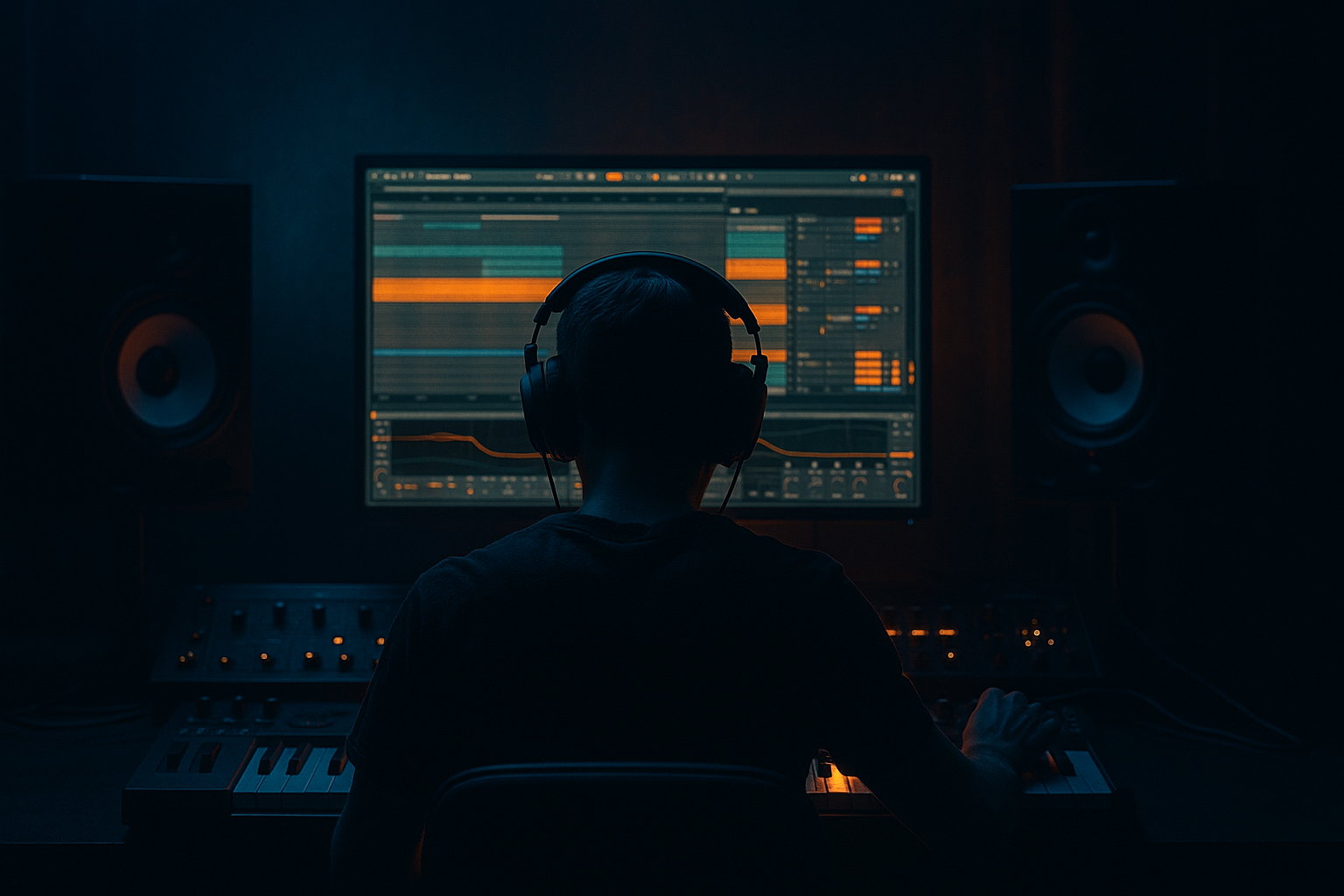
Main tutorial
Modulate Oldskool DnB Sub with Chopped-Vinyl Character in Ableton Live 12
1. Lesson overview
In this lesson, you’ll learn how to make a clean, powerful DnB sub feel like it belongs inside an oldskool jungle / 90s roller by adding chopped-vinyl character without destroying low-end weight.
The goal is not to make the sub lo-fi for the sake of it.
The goal is to keep the fundamental solid and mono, while adding a separate layer of vinyl-style movement, grain, pitch wobble, and transient chop that gives the bassline personality. 🎛️
This technique is especially useful for:
- jungle-style basslines with call-and-response phrasing
- rolling DnB where the sub needs more motion
- darker halftime or oldskool-influenced sections
- intro builds where you want the bass to feel like it’s coming off a dubplate
- Layer 1: Pure sub
- Layer 2: Vinyl-chop character layer
- Layer 3: Optional mid-bass grit
- split the bass into frequency layers
- create vinyl-style movement with Auto Pan, LFO-like modulation, and resampling-style chops
- keep the sub steady while the character layer dances around it
- make the bass groove with the drums in a classic DnB way
- Oscillator A: Sine
- Turn off the other oscillators
- Set Voices to 1 for mono behavior
- Reduce Glide/Portamento if you want tight oldskool steps; increase slightly for more slur
- Keep output clean, no effects yet
- use short notes for punchy oldskool movement
- leave space between notes for the drums to breathe
- try notes that answer the snare hits, especially on 2 and 4
- keep it in the tonic and fifth at first for a classic foundation
- bar 1: root note
- bar 1 beat 3: fifth
- bar 2 beat 1: root note an octave lower
- bar 2 beat 4: passing note
- Utility: Width 0% for mono
- EQ Eight: low-pass if needed around 90–120 Hz to keep it pure
- Keep levels conservative; don’t clip the sub
- Audio Effect Rack
- Create two chains:
- Utility
- EQ Eight
- Optional: Saturator
- High-pass at 110–150 Hz
- Optional gentle low-pass at 3–8 kHz depending on how gritty you want it
- Use a steep slope if the sub is still bleeding through
- Drive: 2–6 dB
- Soft Clip: on
- Analog Clip: optional
- Base output so it doesn’t jump too loud
- Mode: Noise
- Frequency: around 3–7 kHz
- Amount: very small
- Use sparingly; this is texture, not harshness
- Downsample lightly
- Bit reduction very subtle
- This can give a chopped sampler feel, but don’t overdo it unless you want more obvious lo-fi grime
- Phase: 0° for true volume chop
- Amount: 20–60%
- Rate: sync to 1/8, 1/16, or dotted values
- Shape: adjust for sharper chopping
- Offset: use to shift the groove
- Mode: Classic
- Turn on Loop
- Use Warp if needed
- Slice the note into short trigger chunks manually or with transient editing
- Auto Filter cutoff
- Saturator drive
- Utility gain on the character chain
- quick dip on beat 1
- short rise into the offbeat
- repeat every 1/8 or 1/16
- Filter type: Low-pass 24 or Band-pass for more character
- Cutoff: start around 250–800 Hz on the character layer
- Resonance: 10–30%
- Drive: use lightly if it adds body
- keep the bass darker in the verse
- open the filter a bit during turnarounds or snare rolls
- close it again when the full break drops
- pitch envelope amount
- filter cutoff
- sample start point
- map to pitch of the sampled character layer
- keep depth extremely small, around ±5 to ±15 cents
- set rate to very slow or synced micro-movements
- Sidechain from kick, or kick + snare if needed
- Attack: 1–10 ms
- Release: 50–120 ms
- Ratio: 2:1 to 4:1
- Adjust threshold so the bass moves with the groove
- Intro: only filtered character layer, no full sub
- Drop 1: sub enters with simple phrase
- Bar 9 onward: open up the chopped-vinyl layer slightly
- Breakdown: strip to texture and filtered bass
- Second drop: add extra chop density, more grit, or pitch wobble
- 8-bar variation: automate filter cutoff or chop rate
- Spectrum
- EQ Eight
- Utility
- your ears at low monitoring volume
- kick hits clearly without being buried
- snare has room in the 180–250 Hz and upper-mid area
- sub is centered and stable
- chopped layer doesn’t create harsh peaks on snares
- no messy stereo content below about 120 Hz
- reduce its low cutoff
- narrow its width
- shorten its release or gating
- lower its level and let the sub carry the weight
- A: subtle vinyl texture
- B: dark rolling chop
- C: aggressive jungle dubplate grime
- build a clean mono sub first
- split off a separate character layer
- remove true low end from the character layer
- add Saturator, Auto Filter, Auto Pan, Erosion/Redux
- use rhythmic gating, filter motion, and tiny pitch instability
- sidechain the character layer to the drums
- arrange the movement in 8-bar phrases like a real jungle tune
You’ll use stock Ableton Live 12 devices and practical mixing decisions to keep the bass heavy, controlled, and musical.
---
2. What you will build
By the end, you’ll have a bass rack made of:
- sine-based, mono, stable, clean
- band-limited, slightly distorted, modulated, and rhythmically chopped
- for translation on smaller systems
You’ll learn how to:
---
3. Step-by-step walkthrough
Step 1: Start with a solid sub foundation
Create a new MIDI track and load Operator.
#### Operator sub settings
#### MIDI programming
Write a simple DnB sub phrase:
Example:
This should feel more like a bass conversation with the break than a sustained EDM bassline.
#### Mixing starting point
On the sub track:
---
Step 2: Duplicate the sub into a character layer
Duplicate the sub track, or better, create a Group Rack and split the signal into two chains.
#### Build an Audio Effect Rack
On the bass group, insert:
1. Sub Clean
2. Vinyl Character
This is ideal because you can keep the sub chain untouched while processing the character layer aggressively.
---
Step 3: Clean sub chain setup
For the Sub Clean chain:
- Width: 0%
- Gain: adjust to taste
- Low-pass around 100 Hz if necessary
- Remove any accidental top-end
- Drive: 1–2 dB
- Soft Clip: on
- Keep it subtle
The point is to preserve the fundamental and let the low end stay confident in the mix. 🔊
---
Step 4: Create the chopped-vinyl character layer
Now focus on the Vinyl Character chain.
Start by filtering out the true sub frequencies so only the “record texture” and bass presence remain.
#### Suggested chain order
1. EQ Eight
2. Saturator
3. Auto Filter
4. Auto Pan
5. Redux or Erosion
6. Utility
Let’s build it.
---
Step 5: Band-limit the character layer
On EQ Eight:
This prevents phase mess and keeps your low end clean.
You want audible movement, not a second sub fighting the main one.
---
Step 6: Add warm crunch and vinyl edge
Insert Saturator:
If you want more “dubplate” energy, add Erosion after Saturator:
You can also try Redux:
---
Step 7: Make it feel chopped like vinyl
This is where the motion happens.
#### Option A: Auto Pan as a rhythmic gate
Use Auto Pan on the character layer:
This gives you a classic left-right or volume-gated feel.
If you want more of a chopped sampler vibe, keep the phase at 0 so it acts like a rhythmic tremolo rather than stereo movement.
#### Option B: Simpler/Granulator-style chop
If you want a more sample-like feel, resample the bassline first and load it into Simpler:
Then use MIDI notes to retrigger the chopped fragments. This creates that “bounced off vinyl” character very effectively.
#### Option C: Use Shaper-style modulation
If you have Shaper in Live 12, map it to:
This gives precise rhythmic movement synced to the grid.
A good starting shape:
That creates a rolling, broken-up oldskool feel.
---
Step 8: Add filter movement for oldskool vibe
Insert Auto Filter after saturation.
#### Suggested settings
Automate the cutoff so the character opens slightly on fills and closes on busy drum passages.
A very common jungle trick:
This creates that “hardware sampler being played live” energy.
---
Step 9: Add subtle pitch motion for vinyl wobble
To imitate chopped-vinyl instability, you can add tiny pitch modulation.
#### Method 1: Simpler pitch envelope
If using Simpler, slightly vary:
Even tiny changes create a more organic, imperfect feel.
#### Method 2: LFO with Max for Live
If you use LFO from Max for Live:
This is enough to suggest a worn record or unstable deck without sounding out of tune.
#### Method 3: Clip automation
Draw tiny pitch dips on certain chopped notes to make them feel like they were triggered from a sample pad or turntable stab.
---
Step 10: Sidechain the character layer, not the sub
This is a big one.
Your sub should stay strong.
Your character layer should duck around the kick and snare.
Use Compressor or Glue Compressor on the character chain:
This helps the chopped texture feel glued to the drums, which is essential in DnB.
The sub can be sidechained more gently if needed, but don’t over-pump it unless that’s the style.
---
Step 11: Arrange it like classic DnB
Oldskool DnB works best when the bassline evolves in sections.
#### Arrangement ideas
A strong jungle technique is to make the bassline more broken and playful every 8 bars.
That keeps the tune alive without needing a whole new sound.
---
Step 12: Glue the bass with the drums
In DnB, bass and drums are one system.
Check your low-end relationship with:
#### Checklist
If the chopped layer makes the low end feel vague:
---
4. Common mistakes
1. Distorting the actual sub too much
If you grind the true sub layer, the low end loses focus fast.
Keep distortion mostly on the character layer.
2. Letting the chopped layer contain too much low frequency
If the layer still has sub energy, you’ll get phase problems and a muddy drop.
3. Overusing stereo widening
Oldskool DnB bass should feel big, but the real weight needs to stay mostly mono.
4. Making the chop too busy
If every 1/16 note is constantly moving, the groove can lose impact.
Leave space for the break and snare.
5. Using too much bit reduction or aliasing
A little grime is good. Too much can make the bass sound cheap rather than vintage.
6. Forgetting the drums
In jungle and DnB, the bass must interact with the kick/snare/break, not just exist on its own.
---
5. Pro tips for darker/heavier DnB
Tip 1: Layer a very quiet reese ghost behind the chopped character
Add a low-passed reese at extremely low level behind the character layer for menace.
High-pass it so it doesn’t compete with the sub.
Tip 2: Use resonant filter sweeps on fills
A narrow band-pass opening briefly before the drop can make the bass feel like it’s “spinning up” from vinyl.
Tip 3: Automate sample start for a broken-record feel
If using Simpler, tiny changes to start position can sound like the chop is coming from a warped deck.
Tip 4: Saturate before compression for density
If the bass feels too polite, put Saturator before Compressor so the compressor reacts to harmonics and glues the sound harder.
Tip 5: Keep the snare dominant
In darker DnB, the snare is often the anchor.
If the chopped bass masks the snare, back off the midrange around 200 Hz to 2 kHz in the character layer.
Tip 6: Use arrangement contrast
A sparse bar with only sub and hat movement makes the next chopped phrase hit harder.
Contrast is a huge part of oldskool energy.
---
6. Mini practice exercise
Exercise: Build an 8-bar chopped-vinyl bass loop
1. Create a mono sine sub in Operator.
2. Write an 8-bar bassline with:
- root notes
- occasional fifths
- a few short passing notes
3. Duplicate it into a character chain.
4. On the character chain:
- high-pass at 120 Hz
- add Saturator
- add Auto Pan synced to 1/16
- add Auto Filter with automation
5. Sidechain the character layer to the kick.
6. Automate one element every 2 bars:
- filter cutoff
- Auto Pan amount
- saturation drive
- pitch wobble depth
7. Export the loop and compare it with the dry sub-only version.
#### Challenge variation
Make 3 versions:
Listen for which version keeps the most low-end clarity while still sounding interesting.
---
7. Recap
To modulate an oldskool DnB sub with chopped-vinyl character in Ableton Live 12:
The secret is balance:
sub = weight, character = personality.
Get both working together and your bass will feel instantly more oldskool, more alive, and more like proper DnB folklore 🥁🔥
If you want, I can also turn this into a Ableton Live 12 device chain preset plan or a step-by-step screen-by-screen workflow.

