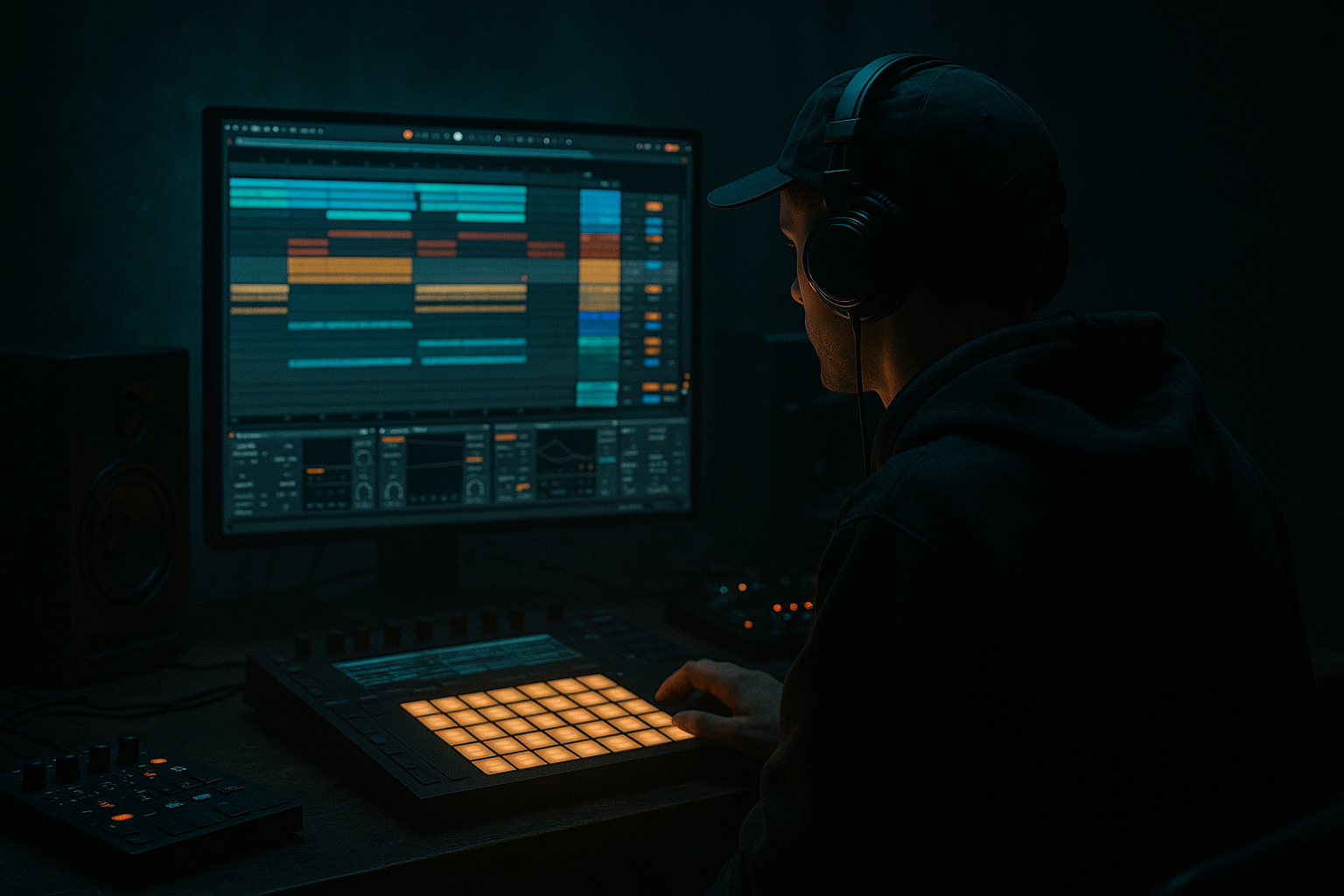
Main tutorial
Moonlit Jungle — Ableton Live 12 “Sub Approach” From Scratch (Beginner / Drums) 🌙🥁
1. Lesson overview
In this lesson you’ll build a tight jungle/drum & bass groove using a “sub approach”: the sub bass dictates the pocket and the drums are designed to lock around it. This is a classic rolling technique for moonlit, deep, shadowy jungle—clean low-end, punchy breakbeats, and controlled movement.
We’ll do it from scratch in Ableton Live 12, using mostly stock devices and practical, repeatable steps.
---
2. What you will build
By the end, you’ll have:
- A 170–174 BPM jungle/DnB session
- A sub bass that hits with consistency and leaves room for drums
- A kick + snare core with break layering for “jungle texture”
- Drum bus processing to glue and thicken
- A simple 8–16 bar arrangement that feels like a real track idea
- Main notes: 1/8
- Ghost notes: 1/16 or shorter
- EQ Eight
- Saturator (very light)
- Add Hybrid Reverb (stock)
- Break filtered (low-pass around 6–10 kHz)
- No kick yet
- Sub muted or very light
- Full drums + full sub
- Break opens up (raise low-pass to 14–18 kHz)
- Remove kick for 1 bar
- Or switch break slice for 1 bar
- Add a quick snare fill (1/16 repeats)
- Filter break down again
- Tease the next section
- Break low-pass opening over 4 bars
- Reverb send spikes on snare at phrase ends
- Tiny sub note variation at bar 8/16 boundaries
- Sub too long: if notes overlap, low end smears. Shorten MIDI notes and check your release.
- Break has too much low end: breaks often carry hidden 80–200 Hz mud. High-pass it.
- Over-saturating early: too much drive kills punch and makes mixing harder.
- Sidechain too heavy: if the bass disappears, reduce threshold or lower ratio.
- Kick and sub fighting: pick one to “own” 50–80 Hz. In this approach, let the sub dominate.
- Make the sub audible on small speakers: a touch of Saturator harmonics goes a long way.
- Use subtle pitch drops on kick OR sub (not both):
- Layer a “tick” on the kick: a quiet top click (2–5 kHz) helps it cut without adding low end.
- Snare weight without mud: add body around 180–220 Hz, but keep it controlled.
- Break distortion in parallel: duplicate BREAK, distort hard (Overdrive), high-pass it, blend quietly for menace.
- Drum Buss, Saturator, Glue Compressor, EQ Eight, Hybrid Reverb, Auto Filter
- You built your groove using the sub approach: sub first, then drums designed to fit.
- You anchored the rhythm with snare on 2 and 4, supported with a tight kick.
- You added jungle character using a break layer, filtered and controlled.
- You used sidechain + EQ to keep low-end clean and rolling.
- You shaped the vibe with drum bus glue and subtle room reverb.
---
3. Step-by-step walkthrough
Step 0 — Set up the session (2 minutes)
1. Set Tempo: 172 BPM
2. Set Time Signature: 4/4
3. Create tracks:
- MIDI Track: `SUB`
- Audio Track: `KICK`
- Audio Track: `SNARE`
- Audio Track: `BREAK`
- Return A: `DRUM ROOM` (reverb)
- Group Track: `DRUM BUS` (group KICK/SNARE/BREAK into it)
Workflow tip: Color-code drums (reds/oranges) and bass (blue) so you can navigate fast.
---
Step 1 — Build the sub first (“sub approach”) 🔊
Goal: A sub that’s simple, stable, and leaves room for drums.
1. On `SUB`, load Operator (stock).
2. In Operator:
- Oscillator A: Sine
- Level: ~ -12 dB to start (avoid clipping early)
3. Add MIDI Clip (8 bars). Use a classic rolling pattern:
- Key suggestion: F minor (works great for dark jungle vibes)
- Notes: mostly F1 (sub range), with occasional Eb1 or G1 for movement.
4. Rhythm suggestion (simple but effective):
- Put notes on 1, the “and” of 1, 3, and the “and” of 3
- Then add 1–2 ghost notes (shorter) before the snare hits to push energy.
Note length:
#### Sub shaping chain (stock)
On the `SUB` track, add:
1. EQ Eight
- HP filter off (don’t remove your sub)
- Add a gentle dip if needed: -2 to -4 dB at 200–300 Hz (reduces boxiness)
2. Saturator
- Mode: Soft Sine or Analog Clip
- Drive: 2–6 dB (just enough to hear the sub on small speakers)
- Turn on Soft Clip
3. Compressor (optional, for control)
- Ratio: 2:1
- Attack: 20–30 ms
- Release: 80–150 ms
- Aim for 1–3 dB gain reduction on peaks
✅ Check: Your sub should sound even and confident, not flabby.
---
Step 2 — Make a solid kick & snare core 🥁
In jungle/DnB, the snare placement is sacred.
#### Snare (anchor)
1. On `SNARE`, drop a snare sample (from your library or Ableton packs).
2. Program snare on beats 2 and 4 (classic DnB backbeat).
3. Add Drum Buss (stock) on SNARE:
- Drive: 5–15%
- Crunch: 0–10%
- Boom: Off (or very low; we want the sub to own the low end)
4. Add EQ Eight:
- High-pass at 120–180 Hz (get rumble out)
- Add presence: small boost around 3–6 kHz if it needs bite
#### Kick (support, not the boss)
1. On `KICK`, choose a tight kick (short tail works best with rolling sub).
2. Put kick on beat 1, and optionally a lighter kick on the “and” of 2 or just before 3 for drive.
Kick processing chain:
- High-pass at 30 Hz (remove useless sub-sub)
- If kick fights sub, dip around 50–80 Hz
- Drive: 1–3 dB
- Soft Clip on
✅ Check: Kick should be heard, but the sub stays dominant.
---
Step 3 — Add a break layer for jungle texture 🧬
This is where “moonlit jungle” comes alive: the break adds movement and grit behind the clean kick/snare.
1. On `BREAK`, drag in a classic break (Amen-style, Think, Hot Pants, etc.).
2. Warp settings:
- Warp: On
- Mode: Beats
- Preserve: 1/16 (tight) or 1/8 (looser)
3. Right-click the clip → Slice to New MIDI Track (optional), or keep it as audio.
- Beginner route: keep as audio and edit the clip.
#### Break shaping chain
On `BREAK` add:
1. EQ Eight
- High-pass: 150–250 Hz (break should not compete with sub)
- Gentle dip if harsh: 6–10 kHz slightly down
2. Drum Buss
- Drive: 10–25%
- Crunch: 10–30%
3. Auto Filter (movement)
- Type: Low-pass
- Frequency: start around 8–14 kHz
- Map to an LFO (if using Auto Filter’s LFO):
- Amount: small
- Rate: 1/4 or 1/8 (subtle wobble)
Blend level tip: Start the break low (e.g., -12 to -18 dB) and bring it up until you feel it.
---
Step 4 — Sidechain: protect the sub pocket ⚙️
This is the “sub approach” glue: drums create space for sub (or vice versa). In rolling jungle, often you sidechain sub to kick very lightly.
1. On `SUB`, add Compressor
2. Turn on Sidechain
3. Input: `KICK`
4. Settings:
- Ratio: 3:1
- Attack: 1–5 ms
- Release: 60–120 ms (time it so sub returns smoothly)
- Threshold: adjust for 2–5 dB gain reduction when kick hits
Optional: Also sidechain the BREAK slightly to the snare to keep the backbeat clear (1–2 dB GR).
---
Step 5 — Drum group glue (DRUM BUS) 🧷
Group `KICK`, `SNARE`, `BREAK` → rename the group `DRUM BUS`.
On `DRUM BUS` add:
1. Glue Compressor
- Attack: 10 ms
- Release: Auto
- Ratio: 2:1
- Aim for 1–3 dB gain reduction
2. Drum Buss (optional, subtle)
- Drive: 5–10%
- Boom: Off (again: protect low end)
3. Limiter (safety)
- Just catching peaks, not squashing
Return track `DRUM ROOM`:
- Algorithmic or Convolution small room
- Decay: 0.4–0.9s
- Pre-delay: 10–25 ms
- HP filter in the reverb: 200–400 Hz
Send a little snare (and tiny break) to this return for atmosphere. 🌫️
---
Step 6 — Arrangement idea (8–16 bars) 🎛️
Keep it simple and real:
Bars 1–4: Intro
Bars 5–8: Drop
Bars 9–12: Variation
Bars 13–16: Reset
Automation to try:
---
4. Common mistakes 🚫
---
5. Pro tips for darker/heavier DnB 🌑
Try automating Operator’s pitch envelope slightly, or use a kick with a short pitch fall.
Stock devices that shine here:
---
6. Mini practice exercise (15 minutes) ⏱️
1. Create a 4-bar loop at 172 BPM.
2. Write a sub pattern using only F1 and Eb1.
3. Program snare on 2 and 4, kick on 1.
4. Add a break loop and high-pass at 200 Hz.
5. Sidechain sub to kick for ~3 dB GR.
6. Make one variation bar (bar 4) using:
- a snare fill, or
- muting the kick, or
- a break slice change
Goal: Make it feel like it wants to loop for 2 minutes.
---
7. Recap ✅
If you want, tell me what style you’re aiming for (deep jungle, techstep, modern rollers) and what key you like, and I’ll give you a starter 16-bar MIDI + drum pattern blueprint tailored to that vibe.

