Main tutorial
Lesson Overview
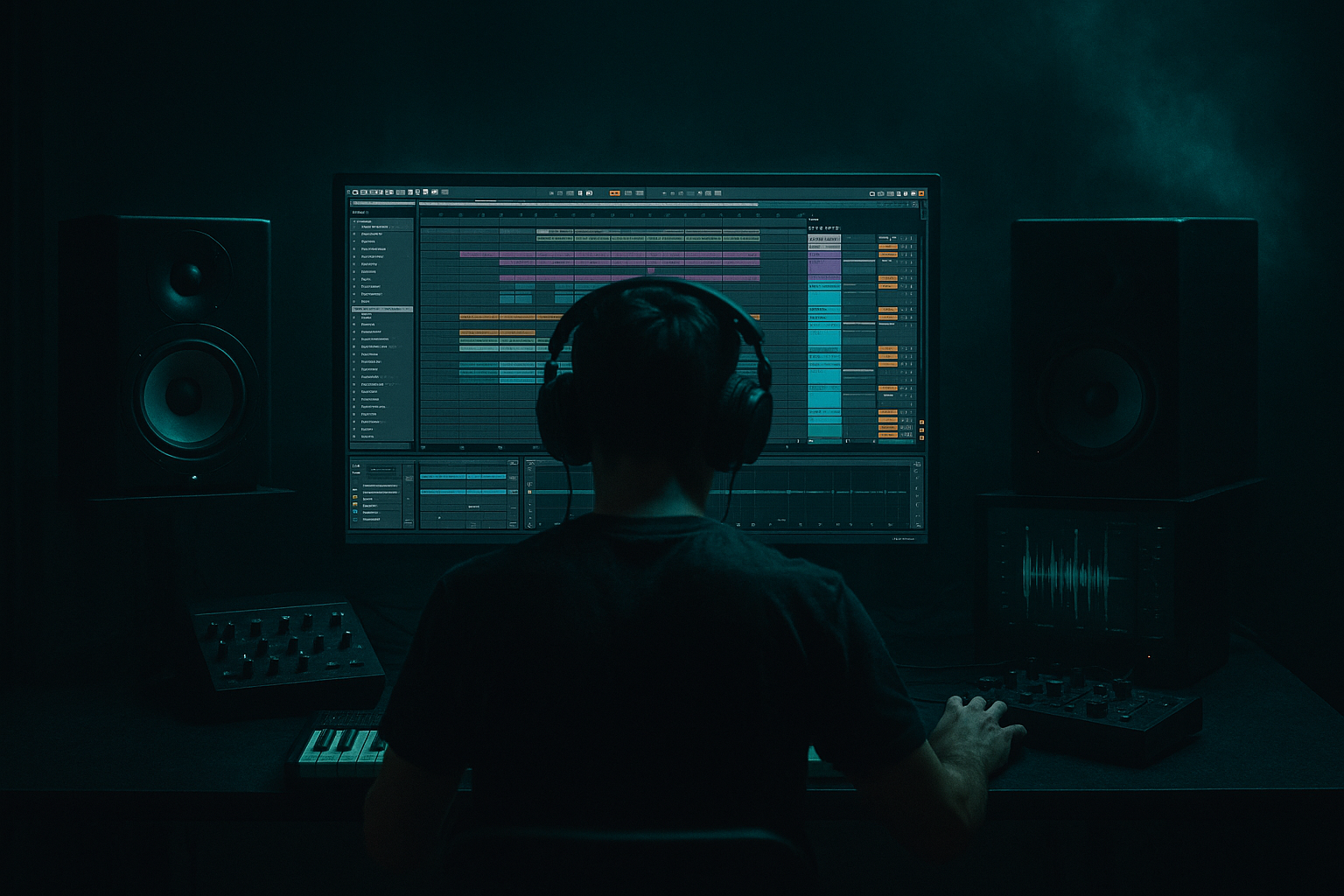
This lesson is about building a Moonlit Jungle breakdown in Ableton Live 12: a moody, cinematic mid-track section where an amen variation carve creates tension, space, and forward motion before the next drop. In a DnB context, this is the kind of breakdown that feels alive: chopped break fragments, ghost notes, atmospheric decay, and bass movement that hints at the drop without giving everything away.
The core idea is simple but powerful: instead of using a full break loop or a plain pad breakdown, you’ll carve a variation out of an amen break and let that carved rhythm become the emotional center of the section. That means removing hits, reshaping transients, filtering the body, and resampling the result so it feels intentional rather than edited after the fact.
Why this matters in DnB: breakdowns are not just “rest” sections. In drum & bass, especially jungle, rollers, darker liquid, and neuro-influenced music, the breakdown often acts as a rhythmic teaser. The listener should still feel the break pulse in the silence. That’s what makes the return to the drop hit harder.
In this lesson, you’ll use Ableton Live 12 stock tools to design a breakdown that sounds:
- gritty, nocturnal, and musical
- driven by a carved amen identity
- spacious enough for atmosphere
- ready to transition cleanly into a drop or switch-up
- a resampled amen variation with selective hits removed and ghost notes emphasized
- a filtered and saturated break texture with controlled low-end
- a dark atmospheric bed using stock Ableton devices
- a subtle reese/bass hint that calls and responds with the break
- automation for filter movement, reverb decay, width, and tension
- a breakdown that can sit between a full drop and a second drop, or function as a mid-track switch-up
- Making the breakdown too empty
- Leaving too much low end in the break
- Over-widening the break
- Using full drop bass during the breakdown
- Over-compressing the amen carve
- Letting reverb wash over the rhythm
- No arrangement contrast
- Resample twice
- Use tiny fills as emotional hooks
- Add harmonic dirt, not just distortion
- Use contrast in motion
- Keep sub almost implied
- Use Automation Lanes aggressively
- Reference a roller and a jungle track separately
- Carve the amen into a phrase, not a loop.
- Keep the break rhythmic, filtered, and emotionally charged.
- Resample to commit the character and speed up decisions.
- Use a bass tease, not a full bassline.
- Shape the breakdown with automation, atmosphere, and contrast.
- Protect the mix with mono-compatible low end, bus control, and headroom.
We’ll focus on practical sound design, arrangement, and mix choices that keep the section authentic to DnB.
What You Will Build
By the end of this lesson, you’ll have a 16-bar Moonlit Jungle breakdown built around:
Musically, this could sit in a track at around 172 BPM, after an eight-bar drop and before a re-entry. Think: a first drop with heavy rollers energy, then a breakdown where the amen becomes ghostly and stripped back, while a low, wavering bass tone and distant textures keep the vibe dark.
The end result should feel like the break is being remembered rather than merely played.
Step-by-Step Walkthrough
1. Set up the session for fast carving and resampling
- Start with a project tempo between 170–174 BPM; for this walkthrough, use 172 BPM.
- Create three main groups:
- DRUMS
- BASS
- ATMOS / FX
- Put your original amen sample on an audio track inside DRUMS. If your amen is stereo, consider converting it to mono-friendly processing for the core hits, then reintroducing width later with effects.
- Drop Utility on the break track and set it to Mono if the source is too wide or phasey. This is especially useful if you want the carved variation to sit centered and punchy in the breakdown.
- Add Warp only if needed. For break carving, you want the hit timing to stay expressive. If the sample already matches your project tempo well, avoid over-warping.
Advanced note: if the amen has too much room tone or competing tail energy, duplicate the track. Use one copy for the main carved hits and a second copy for filtered texture only.
2. Carve the amen into a breakdown phrase, not a loop
- Slice the amen to a new MIDI track using Slice to New MIDI Track if you want granular control, or manually chop the audio clip in Arrangement View for surgical edits.
- Build a 4-bar phrase first, then repeat and mutate it across 8 or 16 bars.
- Remove obvious downbeats in the first bar and leave more space than you think. A Moonlit Jungle breakdown should breathe.
- Keep the following types of elements:
- ghost snare taps
- late hat fragments
- small kick pickups
- rim or snare tails
- a few micro-break fills at the end of bars 2 and 4
- Useful edit move: shorten some hits to 20–60 ms for tick-like fragments, while leaving a few hits longer for emotional decay.
- Use Clip Gain or individual clip envelopes to push ghost notes forward by +1 to +3 dB and tuck louder transients back by -1 to -4 dB. The point is to create an “edited memory” of the break, not a full performance.
Why this works in DnB: break-based genres rely on rhythmic identity. If you keep only the right fragments, the listener’s ear fills in the missing pattern, which makes the breakdown feel active instead of empty.
3. Shape the carve with EQ, transient control, and controlled saturation
- On the carved break track, add Drum Buss first.
- Suggested starting settings:
- Drive: 5–15%
- Boom: very low or off in the breakdown version
- Transient: +5 to +20 for cracked attack, or slightly negative if the break is too spiky
- Crunch: 5–12% for texture
- Follow with EQ Eight:
- High-pass around 90–140 Hz to clear sub from the break
- Gentle cut around 250–450 Hz if the carved break sounds cloudy
- Small presence lift around 3–6 kHz if the ghost taps need definition
- Add Saturator after EQ if you want the fragments to feel closer and dirtier:
- Drive: 2–6 dB
- Soft Clip: on
- Curve: keep it subtle; don’t flatten all transient detail
- If the break is too sharp, use Transient shaping via Drum Buss or reduce clip transients in the sample editor.
Advanced workflow: resample this processed break to audio once you like the tone. That lets you commit to the character and move faster in arrangement.
4. Resample the carved break into a new texture layer
- Create a new audio track called Amen Carve Resample and set its input to the break bus or master, depending on your routing.
- Arm the track and record a few bars of the processed carved break.
- Once recorded, consolidate a strong 4- or 8-bar segment.
- Add Warp mode Complex Pro only if needed for time correction after resampling; otherwise keep it as audio and preserve the punch.
- Now create a second layer by duplicating the resampled clip and processing it differently:
- one version focused on transients
- one version filtered and washed out for atmosphere
- For the washed layer, add:
- Auto Filter with a low-pass around 2.5–6 kHz
- Hybrid Reverb with short-to-medium decay, around 1.2–2.5 s
- Utility to narrow the width if the reverb becomes too wide
- Automate the filter opening subtly over the breakdown so the break feels like it is emerging from fog.
This resampling move matters because it turns arrangement decisions into sound design. You stop “editing drums” and start building a custom DnB texture.
5. Add a dark bass hint that answers the break
- Build a restrained bass layer rather than a full drop bass. The breakdown should tease the bass language of the tune.
- Use Wavetable, Operator, or Analog for a simple sustained tone or reese fragment.
- Good starting shape for a breakdown bass tease:
- two detuned oscillators or a sine + saw blend
- low-pass filter around 150–500 Hz with moderate resonance
- light saturation using Saturator or Roar if you want more aggressive movement
- Keep the bass phrase sparse:
- answer the amen on bar 2 with a low note
- leave bar 4 empty or use a tail
- use a short call-and-response motif rather than continuous playing
- For stereo discipline, keep the fundamental below 120 Hz mono using Utility.
- If you want movement without clutter, automate:
- filter cutoff
- wavetable position
- subtle pitch drift
- LFO rate if the patch supports it
- In the bass group, consider sidechaining lightly to the break with Compressor or Glue Compressor so the break fragments breathe around the bass hint.
Musical context example: if the drop is a hard roller with a Reese bassline, the breakdown bass hint should echo the same note center and timbral DNA, but at half the density. The listener should recognize the character without hearing the full weapon.
6. Build the moonlit atmosphere around the carve
- Create one or two atmospheric layers using stock Ableton devices:
- field recording or texture sample
- a simple synth chord or drone
- reversed cymbal or noise swell
- Process the atmosphere with:
- Auto Filter: high-pass around 180–350 Hz
- Hybrid Reverb: long decay, often 3–8 s for distant space
- Echo: low-feedback, filtered repeats for motion
- Chorus-Ensemble sparingly if you want the texture to widen
- Keep the atmosphere out of the way of the carved break’s transient detail. If the mix feels smeared, reduce reverb low end and narrow the stereo width.
- Use automation on reverb send amount or filter cutoff to create a bloom at the top of each 4-bar phrase, then pull it back before the next phrase starts.
The goal is moonlit, not washed out. You want space around the break, not fog over the groove.
7. Design the breakdown as a phrase with tension and release
- Arrange the breakdown in 16 bars:
- Bars 1–4: introduce the carved amen and minimal atmosphere
- Bars 5–8: open the filter slightly and add a bass answer
- Bars 9–12: thin the break further, perhaps remove the kick fragments
- Bars 13–16: increase tension with rising FX and a final ghost fill
- Use one or two arrangement tricks:
- mute the bass hint for one bar to create a vacuum
- duplicate a snare ghost at the end of bar 8 or 16 for a transition clue
- automate a reverse cymbal or noise swell into the drop
- If the track needs DJ-friendliness, keep the breakdown’s first and last bars clean enough for mixing. You can still make them interesting with subtle break texture and atmospheres.
Advanced arrangement choice: remove low-mid energy progressively across the section, then reintroduce it right before the drop. That creates the sensation of the room “opening” again.
8. Bus shape the drum and bass interaction
- Route the carved break layers to a DRUM BUS and the bass tease to a BASS BUS.
- On the DRUM BUS:
- use Glue Compressor gently, around 1–2 dB gain reduction
- slow attack, medium release to retain transient snap
- add a touch of Saturator or Drum Buss if the break needs glue
- On the BASS BUS:
- use EQ Eight to protect sub clarity
- add Utility to keep low end centered
- if needed, use a slow Compressor sidechain from the kick fragments or a ghost trigger so the bass breathes around the break pattern
- On the master during production, keep headroom. Aim for peaks around -6 dB before final loudness processing.
- Check in mono. If the carved break loses the groove or the bass hint disappears, simplify the stereo effects and reduce wide ambience in the low mids.
Why this works in DnB: break-heavy music collapses fast if the bus balance is sloppy. Tight routing keeps the rhythm readable while still sounding deep and cinematic.
Common Mistakes
- Fix: leave ghost notes, tail fragments, or a very soft bass response so the section still pulses.
- Fix: high-pass the carved amen around 90–140 Hz and keep sub energy for the bass layer.
- Fix: keep core drum transients centered. Use width only on atmospheres and higher textures.
- Fix: strip the bass to a tease. If it sounds like a second drop, you’ve gone too far.
- Fix: preserve transient character. In DnB, the detail of the break is part of the groove.
- Fix: filter your reverbs and automate them. Dark space should frame the groove, not bury it.
- Fix: change density every 4 bars. The listener needs clear phrasing to feel the breakdown build.
Pro Tips for Darker / Heavier DnB
- First resample the raw carve, then resample the processed wash layer separately. This gives you more control and avoids over-processing one chain.
- A two-hit snare drag, a late ghost kick, or a half-bar hat flick can carry more tension than a full fill.
- Try gentle Saturator drive before reverb so the ambience inherits grit. That keeps the atmosphere connected to the drums.
- If the break layer is static, animate the atmosphere. If the atmosphere is static, animate the break cutoff. Don’t move everything at once.
- In darker DnB, the breakdown often feels heavier when the low end is partially implied, not fully stated. A faint sine or filtered bass tail can be enough.
- Automate filter cutoff, send amounts, and drum bus drive over 8 or 16 bars. Subtle automation can turn a loop into a scene.
- Check your carve against both: one for groove and weight, one for break personality. The best Moonlit Jungle breakdowns borrow from both worlds.
Mini Practice Exercise
Spend 10–20 minutes building this variation:
1. Pick one amen loop and slice it into 8–12 usable fragments.
2. Create a 4-bar breakdown phrase with only 5–7 hits total.
3. Process it with EQ Eight, Drum Buss, and Saturator.
4. Resample the processed result into a new audio clip.
5. Add one dark atmosphere using Hybrid Reverb and Auto Filter.
6. Add a single bass tease using Wavetable or Operator on bars 2 and 4 only.
7. Automate a filter opening over 8 bars.
8. Export a quick bounce and listen in mono.
Challenge: make the breakdown feel complete without using a full drum loop or a full bassline. If it still feels musical, you’re doing it right.
Recap
If you get the carve right, the breakdown becomes the emotional core of the track — a moonlit pause that still moves like DnB.

