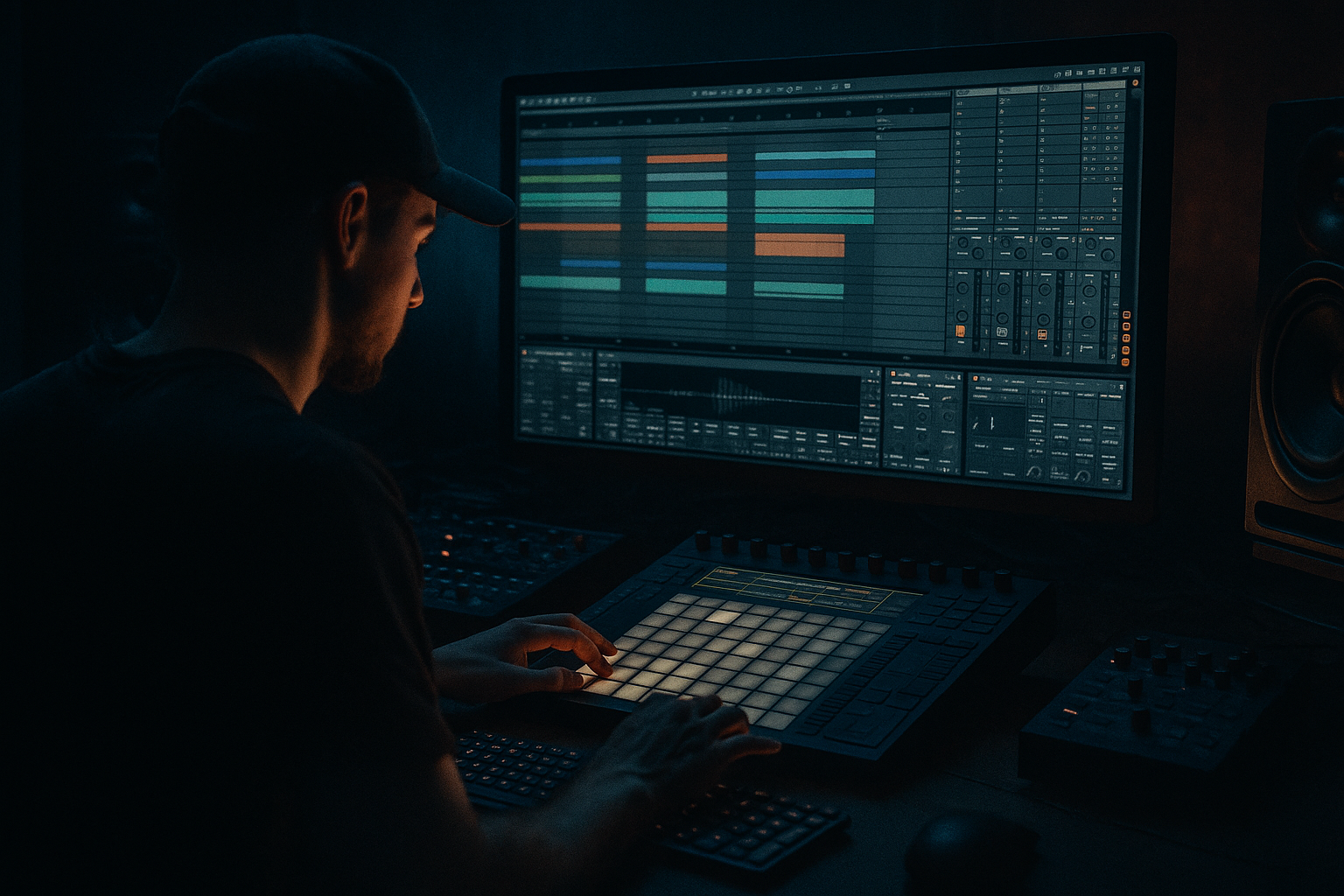
Main tutorial
Lesson Overview
In this lesson, you’ll build a Moonlit Jungle-style jungle arp in Ableton Live 12 and learn how to offset, slice, and arrange it against breakbeats so it feels like a proper DnB phrase instead of a generic synth loop. This is a classic jungle / liquid-darker hybrid idea: a melodic arp that dances over chopped drums, adds motion in the midrange, and helps carry tension into the drop or between drum switches.
Why this matters in DnB: a lot of beginner arps sound too straight, too “EDM,” or too busy. In Drum & Bass, especially jungle and breakbeat-led tracks, the arp needs to feel rhythmic, syncopated, and modular. That means the timing, note offsets, filtering, and arrangement are just as important as the sound itself. If you get this right, your arp becomes part of the groove — not just decoration.
We’ll use stock Ableton devices and a beginner-friendly workflow:
- a simple synth source
- a MIDI arp pattern
- note offsetting for movement
- breakbeat-aware arrangement
- automation for tension and release
- basic mix discipline so it sits with drums and sub
- jungle intros and midsection switches
- breakdowns before a drop
- atmospheric loops over amen-style edits
- darker rollers that need a melodic hook without losing weight
- plays a repeating minor-key motif
- uses offset note timing for a loose, human jungle feel
- works over chopped breakbeats and ghost-note drum edits
- has evolving filter and movement automation
- can be arranged into an intro, build, drop, and switch-up
- stays out of the sub range so the kick and bass remain clear
- a dark, glinting arpeggio in a minor scale
- lightly detuned and atmospheric
- rhythmic enough to lock with the break
- sparse in the intro, fuller in the drop
- ideal for a moonlit jungle / shadowy liquid / breakbeat DnB vibe
- Overfilling the MIDI clip
- Leaving the arp on-grid and robotic
- Letting the arp fight the bass
- Too much reverb
- No arrangement variation
- Harsh top end
- Overdoing width
- Layer a quiet octave below the arp, but keep it filtered and low in level. This adds body without stepping on the sub.
- Use Saturator before the EQ if you want a more worn, jungle-textured edge. Drive it gently so it doesn’t flatten the transients.
- Try a slight pitch envelope or a tiny detune drift if your synth supports it. That gives the arp a haunted, unstable character.
- Automate cutoff against the drum phrasing: open it slightly on the first bar of a new 4- or 8-bar section, then close it again as the phrase settles.
- Add a very light Delay with short feedback and filtered repeats to create motion without washing out the break.
- If the track is darker and more underground, keep the arp’s melody modal and repetitive. A simple motif often sounds more professional than a busy lead line.
- For heavier energy, duplicate the arp and process the second layer with a touch more saturation and a little less reverb, then keep it quieter underneath the main layer.
- Use Utility to check mono and narrow the arp if the stereo image feels too flashy for a rolling DnB mix.
- When arranging, mute the arp for a bar before the drop or switch-up. That tiny hole in the texture can make the return feel massive.
- Build the arp from a simple minor-key pattern.
- Use small note offsets to create jungle-style movement.
- Arrange it around the breakbeat phrasing, not just the grid.
- Use filter automation, subtle saturation, and controlled width to shape energy.
- Keep the arp mid-focused and mix-safe so the drums and bass stay strong.
- Make small arrangement variations every few bars to keep the track moving.
This is especially useful for:
What You Will Build
By the end of the lesson, you’ll have a 4- to 8-bar Moonlit Jungle arp phrase that:
Musically, the result will sound like:
Step-by-Step Walkthrough
1. Set up a simple DnB project and reference the groove
- Open a new Ableton Live 12 set and set the tempo to 170–174 BPM. For a Moonlit Jungle feel, 172 BPM is a great starting point.
- Create two audio/MIDI lanes: one for drums/breakbeat and one for the arp.
- Drop in a breakbeat or program a basic jungle drum pattern first, so the arp is built around the rhythm instead of floating in isolation.
- Keep the drum groove simple at first: a kick, snare on 2 and 4, and a few chopped break slices or ghost notes around them.
- Why this works in DnB: the arp must “dance around” the break. If you write it before the drums, it often ends up too square and clashes with the pocket.
2. Create the arp sound with stock Ableton devices
- On the arp MIDI track, load Instrument Rack or a simple synth like Analog, Wavetable, or Operator.
- For beginners, a clean starting point is:
- Wavetable: basic saw or triangle blend
- Oscillator 1: saw
- Oscillator 2: triangle or another saw slightly detuned
- Filter: low-pass, cutoff around 1.5 kHz to 4 kHz depending on brightness
- Add Chorus-Ensemble very lightly if you want width, but keep it subtle.
- Add Saturator after the synth with Drive around 2–5 dB for a little grit.
- If the sound is too plain, add Echo very quietly or a touch of Reverb, but don’t wash it out yet.
- Keep the patch mid-focused. Your sub should live elsewhere in the arrangement.
3. Write a short minor-key arp pattern
- Use a dark scale such as A minor, D minor, or F# minor.
- Make a 1-bar or 2-bar MIDI clip with 3–5 notes only. Keep it simple.
- Example in A minor:
- A3, C4, E4, G4
- Repeat or vary the order for a rolling pattern
- Try an 8th-note or 16th-note feel, but don’t fill every slot. Leave some space.
- Start with these kinds of note groups:
- A–C–E–G
- D–F–A
- G–A–C
- If you want a more jungle-leaning mood, use smaller intervals and a repeated top note so it feels hypnotic rather than melodic-pop.
- Keep the note range around C3 to C5. Avoid going too low if you already have a bassline.
4. Offset the notes for a looser jungle feel
- This is the core of the lesson. Instead of placing every note perfectly on the grid, offset some notes slightly:
- push certain notes 5–20 ms early or late
- move one or two notes just ahead of the beat for urgency
- delay a repeated note slightly for bounce
- In Ableton Live 12, you can do this directly in the MIDI clip by nudging notes or adjusting note timing visually.
- A good beginner rule:
- keep the first note of the bar mostly on-grid
- shift the second or third note a little late
- shift a higher passing note slightly early
- Use this carefully. You want groove, not sloppiness.
- For a Moonlit Jungle arp, the offset should feel like it’s weaving through the breakbeats, not fighting them.
- Try moving every second note by a tiny amount so the phrase breathes.
- If your drums have swing or a humanized break loop, offsetting the arp makes it feel like part of the same performance.
5. Make the arp lock to the breakbeat
- Loop your breakbeat and listen to where the snare, ghost notes, and hat details land.
- Adjust the arp so it answers those accents:
- place a note just after a snare for a call-and-response feel
- let a higher note land before a drum fill
- leave a gap where the break does something important
- Use the Clip Launch Quantization or clip grid as needed, but don’t quantize away all life.
- If your break has chopped amen-style hits, try aligning arp changes to the start of each 2-bar phrase rather than every bar.
- Add a little rhythmic variety:
- bar 1: shorter, sparse phrase
- bar 2: slightly busier phrase
- This keeps the arp from sounding like a static loop.
6. Shape movement with MIDI and device automation
- Add an Auto Filter after the synth if your synth filter is limited, or use the synth’s own filter.
- Automate the cutoff slowly across 4 or 8 bars:
- intro: cutoff around 300–900 Hz
- build: open to 2–5 kHz
- drop: keep it partly open for brightness, then close slightly on transitions
- Automate Resonance lightly, around 5–20%, to add a moonlit shimmer.
- Add LFO-like movement using:
- Auto Pan with Amount around 10–25% and Rate synced to 1/8 or 1/4
- or subtle Chorus-Ensemble movement
- If you want more tension, automate the Saturator Drive by 1–3 dB in the build.
- Keep movement gradual. In DnB, automation should support the groove, not distract from it.
7. Arrange the arp like a real DnB phrase
- Build a simple arrangement:
- Intro: arp filtered and sparse, drums teased in
- Build: arp opens up and becomes more active
- Drop: full groove with breakbeat and bass
- Switch-up: remove a few arp notes or filter them down for contrast
- A practical 8-bar idea:
- Bars 1–2: arp low-pass filtered, only top notes
- Bars 3–4: full pattern enters
- Bars 5–6: repeat with a variation in the last half-bar
- Bars 7–8: filter closes slightly and a riser/fill leads to the next section
- In a jungle context, let the arp act like an ear-candy motif over chopped drums, especially before the drop or after a drum edit.
- Use duplicate and edit rather than trying to invent every bar from scratch. That’s a very DnB-friendly workflow.
8. Add breakbeat-aware edits and transitions
- Duplicate the arp clip and make one or two small arrangement variations:
- remove the last note before a snare fill
- add a quick 1/16 pickup into a transition
- shorten the final note to create space
- Add a small Reverse sample or downlifter if you want a transition into the next section.
- You can also automate Reverb Dry/Wet up briefly at the end of an 8-bar phrase, then pull it back down at the drop.
- If you’re using a chopped break, try muting the arp for half a bar once in a while. That silence makes the return hit harder.
- This is especially effective in darker DnB: tension often comes from restraint, not constant motion.
9. Mix the arp so it supports the drums and bass
- Add EQ Eight after the instrument.
- High-pass the arp around 120–250 Hz to keep low-end clean.
- If it feels harsh, gently reduce a narrow band around 2.5–5 kHz.
- If it needs air, add a small boost around 8–10 kHz only if the mix can take it.
- Keep the arp mono-compatible in the low mids:
- use Utility and reduce width if it feels too wide
- or keep the width higher only on the top layer
- If you have a bassline already, listen for overlap in the 150–500 Hz zone.
- Why this works in DnB: fast drum programming and strong basslines need a disciplined midrange. A clean arp leaves room for the break transient and sub foundation.
10. Turn the loop into a usable track section
- Once the arp and drums feel good, make an arrangement pass:
- copy the best 8-bar section
- remove the arp in one section to create contrast
- bring it back filtered for the next phrase
- Add a second arp variation:
- lower octave
- fewer notes
- different last note
- This gives you a call-and-response structure, which is huge in DnB.
- A strong arrangement idea:
- Section A: sparse moonlit arp
- Section B: fuller arp with drums
- Section C: arp drops out for bass focus
- Section D: arp returns with a different ending note
- Keep the changes subtle but deliberate. That’s how modern breakbeat DnB stays engaging without becoming messy.
Common Mistakes
- Fix: use fewer notes. In DnB, space often sounds more confident than constant motion.
- Fix: offset a few notes by tiny amounts so it breathes with the break.
- Fix: high-pass the arp and keep the sub region clear. If your bassline lives low, the arp should stay mid/high.
- Fix: reduce decay and dry/wet. If the arp blurs the snare, it’s too wet.
- Fix: duplicate the clip and remove or shift notes in the second phrase. DnB needs movement every few bars.
- Fix: use EQ Eight to tame sharp frequencies or soften the synth filter cutoff.
- Fix: keep the arp narrower in the low mids and wider only in the upper layer if needed.
Pro Tips for Darker / Heavier DnB
Mini Practice Exercise
Spend 10–20 minutes making one full 8-bar Moonlit Jungle arp phrase.
1. Choose a minor key: A minor, D minor, or F# minor.
2. Program a 1-bar arp with only 4 notes in Ableton Live.
3. Offset at least 2 notes slightly early or late.
4. Put a breakbeat loop underneath it.
5. Add Auto Filter and automate the cutoff over 8 bars.
6. Duplicate the arp and create one variation by removing 1–2 notes.
7. High-pass the arp with EQ Eight and listen in context with the drums.
8. Export a quick bounce or save the clip as a sketch.
Goal: make the arp feel like it belongs to a DnB drum pocket, not like a loop pasted on top.
Recap
If you can make one arp feel alive against a break, you’re already thinking like a DnB producer.

