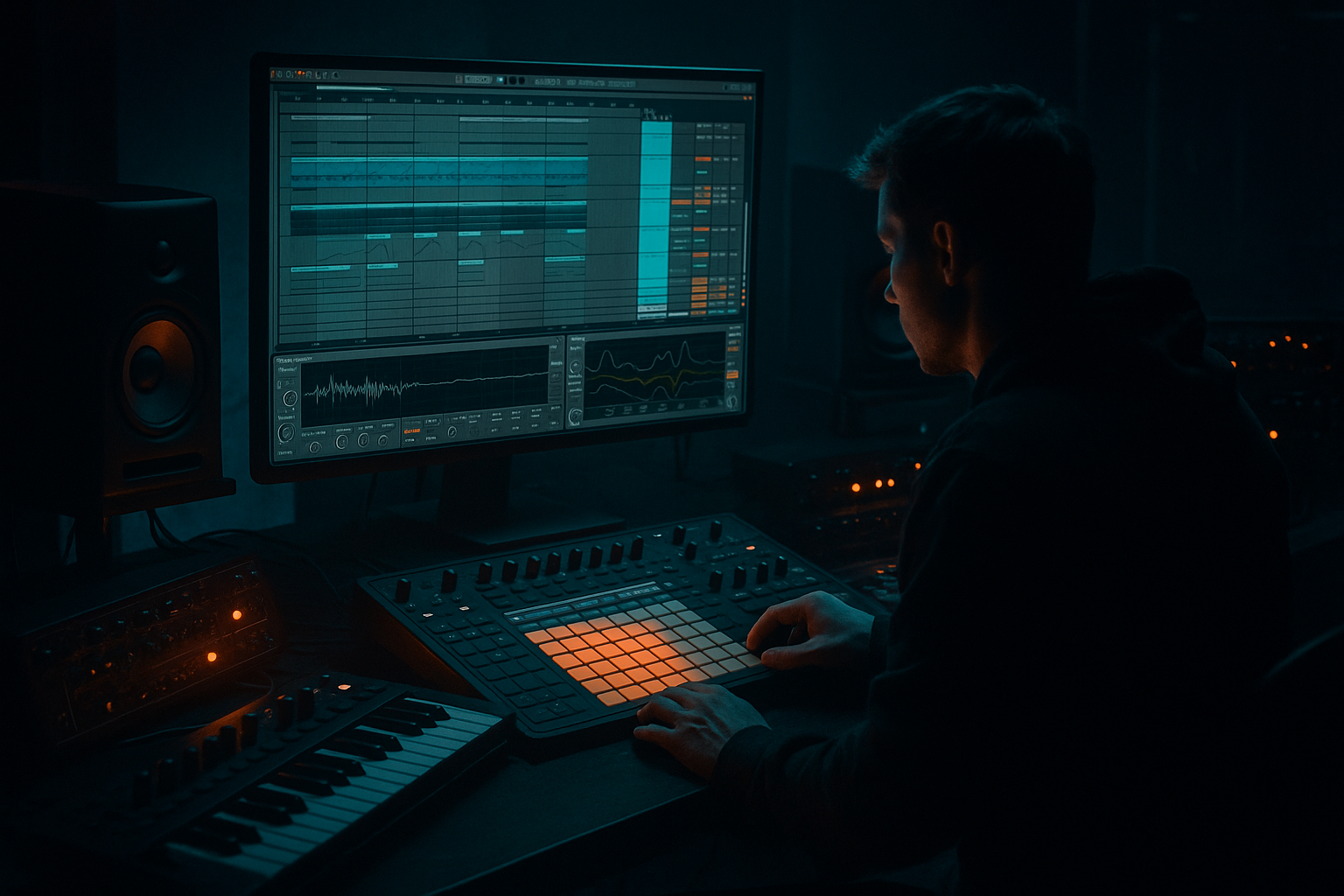
Main tutorial
Moonlit Jungle: Sub Stack + Crunchy Sampler Texture (Ableton Live 12) 🌙🥁
Skill level: Beginner
Category: Mastering (DnB/Jungle-focused “final bass control + character” approach)
---
1) Lesson overview
In rolling drum & bass and jungle, the bass often has two jobs:
1) A pure, stable sub that hits hard and translates on any system.
2) A textured mid layer that gives character, movement, and “moonlit grit” without wrecking your low end.
In this lesson you’ll build a two-layer bass stack and then treat it like a mastering problem: tight low-end management, controlled harmonics, consistent loudness, and translation—all inside Ableton Live 12 using mostly stock devices. ✅
---
2) What you will build
You’ll create a Bass Group with:
- SUB (clean + solid): a pure sine/triangle sub, tightly controlled and mono.
- TEXTURE (crunchy sampler layer): a resampled bass “bite” using Simpler/Sampler, subtle saturation, and band-limited crunch.
- Bass Group mastering chain: glue, soft clipping, dynamic control, and a clean handoff to the master.
- Kick: 1 and “&” variations (or just on 1 for now)
- Snare: on beat 2 and 4
- Hats: 1/8 or 1/16 for movement
- add start offsets, fades, filter envelope, reduce quality, etc.
- Start slightly forward so the transient changes
- Add tiny fade-in (ms) to avoid clicks
- Use Filter Envelope:
- SUB owns 20–110 Hz
- TEXTURE lives mostly 150 Hz and up
- Leave a small “no man’s land” to avoid phase fights (e.g., don’t let both scream at 120 Hz)
- If needed, tiny cut around 200–350 Hz (mud zone)
- If harsh, small cut around 2–4 kHz
- Attack: 10 ms
- Release: Auto
- Ratio: 2:1
- Threshold: aim for 1–3 dB gain reduction on peaks
- Soft Clip: OFF here (we’ll clip later more intentionally)
- Soft Clip: ON
- Drive: 1–4 dB
- Output: reduce so the group doesn’t get louder overall
- Ceiling: -0.8 dB
- Aim for 0–1 dB reduction most of the time
- Bars 1–4: Sub only (sets weight)
- Bars 5–8: Bring in texture quietly (−10 to −6 dB vs sub)
- Bars 9–12: Add filter automation on texture (more bite)
- Bars 13–16: Add a quick “resample fill” (one bar) then drop texture out right before the next section
- TEXTURE Auto Filter cutoff: slowly open 2 kHz → 6 kHz
- Redux amount: slightly increase in the last 2 bars before a drop
- Utility gain on TEXTURE: tiny boost on phrase endings for emphasis
- Letting texture have sub energy: If TEXTURE isn’t high-passed, your low end gets blurry fast.
- Stereo sub: Any width in 20–110 Hz will cause weak playback on clubs/mono systems. Keep SUB mono.
- Overdoing Redux: Too much bit/sample reduction can add harsh noise that masks hats/snare presence.
- Compressing the sub too hard: You’ll flatten the groove and lose the “push-pull” that makes DnB roll.
- Not gain matching: If you add saturation and it gets louder, you’ll think it sounds “better” even if it’s worse.
- Parallel distortion on texture only: Duplicate TEXTURE, distort harder, then low-pass it and blend quietly. Keeps sub clean while adding menace.
- Sub stability check: Put Spectrum on SUB and watch for consistent fundamentals (e.g., 43.65 Hz for F1).
- Midrange “snarl pocket”: Often lives around 300–800 Hz. Shape your texture to sit there without eating the snare body (often ~180–250 Hz).
- Clip in stages: A little Saturator soft clip on TEXTURE + a little on BASS BUS beats one huge limiter smash.
- Use Roar (Live 12) carefully: If you have Roar, try it on TEXTURE only with band-limiting (multiband) so it doesn’t touch sub fundamentals.
- You built a two-layer DnB bass stack: SUB = clean + mono, TEXTURE = sampled crunch + controlled mids.
- You used a resampling workflow to get authentic jungle texture inside Live 12.
- You applied a mastering mindset on the Bass Bus: small EQ moves, gentle glue, soft clipping, and safety limiting.
- You kept translation in mind: mono low end + band-limited distortion = loud, clear rollers.
Goal sound: deep, steady sub under a crunchy, slightly haunted jungle texture—perfect for rollers and late-night edits 🌑.
---
3) Step-by-step walkthrough
Step 0 — Project setup (DnB friendly)
1. Set tempo to 170–174 BPM.
2. In Arrangement, make an 8 or 16-bar loop. DnB bass needs repetition for ear calibration.
3. Add a basic drum groove (even placeholders): kick + snare + hats. Your bass decisions depend on drums.
Quick DnB suggestion:
---
Step 1 — Build the SUB layer (clean foundation) 🔊
1. Create a MIDI track: SUB.
2. Drop Operator (stock) on it.
3. Set Operator:
- Algorithm: A only (single oscillator)
- Oscillator A waveform: Sine
- Coarse: 0
4. Add Amp Envelope settings:
- Attack: 0–5 ms
- Decay: 200–400 ms (optional)
- Sustain: -inf if you want short notes, or 0 dB for held notes
- Release: 60–120 ms (prevents clicks)
5. Add EQ Eight after Operator:
- Enable HP filter at 20–25 Hz (gentle, 12 dB/oct) to remove rumble.
- Optional: tiny bell cut if there’s mud around 120–200 Hz (only if needed).
6. Add Utility after EQ Eight:
- Width: 0% (force mono)
- Leave gain at 0 for now.
DnB note length tip:
Start with 1/8 notes and a few 1/16 pickups. Keep it simple so you can hear the tone shaping.
---
Step 2 — Build the TEXTURE layer (crunchy sampler bite) 🧱
You’ll create a midrange layer that feels sampled, like old jungle resampling workflows, but modern and controlled.
1. Create a new MIDI track: TEXTURE.
2. Drop Simpler on it (or Sampler—Simpler is quicker).
3. Load a source sound into Simpler:
- Option A (recommended): Resample your sub (we’ll do this in Step 3)
- Option B: Use a short bass stab sample (or a reese-ish one-shot)
For now, drag any bass one-shot into Simpler just to get the chain going.
4. In Simpler:
- Mode: Classic
- Voices: 1 (mono)
- Turn Warp OFF (we want stable pitch)
- Filter ON:
- Type: LP24
- Cutoff: ~2–6 kHz (we’ll tune later)
- Drive: a little (2–6) for bite
5. Add EQ Eight after Simpler:
- High-pass at 120–180 Hz (24 dB/oct).
This ensures the sub layer owns the real low end.
- Gentle bell boost around 700 Hz–1.5 kHz if you want “presence” (small boosts only).
6. Add Saturator (stock) after EQ:
- Mode: Soft Clip ON
- Drive: 2–8 dB (start at 4 dB)
- Output: reduce to match level (avoid fooling your ears)
7. Add Redux (stock) after Saturator for sampler crunch:
- Bit Reduction: try 10–12 bits
- Sample Rate: try 10–18 kHz
- Keep it subtle—this is “texture,” not “pain.” 😄
8. Add Auto Filter after Redux:
- Type: Band-Pass or Low-Pass
- Automate cutoff slightly over 8–16 bars for movement (more on this later)
---
Step 3 — Resampling trick: make your own “sampled” texture 🎛️
This is where it becomes Moonlit Jungle. You’ll resample the sub (or a simple bass) and re-inject it as a crunchy mid layer.
1. Create an Audio track called RESAMPLE PRINT.
2. Set its input to Resampling (from the Audio From chooser).
3. Solo your SUB track.
4. Record a few notes/pattern for 4–8 bars.
5. Stop recording. Now you have audio of your sub.
6. Drag that recorded audio clip into Simpler on the TEXTURE track.
Now it’s the same bass, but you can process it like old-school resampling:
Extra texture move: In Simpler, adjust:
- Attack: 0
- Decay: 200–600 ms
- Env Amount: small to moderate
This gives that “bloom” that feels alive.
---
Step 4 — Group the bass + set your crossover workflow 🧩
1. Select SUB + TEXTURE tracks → Cmd/Ctrl + G to group into BASS BUS.
2. On the group, add Spectrum (stock) at the end for visual checking.
Crossover philosophy (simple beginner rule):
---
Step 5 — “Mastering-style” control on the BASS BUS (tight + loud-safe) 🎚️
This is mastering mindset: consistency, translation, headroom.
BASS BUS device chain (in order):
1) EQ Eight (cleanup + control)
Keep changes small (1–3 dB).
2) Glue Compressor (gentle “togetherness”)
3) Saturator (soft clipping for peak control)
4) Limiter (safety only, not smashing)
If it’s doing more, fix levels earlier.
Why this works for DnB:
DnB bass has fast peaks and constant energy. A touch of clipping + light compression makes it feel “printed,” like a finished record, without destroying dynamics.
---
Step 6 — Sidechain bass to the kick (cleaner low end) 🥊
You can do this two ways:
#### Option A: Compressor sidechain (simple)
1. On BASS BUS, add Compressor (not Glue).
2. Enable Sidechain → select Kick track.
3. Settings:
- Ratio: 4:1
- Attack: 1–5 ms
- Release: 60–140 ms (time to tempo)
- Threshold: dial until the kick creates a noticeable dip (but not a hole)
#### Option B: Ducking with Auto Pan (super clean pumping)
1. Add Auto Pan to BASS BUS.
2. Turn Phase to 0° (this makes it act like a volume shaper).
3. Rate: 1/4 (or 1/8 depending on kick pattern)
4. Shape: closer to saw down for a quick dip and smooth return.
5. Amount: 10–30% to start.
DnB note: For rollers, subtle ducking is usually better than extreme pumping.
---
Step 7 — Arrangement ideas (make it feel like jungle) 🧬
Try these bass arrangement moves over 16 bars:
Automation suggestions:
---
Step 8 — Master bus sanity check (beginner-safe) ✅
You asked for Mastering category, so here’s a safe, minimal master approach while you learn:
On MASTER (light touch):
1. EQ Eight
- HP at 20 Hz (gentle)
2. Glue Compressor
- Ratio 2:1, Attack 10 ms, Release Auto
- 1–2 dB gain reduction max
3. Limiter
- Ceiling -1.0 dB
- Don’t chase loudness yet—focus on clean bass translation.
Level target for learning:
Keep master peak around -6 to -3 dB while building. Then use the limiter only at the end.
---
4) Common mistakes
---
5) Pro tips for darker/heavier DnB 🌑
---
6) Mini practice exercise 🧪
Goal: Build a 16-bar rolling bass phrase with controlled sub + evolving crunch.
1. Write a simple sub MIDI pattern in F minor (or any key):
- Use mostly F1, with occasional G#1 or D#1 passing notes.
2. Resample 8 bars of SUB → load into Simpler on TEXTURE.
3. Create movement:
- Automate TEXTURE filter cutoff to open slightly every 4 bars.
- Increase Redux sample rate reduction a touch in bars 15–16.
4. Mix check:
- Mute TEXTURE: does the track still feel powerful? (It should.)
- Mute SUB: does the character remain without low-end? (It should.)
5. Export a quick WAV and test on:
- headphones
- laptop speakers (you should still hear texture even if sub disappears)
---
7) Recap 🔁
If you want, tell me your BPM and key (and whether your kick is punchy or boomy), and I’ll suggest exact crossover points and sidechain timings for your specific groove.

