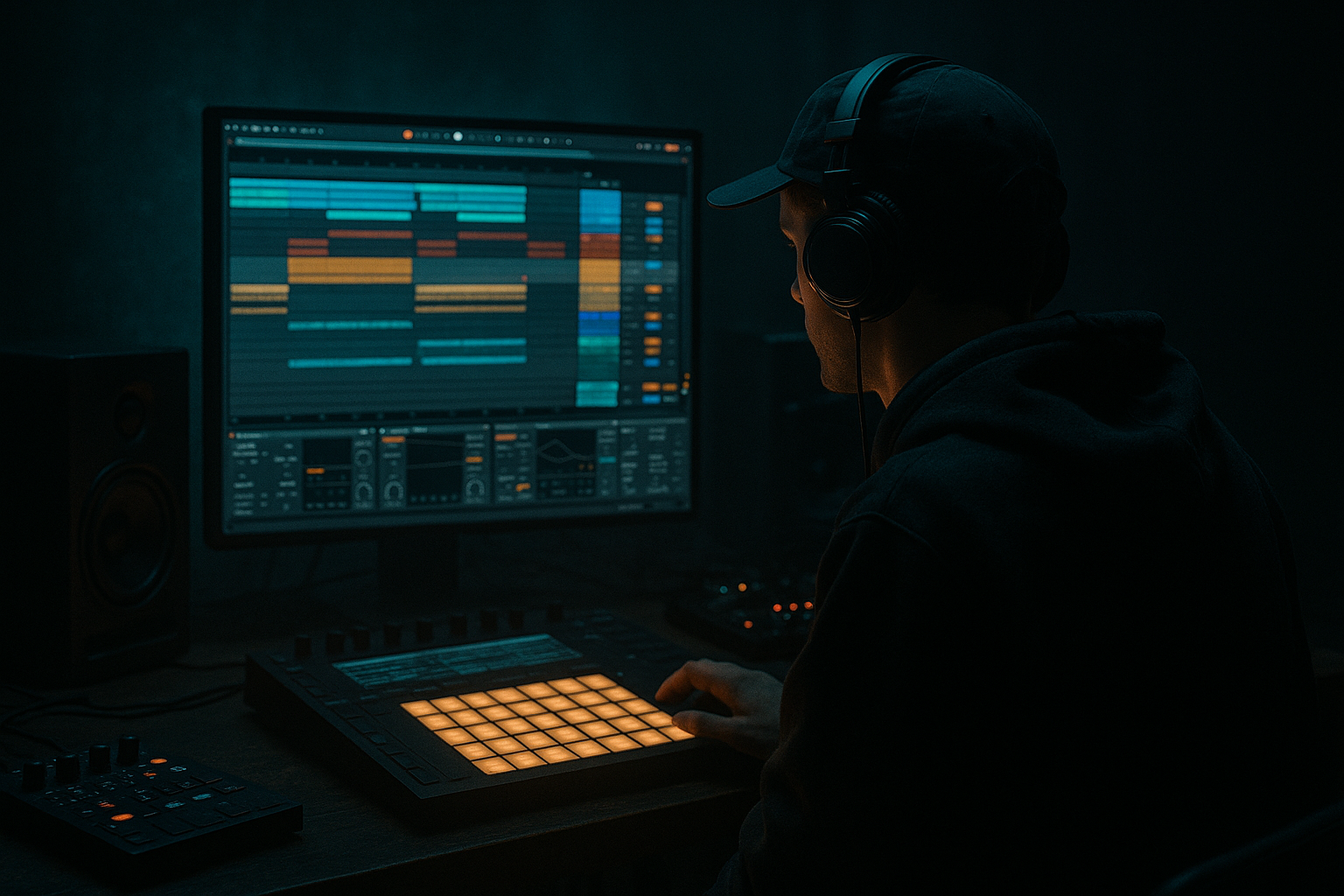
Main tutorial
```markdown
Morphing Vocal Textures into Playable Atmospheres (DnB in Ableton Live) 🎛️🎙️
1) Lesson overview
This lesson is about taking a vocal recording (a sung note, spoken phrase, ad-lib, or even a whispered line) and morphing it into a playable atmospheric instrument that sits perfectly in drum & bass / jungle / rolling bass music.
We’ll focus on:
- Turning vocals into pads, drones, and reese-adjacent air without losing musicality
- Building a Macro-controlled instrument for performance + arrangement
- Making it dark, wide, and mix-ready while staying controlled in the low end
- A playable “Vocal Atmosphere Instrument” (Sampler/Simpler-based)
- A morphing FX rack with Macros for:
- A short arrangement concept: intro atmosphere → drop support layer → breakdown riser
- Sustained vowel: “ahh”, “ohh”, “mmm”
- Spoken phrase with emotion
- One-shot adlib with character
- HPF: 24 dB/oct at 120–250 Hz (start here; adjust by vibe)
- Dip harshness: bell at 2.5–4.5 kHz, -2 to -5 dB, Q ~2
- Add “air” if needed: high shelf 9–12 kHz, +1 to +4 dB
- Filter Type: LP24
- Frequency: 500 Hz – 6 kHz (map this later)
- Drive: 2–6 dB (adds thickness)
- Envelope: very subtle, Amount 5–15%
- LFO: Rate 1/8 or 1/4, Amount 10–25%, Offset to taste
- Mode: Chorus or Ensemble
- Amount: 20–45%
- Rate: 0.10–0.35 Hz
- Width: 120–200%
- HP Filter (if visible): keep low-end clean (aim > 200 Hz)
- Choose Phaser
- Rate: 0.03–0.15 Hz
- Amount: 15–35%
- Feedback: 5–20%
- Mix: 10–25%
- Algorithm: Hall or Shimmer (Shimmer is great for sci-fi DnB intros)
- Decay: 4–12 s
- Pre-delay: 15–45 ms (lets the vocal articulate before the wash)
- Size: 70–100%
- Low Cut: 200–400 Hz
- High Cut: 6–10 kHz (darker = lower cutoff)
- Mix: 25–55% (or put it 100% wet on a Return track)
- Bass Mono: ON, set around 120–200 Hz
- Width: 90–140% depending on how wide your drop is
- Sidechain: ON
- Input: your Kick (or a ghost kick track)
- Ratio: 2:1 to 4:1
- Attack: 2–10 ms
- Release: 80–180 ms (tune to tempo/groove)
- Threshold: set for 2–6 dB gain reduction
- Phase: 0° (so it’s volume modulation, not stereo pan)
- Rate: 1/4 or 1/8
- Amount: 20–60%
- Intro (16 bars): automate Macro 1 “Darkness” from bright → dark, and Macro 2 “Wash” up.
- Pre-drop (8 bars): shorten decay slightly, increase Motion slowly, add a filtered riser note.
- Drop: reduce Wash, keep Darkness fairly low (darker), keep sidechain active.
- Breakdown: bring Wash back, remove sidechain, widen stereo again.
- Freeze-ish smear with moderate feedback
- Use small shifts for “ghost choir” textures
- Tune to the key of the track
- Use Noise/Width carefully to avoid piercing highs
- Too much low end: vocal pads often hide mud around 150–350 Hz. HPF it and don’t be afraid to cut.
- Over-widening: super wide atmos can collapse badly in mono and fight cymbals. Use Utility’s Bass Mono + moderate width.
- Reverb with no pre-delay: the vocal loses clarity and becomes a flat wash.
- No groove interaction: static atmos feel disconnected in DnB—sidechain or tremolo is your friend.
- Harsh resonances: phaser/chorus can create spikes. Sweep EQ Eight with a narrow bell and tame offenders.
- Make the “air” gritty, not bright: Use Saturator + low-pass around 6–10 kHz instead of boosting top end.
- Minor key drifts: Automate slight pitch drift (±5–15 cents) using Clip Envelopes or Sampler LFO for unease.
- Call-and-response with reese: Let the vocal atmos occupy 1–6 kHz, and carve a pocket in your bass layer there.
- Noise floor vibe: Add Vinyl Distortion very subtly (or Saturator with Noise) for texture—then high-pass it.
- “Haunted chorus” technique: Duplicate the track:
- You turned a vocal into a playable pad/drone using Simpler/Sampler looping + envelopes.
- You built a morphing atmosphere chain using stock devices (filter, modulation, reverb, utility).
- You made it DnB-ready by controlling low end, width, harshness, and adding groove via sidechain/tremolo.
- You created Macros for fast automation, which is key for intros, breakdowns, and drop transitions. ✅
Everything is done with Ableton Live stock devices (with a few optional extras if you have Suite).
---
2) What you will build
By the end, you’ll have:
- Grain smear / time stretch vibe
- Formant character / “human” tone
- Movement (autopan/chorus/phaser)
- Space (reverb size + pre-delay)
- Dark DnB filtering + sidechain pumping
---
3) Step-by-step walkthrough
Step 0 — Pick the right source vocal 🎙️
Goal: a vocal with tone, not just consonants.
Best sources:
Quick prep:
1. Warp the vocal clip in Arrangement.
2. Set Warp Mode: Complex Pro (great for vocals).
3. If it’s a phrase, find a clean 300–1500 ms region with steady tone.
DnB tip: Dark atmospheric DnB loves imperfect vocals—breaths and grit are good, but we’ll manage harshness later.
---
Step 1 — Create a playable instrument (Sampler or Simpler)
#### Option A (fast): Simpler (Classic or Slice)
1. Drag the vocal clip into a new MIDI track → it becomes a Simpler.
2. In Simpler:
- Mode: Classic
- Warp: ON
- Warp Mode: Complex Pro (or Texture for grainier smear)
- Voices: 6–12 (so chords don’t cut each other off)
- Glide: OFF for pads (ON if you want drift)
3. Amplitude Envelope (AMP):
- Attack: 40–120 ms
- Decay: 2–6 s
- Sustain: -6 to -12 dB
- Release: 1.5–6 s
This makes it playable like a pad/drone.
4. Looping for drones:
- Enable Loop
- Start with Loop Length 150–500 ms (find a stable vowel section)
- Crossfade (if available): 20–80 ms
You want a loop that doesn’t click.
#### Option B (deeper): Sampler
If you want more modulation options, right-click Simpler → Convert to Sampler.
---
Step 2 — “Morph” it into atmosphere using grain + modulation (stock-only)
We’ll build a chain that turns vocal identity into “air” while keeping tonal control.
#### Device chain (recommended order)
Simpler/Sampler → EQ Eight → Auto Filter → Chorus-Ensemble → Phaser-Flanger → Hybrid Reverb → Utility
##### 2.1 EQ Eight (clean-up + tone shaping)
DnB context: This keeps your atmosphere from fighting the sub + kick while still feeling expensive.
##### 2.2 Auto Filter (movement + darkness) 🌑
Keep it slow—your drums are fast; your atmos should breathe.
##### 2.3 Chorus-Ensemble (width + soft blur)
##### 2.4 Phaser-Flanger (subtle shifting “morph”)
This creates evolving vocal resonances without obvious “EDM swoosh”.
##### 2.5 Hybrid Reverb (space engine)
##### 2.6 Utility (stereo + mono management)
---
Step 3 — Add “playable control” with an Audio Effect Rack 🎚️
Select your FX devices (EQ → Utility) and Cmd/Ctrl+G to group into an Audio Effect Rack.
Create Macros like this:
1. Macro 1: Darkness
- Map Auto Filter Frequency (LP cutoff)
- Map Hybrid Reverb High Cut
- Optional: map EQ shelf gain (air)
2. Macro 2: Wash
- Map Hybrid Reverb Mix
- Map Decay (small range: e.g. 4–10 s)
3. Macro 3: Motion
- Map Chorus Amount
- Map Phaser Amount
- Map Auto Filter LFO Amount
4. Macro 4: Grit
- Add Saturator before reverb:
- Drive 2–8 dB, Soft Clip ON
- Map Drive + maybe Auto Filter Drive
5. Macro 5: Width
- Map Chorus Width + Utility Width (careful: don’t go too far in a dense drop)
Now you’ve got a performance-ready “atmosphere instrument” you can automate in Arrangement.
---
Step 4 — Make it “DnB tight” with sidechain + rhythm
Atmospheres in DnB feel glued when they pump with the groove.
#### 4.1 Sidechain compression (classic glue) 🥁
Add Compressor at the end of the chain:
#### 4.2 Alternative: Volume shaping without Compressor
Use Auto Pan as a tremolo:
This can be cleaner and more “rolling” than heavy compression.
---
Step 5 — Turn it into a layer that works in a rolling drop
A common DnB move: atmos sit above the bass, filling the mid-high while staying out of the way.
Arrangement ideas:
MIDI tip: Write pads as two-note intervals (root + 5th) or minor 7th voicings for moody DnB. Keep it sparse—your drums are the star.
---
Step 6 — Optional advanced moves (Suite-friendly)
If you have Suite, these are lethal:
#### 6.1 Spectral Time / Spectral Resonator (amazing for morphing)
Insert Spectral Time after Simpler:
Or Spectral Resonator:
#### 6.2 Resample and re-grain
1. Arm a new audio track: Resampling
2. Record 8–16 bars while tweaking Macros
3. Chop the best moments and re-load into Simpler
This is how you get unique “one-off” atmos that sound like a record, not a preset.
---
4) Common mistakes
---
5) Pro tips for darker/heavier DnB 🖤
- Track A: darker, more mono, less reverb
- Track B: brighter, wider, heavy reverb, tucked low in volume
Automate B up in breakdowns and intros.
---
6) Mini practice exercise (20–30 minutes) ⏱️
1. Take a 1–2 second vocal “ahh” sample.
2. Make it playable in Simpler with looping and a pad envelope.
3. Build the rack with:
- EQ Eight, Auto Filter, Chorus-Ensemble, Hybrid Reverb, Utility
4. Create 5 Macros: Darkness, Wash, Motion, Grit, Width
5. Write an 8-bar MIDI progression:
- Bars 1–4: two notes held (root + 5th)
- Bars 5–8: add a higher note for tension
6. Automate:
- Darkness slowly down (darker) into bar 8
- Wash up in bars 7–8 then down on the drop
7. Add sidechain (kick) and bounce/resample 16 bars.
Deliverable: one bounced audio file that sounds like a cinematic DnB intro layer and still works under a rolling drop.
---
7) Recap
If you want, tell me your track tempo + key and what kind of vocal you’re using (sung/spoken/whisper), and I’ll suggest a specific Macro mapping range + an 8-bar progression that fits a rolling DnB drop.
```

