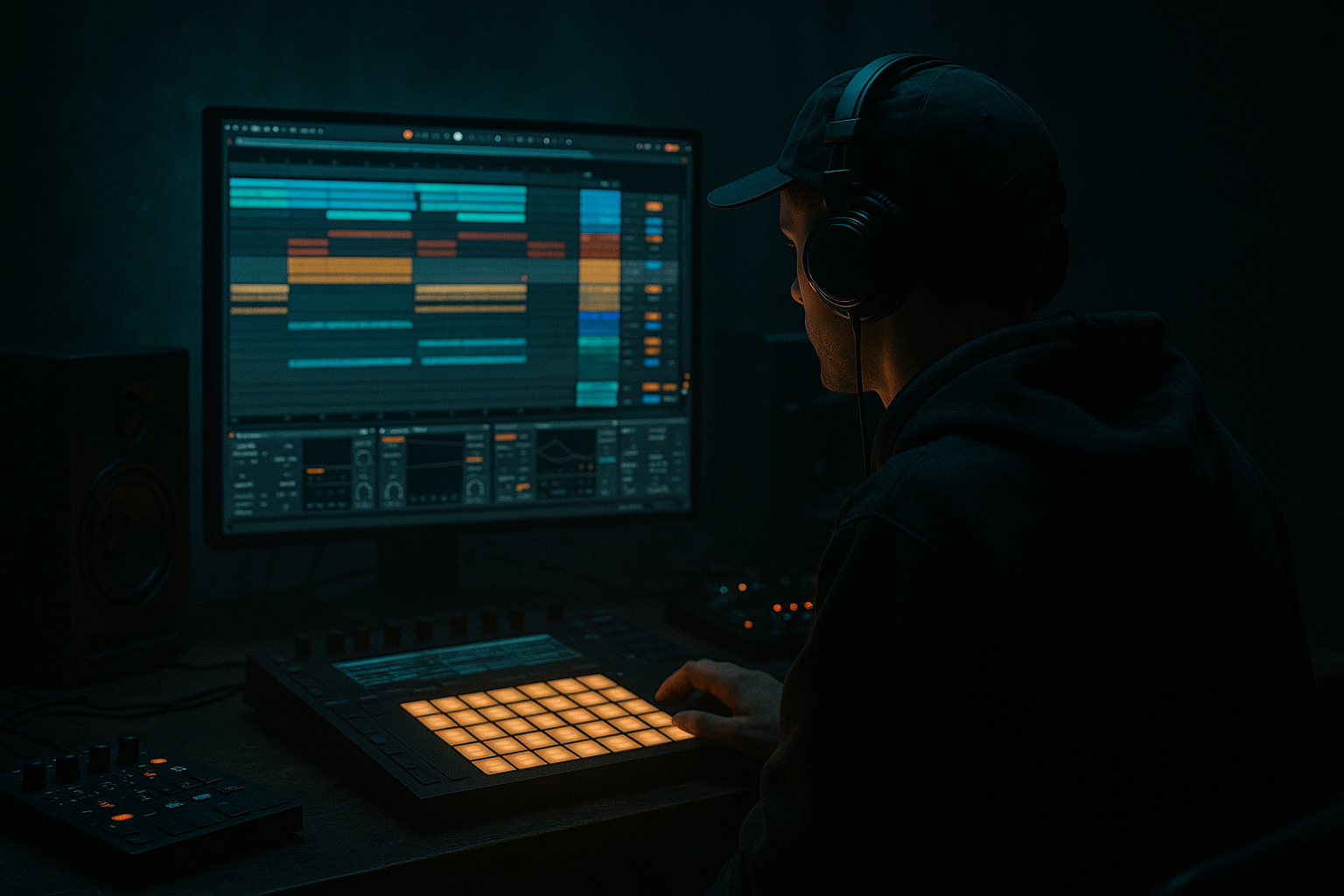
Main tutorial
Multi-stage Bass Processing with Simple Racks
Advanced Ableton Live tutorial for drum and bass bassline design 🔊
---
1. Lesson overview
In drum and bass, the bass rarely comes from one sound doing everything. The biggest, darkest, most controllable basslines are usually built as a clean low-end foundation plus multiple processing stages that each handle one specific job:
- Sub stability
- Midrange tone
- Movement
- Distortion
- Stereo control
- Dynamics
- Arrangement variation
- Neuro-influenced rollers
- Dark techstep
- Minimal DnB
- Jungle-inspired reese movement
- Heavy halftime-to-DnB crossover basses
- solid in mono
- aggressive in the mids
- controlled in the top
- easy to automate in arrangement
- A rolling DnB bassline setup
- A simple rack with macros
- A bass chain you can automate through an arrangement
- A reusable workflow for future projects
- Keep notes mostly short to medium
- Leave space around the kick
- Use syncopation against the snare
- Try a phrase like:
- Track 1: SUB
- Track 2: MID BASS
- Oscillator A: Sine wave
- Coarse: 1.00
- Level: 0 dB
- Filter: Off
- Voices: 1
- Mono: On
- Glide: 20–60 ms depending on vibe
- Attack: 0–5 ms
- Decay: 300–600 ms
- Sustain: around -6 dB to 0 dB depending on phrase
- Release: 50–120 ms
- Layer a tiny bit of Osc B at a low level
- Use a triangle-ish waveform or lightly FM the sine
- Keep it subtle
- Osc 1: Basic Shapes, saw
- Osc 2: saw or square, detuned slightly
- Unison: 2–4 voices, low amount
- Filter: MS2 or SMP
- Filter drive: moderate
- Amp envelope:
- Slight filter envelope
- Slow LFO to wavetable position
- Small pitch drift
- Velocity mapped to filter amount
- Sub: 30–90 Hz
- Body/Growl: 90–400 Hz
- Presence/Texture: 400 Hz–5 kHz
- Fizz/Top detail: 5 kHz+
- Chain 1: Clean Body
- Chain 2: Drive
- Chain 3: High Texture
- High-pass at 90–120 Hz
- Gentle low-pass around 2.5–4 kHz
- If muddy, dip 180–300 Hz by 1–3 dB
- If hollow, gently boost around 500–800 Hz
- Ratio: 2:1 to 4:1
- Attack: 10–30 ms
- Release: 50–120 ms
- Aim for 2–4 dB gain reduction
- Width: 0–30%
- Keep it mostly centered
- High-pass: 100–150 Hz
- Low-pass: 3–6 kHz
- Optional boost: 700 Hz–1.5 kHz for more bite
- Mode: Analog Clip, Wave Shaper, or Sinoid Fold
- Drive: 4–10 dB
- Soft Clip: On
- Output down to level match
- Use less top-end before distortion
- Push more low-mid content into the Saturator
- Mode: Heavy or Blues
- Gain: low to moderate
- Bass: controlled
- Mid: boosted slightly
- Presence: use carefully
- Dry/Wet: 20–50%
- Pick a warmer mode first
- Add multiband-style emphasis with internal tone shaping
- Keep output controlled
- Filter type: Low-pass or band-pass
- Frequency: automate between 400 Hz and 4 kHz
- Resonance: low to medium
- Envelope off or subtle
- LFO very subtle if you want motion
- Fast-ish attack
- Medium release
- 3–6 dB GR if needed
- High-pass aggressively at 700 Hz–1.5 kHz
- Optionally low-pass at 6–10 kHz
- Downsample: subtle
- Bit reduction: low to medium
- Dry/Wet: 10–30%
- Filter engaged
- Focus around 1–4 kHz
- Drive moderate
- Tone dark if you want techstep-style edge
- Use a subtle amount
- Keep rate slow
- Amount moderate
- This creates width without ruining mono low-end
- Decay: 0.2–0.8 sec
- Pre-delay: low
- High-pass the reverb signal
- Dry/Wet: 5–15%
- Width: 120–180%
- Optionally automate gain on this chain for fills
- Clean Body: 0 dB
- Drive: -6 to -12 dB
- High Texture: -12 to -18 dB
- too much texture
- not enough body
- poor sub/mid relationship
- Saturator Drive
- Amp Gain
- Maybe slightly lower Drive chain volume as drive increases
- Auto Filter cutoff on Drive chain
- Maybe also Wavetable filter cutoff
- High Texture chain volume
- Chorus amount
- Reverb dry/wet slightly
- Clean Body EQ low-pass
- Slight boost/dip around 250–700 Hz
- High Texture Utility Width
- Chorus amount
- Drive chain low-pass
- High Texture EQ low-pass
- Maybe reduce reverb brightness at the same time
- Ratio: 2:1
- Attack: 1–10 ms
- Release: 40–100 ms
- Just enough to create space
- Ratio: 2:1 to 4:1
- Faster release for groove
- You can duck more than the sub
- Tiny cut around 250–400 Hz if the whole bass bus clouds the mix
- Small tilt if needed
- Attack: 10 ms
- Release: Auto or 0.3 sec
- Ratio: 2:1
- 1–2 dB GR only
- Drive: 1–2 dB
- Soft Clip: On
- Just enough to unify layers
- Check mono compatibility often
- Gain trim
- Less High Texture
- Lower Drive
- Darker filter position
- More body, less top
- Automate Filter Movement upward
- Increase Texture Blend gradually
- Add a short automation spike on Drive
- Remove sub for 1/2 bar before the drop for impact
- Stable sub
- Moderate drive
- Controlled width
- Focus on groove and weight
- Increase texture chain
- Add more distortion
- Open filter more
- Introduce resampled fills or call-and-response bass edits
- Keep sub simpler and more legato
- Let the reese/mid layer move around it
- Use automation to make the high texture feel unstable and haunting
- chop bass phrases rhythmically
- reverse fills
- freeze complex modulation into audio
- create one-shot growls and transitional hits
- drive
- filter
- texture
- width
- Remove extreme highs before saturating
- Push low-mids into distortion for chesty weight
- Narrow the focus with band-pass for talking growls
- Sub = stable
- Body = mostly stable
- Drive chain = moderate motion
- High Texture = most of the movement
- 500 Hz
- 1.2 kHz
- 2.5 kHz
- “micro-reverb on filtered texture only”
- 1–2 dB drive
- output compensated
- reverse a reese tail into a snare
- pitch down the last note of an 8-bar phrase
- chop a distorted burst before bar transitions
- 1 sub track
- 1 mid bass track
- 1 three-chain rack
- Operator sine
- Mono
- Slight saturation only
- Clean Body chain
- Drive chain
- High Texture chain
- Drive Amount
- Filter Movement
- Texture Blend
- Bars 1–4: restrained, darker
- Bars 5–8: more open and aggressive
- Add one bass fill before bar 8
- Sub stays mono
- High texture stays mostly above 1 kHz
- Sidechain bass lightly around drums
- No more than 2 dB Glue Compression on Bass Bus
- Sub for weight
- Body for note definition
- Drive for aggression
- Texture for width and detail
- Operator
- Wavetable
- Audio Effect Rack
- EQ Eight
- Saturator
- Amp
- Auto Filter
- Compressor / Glue Compressor
- Chorus-Ensemble
- Utility
- Redux
- Hybrid Reverb
- What handles the sub?
- What handles the mids?
- What adds the aggression?
- What creates width?
- What can I automate in the arrangement?
- a macro map cheat sheet
- a ready-to-build Ableton rack layout
- or a neuro vs roller variation guide.
In this lesson, you’ll build a simple but powerful bass processing rack in Ableton Live using stock devices. The focus is not on making an overcomplicated “all-in-one mega rack,” but on creating a modular, practical chain you can actually use in a rolling DnB session.
We’ll design a bass workflow that works especially well for:
The goal is to create a bass that feels:
---
2. What you will build
You’ll build a 3-part bass system:
A. Sub track
A dedicated low-end layer that stays clean, mono, and consistent.
B. Mid bass track
A tonal/aggressive layer with movement and texture.
C. Simple Audio Effect Rack
A multi-stage rack for the mid bass with parallel chains:
1. Clean Body
2. Drive
3. High Texture
This lets you blend weight, grit, and air separately instead of smashing one channel with random effects.
Final result
By the end, you’ll have:
---
3. Step-by-step walkthrough
---
Step 1: Create the bassline source
Start with a bass phrase that already fits DnB rhythmically.
#### MIDI pattern idea
For a rolling 174 BPM tune:
- Note on beat 1
- Short stab before beat 2
- Sustained note across beat 3
- Short answer after beat 4
Think in terms of push-pull groove, not constant sustain.
#### Instrument setup
Create two MIDI tracks:
Duplicate the MIDI from one to the other.
---
Step 2: Build the sub
Your sub should do one thing very well: deliver stable low-end.
#### On the SUB track:
Use Operator.
#### Operator settings
#### Envelope
If you want a slightly more audible sub:
#### Sub cleanup chain
Add:
1. EQ Eight
- Low cut: off or very low, around 25 Hz if needed
- Tiny dip around 200–350 Hz if the sub is boxy
2. Saturator
- Mode: Analog Clip or Soft Sine
- Drive: 1–3 dB
- Output: compensate gain
- Soft Clip: On
3. Utility
- Bass Mono: On
- Width: 0%
- Gain stage carefully
This gives you a sub that translates on systems without losing clean low-end.
---
Step 3: Build the mid bass source
Now create the more interesting layer.
#### Instrument choice
Use Wavetable, Operator, or Analog.
A strong stock option is Wavetable.
#### Wavetable starting patch
- Attack: 0 ms
- Decay: 400–900 ms
- Sustain: medium
- Release: 80–150 ms
#### Movement options
Use one of these:
Keep source movement subtle. We’ll get the bigger motion from processing.
---
Step 4: Split your processing mindset
Before adding effects, think in frequency roles:
In DnB, your bass gets huge when these bands are handled separately. Instead of making one distortion chain do everything, build parallel chains.
---
Step 5: Create the simple rack
On the MID BASS track, add an Audio Effect Rack.
Create 3 chains inside the rack:
We’ll process each chain differently.
---
Chain 1: Clean Body
This keeps note definition and low-mid weight.
Devices
1. EQ Eight
2. Compressor
3. Utility
Settings
#### EQ Eight
- This makes room for the dedicated sub
- Keeps this chain focused on body
#### Compressor
#### Utility
Purpose
This chain is the anchor for the mid bass. If your distortion chains get wild, this keeps the note readable.
---
Chain 2: Drive
This is where the aggression lives 😈
Devices
1. EQ Eight
2. Saturator
3. Amp or Roar if available
4. Auto Filter
5. Compressor
Settings
#### EQ Eight (pre-distortion)
Shape what hits the distortion:
Pre-EQ matters a lot. Distortion reacts differently depending on what frequencies you feed it.
#### Saturator
Try:
For darker rollers:
#### Amp
Great stock choice for dirt.
Try:
If using Roar instead:
#### Auto Filter
Use after distortion to sculpt the result:
#### Compressor
Purpose
This chain adds grit, roar, crunch, and motion without trashing the entire bass sound.
---
Chain 3: High Texture
This is the secret sauce for width and detail.
Devices
1. EQ Eight
2. Redux or Overdrive
3. Chorus-Ensemble
4. Hybrid Reverb or Reverb
5. Utility
Settings
#### EQ Eight
This chain should contain zero low-end responsibility.
#### Redux
Use carefully:
Or use Overdrive:
#### Chorus-Ensemble
#### Reverb / Hybrid Reverb
Very short settings only:
#### Utility
Purpose
This chain creates the hair, air, and stereo spread that make a bass feel expensive and alive.
---
Step 6: Set chain levels properly
This is where advanced producers separate themselves from preset hunters.
Start with all chains muted, then bring them in one by one:
1. Clean Body first
2. Add Drive
3. Add High Texture last
#### Good starting balance
The aggressive chains should support the body, not replace it.
If the bass sounds impressive soloed but disappears in the mix, the usual problem is:
---
Step 7: Add rack macros
Map the rack to a few high-value macros. Keep it simple.
Suggested macros
#### 1. Drive Amount
Map to:
#### 2. Filter Movement
Map to:
#### 3. Texture Blend
Map to:
#### 4. Body Focus
Map to:
#### 5. Width
Map to:
#### 6. Dark/Bright
Map to:
This gives you arrangement control without opening 20 devices.
---
Step 8: Sidechain around the drums
DnB bass needs to work with fast drums, not fight them.
#### On the SUB and MID BASS tracks:
Add Compressor or Glue Compressor with sidechain from kick and/or snare bus.
#### Sub sidechain
#### Mid bass sidechain
For rolling DnB, don’t overdo EDM-style pumping. Aim for clearance, not obvious bounce.
---
Step 9: Group the sub and mid together
Group both tracks into a Bass Bus.
On the bus, add light glue and tone shaping.
Bass Bus devices
1. EQ Eight
2. Glue Compressor
3. Saturator
4. Utility
#### EQ Eight
#### Glue Compressor
#### Saturator
#### Utility
This bus should feel like finishing polish, not rescue processing.
---
Step 10: Create arrangement variation
A great DnB bass chain isn’t static. It evolves over 16 or 32 bars.
#### Arrangement ideas
Verse / intro section
Build / pre-drop
Drop A
Drop B
Jungle-style variation
For a more jungle-rooted approach:
---
Step 11: Resample for advanced control
Once the rack is sounding good, resample your MID BASS.
#### Why resample?
Because it lets you:
#### Workflow
1. Create audio track: BASS RESAMPLE
2. Set input from MID BASS or Bass Bus
3. Record 8–16 bars of performance
4. Chop best moments into:
- pre-snare stabs
- drop fills
- one-shots
- reversed swells
This is extremely effective for darker DnB where bass edits answer the drum groove.
---
4. Common mistakes
1. Distorting the sub with the mids
This usually weakens low-end punch.
Fix: Keep your main sub on a separate track and process it minimally.
---
2. Too much stereo below 150 Hz
Sounds huge in headphones, weak in clubs.
Fix: Use Utility or EQ Eight M/S workflow to keep the low-end mono.
---
3. Over-layering distortion chains
If every chain is aggressive, the result becomes flat and blurry.
Fix: Make one chain responsible for body, one for aggression, one for texture.
---
4. Ignoring gain staging
Distortion devices react dramatically to input level.
Fix: Level-match before and after each stage. Turn things down more than you think.
---
5. Too much 200–400 Hz
This is the classic DnB mud zone, especially with dense breaks.
Fix: Check bass against drums and pads. Cut gently where the groove clouds up.
---
6. Automating too many things at once
Movement becomes random instead of intentional.
Fix: Use a few macro-based automations with clear roles:
---
7. Making the bass sound exciting only in solo
If the bass only sounds good alone, it’s not finished.
Fix: Tune the bass while the drums and main groove are playing.
---
5. Pro tips for darker/heavier DnB
Use pre-distortion EQ aggressively
One of the fastest ways to get dark techy basses is to control what frequencies go into the distortion.
Try these pre-distortion shapes:
This is more effective than adding random post-EQ boosts later.
---
Let the body stay boring
This is a big one.
The Clean Body chain should often feel a little plain on its own. That’s good. It means it will support the bass when the exciting chains are automated in and out.
---
Use movement in layers, not everywhere
For darker DnB:
That distribution feels heavier than having every layer wobbling.
---
Try notch filtering after distortion
Add Auto Filter in notch mode or use EQ Eight with moving cuts.
Automate a narrow cut slowly between:
This creates neuro-ish vowel motion without overcomplicating synthesis.
---
Use tiny reverb only on the top texture
Dark bass often feels larger because only the upper grit is in a space.
Never think “reverb on bass.”
Think:
That’s the difference between cinematic and muddy.
---
Clip the bass bus lightly
A small amount of Saturator Soft Clip on the bus helps hold together aggressive chains.
But keep it subtle:
---
Write fills with audio, not only MIDI
For rolling bass music, audio edits hit harder:
That’s where the personality comes from 🎯
---
6. Mini practice exercise
Here’s a focused assignment to lock this in.
Goal
Create an 8-bar dark rolling DnB bassline at 174 BPM using:
Requirements
#### Sub
#### Mid Bass Rack
Must include:
#### Macro automation
Automate at least:
Arrangement task
Technical targets
Self-check questions
Ask yourself:
1. Can I clearly hear the note pitch?
2. Does the sub remain solid when summed to mono?
3. Is the bass too bright for the break?
4. Does the second half of the phrase feel like progression, not just “more distortion”?
Bounce it, listen quietly, and then listen on headphones. If the bass feels all texture and no chest, rebalance toward the Clean Body chain.
---
7. Recap
Multi-stage bass processing is one of the most useful advanced DnB techniques because it gives you power and control at the same time.
Core idea
Instead of forcing one bass channel to do everything, split the job into layers:
Key Ableton tools used
Best workflow habit
Build the bass so you can answer these questions fast:
If each role is clear, your basses will hit harder, mix faster, and translate better on real systems. That’s exactly what you want in drum and bass. 🔥
---
If you want, I can also turn this lesson into:

