Main tutorial
Naming and colouring tracks — Ableton Live workflow for Drum & Bass (Beginner)
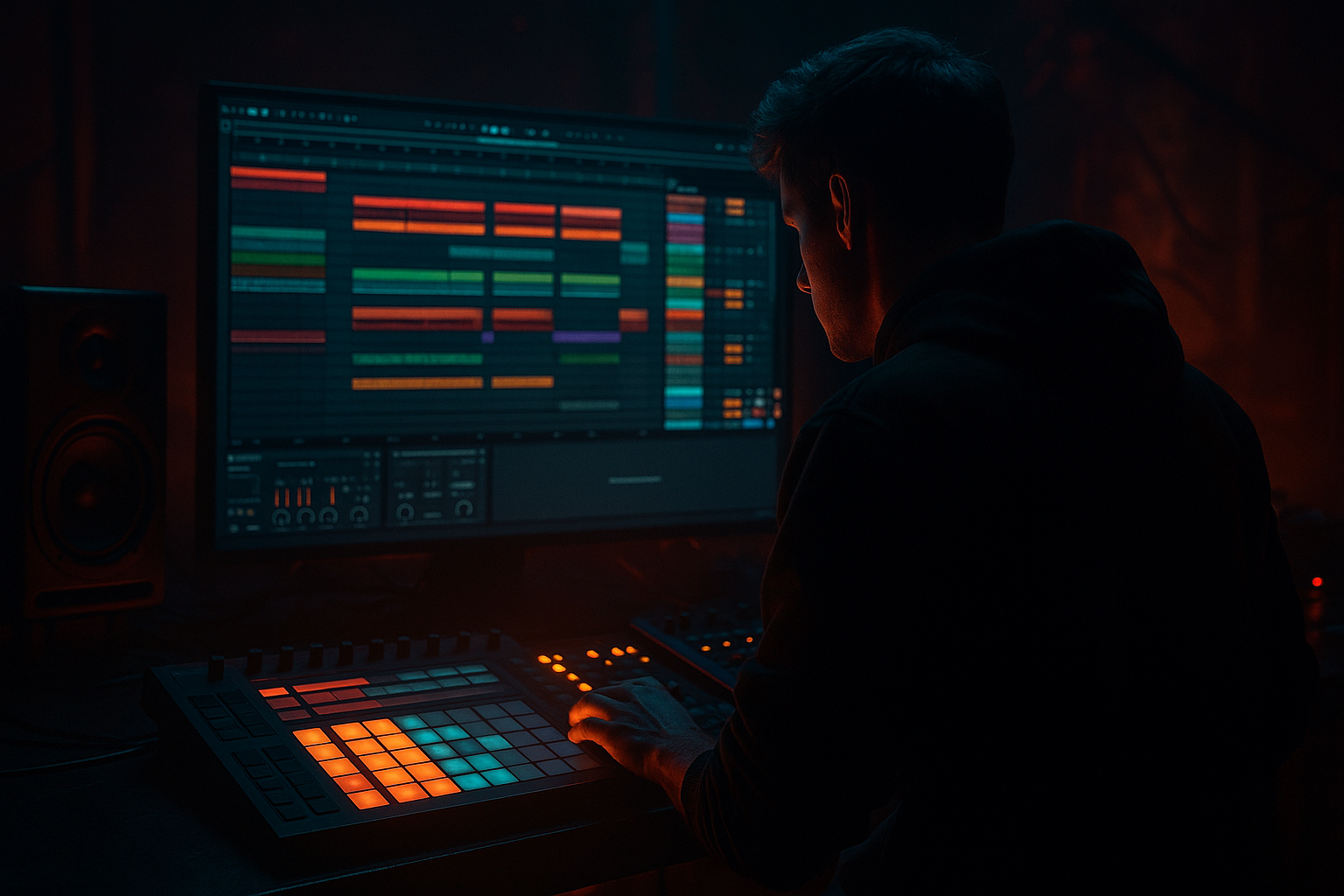
Energetic, clear, and practical — this lesson teaches you how to name, colour and organise tracks in Ableton Live so your drum & bass sessions (jungle / rolling DnB) stay fast to navigate, mix and arrange. Good track naming + consistent colour-coding speeds up decision-making when you’re building heavy drums, sub bass and fast edits.
🔊 Target: a clean DnB template with grouped drums, bass, synths, returns, and a Sidechain bus. Includes device-chain examples and arrangement suggestions.
---
1. Lesson overview
Why this matters
- Fast navigation in fast genres: DnB producers make quick edits (break rolls, pattern swaps). Naming + colours reduce friction.
- Better mixing: group processing is simpler when bus tracks are obvious.
- Faster arrangement: color-coded sections and track groups help you sketch intros, drops, and fills at speed.
- A naming convention tailored for DnB (kick/snare/hats/breaks/bass/FX)
- A colour system that translates across sessions
- Practical routing: returns, sidechain bus, drum & bass group processing
- Real device-chain examples using Ableton stock devices (EQ Eight, Compressor, Glue Compressor, Saturator, Auto Filter, Utility, Drum Rack, Simpler/Operator/Wavetable)
- Drum Group (Kick, Snare, Breaks, Hats, Perc)
- Bass Group (Sub + Mid Grit split)
- Synths/Atmos Group
- FX/One-shots Group
- Returns: Reverb (REV), Delay (DL), Dist/Grime (GRIT)
- Dedicated Sidechain bus for clean sidechaining
- Saved template you can reuse and expand
- Inconsistent colours across projects — causes confusion. Stick to a palette.
- Colouring too many similar hues — they blend together. Use high contrast.
- Long, unreadable names — use short, descriptive prefixes (DRUMS-KICK, BASS-SUB).
- Over-grouping everything — keep groups meaningful (control vs. one-shots).
- Mixing critical processing on individual tracks and again on buses with conflicting settings — decide whether glue happens on bus or master.
- Forgetting to mono the low end of bass — leads to phase issues on club systems.
- Not labelling returns —you’ll forget which return is Reverb vs Distortion in a complex set.
- Naming + colouring are small, high-leverage steps that speed up creative decisions in drum & bass.
- Use consistent prefixes: DRUMS-, BASS-, SYNTHS-, FX-, A-REV, B-DL, C-GRIT.
- Colour groups distinctly: drums (orange), bass (teal), synths (purple), returns (pink/blue/red).
- Build practical device chains: EQ → Saturator → Compressor on drums; SUB (mono) + MID-GRIT split for bass in an Instrument Rack.
- Set up sidechain routing for pumping and save the configuration as a template for fast session starts.
What you’ll learn
Emojis: use them in clip/track names for quick visual cues. 🎛️🔥🕳️
---
2. What you will build
A minimal DnB session template with:
This will give you a rolling DnB skeleton ready for drums, basslines and quick arrangement.
---
3. Step-by-step walkthrough
Follow these steps in Ableton Live (Session or Arrangement). I'll assume Live 11+ but steps work in Live 10 with equivalent features.
A. Create the core tracks and group them
1. New Live set. Remove unused tracks.
2. Create audio/MIDI tracks:
- Cmd/Ctrl+T to create Audio track (or Shift+Cmd/Ctrl+T for MIDI).
- Make these tracks (use clear naming right away):
- DRUMS-KICK (Audio or MIDI)
- DRUMS-SNARE (Audio or MIDI / or pads in Drum Rack)
- DRUMS-BREAKS (Audio)
- DRUMS-HATS (MIDI or Audio)
- DRUMS-PERC (Audio)
- BASS-SUB (MIDI)
- BASS-MID (MIDI)
- SYNTHS (MIDI)
- FX-VOX / SFX (Audio)
3. Group tracks:
- Select the drum tracks > Cmd/Ctrl+G → Name group: DRUMS (add emoji like 🥁 if you want). Colour the group a strong orange.
- Select bass tracks > Group > BASS (teal/green).
- Select synths + FX > Group > SYNTHS/FX (purple/pink).
B. Colour code consistently
1. Right-click a track header > Set Color. Choose colours that are visually distinct:
- DRUMS group: orange (#FF8C00)
- Kick: darker orange or brown
- Snare: bright orange highlight
- BREAKS: mustard / textured orange
- BASS group: teal / green (sub = darker green)
- SYNTHS/FX: purple for synths, pink for vocals/FX
- RETURNS: pink (reverb), blue (delay), red/dark (grit/distortion)
- MASTER: neutral grey, BUSSES: darker shade of group colour
2. Use consistent colour across future projects. I recommend creating a colour legend text file or sticking to this palette so you always know where to look.
C. Create Returns and a Sidechain bus
1. Create returns: right-click in Session view’s return area > "Create Return Track" or Cmd/Ctrl+Alt+T.
- Rename: A-REV, B-DL, C-GRIT
- Colour A-REV pink; B-DL blue; C-GRIT red.
2. Populate returns with stock devices:
- A-REV: Reverb → EQ Eight (high-cut 8 kHz, low-cut 250 Hz)
- Reverb settings: Decay 2.0–3.5s, Size 1.20, Low Cut 250 Hz, Diffusion ~50%. Pre-delay 0–20 ms.
- B-DL: Ping Pong Delay → Filter (Auto Filter or EQ Eight)
- Delay: 1/8 or dotted 1/16 synced to project. Feedback 20–35%.
- C-GRIT: Saturator → Erosion/Redux (or Overdrive) → Glue Compressor mild glue
- Saturator Drive 2–6, Analog Clip On, EQ after to tame highs.
3. Create Sidechain bus:
- Create a new audio track and name it SC-KICK (or SIDECHAIN). Put it out of the way (e.g., at the bottom). Colour it grey.
- Put a small transient sample or a MIDI-triggered short click on SC-KICK. This is the trigger source for external sidechain if you prefer using an audio source. (Alternatively use Kick track as compressor sidechain source directly.)
D. Routing and sidechain setup
1. On channels that need pumping (BASS-SUB, BASS-MID, SYNTHS, PADS):
- Insert Compressor (stock) or Glue Compressor. Open Sidechain in the device (top right).
- Set Sidechain: choose DRUMS-KICK or SC-KICK as input. Use Filter in sidechain to focus source (e.g., highpass at 40-60Hz to emphasize attack).
- Typical settings for DnB pumping: Threshold -18 dB, Ratio 3:1–6:1, Attack 5–10 ms, Release 60–150 ms. Adjust by ear.
2. For faster transients (jungle style), shorter release (40–80 ms) for choppy pumping.
E. Build quick drum processing chains (on group and bus)
1. On each drum track (Kick / Snare / Breaks):
- Insert EQ Eight first: Highpass at 20–30 Hz (for kick sub control); notch any mud 200–400 Hz if needed.
- Insert Saturator: Soft clipping, Drive 2–5. Shape with “Analog Clip” or “Soft Sine” for warmth.
- Insert Compressor: Threshold and ratio to tame peaks, attack 10–30 ms for transients.
2. On DRUMS group track (bus):
- Audio Effect Rack (create chain) with Macro for parallel processing:
- Chain 1: Drum Buss (Stock Drum Buss): Drive ~3–6, Boom 2–4 for low warmth.
- Chain 2: Glue Compressor: Attack 10 ms, Release 0.2–0.5 s, Ratio 2–4 => gentle glue.
- Put an EQ Eight after the Drum Buss to shape (boost 2–4 kHz for snap; cut 300–400 Hz for mud).
- Map key macros: BUS Saturation / BUS Compress / BUS HiBoost to macro knobs for quick automation.
F. Bass: useful stock device chain split (Sub + Grit)
1. Create an Instrument Rack on BASS group with two chains (split by Key / Frequency):
- Chain 1: SUB (Wavetable/Operator or Sampler with sine)
- Device chain: Wavetable (sine or triangle) → EQ Eight: Low-pass 200 Hz, boost 60–90 Hz slightly → Utility: Width 0% (mono) → Compressor (light)
- Name: BASS-SUB
- Chain 2: MID-GRIT (Wavetable / Serum-like patch or sample)
- Device chain: Wavetable or Sampler → Saturator (Drive 4–8) → Overdrive/Redux for texture → EQ Eight: high-pass below 60–80 Hz so it doesn’t conflict with sub → Auto Filter for movement → Glue Compressor → Utility (optional stereo widen)
- Name: BASS-GRIT
2. Map macros:
- Macro 1: SUB Level
- Macro 2: GRIT Gain
- Macro 3: GRIT Wet/Dry (Auto Filter or Saturator dry/wet)
3. Routing: Keep SUB chain mono (Utility Width 0%). Keep MID chain wider for stereo aggression.
G. Save as a template
1. Clean up: remove audio clips used for testing but leave devices and routing.
2. Save Live set as “DnB_Template_[v1]”. Optionally save as default set so Live opens with it:
- File > Save Live Set As... in a Templates folder, or use Live’s “Save Live Set as Default” if you want it as default (check your Live version).
3. From now on, open that template to start new tracks quickly.
H. Arrangement tips
1. Colour whole sections: select clips for Intro / Drop / Buildup > right-click > colour to mark structure (Intro = grey, Build = yellow, Drop = red).
2. Use scene colors in Session view to represent sections (Intro, Build, Drop, Fill).
3. Keep drums/backbone in center lanes in the Arrangement, bass below drums in a consistent order across projects.
---
4. Common mistakes
---
5. Pro tips for darker/heavier DnB
1. Colour signalling for intent
- Use red / dark maroon for aggressive processing tracks (BASS-GRIT, DIST FX) so they visually warn you that they’re destructive 💀.
2. Dedicated “GRIME” return (C-GRIT)
- Put Saturator → Overdrive → EQ Eight (high-shelf boost) → Redux (sample rate down) on a return so you can send snares/breaks/bass to it when you want grimey texture.
- Example settings: Saturator Drive 6, Overdrive Drive 30%, Redux Bit Depth 8-bit, Downsample 6 kHz. Blend to taste.
3. Bass bus chain for punch and darkness
- On BASS group: Glue Compressor (Attack 10–20ms, Release 0.2–0.4s), then Saturator (Soft), then EQ Eight with a gentle boost 800–1200 Hz for growl, cut 300–400 Hz to avoid mud.
- Sidechain the bass to Kick with medium-fast release (50–100ms) to preserve groove but let sub breathe.
4. Harshness control
- Use Multiband Dynamics (stock in Suite) on synths or masters to tame aggressive upper mids without killing presence.
5. Drum roll emphasis
- Colour roll clips bright yellow and name them with a “ROLL” prefix. Put transient processor (e.g., Compressor with Sidechain from Kick) on a send to glue rolls into the groove.
6. Quick toggle for destructive processing
- Keep a Macro mapped to the Device Activator of the GRIT return or Saturator on the Bass Group so you can turn heavy processing on/off fast during arrangement.
---
6. Mini practice exercise (20–30 minutes)
Goal: Build a functional two-bar groove and save a coloured template.
Step-by-step:
1. Open a new Live Set. Create tracks and groups as described:
- DRUMS group (Kick, Snare, Breaks, Hats)
- BASS group (BASS-SUB, BASS-GRIT)
- Returns: A-REV (pink), B-DL (blue), C-GRIT (red)
2. Colour and name each track using the palette.
3. Load a short kick on DRUMS-KICK (Simpler or Drum Rack). Place a transient on 1 and a ghost on 3.
4. Load a snappy snare on DRUMS-SNARE. Put hits on 2 and 4.
5. Drag a 2-bar amen/break to DRUMS-BREAKS and chop to taste. Colour the clip bright yellow if it’s the roll.
6. On BASS-SUB: create a sine sub in Wavetable/Operator, play an 8th-note rolling line (root notes). On BASS-GRIT: create a distorted mid patch and program a complementary rhythm.
7. Sidechain both bass tracks to DRUMS-KICK via the Compressor device: Threshold ~-20 dB, Ratio 4:1, Attack 5–10ms, Release 80 ms. Adjust for groove.
8. Add a small Reverb on A-REV (Decay 2.2s), send snare and break to it at ~10–20%.
9. Add Saturator → Redux on C-GRIT return and send the break channel to it around 8–12% for grit.
10. Play back. Rename any track short if needed, check colours. Save set as “DnB_Practice_01”.
Results: A rolling DnB groove with clear naming and colours, ready for arrangement.
---
7. Recap
Go build a session now — set up the colours and names first, then you’ll find arranging your next heavy rolling drop feels twice as fast. If you want, I can create a downloadable template or a short video screen walkthrough next. 🎛️🔥🕳️
Want a preset palette and an example Live Set (.als) I can outline?

