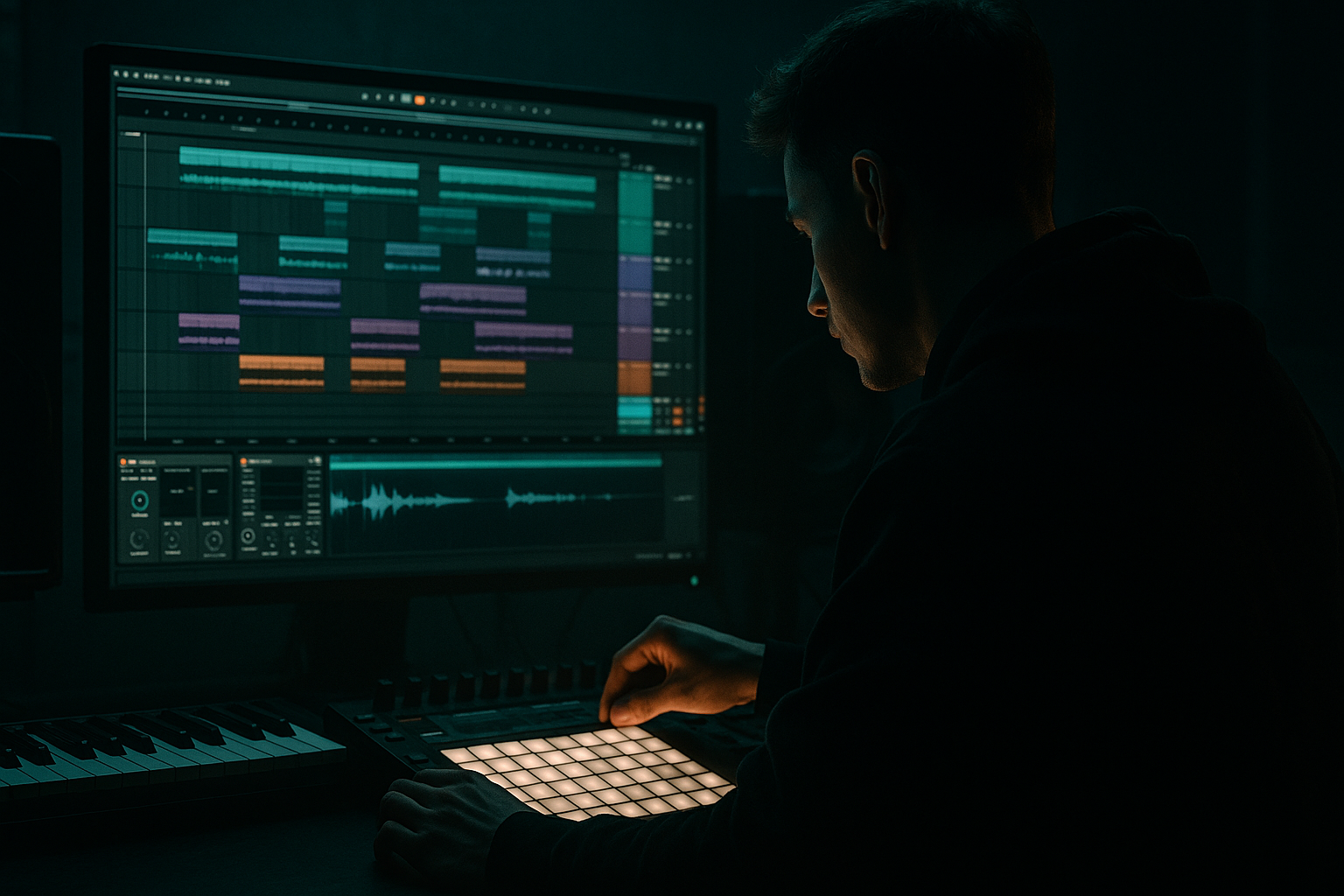
Main tutorial
Narrative arrangement for dark DnB in Ableton (Intermediate)
Energetic, clear, and practical — this lesson will get you arranging a dark, cinematic drum & bass track in Ableton Live with concrete workflows, device chains, automation ideas, and fail-safe settings. Expect real steps you can apply immediately to build tension, release, and movement for a moody, rolling DnB story. ⚡️🥁
---
1. Lesson overview
What you'll learn:
- How to structure a narrative arrangement for dark drum & bass (intro → build → drop → development → drop → outro).
- Practical Ableton workflows for creating tension/release using filters, automation, and returns.
- Device chains and exact settings for drums, bass, atmospheres, and FX using Ableton stock devices.
- Arrangement techniques to keep a track evolving and dark without becoming chaotic.
- Dark DnB relies on atmosphere, momentum, and contrast. Arrangement is the tool that turns loops and sounds into a story — build anticipation, give the listener release, and then twist expectations.
- 8–16 bar ambient intro
- 16-bar tension build
- 32-bar main drop (rolling drums + growling bass)
- 16-bar breakdown (half-time or sparse)
- 32-bar second/variation drop with extra intensity
- 16–24 bar outro
- Bars 1–16: Intro — pad + light percussion + fx. Keep drums minimal (kick + ghost hat), low-pass on everything.
- Bars 17–32: Build — introduce break elements, riser automation, growl teaser (low filtered), increase send to FX.
- Bars 33–64: Drop 1 (full drums + bass) — main groove, change automation (filters open), reduced reverb sends, punchy drums.
- Bars 65–80: Breakdown — half-time or sparse, remove drums, reintroduce atmospheric elements and vocal chops, modulate bass.
- Bars 81–112: Drop 2 — variation + extra elements (resonators, distortion, different break variation). Add extra impact (sub pitch modulation, more saturation).
- Bars 113–128: Outro — strip elements, automate low-pass down, add long reverb tails.
- Loop-based stagnation: Repeating the same 8-bar drum loop without micro-variations. Fix: automate ride/hihat patterns, add ghost notes, reverse cymbals, and fills every 8 bars.
- Muddy low end: letting midbass and sub occupy the same frequencies. Fix: split bass into sub and mid, use narrow EQ cuts and mono sub below 120–140 Hz.
- Overusing reverb: everything sounds distant and one-dimensional. Fix: reserve long reverb for transitions/breakdowns; use short reverb or plate for drums with EQ’d low cut.
- Too much saturation across the board: kills dynamics. Fix: use saturation on character tracks (growl, snare) and keep sub clean. Use sends for destructive FX.
- Static arrangement energy: no clear peaks or drops. Fix: explicitly automate filter/resonance, pitch of growls, send levels, and stereo width to mark section boundaries.
- Tension by subtraction: occasionally strip everything to a single element (sub or a vocal chop) for 2–4 bars before a drop — silence is a powerful tool. ⚫️
- Mid-range growl movement: automate Wavetable position, LFO rate, and granular resampling to prevent the growl from getting static.
- Use half-time breakdowns: drop drums to half time (85–88 BPM feel) with doubled reverb tails — it adds weight before the second drop.
- Resonant layering: duplicate growl, push one copy through Corpus/Resonators tuned a few Hz off to create beating/inharmonic texture.
- Stereo chaos vs. mono control: automate Utility width — widen textures during atmos, tighten the low end (mono) for drops. Keep sub strictly mono below ~120–140 Hz.
- Aggressive but musical distortion: use Narrow EQ boosts (Q around 1.0–2.5) before Saturator to emphasize grit, then tame with EQ Eight after.
- Automation shapes: use logarithmic curves for faster, natural-sounding swells (right-click automation lane to set curve in Ableton).
- Resample creative sections: record a full drop (Resampling or Output to Audio Track), then chop and reprocess (Redux > Grain Delay > Simpler) to create unique transition FX.
- Narrative in dark DnB is built with contrast: careful use of filters, automation, and subtraction creates drama.
- Split bass into sub + mid/growl, sidechain to drums, and automate timbre across drops.
- Use Drum Rack/Simpler for breaks, Drum Buss + Saturator for aggression, and sends (Reverb/Delay/Grain) for space.
- Structure with clear sections (intro/build/drop/break/drop/outro) using 8/16/32-bar phrases and automation markers.
- Practice the 90-second exercise to lock in the arrangement habits: tension by subtraction, movement by modulation, and punch by selective processing.
Why narrative matters:
---
2. What you will build
A 2–3 minute narrative skeleton of a dark DnB track at 174 BPM that includes:
This skeleton is perfect for expanding to a full track, DJ-friendly edits, or resampling into a polished release.
---
3. Step-by-step walkthrough
A. Project setup (first 5–10 minutes)
1. Tempo: set to 174 BPM (range 170–176 is common). Key: pick a minor key or ambiguous root (e.g., D minor or C minor) for darker tonality.
2. Create a color-coded arrangement template:
- Drums (red), Bass (blue), FX/Ambience (purple), Leads/Textures (green), Returns (orange), Master (grey).
3. Insert basic return tracks:
- Return A: Reverb (Audio Effect Rack with Reverb) — Decay 1.2–2.5s, Dry/Wet 12–25% to taste.
- Return B: Delay (Ping Pong Delay) — Time 1/8 + Feedback 20–35%, Dry/Wet 10–20%.
- Return C: Grain Delay/Resonator for metallic hits — Grain Size 6–12 ms, Pitch +-12 st, Dry/Wet 10–20%.
- Return D: Vinatge/Redux — Bit reduction tastefully on FX only.
Note: Use short, subtle sends for drums; larger sends for atmos or risers.
B. Drum chain & arrangement workflow
1. Create Drum Rack for main breaks (group of chains):
- Chain 1: Kick (layer 1) — use Simpler (Slice or Classic) if sample-based. Add Utility afterwards for gain. Slight pitch envelope using Sampler or transpose automation.
- Chain 2: Snare/Clap (layered) — Sampler + Drum Rack. Add Compressor (Stock Compressor) with soft attack 10–20 ms, ratio 3:1 to glue the transient. Add Saturator after Compressor (Drive 2–4).
- Chain 3: Breakloop (Amen or other) — use Simpler in Slice mode or Sampler; warp mode Beats if you need groove preserved. Use transient shaping with Ableton’s Drum Buss (Drive 4–6, Boom 0–10%).
- Chain 4: Hats + rides (programmed steps) — use Groove Pool to humanize (swing ~6–16% or use groove templates for jungle swing).
2. Drum processing chain example (in order):
- EQ Eight (high-pass non-sub elements at 80–120 Hz)
- Drum Buss (Transient mode: increase transient + drive lightly)
- Saturator (Analog Clip or Soft Sine, Drive 2–5)
- Compressor (sidechain bus later) if needed
- Utility for mono’ing below ~120 Hz (Automate for drops/sections)
3. Make the drums roll:
- Arrange drums in 16/32-bar blocks but add micro-variation every 8 bars: ghost snare, reversed cymbals, pitch drop on toms.
- Use Beat Repeat for fills: set interval 1/8 or 1/16, grid 1/16, chance 20–40%, decay 75% — automate the On/Off at transitions.
4. Automation for tension:
- Automate high frequency content and reverb send on hats during builds (cut highs and reduce reverb in drops for dry, punchy hits).
- Automate an Auto Filter (LP) on drum group: start cutoff around 6–8 kHz during intro, open over 8–16 bars.
C. Bass chain (growl + sub)
1. Split bass into two tracks: Sub (mono) + Mid/Growl (stereo).
- Sub: Operator or Wavetable → sine or triangle oscillator. Low-pass cut at ~150–300 Hz, filter slope steep. Use Utility to mono below 140 Hz. Compressor light.
- Example Operator: Osc A sine, FM B small amount for harmonic shape. Pitch envelope: Attack 2–10 ms, Decay 200–400 ms for plucks.
- Mid/Growl: Wavetable or Sampler with a pitched growl sample. Chain example:
- Wavetable → EQ Eight (shelf + cut at 40Hz) → Saturator (Analog Clip) Drive 3–6 → Multiband Dynamics (compress mids) → Auto Filter (band-pass/LP with LFO subtle) → Glue Compressor on group.
2. Sidechain and ducking:
- Group sub + mid into "BASS GROUP".
- Add Compressor (Stock) on the BASS GROUP, enable Sidechain from Drum Kick or main drum bus. Settings: Ratio 4:1, Attack 0.5–2 ms, Release 90–150 ms, Threshold -18 to -12 dB (adjust so sub ducks briefly on kick/snare hits).
- Alternatively use Utility gain automation keyed to kick for snappier control.
3. Growl movement:
- Automate wavetable position, filter cutoff, or use LFO (in Wavetable or Auto Filter) to change formants across the drop. Make these moves align with 8-bar phrases.
- Use Resonators/Corpus subtly on a copy of the growl to produce metallic overtones for the second drop.
4. EQ tips:
- Sub: low shelf boost around 50–80 Hz if needed; cut 200–400 Hz if muddy.
- Growl: boost around 800–2400 Hz for bite; narrow cut where vocals or snares clash.
D. Atmosphere & FX (the narrative glue)
1. Textures:
- Create an ambient pad in Wavetable: use slow LFO on filter and wavetable position; long release. High-pass > 200 Hz for movement layer to avoid low end conflicts.
- Send pad heavily to Reverb A (large, dark) and Grain Delay C (modulate pitch for eerie artifacts).
2. Risers & transitions:
- Riser chain: Noise, Pitch-shifted vocal/field sample, Auto Filter (LP sweep), Saturator, Reverb. Automate pitch up between -12 to +24 semitones across 8 bars for rising tension.
- Use reversed cymbal samples and short gated ambience fills across transition beats.
3. Use Ableton’s Corpus & Frequency Shifter for metallic body:
- Put Corpus on a small percussive hit (decay < 250 ms), tune the resonator to track the key for a creepy tonal strike.
4. Automation moves to tell the story:
- Filter cutoff (lowpass) on the master pad: start closed, gradually open to reveal harmonic content at drop.
- Send levels to Reverb/Delay: higher in intro/build to blur elements, lower in drop for punch.
- Widening: Automate Utility Width (40% -> 140% stereo) across sections but keep sub mono.
E. Arrangement plan with bar counts
Use 32-bar musical phrasing as backbone. At 174 BPM, bar lengths are short — stamp sections clearly in Arrangement View.
Always put markers (CMD+M / Ctrl+M or use Arrangement Locators) and name each section.
F. Final mix and master bus
1. Bus chains:
- DRUM BUS: EQ Eight (HPF on non-bass), Glue Compressor (light), Saturator.
- MUSIC BUS (pads + FX): Multiband Dynamics to control low mid buildup.
- MASTER: EQ Eight (gentle cuts at problem frequencies), Glue Compressor (threshold -3 to -6 dB, ratio 2:1, attack 10–30 ms), Limiter last (ceiling -0.3 dB).
2. Loudness target: leave headroom (export around -6 to -3 dB RMS before final mastering).
---
4. Common mistakes
---
5. Pro tips for darker/heavier DnB
---
6. Mini practice exercise (30–90 minutes)
Goal: build a 90-second arrangement skeleton in Ableton at 174 BPM that tells a dark DnB story.
Steps:
1. 0–10 min: Set project tempo (174), create tracks (Drums, Bass Sub, Bass Growl, Pad/Atmos, FX), setup returns (Reverb, Delay, Grain).
2. 10–25 min: Create a 16-bar intro: pad (Wavetable), faint hithats (8th + ghost 16ths), reversed cymbals each 4 bars. Send pad to Reverb A, increase Dry/Wet 18%.
3. 25–45 min: Build (16 bars): bring in a filtered growl (Wavetable with LP at 600 Hz), add riser (noise + pitch automation), automate pad filter open from closed to 40% cutoff.
4. 45–65 min: Drop (32 bars): program rolling break (use a sliced amen in Simpler or Drum Rack), create sub sine hit in Operator, sidechain bass to drums. Add Drum Buss on break with Drive 6.
5. 65–75 min: Breakdown (16 bars): half-time pad + vocal chop, reverb tails long (decay 3.0s), lower drums significantly.
6. 75–90 min: Final drop & outro (remaining bars): reintroduce full growl + extra distortion on a duplicate track, then automate low-pass down over 8 bars to fade out.
Deliverable: Export the 90-second arrangement as a reference mix and save a project template for iteration.
Emoji hint: Use a clock emoji ⏱️ to timebox each step.
---
7. Recap
Go make something dark, rolling, and cinematic. Send me a screenshot of your arrangement or the session view and I’ll give precise critique and next-step suggestions — let’s tighten that drop! 🔥🖤

