Main tutorial
Lesson Overview
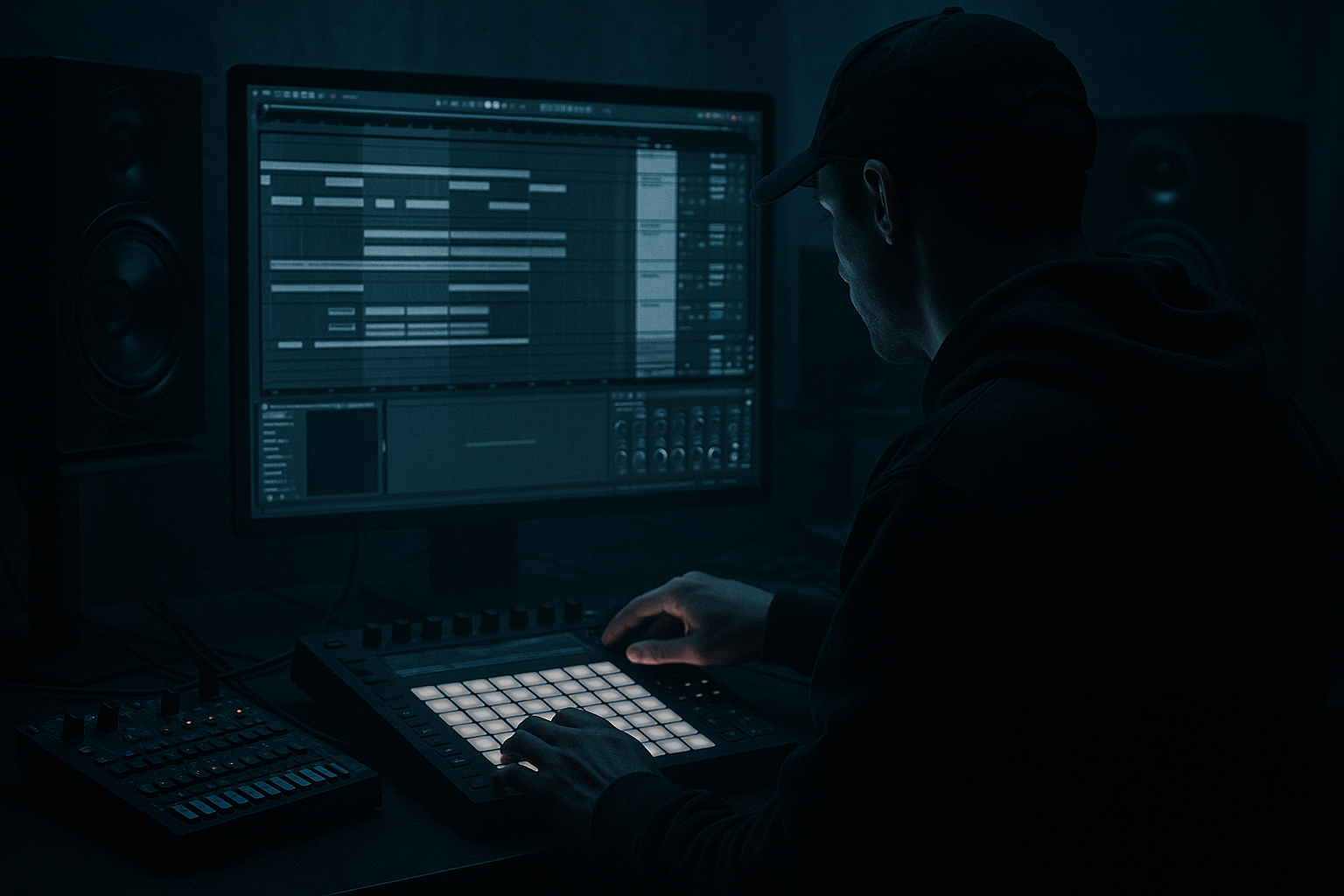
A Nightbus jungle edit is the kind of track idea that feels fast, moody, and late-night without needing a huge amount of sound design. In this lesson, you’ll learn how to resample a short musical idea into a broken jungle-style edit, then arrange it into a proper DnB structure inside Ableton Live 12.
This matters because a lot of modern Drum & Bass—especially jungle edits, rollers, darker bass music, and half-time switch-up sections—is built from small loop ideas that get resampled, chopped, and rearranged. Instead of trying to write a perfect 3-minute arrangement from scratch, you capture a strong loop, print it, slice it, and turn it into a track that evolves.
For beginner producers, this approach is powerful because it:
- keeps the creative process moving fast,
- helps you make stronger arrangement decisions,
- and makes your edit feel more “produced” than just looped.
- a moody atmospheric intro
- a tight break-driven drop
- a resampled bass/musical loop chopped into call-and-response phrases
- sub weight that stays centered and clean
- drum edits with ghost notes and fills
- a breakdown and switch-up for tension
- a DJ-friendly intro and outro so the edit can actually be mixed
- Resampling too late or not at all
- Too much low end in the atmospheric loop
- Overfilling every bar with notes
- Stereo bass
- No variation between sections
- Breaks sounding harsh or messy
- Split your bass into sub + character
- Use short automation moves
- Make the break feel alive
- Use resampled hits as arrangement glue
- Don’t overcrowd the midrange
- Think like a DJ
- Build a short dark musical loop, a simple break, and a clean bass foundation.
- Resample early so you can chop, reverse, and rearrange audio into a jungle edit.
- Keep the sub mono, the breaks punchy, and the arrangement moving every few bars.
- Use Ableton stock tools like EQ Eight, Saturator, Drum Buss, Auto Filter, Echo, Reverb, Utility, and Warp to shape the vibe.
- In DnB, strong edits come from contrast, space, and intentional resampling more than from having lots of layers.
You’ll use Ableton stock tools like Sampler/Simpler, Drum Rack, Warp, Auto Filter, Saturator, Drum Buss, Echo, Reverb, Utility, and EQ Eight to build the idea and shape it for a proper DnB arrangement.
Why this works in DnB: jungle and DnB often rely on rhythmic contrast—clean sub against chopped breaks, short musical phrases against long drops, and tension against release. Resampling turns one idea into multiple layers of motion, which is exactly what makes a track feel alive on the dancefloor.
What You Will Build
By the end of this lesson, you’ll have a Nightbus-style jungle edit with:
Musically, think of a scene like this: a dark, rain-soaked night bus moving through the city, with a filtered chord loop, a chopped Amen-style break, and a reese or sub movement that answers the drums in short phrases. The track doesn’t need to be overly complex—it needs to feel intentional, heavy, and flowing.
Step-by-Step Walkthrough
1. Set up a simple 4-track layout
Open a new Ableton Live 12 project and create these tracks:
- Drums
- Bass
- Music/Atmosphere
- Resample Print
Keep the session clean. For beginners, organization is a huge part of finishing. Color-code the tracks if you want:
- drums = red/orange
- bass = purple
- atmos = blue
- resample = green
Set the project tempo to 170–174 BPM, which is a classic jungle/DnB zone. If you want the edit to feel slightly looser and more head-noddy, try 172 BPM.
On your Master, leave headroom. Aim so your loudest rough mix peaks around -6 dB before any final mastering.
2. Build a simple night-time musical loop
On the Music/Atmosphere track, load a chord, pad, piano, or texture from Ableton’s stock sounds. You’re not trying to make a full harmony arrangement—just one loop that feels cinematic and dark.
Good beginner-friendly choices:
- a minor chord stab
- a short pad with movement
- a muted piano motif
- a filtered synth texture
Keep the phrase short: 1 or 2 bars. In jungle edits, short motifs work best because they leave space for breakbeats and bass movement.
Add these stock devices in order:
- EQ Eight: high-pass around 120–200 Hz so it stays out of the sub
- Auto Filter: low-pass around 4–8 kHz if the sound feels too bright
- Reverb: small to medium space, Decay 1.5–3.5 s, Dry/Wet around 10–25%
You want the loop to feel like atmosphere, not the main event.
3. Program a basic jungle drum foundation
On the Drums track, use Drum Rack with a kick, snare, hat, and a break sample if you have one available from Ableton’s stock library. If you don’t want to overcomplicate it, start with:
- kick on the downbeats,
- snare on the main backbeats,
- hats with offbeat movement,
- and a chopped break loop underneath or layered on top.
A beginner-friendly pattern:
- Snare on 2 and 4
- kick on 1, a pickup before 3, and a few extra syncopated hits
- hats on offbeats or in 1/16th patterns with some velocity changes
For the drum bus, add:
- Drum Buss
- Drive: 5–15%
- Crunch: light, around 5–10%
- Boom: use carefully, only if the kick needs extra low-end weight
- EQ Eight
- remove unnecessary sub-rumble under 30 Hz
- reduce harshness around 5–8 kHz if the break gets brittle
If your break sounds stiff, nudge some hits slightly off-grid. DnB groove often comes from tiny timing variation, not perfect quantization.
4. Create a bass line that leaves room for the break
On the Bass track, make a simple sub or reese-style bass using a stock Ableton instrument like Wavetable, Operator, or even Analog if you already know it.
For a beginner-friendly dark bass:
- use a sine or saw-based patch
- keep the notes short
- focus on 2–4 note phrases
- leave gaps for drum fills and break accents
Suggested sound-shaping:
- Operator sine sub: pure low end, no extra harmonics
- Saturator: Drive around 2–6 dB for audibility on smaller speakers
- EQ Eight: low-pass a reese if it clashes with the break, or high-pass a mid-bass layer above 80–120 Hz if you’re layering
Keep the sub in mono. Use Utility and turn Width to 0% if needed, or just make sure the low-end is centered. That’s a must in DnB.
Make the bass phrase answer the drums. For example:
- drums hit a fill,
- bass answers with a short two-note stab,
- then the break returns.
This call-and-response pattern is a core part of jungle energy.
5. Print the idea with Resampling
This is the key move.
Create a new audio track called Resample Print. Set its input to Resampling or route the output from your music/bass group if you want to print just a specific section. In Ableton, the simplest beginner method is:
- set the new audio track input to Resampling
- arm the track
- record 4–8 bars while the loop plays
What to print:
- the musical loop with effects
- a combined bass-and-atmosphere pass
- a filtered version for intro material
- a more distorted version for drop energy
The point is to capture a version that already sounds like a record, not a dry loop.
Why this works in DnB: resampling turns a plain idea into a new audio object you can chop, reverse, and automate. That’s perfect for jungle edits because the genre is full of printed textures, edited breaks, and performance-style arrangement moves.
After recording, mute the original source or keep it only as a backup. Now your printed audio becomes the raw material for the edit.
6. Slice the resampled audio into playable pieces
Drag your recorded audio into a new audio track or into a Simpler/Drum Rack for slicing.
Beginner-friendly approaches:
- right-click the clip and choose Slice to New MIDI Track
- slice by transients or 1/4 notes depending on how rhythmic the audio is
- use the slices as one-shot phrases, stabs, or fills
If you want a more hands-on approach, keep it in audio and manually cut the clip into chunks:
- a filtered intro chunk
- a full-power drop chunk
- a reversed transition chunk
- a one-shot impact chunk
Helpful edits:
- reverse a short tail into a drop
- add a tiny fade-in/fade-out to each cut
- use Warp to keep timing locked if needed
Try a structure where the resampled audio becomes:
- a 1-bar intro phrase,
- a 2-bar answer phrase,
- and a final fill before the drop.
This creates movement without needing tons of extra sound design.
7. Arrange the tune like a real jungle edit
Now build the track structure. A good beginner DnB arrangement might look like this:
- Bars 1–16: intro with filtered atmosphere, break fragments, and a hint of bass
- Bars 17–33: first drop with full drums and resampled musical phrasing
- Bars 33–41: breakdown or tension section
- Bars 41–57: second drop with a variation
- Bars 57–65: outro for DJ mixing
Keep the energy rising by changing one thing every 4 or 8 bars:
- bring in a new break layer
- automate a filter open
- drop out the kick for a bar
- add a reverse resample hit into the next section
A musical context example: if your intro feels like a wet, late-night city scene, the first drop can feel like the bus hits a tunnel and the break starts snapping harder. Then the breakdown opens the space again before the second drop comes back more aggressive.
Use automation on:
- Auto Filter cutoff for tension
- Reverb dry/wet for width in breakdowns
- Echo feedback for transition tails
- Utility gain to pull sections down before drops
8. Shape transitions and impact
DnB arrangement lives and dies by transitions. Use stock Ableton FX to connect sections:
- Reverb on a snare or stab before a drop
- Echo on a vocal chop, hit, or resampled slice
- Reverse audio before the next section starts
- Impulse-like impact using a short kick/snare hit plus a noise burst if you have it
A simple drop transition:
- last 1/2 bar: filter closes on the music loop
- last 1 beat: drum fill
- last 1/4 beat: reverse resample swell
- downbeat: full drum + bass entry
Keep these transitions short. In DnB, long effects can kill momentum.
9. Do a basic mix pass for low-end clarity
Before you get excited and keep adding more layers, do a rough mix pass.
On the bass and drum tracks:
- use EQ Eight to carve out unnecessary mud
- keep sub information focused below about 90–120 Hz
- reduce boxiness around 200–400 Hz if the mix feels cloudy
- tame harsh hats or break fizz around 6–9 kHz if needed
On the Master, use Utility or just reference your levels visually:
- drums and bass should dominate
- atmosphere should support, not compete
- don’t let the printed resample overload the low end
If the kick disappears when the bass enters, simplify the bass rhythm first before boosting anything. In DnB, arrangement fixes usually beat EQ fixes.
Common Mistakes
If you keep tweaking the same loop forever, the idea stays small. Print it early so you can edit it like audio.
Fix: high-pass the music layer around 120–200 Hz so the kick and sub stay clean.
Fix: leave gaps. Jungle works because the drums breathe.
Fix: keep the sub mono and use width only on higher harmonics, not the fundamental.
Fix: change one element every 4 or 8 bars—filter, drum fill, bass phrase, or resample chop.
Fix: use EQ Eight, Drum Buss, and careful clip gain before you add more layers.
Pro Tips for Darker / Heavier DnB
- Keep the sub clean and mono.
- Add a mid layer with Saturator or Wavetable for grind and presence.
- Filter cutoff rising over 1–2 bars can create more tension than a huge FX chain.
- Automate Echo feedback briefly on a last hit, then cut it off.
- Duplicate a break track and process one version lightly, one version harder.
- Use tiny velocity changes and ghost notes to stop it sounding looped.
- A printed stab can become a fill, an intro texture, or a transition hit.
- Reversing a resampled tail before a drop is a classic dark DnB move.
- If the bass is gritty, keep the atmospheric loop thinner.
- If the break is bright, darken the music loop so the mix stays focused.
- Leave a clean intro and outro.
- Avoid opening with full energy immediately unless you want a hard edit style.
Mini Practice Exercise
Spend 15 minutes building a tiny version of this technique.
1. Make a 2-bar dark chord or texture loop.
2. Add a simple break pattern at 170–174 BPM.
3. Write a 2-note bass phrase underneath it.
4. Resample the full loop for 4 bars onto a new audio track.
5. Slice the resample into 3 or 4 chunks.
6. Rearrange those chunks into:
- intro
- drop
- fill
- variation
7. Add one automation move:
- filter cutoff,
- reverb wet/dry,
- or echo feedback.
8. Export a rough 30–45 second section and listen back for:
- whether the bass is too busy,
- whether the break feels punchy,
- and whether the resampled edit creates motion.
Goal: make something that feels like a real jungle phrase, not a loop.

