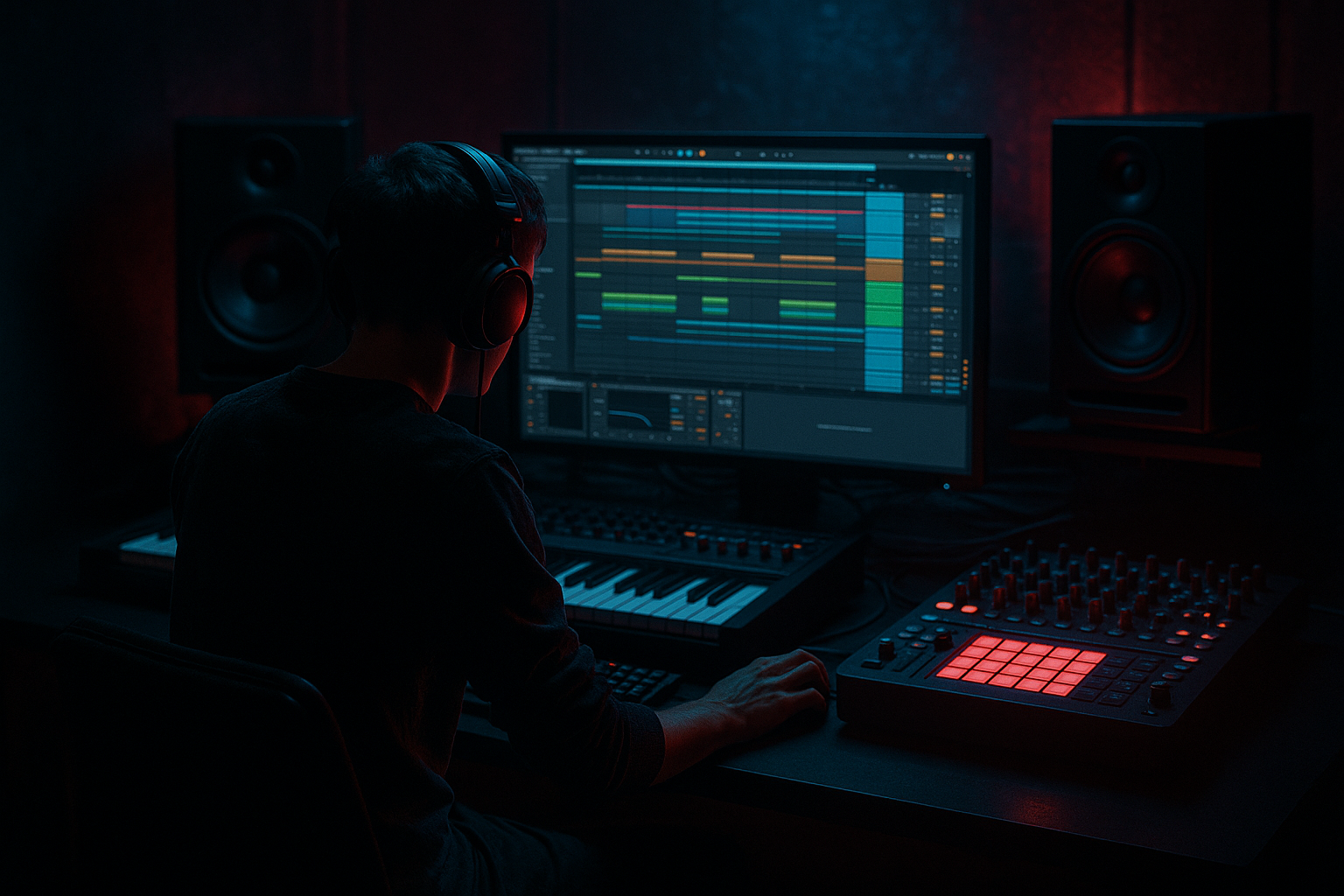
Main tutorial
```markdown
Nightbus Method: “SubSine Route” in Ableton Live 12 (Jungle / Oldskool DnB Atmospheres) 🚌🌒
1. Lesson overview
The Nightbus method is a classic jungle/DnB atmosphere trick: you build a deep sub sine as the “bus” (the foundation), then route copies of it into texture, movement, distortion, reverb, and resampling chains—without wrecking the clean low-end.
In Ableton Live 12, we’ll set up a SubSine Route that stays tight in mono while spawning dirty, wide, haunted layers that feel like oldskool tape/warehouse vibes.
You’ll end up with:
- A clean sub you can trust on a system 🔊
- Multiple atmo layers derived from the same source (so they feel glued)
- A repeatable routing template for jungle rollers
- Tempo: 160–170 BPM (try 165 BPM for jungle rollers)
- Create groups in Arrangement:
- Put a Limiter (stock) on the Master while building to avoid random spikes.
- Return A (GRIT) (often more pumping is okay)
- Return B (ATMOS) (gentle pumping is vibey)
- Bars 1–9 (Intro): Only ATMOS return + distant break filtered
- Bars 9–17 (Tension): Bring GRIT in quietly, tease sub with short notes
- Bar 17 (Drop): Full CLEAN SUB + GRIT, ATMOS tucked in
- Bars 25–33 (Variation): Automate reverb size up, add a one-bar stop, then slam back
- Putting reverb/chorus directly on the clean sub → instant mush + phase issues.
- Not high-passing the ATMOS layer → low-end gets cloudy and fights the real sub.
- Over-widening the bass → mono playback loses power. Keep sub mono always.
- Too much distortion on the sub lane → harmonics shift the perceived fundamental and can weaken the drop.
- Ignoring gain staging → returns stack fast; keep sends conservative.
- Parallel “air band” noise: Add a tiny layer of Analog noise (Operator noise or sample) into the ATMOS return, filtered 2–8 kHz, for creep.
- Pitch drift for menace: Add subtle LFO to Operator pitch (±3 to ±7 cents) only on the GRIT layer version (not the clean sub).
- Mid/Side control: On ATMOS return, use EQ Eight in M/S mode:
- Aggro grit without killing subs: Distort only above ~120 Hz (HP into Saturator/Drum Buss).
- Darkroom reverb discipline: Long tails are fine—just HP them hard and duck them with sidechain.
- Clean sub is the anchor: Operator sine + EQ + Utility (mono).
- Nightbus method = routed copies: use returns to generate grit + atmos from the same sub pattern.
- Band-limit and sidechain: keep low-end clean, let movement live above it.
- Resample for authenticity: print the atmo, chop it, and layer like a jungle record.
---
2. What you will build
A 3-lane setup:
1. SUB (Clean)
Pure sine, mono, controlled envelope. No stereo, no reverb.
2. MID/GRIT (Derived from sub)
Saturated, filtered, rhythmic movement—audible on small speakers.
3. NIGHTBUS ATMOS (Derived from sub)
Reverb/delay/granular-ish smear, band-limited, wide, moving—used as atmosphere under breaks.
All three are fed from a single “SubSine” MIDI pattern so the vibe stays coherent. ✅
---
3. Step-by-step walkthrough
Step 0 — Session setup (DnB-friendly)
- DRUMS
- BASS
- ATMOS
Optional but recommended:
---
Step 1 — Create the SubSine “bus” (the foundation) 🔥
1. Create a new MIDI Track: name it SUBSINE – CLEAN
2. Load Operator (stock):
- Algorithm: single oscillator (default is fine)
- Osc A: Sine
- Voices: 1 (mono)
- Glide/Portamento: Off for now
3. Set Operator’s Amp Envelope:
- Attack: 0–5 ms
- Decay: ~200–500 ms (optional)
- Sustain: 0 dB (or slightly under if you want pluck)
- Release: 60–120 ms (prevents clicks when notes end)
4. Add MIDI notes in the clip:
- Use a 1-bar loop to start.
- Typical jungle sub notes: F, F#, G, A (depending on key)
- Keep notes fairly long (1/2 to 1 bar), then we’ll add rhythm with sidechain later.
5. Add devices after Operator on the clean sub:
- EQ Eight
- Enable HP filter at 20–30 Hz (12 or 24 dB/oct) to remove rumble
- Optional: tiny dip around 200–300 Hz if it clouds
- Utility
- Bass Mono: ON (or set Width = 0%)
- Gain staged so peaks sit cleanly (don’t slam it yet)
This track is sacred. No reverb. No chorus. No widening. 🙅♂️
---
Step 2 — Create routing lanes (the “Nightbus” part) 🚌
We’re going to make audio-derived layers that follow the sub perfectly.
Option A (cleanest workflow): Audio Sends from the Sub track
1. Create two Return Tracks:
- Return A: SUB → GRIT
- Return B: SUB → ATMOS
2. On SUBSINE – CLEAN, turn up Send A and Send B to taste (start around -18 to -12 dB)
Important: In each Return track, set the return to 100% wet processing (because the dry sub is already on the main sub track).
---
Step 3 — Build the GRIT return (midrange presence for oldskool systems) ⚙️
On Return A (SUB → GRIT) insert:
1. Saturator
- Mode: Analog Clip (or Soft Sine for smoother)
- Drive: 3–8 dB
- Output: compensate so it’s not louder than input
2. Auto Filter
- Type: LP24 (classic weight)
- Cutoff: 150–500 Hz (we want mid harmonics, not sub)
- Resonance: 0.7–1.2 (subtle bite)
3. EQ Eight (shape into “speaker bass”)
- High-pass at 90–140 Hz (steep, 24/48 dB if needed)
- Gentle boost around 200–800 Hz if it’s too thin
- Dip any nasty honk around 400–600 Hz if required
4. Drum Buss (yes, on bass layers—very jungle 😈)
- Drive: 5–15%
- Crunch: 0–10%
- Boom: Off or very low (Boom can reintroduce low-end you don’t want)
5. Utility
- Width: 0–30% (keep it mostly mono so it hits like hardware)
Goal: This layer makes the bass audible on phones and small monitors while your clean sub stays stable.
---
Step 4 — Build the ATMOS return (haunted nightbus smear) 🌫️
On Return B (SUB → ATMOS) insert:
1. EQ Eight (band-limit first, like old recordings)
- High-pass: 150–300 Hz
- Low-pass: 4–10 kHz (depending how dark you want it)
2. Echo
- Mode: Ping Pong (for width) or Mid-Side if you’re careful
- Time: 1/8 or 1/4
- Feedback: 20–45%
- Filter inside Echo: HP ~300 Hz, LP ~6–8 kHz
- Mix: since it’s a return, keep Echo 60–100% wet (taste)
3. Hybrid Reverb
- Algorithm: Hall or Plate
- Decay: 3–8 s
- Pre-delay: 10–30 ms
- Size: medium-large
- EQ section: high-pass up to 250–400 Hz, damp highs to keep it shadowy
4. Auto Pan (movement = life)
- Rate: 1/2 or 1 bar
- Amount: 20–60%
- Phase: 120–180° for width (watch mono compatibility)
5. Redux (optional, for oldskool grit)
- Bit Reduction: light (try 10–12 bits)
- Downsample: subtle (try 1.5–3)
6. Compressor (optional glue)
- Slowish attack (10–30 ms), medium release (80–150 ms)
- Just 1–3 dB GR to smooth the tail
Result: a wide, moving “air bed” that follows your sub notes—perfect under breaks, pads, and rave stabs.
---
Step 5 — Sidechain the sub and layers to the breaks (rolling jungle feel) 🥁
To get that classic break-driven pump without destroying low-end:
1. On SUBSINE – CLEAN, add Compressor
2. Enable Sidechain
3. Sidechain input: your DRUMS (or Kick) track
4. Settings (starting point):
- Ratio: 3:1
- Attack: 3–10 ms
- Release: 80–160 ms (tempo dependent)
- Threshold: adjust for 2–5 dB reduction on hits
Do similar sidechain on:
This makes the bass breathe with the breaks like proper 90s rollers. ✅
---
Step 6 — Arrangement ideas (make it feel like a night ride) 🛣️
Try this 32-bar structure:
DnB trick: automate Send B (ATMOS) up at the end of phrases to “wash” into the next section.
---
Step 7 — Resampling (the secret sauce) 🎛️
To get a truly “printed” oldskool feel:
1. Create a new Audio Track called RESAMPLE – NIGHTBUS
2. Set Audio From: Return B (SUB → ATMOS) or the BASS group
3. Record 8–16 bars of movement.
4. Then chop it, reverse some bits, and layer it quietly.
Add Vinyl Distortion (stock) or subtle Saturator after resampling for that taped air.
---
4. Common mistakes
---
5. Pro tips for darker/heavier DnB 🖤
- Cut lows in the Side channel aggressively (keep width only in mids/highs).
---
6. Mini practice exercise (15–20 minutes) ✅
1. Build the SUBSINE – CLEAN track with Operator and a 1-bar pattern.
2. Create Return A (GRIT) and Return B (ATMOS) exactly as above.
3. Program a classic break (Amen-style) and sidechain all bass layers to it.
4. Automate Send B (ATMOS):
- +3 to +6 dB at the last beat of every 4 bars (a “wash” into the next phrase).
5. Export a 16-bar loop and listen on:
- headphones
- phone speaker
- mono (Utility width 0 on Master temporarily)
Goal: sub stays stable in mono, while the atmo creates a moving night haze.
---
7. Recap
If you want, tell me your track key and tempo and I’ll suggest a ready-to-use 2-bar sub pattern plus exact cutoff ranges for the GRIT/ATMOS returns to match that key.
```

