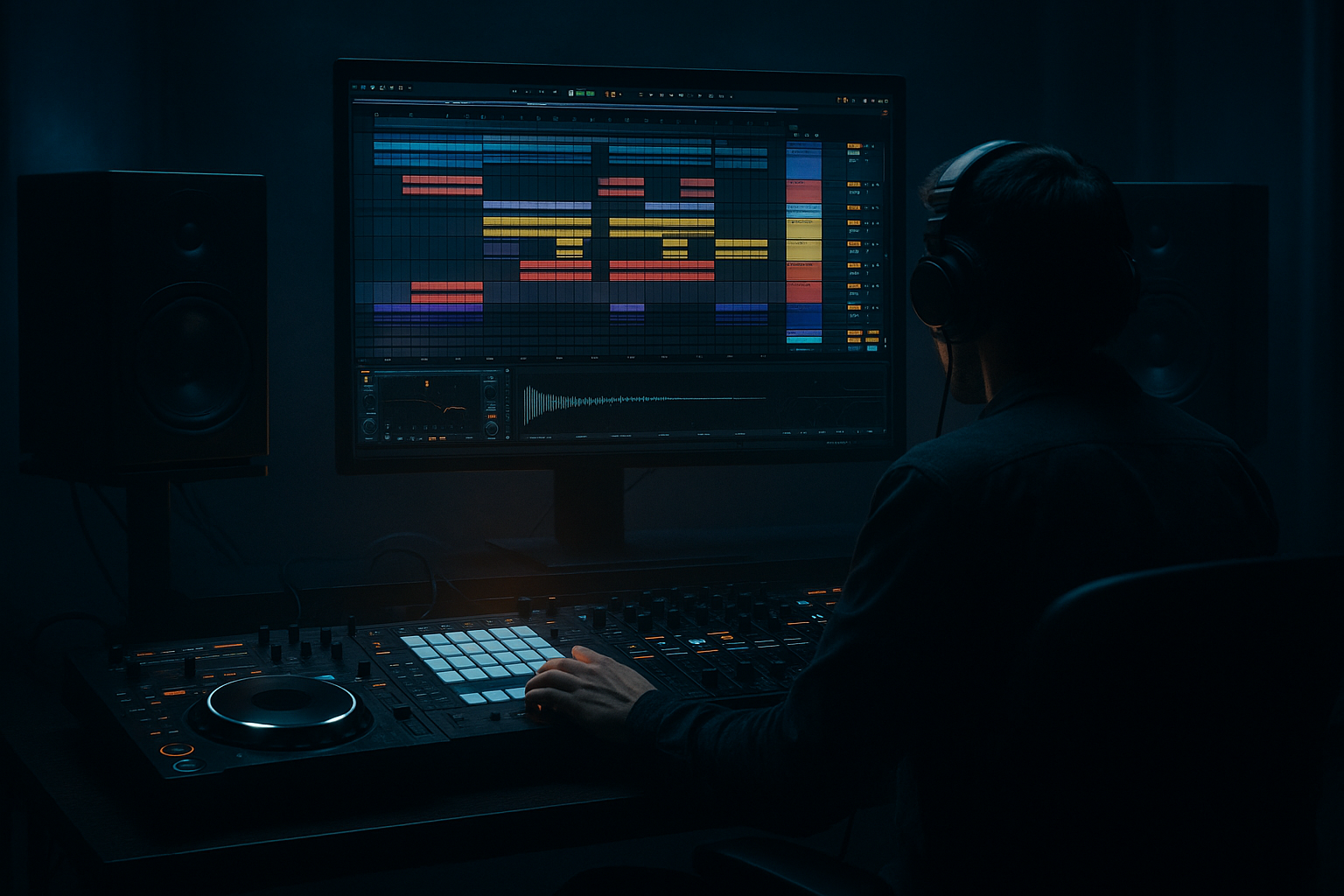
Main tutorial
Noise Layers for Pirate‑Radio Vibes (90s Rave Flavor) — Ableton Live Masterclass 📻🔥
Intermediate | Sound Design | Drum & Bass / Jungle
---
1. Lesson overview
That “pirate radio” vibe in 90s jungle/DnB isn’t just nostalgia—it’s intentional noise design: hiss, RF whine, tape grit, air, rumble, and crunchy bandwidth limits that glue the music together and make it feel broadcast from a dodgy tower block at 2AM. 😄
In this lesson you’ll learn how to build musical noise layers in Ableton Live that:
- sit behind your drums and bass without masking,
- move with the groove (sidechain + gating),
- deliver authentic “broadcast” energy (bandwidth, distortion, modulation),
- can be automated for drops, fills, and transitions.
- Auto Filter (band-limiting like FM/AM radio),
- Saturator / Pedal / Overdrive (grit),
- Redux (digital/rave crunch),
- Amp / Cabinet (cheap broadcast speaker vibe),
- Gate (rhythmic chatter),
- Compressor (sidechain pump to drums),
- Utility (mono compatibility + width control).
- Tempo: 172 BPM
- Have a basic loop ready:
- `Air Hiss`
- `RF Whine`
- `Tape/Vinyl Dirt`
- `Swells & Hits`
- Record a quiet room tone (phone mic works!)
- Use a sample of tape hiss
- Or synthesize noise with Operator:
- Add Operator on `RF Whine`
- Oscillator A: Sine
- Set Frequency: start around 2.2 kHz or 3.3 kHz (classic irritating zone)
- Add a tiny bit of pitch drift:
- Vinyl crackle sample, cassette noise, old crowd recordings
- Record your own: lightly rub a mic cable, handle a record sleeve, etc.
- Drop in a noise sample OR resample your Air Hiss and stretch it.
- Add Auto Filter and automate frequency.
- 1 bar before drop: band-limit everything (see next step), crank swell, then hard cut noise on drop.
- After drop: reintroduce subtle hiss after 8 bars to keep long sections alive.
- HP: 120–250 Hz
- LP: 9–12 kHz
- Mode: Band-Pass
- Freq: 1.5–4 kHz (automate for “tuning” effect)
- Resonance: 0.8–1.6
- Drive: +3 to +9 dB (careful)
- Mode: Overdrive
- Drive: 10–25%
- Tone: adjust so it’s not ice-picky
- Attack: 3 ms
- Release: Auto or 0.1–0.3 s
- Ratio: 2:1
- 1–2 dB GR to unify layers
- Put Compressor on each noise layer or on the whole bus.
- Sidechain from kick+snare.
- Aim: 2–6 dB GR on hits.
- Put Gate on RF whine or vinyl crackle.
- Sidechain from break track (post-EQ).
- Dial threshold so it opens on ghosts and shuffles.
- Too loud noise layers: if you notice hiss constantly, it’s probably 3–6 dB too hot.
- No high-pass filtering: low-end noise kills sub clarity fast. HP everything noise-related.
- Over-wide stereo noise: wide hiss can smear your mix and weaken center punch. Keep some layers mono-ish.
- Masking the snare crack (2–5 kHz): RF whine and vinyl presence live here—use EQ dips or sidechain to snare.
- Random noise with no groove: always make it breathe (sidechain/gate/automation).
- Over-distorting the bus: distortion is vibe, but too much becomes harsh fatigue—check at low volume.
- Make the noise “angry” but controlled:
- Add sub-safe “room tone” without mud:
- Reese + noise cohesion trick:
- Jungle authenticity:
- Use “tuning drift” automation:
- Pirate-radio vibe = controlled noise layers + bandwidth limitation + movement 📻
- Build a reusable Noise Bus with multiple layers (air, RF, dirt, swells).
- Use EQ Eight HP/LP to keep sub clean, and Auto Filter band-pass for broadcast flavor.
- Make noise groove with sidechain compression and gating.
- Automate noise for transitions and 90s rave drama without cluttering the drop.
Everything here uses Ableton stock devices.
---
2. What you will build
You’ll create a Noise Bus (one group/return that you can reuse in every project) containing:
1) Constant Air Hiss Layer (wide, subtle)
2) RF/Radio Whine Layer (narrow, pitch‑like, modulated)
3) Vinyl/Tape Dirt Layer (mid-focused, transient-friendly)
4) Drop/Impact Noise Swells (for transitions and hype)
…and you’ll process them with:
This will work perfectly in rolling DnB at ~170–176 BPM.
---
3. Step-by-step walkthrough
Step 0 — Project setup (fast and practical)
- Break + punchy kick/snare (classic DnB drum rack or chopped break)
- Rolling bass (Reese/sub combo)
Create a Group called: `NOISE BUS 📻`
Inside it, create 4 Audio Tracks:
Route the group output to your drum+bass mix (master or pre-master as usual).
---
Step 1 — Air Hiss (the glue layer) 🌫️
Goal: subtle constant air that makes everything feel “on air” and less sterile.
Source options (pick one):
- Create MIDI track → Operator
- Oscillator A: choose Noise White (or use a noisy waveform / noise mode depending on version)
- Play a long note (or use a MIDI clip that holds a note)
Processing chain (Air Hiss track):
1. EQ Eight
- HP at 250–500 Hz (24 dB/oct)
- Gentle dip around 2–4 kHz if it fights hats/snare snap
- Optional shelf boost 8–12 kHz (+1 to +3 dB) for “air”
2. Auto Filter (band-limit “broadcast” vibe)
- Mode: Band-Pass
- Freq: 6–9 kHz
- Resonance: 0.7–1.2
- Drive: +2 to +6 dB (subtle)
3. Saturator
- Mode: Soft Clip ON
- Drive: 1–4 dB
- Output: trim to match
4. Compressor (sidechain to drums)
- Sidechain input: Drum Bus (or kick+snare group)
- Ratio: 3:1
- Attack: 2–10 ms
- Release: 80–160 ms (set to groove)
- Aim for 2–5 dB GR when kick/snare hit
5. Utility
- Width: 80–120% (use width carefully)
- If your mix is messy: set Bass Mono by keeping hiss HP’d (already done)
Level tip: You should feel it when you mute it, but not hear it as “hiss” when it’s on. Usually -24 to -16 dB range depending on the rest of the mix.
---
Step 2 — RF Whine (the pirate transmitter character) 📡
Goal: that narrow, annoying “radio electronics” tone that moves and feels alive.
Make a whine source (Operator method):
- LFO (use Auto Filter or built-in modulation if available)
- If using stock devices: put Auto Pan after Operator, set to modulate phase/feel; or use Shifter for tiny movement.
Processing chain (RF Whine track):
1. Auto Filter
- Mode: Band-Pass
- Freq: match your sine (e.g., 2.5 kHz)
- Resonance: 1.5–3.5 (make it “ring”)
- Envelope amount: small (5–15%) so it reacts slightly to level
2. Shifter (adds that detuned RF movement)
- Mode: Freq Shift
- Fine: +5 to +25 Hz
- Mix: 30–60%
3. Redux (optional, for crunchy 90s digital edge)
- Downsample: 2–6
- Bit Reduction: 10–14 bits
- Dry/Wet: 10–25%
4. Gate (make it chatter rhythmically)
- Sidechain: From Hi-hat or break percussion (so it opens with groove)
- Threshold: set so it opens on hats/ghosts
- Return: 10–30 ms
- Hold: 20–60 ms
- Release: 60–140 ms
5. Utility
- Width: 0–40% (often better closer to mono for “broadcast” realism)
Arrangement idea: automate RF whine up slightly in pre-drop (last 4 bars), then hard cut it on the drop for impact.
---
Step 3 — Tape/Vinyl Dirt (midrange texture that makes breaks feel old) 🎚️
Goal: add “age” and grit without ruining transient punch.
Source options:
Processing chain (Tape/Vinyl Dirt track):
1. EQ Eight
- HP at 150–300 Hz
- LP at 8–12 kHz (depends on brightness)
- Small boost around 1–3 kHz (+1–2 dB) for “paper/needle” presence
2. Drum Buss
- Drive: 2–8
- Crunch: 5–20%
- Transients: -5 to -15 (tames spiky crackles)
- Boom: OFF (usually don’t want boom on noise)
3. Amp (cheap speaker feel)
- Preset area: try Clean or Blues
- Gain: low-mid (2–5)
- Bass: reduce if needed
4. Cabinet (optional but effective)
- 1x12 or 2x12 style
- Dry/Wet: 20–50%
5. Compressor (sidechain to snare)
- Ratio: 4:1
- Attack: 1–5 ms
- Release: 70–140 ms
- 2–6 dB GR so crackle “ducks” under hits
DnB tip: This layer is magic under breaks like Amen edits—especially if you automate it louder during fills.
---
Step 4 — Swells & Hits (transitions: uplifters, downlifters, drop smoke) 💥
Goal: create noise movements that hype the drop like old rave radio intros.
Create a noise swell (Audio track):
Device chain (Swells & Hits track):
1. Auto Filter
- Mode: Low-Pass
- Resonance: 0.8–1.4
- Automate Freq:
- Uplifter: 300 Hz → 12 kHz over 1–4 bars
- Downlifter: reverse
2. Reverb
- Size: Medium/Large
- Decay: 2–6 s
- Predelay: 10–25 ms
- Dry/Wet: 15–35%
3. Saturator or Pedal
- Pedal mode: try OD or Fuzz lightly
4. Utility
- Automate Gain to “throw” into transitions
- Optional: automate Width wider during build, then snap to narrower on drop
Arrangement moves that scream 90s:
---
Step 5 — The “Pirate Broadcast” Macro (bandwidth + distortion on the whole Noise Bus) 📻
On the NOISE BUS group, add:
1) EQ Eight
This instantly makes it feel like “not full fidelity.”
2) Auto Filter
3) Pedal (for radio crunch)
4) Glue Compressor (optional)
Automation idea:
In breakdowns and intros: increase band-pass resonance and narrow frequency range.
On drops: open it up slightly (or mute the RF whine to clear space).
---
Step 6 — Make it groove with the drums (essential) 🥁
Noise that doesn’t move will feel like a mistake. Noise that breathes with the break feels like era-correct atmosphere.
Two reliable methods:
A) Sidechain Compressor (smooth pump)
B) Gate keyed by hats/break (choppy excitement)
For rolling DnB, I often combine both: Gate for rhythm + Compressor for headroom.
---
4. Common mistakes
---
5. Pro tips for darker/heavier DnB 🖤
Add Saturator (Soft Clip) → EQ Eight notch at 4–6 kHz (tame harshness) → multiband control (if you use Multiband Dynamics, keep it gentle).
If you want weight, don’t use noise—use very quiet filtered rumble on a separate FX track:
- Reverb on a kick tail → EQ HP at 30–40 Hz, LP at 120 Hz, keep super low in level.
Sidechain noise from the bass slightly (1–3 dB GR) so the bass feels like it’s “pushing through a transmitter.”
Resample a 4–8 bar section of your track, then run it through:
- Auto Filter band-pass (mid-focused),
- Redux (subtle),
- Vinyl Distortion style (use Pedal + EQ)
…and blend that resample quietly under the main mix for instant “tape-to-tape” vibe.
Automate band-pass frequency slightly up/down every 8 bars (tiny moves). Old gear never sits perfectly still.
---
6. Mini practice exercise (15–25 minutes) ⏱️
1. Build a 16-bar rolling DnB loop (drums + bass).
2. Create the `NOISE BUS 📻` with Air Hiss + RF Whine only.
3. Make these moves:
- Sidechain Air Hiss to kick+snare for ~3 dB GR.
- Gate RF Whine from hats so it chatters.
4. Arrange:
- Bars 1–8: noise subtle
- Bars 9–12: automate RF whine +2 dB and increase band-pass resonance
- Bar 16: add a 1-bar noise uplifter and then hard cut on the drop (bar 17)
5. Export a quick bounce and check on:
- headphones
- phone speaker (pirate radio test!)
If it still feels vibey on a phone, you nailed the midrange character.
---
7. Recap
If you want, tell me your subgenre target (jungle, techstep, neuro-ish roller, liquid with grit) and I’ll suggest a tuned Noise Bus preset layout and exact macro assignments for your template.

