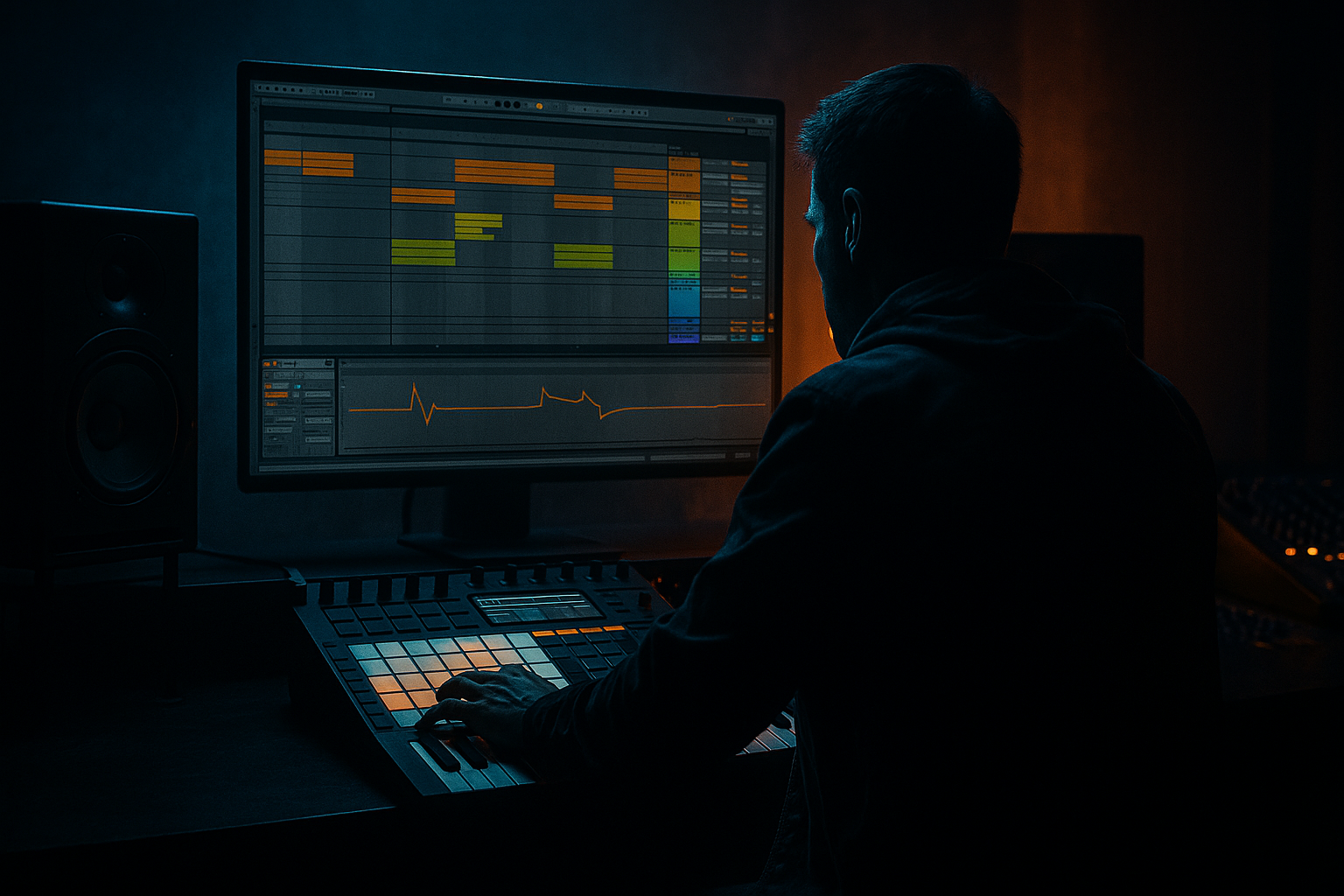
Main tutorial
```markdown
Noise Sweeps from White Noise + Filters (DnB in Ableton Live) 🎛️🌪️
1) Lesson overview
Noise sweeps are one of the most reliable “glue + hype” tools in drum & bass: they create motion, mask transitions, and build tension without stealing melodic focus. In this lesson you’ll build clean, controllable white-noise sweeps using Ableton stock devices, and shape them to work in rolling, jungle, and heavier DnB arrangements.
You’ll learn:
- How to generate white noise (no samples needed)
- How to shape it with filters + envelopes for rises/falls
- How to make it sit in a DnB mix (sidechain, EQ, stereo, reverb)
- How to turn basic noise into dark, aggressive sweeps
- Operator (noise source)
- Auto Filter
- EQ Eight
- Saturator
- Hybrid Reverb / Reverb
- Utility
- Compressor (sidechain)
- 16-bar riser into the drop: start opening subtly around bar 9, then accelerate in the last 2 bars.
- 2-bar mini sweep before fills: faster curve, more resonance.
- High-pass around 120–250 Hz (12 or 24 dB slope)
- If it’s harsh: small dip around 6–9 kHz (-2 to -4 dB, Q ~1.5)
- Enable Sidechain
- Audio From: your Drum Bus (or Kick/Snare group)
- Settings (starting point):
- Algorithmic mode
- Decay: 2.5–6.0 s (longer for intros)
- Pre-delay: 10–25 ms
- High Cut: 6–10 kHz (reduces hiss)
- Dry/Wet: 10–25%
- For widescreen builds: Width 130–170%
- For drop-adjacent moments: Width 100–130%
- If it gets phasey: reduce width and keep reverb more mono-ish.
- Drive: 4–10 dB
- Curve: Analog Clip or Soft Sine (try both)
- Enable Soft Clip
- Downsample: 2–6
- Bit Reduction: 8–12
- Amount: 5–15%
- Rate: 1/8 or 1/16 (sync)
- Phase: 0°
- 16-bar intro → 16-bar build: automate filter open slowly; add resonance boost in last 2 bars.
- Last bar before drop: quick mute (1/8–1/4 beat silence) then hit the drop—classic tension release.
- Jungle switch-ups: use 1-bar downlifters into edits; sidechain harder so breaks stay crisp.
- Call-and-response with bass: automate sweep to duck when the reese speaks (sidechain or volume automation).
- Too much low-end in the noise: always high-pass (120–250 Hz). Sub + kick need that space.
- No volume shaping: a sweep that only changes brightness often feels flat. Automate gain too.
- Over-widening: 200% width + long reverb = phase soup. Keep it controlled.
- Resonance too high: can whistle and hurt ears around 2–5 kHz. Use EQ if needed.
- Not sidechaining: in DnB, un-sidechained noise smears drum transients fast.
- Band-limit the sweep for “fog” vibes:
- Automate Saturator drive upward into the drop (e.g., 4 dB → 9 dB). Feels like pressure building.
- Resonant notch movement:
- Layer two noises:
- Gate the noise rhythmically:
- Generate noise quickly with Operator (White Noise).
- Shape the motion with Auto Filter frequency automation (LP24 is the classic).
- Make it feel musical with volume shaping + sidechain to drums.
- Keep it mix-safe with EQ Eight (high-pass!) and controlled width.
- For darker DnB, add Saturator/Redux, LFO movement, and tighter band-limiting.
---
2) What you will build
By the end you’ll have three ready-to-use sweep racks:
1. Classic White-Noise Riser (16 bars into a drop)
2. Reverse Sweep / Downlifter (1–2 bars for drop impact)
3. Dark “Industrial” Sweep (movement + grit for neuro/techy DnB)
All built with stock devices like:
---
3) Step-by-step walkthrough
A) Create the noise source (Operator = fastest + cleanest)
1. Create a new MIDI track → load Operator.
2. In Operator:
- Click Oscillator A
- Change waveform to Noise (White) (noise mode)
- Turn Filter off inside Operator (we’ll use Auto Filter for better control)
3. MIDI clip:
- Draw a long note (e.g., C3) for the sweep length (1 bar, 4 bars, or 16 bars)
Goal: a steady white noise tone that you’ll sculpt with effects.
Optional: If you prefer audio clips, you can also use Analog (Noise) or a noise sample, but Operator is ideal for repeatability.
---
B) Shape the sweep with Auto Filter (the core move) 🔥
1. After Operator, add Auto Filter.
2. Set:
- Filter type: LP24 (24 dB low-pass) for classic risers
- Resonance: ~ 20–35% (don’t overdo yet)
- Drive: 2–6 dB (adds urgency)
3. Map movement:
- Click Filter Frequency → Show Automation (or draw it in Arrangement)
- For a riser: automate frequency from ~ 150 Hz → 14–18 kHz
- For a downlifter: automate 18 kHz → 200 Hz
DnB timing suggestion:
Curve tip: In Arrangement automation, use a slow start / fast end curve for that “pull into the drop” feeling.
---
C) Control the volume “shape” (so it doesn’t feel static)
You want the sweep to have a clear attack and ramp, not just “noise that gets brighter.”
Option 1 (simple): Utility gain automation
1. Add Utility after Auto Filter.
2. Automate Gain:
- Riser: from -inf (or -24 dB) up to -6 to -3 dB
- Downlifter: start around -6 dB then taper down fast
Option 2 (cleaner): Operator’s Amp Envelope
1. In Operator, go to AMP envelope:
- Attack: 10–50 ms (avoid clicks)
- Decay: 2–8 s (depends on length)
- Sustain: -6 to -12 dB
- Release: 200–800 ms
For DnB, I often do Utility automation because it’s visual and arrangement-friendly.
---
D) Make it mix-ready (EQ + sidechain = instant pro) ✅
#### 1) EQ the junk out
Add EQ Eight after Auto Filter:
This prevents low-end wash over your kick + sub.
#### 2) Sidechain to drums (so it breathes with the groove) 🥁
Add Compressor after EQ Eight:
- Ratio: 4:1
- Attack: 2–10 ms
- Release: 80–200 ms (sync to groove)
- Aim for 3–8 dB gain reduction when drums hit
This is huge in rolling DnB: the sweep becomes rhythmic and doesn’t smear transients.
---
E) Add space + width (but keep it controlled)
#### Reverb (Hybrid Reverb recommended)
Add Hybrid Reverb (after sidechain):
#### Stereo control
Add Utility at the end:
DnB arrangement trick: make it wide in the build, then snap narrower right before the drop for impact.
---
F) Turn it into a darker/heavier DnB sweep 😈
Now we mutate the clean sweep into something more “metal air” / industrial / neuro texture.
Device chain (stock):
`Operator (Noise) → Auto Filter → Saturator → Redux (optional) → EQ Eight → Compressor (SC) → Hybrid Reverb → Utility`
#### Saturator
This thickens noise so it cuts through dense basses.
#### Redux (optional for grit)
Blend carefully—too much becomes fizzy rather than heavy.
#### Movement (Auto Filter LFO)
Inside Auto Filter, enable LFO:
This creates a subtle “shiver” that feels alive, great for techy rollers.
---
G) Arrangement ideas rooted in DnB / jungle
---
4) Common mistakes
---
5) Pro tips for darker/heavier DnB
Use EQ Eight to also low-pass around 8–12 kHz so it’s thick, not fizzy.
Use Auto Filter in Band-Pass mode briefly (last 1–2 bars) to create a “screaming air” effect.
One clean wide riser + one distorted narrow mid sweep (mono-ish). Blend for weight.
Use Auto Pan with Amount 100% and Phase 0° (acts like tremolo). Rate at 1/8 for rolling pulses.
---
6) Mini practice exercise (15 minutes) ⏱️
1. Build a 16-bar riser using Operator + Auto Filter + Utility.
2. Add EQ Eight high-pass at 180 Hz.
3. Add sidechain compression from your drum group (aim 5 dB ducking).
4. Create two automation lanes:
- Auto Filter Frequency: 150 Hz → 16 kHz (curved)
- Utility Gain: -24 dB → -5 dB
5. Duplicate it and make a 2-bar downlifter:
- Reverse the filter automation
- Shorter reverb decay (1–2 s)
6. Render both as audio and drop them into a project template for quick reuse.
---
7) Recap
If you want, tell me your sub genre (liquid, jungle, neuro, dancefloor) and your tempo (usually 172–175), and I’ll suggest an exact sweep automation curve + device rack macro setup for your style.
```

