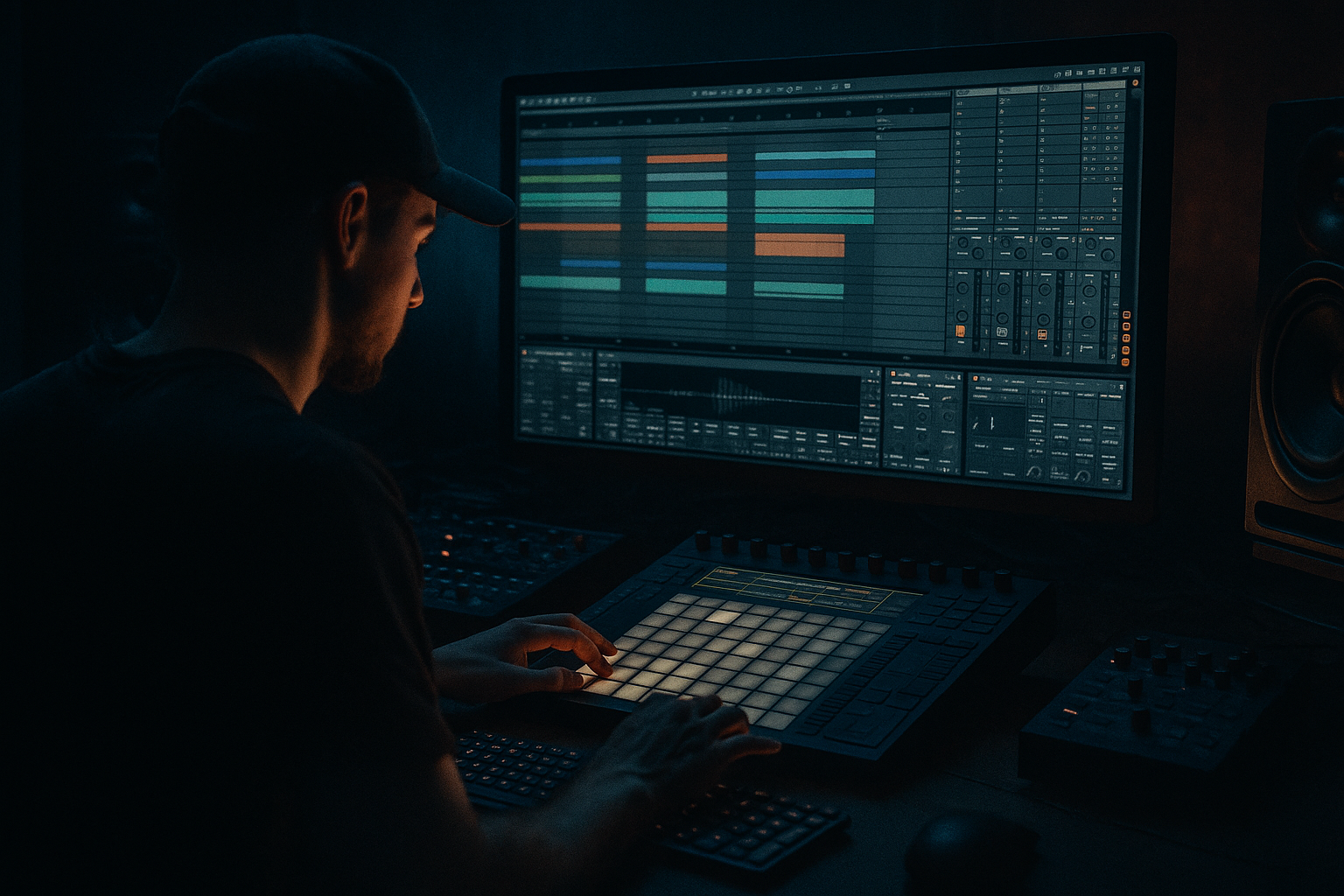
Main tutorial
Noise Sweeps in Transitions (DnB in Ableton Live) 🌪️🥁
1. Lesson overview
Noise sweeps are one of the fastest ways to make drum and bass transitions feel intentional, energetic, and “DJ-ready.” In DnB/jungle, you’ll hear them everywhere: riser into a drop, downlifter into a breakdown, subtle whooshes between phrases, and noise bursts to emphasize fills.
In this lesson you’ll learn how to build clean, controllable noise sweeps using only Ableton Live stock devices, then place and automate them like a proper DnB arrangement.
---
2. What you will build
You’ll create a dedicated FX track containing:
- A white-noise riser (builds tension into the drop) ⬆️
- A downlifter (releases energy after impact) ⬇️
- A short noise “whoosh” (for bar/phrase transitions) 💨
- Filter automation (the key to “movement”)
- Reverb/delay shaping (size + tail control)
- Sidechain ducking to the kick/snare (so it sits in the mix like real DnB)
- Optional distortion for heavier styles
- Analog has noise too (great for raw sweeps).
- Wavetable can do noise-style textures, but Operator is simple and CPU-light.
- Filter type: Lowpass 24 dB (clean, steep)
- Resonance: 20–35% (a bit of whistle helps it read in a loud mix)
- Drive: 0–6 dB (taste—adds bite)
- Size: 60–90
- Decay time: 2.5–6.0 s (longer for bigger builds)
- Pre-delay: 10–25 ms (keeps it punchy)
- High Cut: 6–10 kHz (prevents harsh fizz)
- Dry/Wet: 20–40% (don’t drown it yet)
- Start with -12 dB gain. Noise is deceptive—keep headroom.
- Automate Resonance from 15% → 35% toward the end.
- Don’t go too high or it’ll scream and mask your snare.
- Automate Reverb Dry/Wet up slightly near the end:
- Mode: Analog Clip or Soft Sine
- Drive: 2–8 dB
- Turn Soft Clip ON
- Optional: automate Drive up in the last 1/4 bar for aggression.
- Downsample: small amount (e.g., 1.2–2.5)
- Great for neuro/darker transitions, but easy to overdo.
- Too loud: Noise feels exciting but quickly masks snares/hats. Keep it controlled with Utility and sidechain.
- No filtering (or boring automation): A static noise layer is just hiss. The sweep is the point—automate cutoff.
- Harsh top end: White noise + lots of reverb can get fizzy. Use Reverb High Cut, and consider Auto Filter after reverb if needed.
- Clashing with cymbals: If your drop has bright rides/hats, consider ending your riser slightly lower (like 10–14 kHz) to leave space.
- Overlong tails into the drop: Reverb tails can smear impact. Reduce decay or automate Dry/Wet down right at the drop.
- Band-limit for “club weight”:
- Automate stereo width:
- Make it “industrial”:
- Phrase-aware transitions (very DnB):
- Noise sweeps = tension/release tools that help DnB transitions feel professional.
- Use Operator (Noise) + Auto Filter automation as your core engine.
- Shape space with Reverb/Echo, control level with Utility, and make it sit with sidechain compression.
- Place sweeps with DnB phrasing in mind (4/8/16-bar logic).
- For darker/heavier styles, add Saturator, band-limit with EQ Eight, and automate stereo width for impact.
All with:
---
3. Step-by-step walkthrough
Step 0 — Set up a proper DnB context
1. Set tempo to 172–176 BPM.
2. In Arrangement View, mark a typical structure:
- 16 bars intro
- 16 bars build
- Drop at bar 33 (or wherever your drop is)
3. Create a dedicated audio group or label: “FX”.
---
Step 1 — Create your noise source (stock-only)
Option A (recommended): Operator as noise
1. Create a new MIDI Track: `Cmd/Ctrl + Shift + T`
2. Load Operator.
3. In Operator:
- Click the waveform selector for Oscillator A and choose Noise (the noise options)
- Turn Filter ON inside Operator (optional) or leave it off—we’ll filter later with Auto Filter.
4. Create a MIDI clip that holds a note for the sweep length:
- For a riser: 1 bar or 2 bars (DnB builds often use 1–2 bars right before the drop)
- Note: C3 is fine—pitch doesn’t matter much for noise.
Option B: Analog / Wavetable noise
---
Step 2 — Add the classic sweep chain (Auto Filter + Reverb)
On the noise track, add this device chain:
1. Auto Filter
2. Reverb
3. Utility (gain staging)
4. (Optional) Saturator for grit
#### Auto Filter settings (starter)
#### Reverb settings (DnB-friendly)
#### Utility
---
Step 3 — Automate the riser (the money move) 🔥
In Arrangement View, show automation: press A.
#### Automate Auto Filter cutoff
1. Choose Auto Filter → Frequency.
2. Draw automation over the 1–2 bar build:
- Start around 150–300 Hz
- End around 12–18 kHz
3. Make the curve exponential-ish (slow at first, faster near the end) to feel like tension is accelerating.
#### Add intensity with resonance automation (optional)
#### Add reverb “lift” automation (optional)
- e.g., 25% → 40% in the last half bar.
DnB arrangement tip:
Place the riser starting 1 bar before the drop, and consider a second layer starting 2 bars before but quieter, so the last bar feels bigger.
---
Step 4 — Make it groove with sidechain ducking (DnB polish) 🎛️
Noise sweeps can swallow drums. In DnB, you want the sweep to pump around the kick/snare.
1. Add Compressor after Reverb.
2. Enable Sidechain.
3. Set Audio From: your Drum Buss / Drum Group (or kick+snare bus).
4. Settings:
- Ratio: 4:1 to 10:1
- Attack: 1–5 ms (fast)
- Release: 80–200 ms (tempo-dependent; aim for musical pumping)
- Adjust Threshold until you see 3–8 dB gain reduction on hits.
This keeps the sweep loud but not messy.
---
Step 5 — Create a downlifter (release after impact) ⬇️
Duplicate your riser clip/region and reverse the motion:
1. Copy the noise MIDI clip to right after the drop (e.g., the first bar after impact).
2. Reverse the filter movement:
- Auto Filter Frequency starts 12–18 kHz
- Ends around 200–500 Hz
3. Shorten it:
- Often 1/2 bar to 1 bar is perfect after a DnB drop impact.
4. Reduce reverb tail if it clouds the drop:
- Shorten decay (e.g., 1.5–3.0 s) or lower Dry/Wet.
Arrangement idea: Put the downlifter right after the first crash/snare impact—classic “breath out” moment.
---
Step 6 — Make quick whooshes for fills and phrase changes 💨
For jungle/DnB, small transitional whooshes are gold between 4/8/16-bar phrases.
1. Create a 1/8 to 1/2 bar MIDI note.
2. Keep Auto Filter automation tight:
- HP or LP sweeps can work, but try Highpass 12 dB for a “lift” whoosh:
- Start: 100 Hz
- End: 2–6 kHz
3. Add Delay (stock Echo) for movement:
- Time: 1/8 or 1/16
- Feedback: 10–25%
- Dry/Wet: 8–18%
4. Keep it subtle and tucked behind drums.
DnB placement: right before a snare fill, or on bar 8/16 transitions to signal “new section incoming.”
---
Step 7 — Optional: Make it heavier and more “DnB” (texture layer)
If your sweep feels too clean, add controlled grit.
Add Saturator (after Auto Filter, before Reverb)
Or add Redux (sparingly)
---
4. Common mistakes
---
5. Pro tips for darker/heavier DnB 🖤
Put an EQ Eight after Auto Filter and shape it:
- High-pass around 80–150 Hz (avoid sub rumble)
- Gentle dip around 3–6 kHz if it bites too hard
- Optional shelf boost around 8–12 kHz if it needs air
Use Utility → Width:
- Start around 70–90%
- End around 120–150% right before the drop
Wide noise feels huge, but duck it with sidechain.
Layer a second noise track with Corpus (yes, on noise!)
- Try preset-like behavior: small decay, tune around 150–400 Hz
- Blend quietly for metallic character.
Use bigger sweeps at 16-bar boundaries, smaller whooshes at 4/8-bar boundaries. This makes your arrangement feel “DJ-mixable.”
---
6. Mini practice exercise (10 minutes) ⏱️
1. In a 32-bar loop at 174 BPM, place a drop at bar 17.
2. Build:
- A 2-bar riser from bar 15–17
- A 1/2-bar whoosh at bar 16.4 (last half bar before drop)
- A 1-bar downlifter from bar 17–18
3. Requirements:
- Auto Filter cutoff automation on all three
- Sidechain compression from your drum bus
- Keep peaks under control (aim your FX track around -12 to -6 dB peak depending on your mix)
Bounce a quick audio render and listen on low volume—if the transition still reads, you’ve nailed it.
---
7. Recap ✅
If you tell me what substyle you’re making (liquid, rollers, jungle, neuro), I can suggest a couple sweep “recipes” that match the vibe and typical drum brightness.

