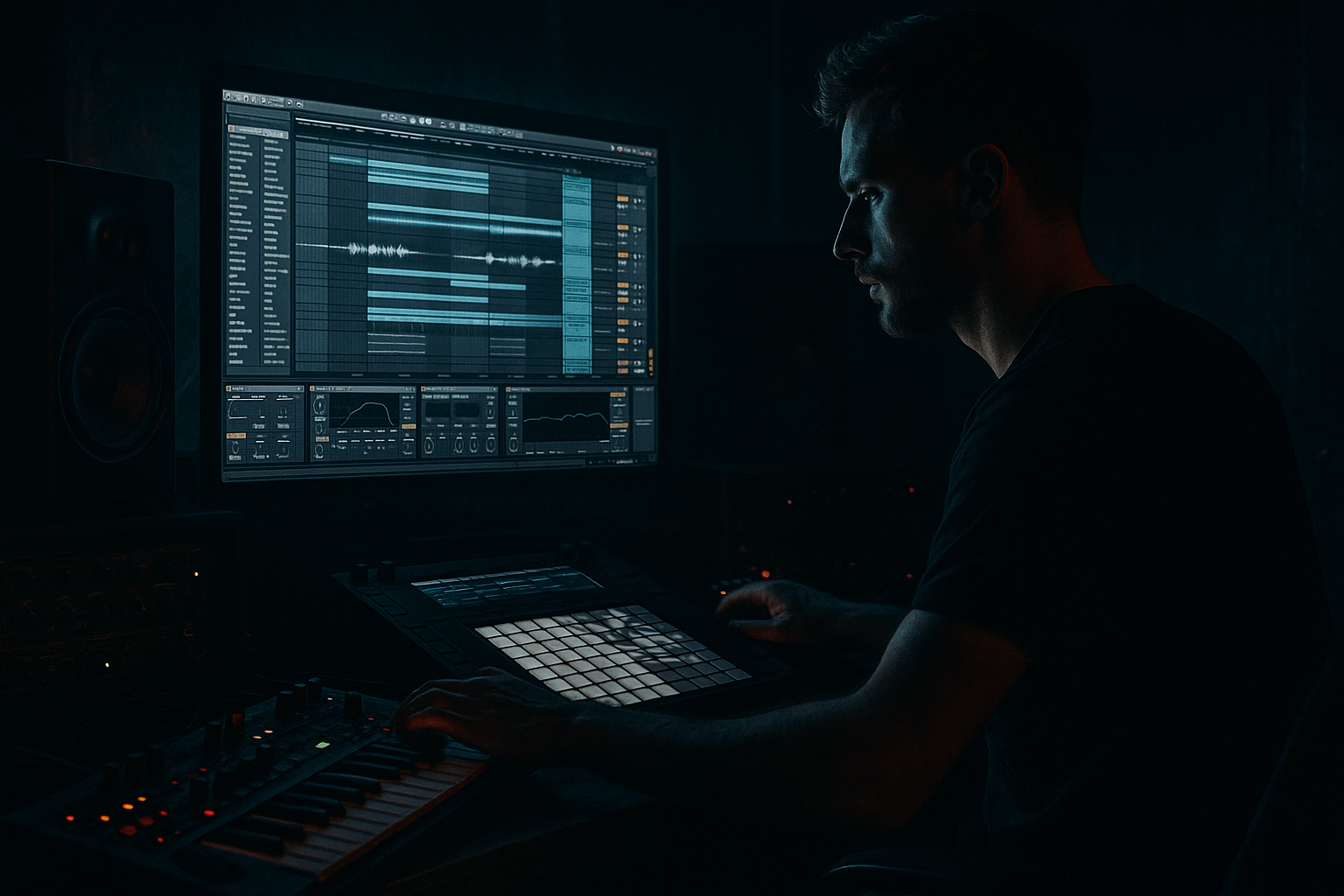
Main tutorial
Noise Sweeps with Stock Devices (Live 12 + Stock Packs) — DnB FX Lesson 🎛️⚡
1) Lesson overview
Noise sweeps are a core “glue + hype” tool in drum & bass: they set up drops, smooth transitions, and add movement without stealing focus from drums and bass. In this lesson you’ll build professional DnB-style risers, downlifters, and “air” sweeps using only Ableton Live 12 stock devices and stock packs/samples—no third‑party synths needed.
You’ll also learn how to shape noise like a synth, add rhythmic motion, and place sweeps in arrangement so they support rolling energy rather than clutter the mix.
---
2) What you will build
By the end you’ll have a small “FX toolkit”:
- Riser (8 bars → drop): filtered noise + pitch illusion + widening + controlled reverb tail
- Downlifter (1–2 bars): reverse/noise fall with tight low cut
- Rhythmic noise gate: sidechained/ducked “air” that pumps with the drums
- DnB transition chain you can save as an Audio Effect Rack with macros 🎚️
- Filter Type: Highpass 12 dB (HP12)
- Freq: start around 200–400 Hz (we don’t want low-end wash)
- Resonance (Q): 0.70–1.20 (a bit of whistle helps it cut)
- Drive: 2–6 dB (adds bite)
- For an 8-bar riser, automate Freq from ~300 Hz → 12–16 kHz.
- Add a slight Resonance increase in the last bar for urgency (but don’t scream).
- Start the riser quiet around bar -8 to -4, then ramp more aggressively in the last 2 bars before the drop.
- Mode: Phaser
- Rate: 0.08–0.20 Hz (slow drift)
- Amount: 40–70%
- Feedback: 10–25%
- Dry/Wet: 15–35%
- Mode: Ring Mod (more aggressive) or Single Sideband (cleaner)
- Fine: 10–40 Hz (slow movement, subtle)
- Amount: automate from 0% → 15–30% into the drop
- Optional: automate Frequency up slightly in the last bar for tension
- Algorithm/IR: pick something “Hall / Plate / Large”
- Decay: 3.5–7.0 s
- Pre-Delay: 10–25 ms
- Dry/Wet: 15–30% (don’t drown it)
- EQ inside Hybrid Reverb (if used):
- Automate Dry/Wet up slightly approaching the drop (e.g. 15% → 28%)
- Then snap it down right on the drop to keep drums clean.
- Enable Sidechain
- Audio From: your Drum Bus (or a dedicated “SC Trigger” with kick+snare)
- Ratio: 4:1
- Attack: 1–5 ms
- Release: 80–140 ms (match your groove)
- Lower Threshold until the sweep breathes with the drums (often -20 to -35 dB depending on level)
- Clip length: 8 bars
- Auto Filter Freq: 300 Hz → 16 kHz
- Add a volume ramp: -inf → taste (don’t slam)
- Last 1/2 bar: increase Resonance slightly and/or Reverb Wet slightly
- Keep noise low in the mix (it’s “air”, not a lead)
- Heavy sidechain from drums
- Add Auto Pan (stock) before reverb:
- Too much low end: Always high-pass noise sweeps (often 250–600 Hz). Low-end wash kills punch.
- No sidechain: Without ducking, sweeps mask the snare transient—your drop feels smaller.
- Over-widening: If you add width (e.g., Utility Width), keep it tasteful. Wide noise can cause harshness and mono issues.
- Too bright / fizzy: If it’s ripping your ears, use EQ Eight:
- Reverb tails running into the drop: Automate reverb wet down at the exact drop, or shorten decay.
- Make the noise “talk” with saturation:
- Band-limit for “radio comms / dystopian air”:
- Resample and chop:
- Micro-rise into every 8 bars:
- Use Frequency Shifter like “metal air”:
- Is the snare still the loudest “event”?
- Does the sweep add excitement without harshness?
- Use noise audio (stock packs/Core Library) or a stock instrument noise source.
- Shape with Auto Filter (HP + automation = the sweep).
- Add movement via Phaser-Flanger or Frequency Shifter.
- Add space with Hybrid Reverb, but automate it to stay clean at the drop.
- Sidechain compress from the Drum Bus to keep DnB punch.
- Wrap it all into an Audio Effect Rack with macros for fast, repeatable results.
---
3) Step-by-step walkthrough
Step 0 — Session context (DnB-ready)
1. Set tempo to 174 BPM.
2. Have at least:
- A Drum Bus (break + tops)
- A Bass Bus
- A Return track “FX Verb” (we’ll use it later)
Noise sweeps should serve the groove: we’ll keep them bright, controlled, and ducked.
---
Step 1 — Get a noise source (stock-only)
You have two solid stock approaches:
#### Option A: Use stock noise samples (fastest)
1. Create an Audio Track named `NOISE SWEEP`.
2. Open the Browser → Packs and look for noise/FX samples (common places):
- Core Library: “Noise”, “SFX”, “Sweeps”, “Risers”
- Any Live 12 stock packs you have installed that include FX one-shots
3. Drag a white/pink noise sample or “air” texture onto the track.
4. Turn on Warp (if it’s not already). Use:
- Warp Mode: Complex (good general)
- Or Texture for grainy movement (try Grain Size ~ 80–120 ms)
#### Option B: Generate noise inside Live (more control)
If you prefer synthesis-like control without third-party tools:
1. Create a MIDI Track named `NOISE SYNTH`.
2. Load Drift (stock instrument).
3. In Drift:
- Set Oscillator level low (or off)
- Use Noise (if available in your Drift config) as the main source
If Drift’s noise isn’t obvious in your setup, stick to Option A—audio noise is totally standard in DnB.
DnB workflow note: Audio noise is common because it’s quick, consistent, and easy to resample.
---
Step 2 — Shape the sweep with Auto Filter (the core move)
On your `NOISE SWEEP` track, add Auto Filter.
Suggested starting settings (riser):
Automate the Frequency:
🎯 DnB arrangement placement:
---
Step 3 — Add motion: Phaser-Flanger OR Frequency Shifter (stock spice)
Noise can feel static—movement makes it musical.
#### Option A: Phaser-Flanger (smooth, classic)
Add Phaser-Flanger after Auto Filter.
#### Option B: Frequency Shifter (edgier, metallic—great for techy DnB)
Add Frequency Shifter after Auto Filter.
This is a signature “industrial air” trick for darker rolling tunes.
---
Step 4 — Create the “lift”: Reverb + controlled size
Add Hybrid Reverb after modulation.
Riser reverb starting point:
- Low cut: 250–500 Hz
- High cut: 12–16 kHz (optional—depends on harshness)
Automation idea:
---
Step 5 — Make it hit like DnB: Duck it with sidechain
Noise sweeps can mask snares and hats. In DnB, cleanliness = power.
Add Compressor at the end of the chain.
✅ Result: the sweep moves rhythmically and stays out of the way.
---
Step 6 — Turn it into an Audio Effect Rack with macros (fast workflow) 🎚️
Select your devices (example chain):
Auto Filter → Frequency Shifter → Hybrid Reverb → Compressor
Group them (`Cmd/Ctrl + G`) into an Audio Effect Rack.
Map macros:
1. Sweep → Auto Filter Frequency
2. Tension → Auto Filter Resonance + Frequency Shifter Amount
3. Air → Hybrid Reverb Dry/Wet
4. Size → Hybrid Reverb Decay
5. Pump → Compressor Threshold
6. Tone → Auto Filter Drive (or add Saturator and map Drive)
Save the rack as: `DnB Noise Sweep - Stock.adg`
---
Step 7 — Build 3 common DnB sweep types
#### A) 8-bar riser (into a drop)
#### B) 1-bar downlifter (post-drop “air release”)
1. Duplicate your riser audio.
2. Reverse it (right-click clip → Reverse).
3. Use Auto Filter:
- Highpass to keep lows clean (300–600 Hz)
- Optionally automate Frequency down slightly
4. Reduce reverb wet on the downlifter so it doesn’t smear the new section.
#### C) Rhythmic noise “top layer” (rolling section enhancer)
- Rate: 1/8 or 1/16
- Amount: 20–40%
- Phase: 0–90 (taste)
This creates a subtle shuffling “spray” above hats—very jungle/rollers friendly.
---
4) Common mistakes 🚫
- Dip 6–10 kHz a few dB
- Or low-pass slightly at 14–16 kHz
---
5) Pro tips for darker/heavier DnB 🖤🔩
- Add Saturator before reverb
- Try Soft Clip ON, Drive 3–8 dB
- Then high-pass after saturation if it adds mud
- Use EQ Eight: high-pass 500 Hz, low-pass 6–9 kHz
- This gives that tight, menacing mid-band texture that sits behind neuro/tech rollers.
Record 16 bars of sweep automation, Freeze/Flatten or Resample, then pick the best moments as one-shots.
In rolling DnB, add tiny 1/2-bar mini risers before phrase changes. Keep them subtle and ducked.
Ring Mod at low amount + slow movement creates gritty tension without sounding like a trance riser.
---
6) Mini practice exercise 🧪
Create a 16-bar DnB phrase (drums + bass loop) and add three noise events:
1. Bars 1–8: Subtle rhythmic air layer
- Auto Pan 1/16, sidechained, low level
2. Bars 9–16: 8-bar riser into bar 17 drop
- Auto Filter sweep up, increasing tension in last bar
3. Bar 17 (drop): Reverb “snap-down”
- Automate Hybrid Reverb Dry/Wet from ~25% to 0–5% exactly on the drop
Deliverable: bounce a quick demo and check:
---
7) Recap ✅
If you want, tell me your subgenre (liquid / jungle / neuro / minimal rollers) and I’ll give you a specific macro mapping + exact 8-bar automation curve that fits that vibe.

