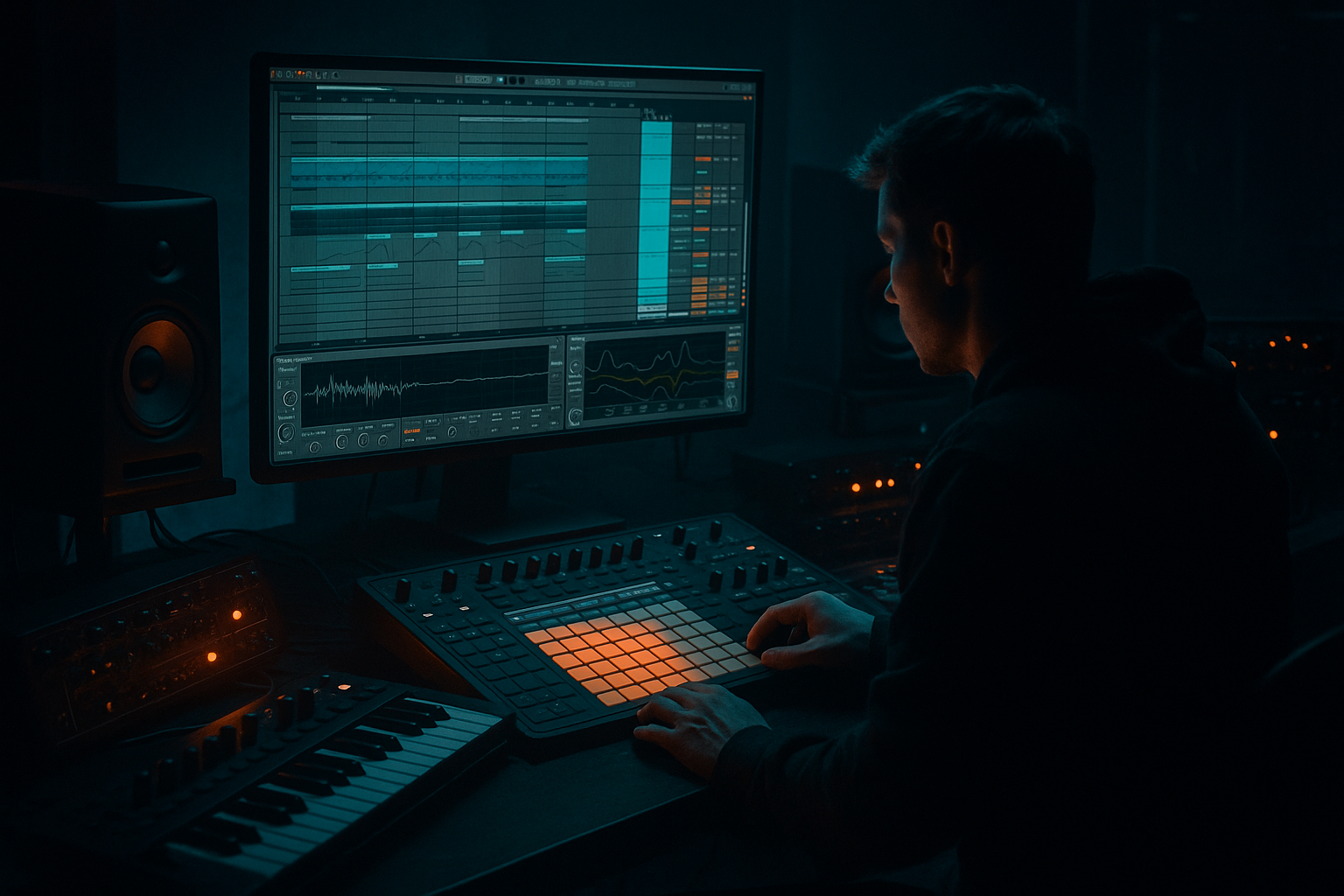
Main tutorial
```markdown
Note Off Timing & Rhythmic Feel (Advanced DnB Groove) 🎛️🥁
1. Lesson overview
In drum & bass, note-on timing gets most of the attention (swing, micro-shift, quantize strength)… but note-off timing is a massive part of feel.
Shortening or lengthening MIDI notes changes:
- How long a drum/bass “speaks”
- The groove pocket (how tails overlap, choke, or leave space)
- Perceived tightness vs. roll
- Transient clarity (especially with layered breaks + modern drums)
- Sidechain behavior (release and “breathing” timing)
- Tight kick/snare and controlled ghosts
- A break layer that pumps rhythmically without masking the snare
- A reese/sub bass that feels “talky” and syncopated using note lengths
- A ride/shaker texture that moves using intentional note-off timing
- A workflow for “note-off groove” you can reuse across tracks
- Open the MIDI clip.
- Click the kick note at 1.3.3 and shorten its length slightly (e.g., from 1/16 to ~1/32–1/24 visually).
- Right-click break clip → Slice to New MIDI Track
- Choose Transient and Built-in (creates a Drum Rack)
- Shorten ghost hits (tiny notes)
- Let key hits ring (longer notes)
- Control the “rolling” feel by deciding what gets to sustain
- Reduce Release (in the Amp envelope) for tightness
- Increase Release slightly for selective glue (only on some slices)
- Make hats on the offbeat slightly longer than hats on the beat.
- Insert Gate (stock device) after the hat channel.
- Use:
- Attack: 0–5 ms
- Decay: short-medium
- Sustain: medium
- Release: start at 50–120 ms (this is crucial)
- Write a rolling bassline with 1/8 and 1/16 notes.
- Then edit note lengths to carve space:
- Enable Sidechain, input from your drum bus or kick+snare group
- Settings to try:
- Short bass notes + fast compressor release = “machine-gun tight”
- Longer bass notes + slightly longer release = “rolling wave”
- For bass notes that happen before 2 and 4, end them 10–40 ms early.
- Let the bass note after the snare overlap slightly with the next hat/ghost.
- Operator Release automation:
- Break slice release changes: in Simpler, slightly longer release on fills
- Add a fill where open hats are less choked (longer ring) in bar 8/16
- Reese “gasp” effect: shorten MIDI note length but increase Operator Release slightly.
- Use Saturator after dynamics, not before (often):
- Multiband tail control with Multiband Dynamics:
- Make ghost notes shorter than you think:
- Create “negative space drops”:
- Note-off timing is groove: it controls space, overlap, and pocket.
- In Ableton Live, you shape it via:
- In DnB, the biggest wins come from:
- Automate release/length across 16 bars for evolving groove without adding clutter.
In Ableton Live, note-off timing matters in three big places:
1. MIDI note length (when the note releases)
2. Amp/volume envelope release (Sampler/Simpler/Operator/etc.)
3. Gate/choke behaviors (drum groups, choke groups, gates, sidechain)
We’ll use those to create a rolling, controlled, forward-driving DnB groove that still feels alive. ⚡
---
2. What you will build
A 16-bar rolling DnB loop with:
Target tempo: 174 BPM.
---
3. Step-by-step walkthrough
Step 0 — Session setup (so your groove decisions translate)
1. Set tempo to 174 BPM.
2. In Preferences → Record/Warp/Launch:
- Turn Create Fades on Clip Edges ON (helps with clean edits later).
3. Set global grid:
- Start with 1/16, but get ready to use 1/32 and off-grid.
---
Step 1 — Build a solid drum foundation (kick/snare), then make note-offs matter
#### A) Kick & snare (tight core)
1. Create a MIDI track: Drum Rack.
2. Load:
- Kick on C1
- Snare on D1
3. Program a standard DnB pattern (1 bar):
- Kick: 1.1 and 1.3.3 (or add extra for your style)
- Snare: 1.2 and 1.4
Now the key part: control tail overlap using note length.
This reduces overlap into the snare and keeps the backbeat dominant.
#### B) Use choke groups for “note-off by design”
In Drum Rack:
1. Put a closed hat and an open hat on separate pads.
2. Click the open hat pad → in its Sample tab:
- Assign it to Choke Group 1
3. Click the closed hat pad:
- Assign to Choke Group 1
Now whenever the closed hat plays, it forces a note-off on the open hat.
This is literal note-off timing as groove.
DnB application: Use an open hat on the “and” before the snare, then choke it with a tight closed hat right after the snare for that crisp “tss—tk” movement.
---
Step 2 — Break layer: control tail length so it rolls instead of washes
Create an Audio track with a break (Amen, Think, or any crunchy loop).
1. Warp mode:
- Try Beats mode first.
- Set Preserve: Transients
2. In Beats mode, adjust Transient Envelope:
- Lower it to shorten tails without killing transients.
- This behaves like note-off shaping for audio.
Advanced move: Slice the break to MIDI:
Now you can edit MIDI note lengths for each slice:
Inside each slice’s Simpler:
This is where you can make a jungle layer feel “played,” not looped. 🧩
---
Step 3 — Hi-hat / ride groove: note-off timing = perceived swing
Create a MIDI track with a Simpler (or a Drum Rack with hats).
#### A) Program hats at 1/16
1. Add a closed hat every 1/16 for one bar.
2. Set velocities with a slight pattern (e.g., strong on the offbeats).
#### B) Now shape groove with length, not just timing
- Example: beat hats = very short (near 1/64)
- offbeat hats = 1/32 or a touch longer
This causes a subtle “lean” forward/back because the ear hears sustain energy as part of rhythm.
Add motion using Gate:
- Threshold: just enough to trim tails
- Release: tempo-synced feel (start around 30–80 ms, then tune)
This is basically “audio note-off timing” for samples that are too long.
---
Step 4 — Reese/sub bass: create pocket using MIDI note release + envelope release
This is the big one in DnB. The bass breathes around the drums.
#### A) Build a reese in Operator (stock, powerful)
1. Create MIDI track → load Operator
2. Simple reese start:
- Osc A: Saw
- Osc B: Saw (detune slightly, e.g., +6 to +12 cents)
3. Filter:
- Use LP24
- Drive a bit (Operator filter can bite nicely)
#### B) Make note-off timing audible
In Operator’s Amp envelope:
Now in the MIDI clip:
- Notes leading into the snare: shorten (so snare hits clean)
- Notes after snare: lengthen slightly (fills the gap, adds momentum)
Rule of thumb (advanced):
Don’t just shorten everything. Create contrast: short notes = punctuation, long notes = glue.
#### C) Sidechain reacts to note-off timing
Add Compressor (stock) on the bass:
- Ratio: 4:1
- Attack: 0.3–3 ms
- Release: 80–160 ms (tune to tempo and groove)
Now notice:
You’re sculpting the groove using when the bass stops as much as when it starts.
---
Step 5 — Make note-off timing musical with “intentional overlaps”
The dark art: micro-overlap to create push, and micro-gaps to create snap.
#### A) Micro-gaps before snare (clean punch)
This makes the snare feel louder without actually changing volume.
#### B) Micro-overlaps after snare (roll)
This creates density and forward motion.
#### C) Use Live’s Groove Pool… but only after note lengths are intentional
1. Add a groove (MPC-ish swing, or extract from a break).
2. Apply it lightly:
- Timing: 10–25%
- Random: 0–5%
3. Re-check note lengths after groove: the groove may shift note-offs in ways that cause unwanted overlaps.
Pro workflow:
Do note length editing first, then groove, then final cleanup.
---
Step 6 — Arrangement move: automate “note-off feel” across 16 bars
To keep a loop from feeling static, automate release/decay characteristics.
Ideas:
- Bars 1–8 tighter release (e.g., 60–80 ms)
- Bars 9–16 slightly longer (e.g., 90–130 ms) for lift
This creates progression without adding new notes—pure groove evolution. 🔥
---
4. Common mistakes
1. Everything short = lifeless
Ultra-short notes remove groove glue. Keep contrast.
2. Bass notes ringing into the snare
That’s the #1 “why does my snare sound weak?” issue. Trim bass note-offs early.
3. Confusing note-off timing with velocity
Velocity changes impact, but release/length changes space and pocket.
4. Over-choking cymbals
If you choke every open hat instantly, you lose air and width—use it selectively.
5. Sidechain release fights note lengths
If your bass notes are short but sidechain release is long, you’ll get weird “duck tails.”
---
5. Pro tips for darker/heavier DnB 🖤
You get a “cut note” with a controlled tail—aggressive but not clicky.
Chain idea:
Operator → EQ Eight (HP cleanup) → Compressor (sidechain) → Saturator → Utility
Saturating after sidechain can make the groove pump more audibly.
Use it gently to keep low sustain consistent while letting mids spit.
In break slices, shorten ghost MIDI notes heavily so they behave like transient flicks.
In bar 15, shorten everything slightly (hats + bass), then let bar 16 ring longer.
That contrast hits hard in minimal/techy DnB.
---
6. Mini practice exercise (15 minutes) ⏱️
1. Take an existing 1-bar DnB loop (drums + bass).
2. Duplicate it to 8 bars.
3. Without changing note-on positions, do only:
- Edit bass note lengths (make pre-snare notes end early)
- Edit hat lengths (offbeats longer than downbeats)
- Add one choke relationship (open hat choked by closed hat)
4. A/B test:
- Version A: all notes default length
- Version B: your edited note-offs
5. Export both and listen on headphones:
Which version “rolls” more? Which snare feels cleaner?
---
7. Recap ✅
- MIDI note lengths
- Amp envelope release
- Choke groups / Gate
- Warp transient envelope (for breaks)
- Ending bass notes early before snares
- Using selective sustain for roll
- Managing break tails so they don’t mask transients
If you want, tell me your subgenre (rollers, jump-up, techstep, jungle) and what you’re using for bass (Operator/Wavetable/Vital/etc.), and I’ll give you a bar-by-bar note-length template that fits that style.
```

